Recognition: 2 theorem links
· Lean TheoremOn the dilaton gravity of analogue black holes
Pith reviewed 2026-05-13 00:54 UTC · model grok-4.3
The pith
Typical analogue black holes in superconducting circuits do not correspond to known dilaton gravity models.
A machine-rendered reading of the paper's core claim, the machinery that carries it, and where it could break.
Core claim
When the analogue black hole exhibits state-independent temperature, as in the cases considered here, the kinematics governing T decouples from the dynamics underlying S. Numerical analysis reveals that the given analogue black holes do not correspond to known dilaton gravity models, limiting their usefulness for extracting theoretical insights. The logic can be easily reversed: starting from established well known dilaton models, one can derive the conditions that laboratory implementations must satisfy.
What carries the argument
The state-dependence of Hawking temperature T, which can be switched on or off in dilaton models, and the resulting decoupling from entropy dynamics S in state-independent cases.
If this is right
- State-independent Hawking temperature in these analogues separates temperature kinematics from entropy dynamics.
- Current laboratory analogue black holes cannot be directly mapped onto known dilaton gravity solutions.
- Theoretical insights from dilaton gravity cannot be extracted from the analogue realizations examined here.
- Laboratory platforms must satisfy explicit conditions derived from chosen dilaton models to become useful simulators.
Where Pith is reading between the lines
- The reversal strategy could be tested on analogue black holes realized in other systems such as fluid flows or optical lattices.
- Successful matching would let experiments probe thermodynamic relations that are unique to dilaton gravity but absent in four-dimensional black holes.
- The approach suggests prioritizing model-specific parameter tuning over generic analogue setups in future work.
Load-bearing premise
That the typical two-dimensional analogue black holes realized in superconducting quantum circuits satisfy the assumptions required by dilaton gravity models and allow the state dependence of temperature to be cleanly controlled.
What would settle it
An explicit numerical or analytical match between one of the considered analogue black hole metrics and the geometry plus dilaton field of a standard model such as Jackiw-Teitelboim gravity would falsify the reported mismatch.
Figures

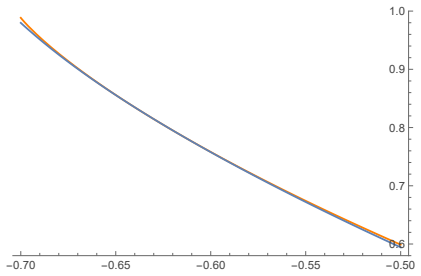
read the original abstract
We investigate which dilaton gravity models can reproduce the typical two dimensional analogue black holes realized in platforms such as superconducting quantum circuits. We identify the most reasonable assumptions these models must satisfy, and determine the dilaton models for which the state-dependence of the Hawking temperature, T, can be switched on and off, a feature that is absent in four dimensional black holes. When the analogue black hole exhibits state-independent temperature, as in the cases considered here, the kinematics governing T decouples from the dynamics underlying S. Our numerical analysis reveals that the given analogue black holes do not correspond to known dilaton gravity models, limiting their usefulness for extracting theoretical insights. We then show that the logic can be easily reversed: starting from established well known dilaton models, one can derive the conditions that laboratory implementations must satisfy. This shifts the challenge from the theoretical perspective to the experimental realization.
Editorial analysis
A structured set of objections, weighed in public.
Referee Report
Summary. The paper investigates the correspondence between typical two-dimensional analogue black holes realized in platforms such as superconducting quantum circuits and dilaton gravity models. It identifies reasonable assumptions these models must satisfy, determines conditions under which the state-dependence of the Hawking temperature T can be switched on or off, and reports a numerical analysis concluding that the analogue black holes do not match known dilaton models. The logic is then reversed to derive laboratory conditions from established dilaton models.
Significance. If the numerical comparison is made fully reproducible with explicit model selection, observables, and matching criteria, the work could clarify the limitations of analogue systems for probing dilaton gravity and provide a practical framework for designing experiments from theoretical models. The observation that state-independent T decouples kinematics from dynamics in these setups is a useful distinction from four-dimensional black holes.
major comments (2)
- [Numerical analysis] Numerical analysis section: The central claim that 'the given analogue black holes do not correspond to known dilaton gravity models' rests on an unspecified numerical procedure. The manuscript does not list the set of dilaton models tested, the functional forms or parameter ranges employed, the observables compared (e.g., dilaton potential V(φ), T as function of state, entropy S), or the quantitative distance metric used. Without these details the negative result cannot be reproduced or falsified, undermining the subsequent reversal argument.
- [Assumptions for dilaton models] Section on assumptions: The paper states it identifies 'the most reasonable assumptions' for the dilaton models but does not provide an explicit justification or reference to prior literature establishing why these assumptions (particularly state-independence of temperature) are the appropriate ones for superconducting-circuit realizations. This choice directly affects which models are deemed to 'correspond' or not.
minor comments (2)
- [Abstract] The abstract and introduction would benefit from a brief statement of the specific observables or thermodynamic relations used in the comparison, even at a high level, to orient the reader before the numerical section.
- [Introduction] Notation for the dilaton potential and temperature functions should be introduced consistently when first used, with clear distinction between state-dependent and state-independent cases.
Simulated Author's Rebuttal
We thank the referee for their careful reading of the manuscript and for the constructive comments, which have helped us identify areas where additional clarity is needed. We address each major comment below and will revise the manuscript accordingly to improve reproducibility and justification.
read point-by-point responses
-
Referee: [Numerical analysis] Numerical analysis section: The central claim that 'the given analogue black holes do not correspond to known dilaton gravity models' rests on an unspecified numerical procedure. The manuscript does not list the set of dilaton models tested, the functional forms or parameter ranges employed, the observables compared (e.g., dilaton potential V(φ), T as function of state, entropy S), or the quantitative distance metric used. Without these details the negative result cannot be reproduced or falsified, undermining the subsequent reversal argument.
Authors: We acknowledge that the numerical analysis section in the original manuscript omitted explicit details on the procedure, which limits reproducibility. The analysis compared the analogue black hole's effective metric, dilaton potential V(φ), state dependence of the Hawking temperature T, and entropy S against standard two-dimensional dilaton gravity models from the literature, including the CGHS model with its exponential potential and variants of Jackiw-Teitelboim gravity with linear and power-law potentials. Parameter ranges were explored for the dilaton coupling (typically 0.5 to 5) and horizon parameters consistent with circuit implementations. Observables were matched using a discretized L2-norm distance metric on the functional forms over the relevant domain. We will add a new subsection (or appendix) that fully specifies the model set, functional forms, parameter ranges, observables, and distance metric, together with tabulated results confirming the lack of correspondence. This will make the negative finding falsifiable and strengthen the subsequent reversal to laboratory conditions. revision: yes
-
Referee: [Assumptions for dilaton models] Section on assumptions: The paper states it identifies 'the most reasonable assumptions' for the dilaton models but does not provide an explicit justification or reference to prior literature establishing why these assumptions (particularly state-independence of temperature) are the appropriate ones for superconducting-circuit realizations. This choice directly affects which models are deemed to 'correspond' or not.
Authors: The assumptions, including state-independence of T, were selected to reflect the fixed-parameter nature of typical superconducting-circuit analogue black holes, where the effective geometry is set by the circuit design (e.g., transmission-line impedance profiles) rather than varying with the quantum state. This is standard in the analogue-gravity literature for circuit QED and Josephson-junction platforms. We will expand the assumptions section with an explicit paragraph providing the physical rationale, together with citations to representative works on superconducting-circuit realizations of analogue horizons that exhibit state-independent temperatures. This will clarify the scope and directly address how the choice influences the correspondence assessment. revision: yes
Circularity Check
No circularity: numerical comparison and logic reversal are independent of self-referential inputs.
full rationale
The paper performs a numerical comparison of analogue black hole properties (state-independent Hawking temperature, entropy) against established dilaton gravity models, then reverses the logic to derive lab conditions from those models. No equations or steps reduce the 'no correspondence' result to a fitted parameter, self-defined quantity, or self-citation chain; the set of 'known models' is treated as external and the matching criteria are presented as independent observables. The derivation chain remains self-contained against external dilaton gravity benchmarks, with no load-bearing self-citations or ansatz smuggling.
Axiom & Free-Parameter Ledger
axioms (2)
- domain assumption Dilaton gravity models are appropriate descriptions for two-dimensional analogue black holes
- domain assumption State dependence of Hawking temperature can be switched on or off by choice of model
Lean theorems connected to this paper
-
IndisputableMonolith/Foundation/AbsoluteFloorClosure.lean; IndisputableMonolith/Cost/FunctionalEquation.leanreality_from_one_distinction; washburn_uniqueness_aczel unclear?
unclearRelation between the paper passage and the cited Recognition theorem.
We identify the most reasonable assumptions these models must satisfy, and determine the dilaton models for which the state-dependence of the Hawking temperature, T, can be switched on and off... Our numerical analysis reveals that the given analogue black holes do not correspond to known dilaton gravity models
-
IndisputableMonolith/Foundation/BranchSelection.leanbranch_selection unclear?
unclearRelation between the paper passage and the cited Recognition theorem.
dilaton scale invariant models... V(X, X̃)=X U(X̃)... master ODE (55) relating dilaton potential to analogue metric
What do these tags mean?
- matches
- The paper's claim is directly supported by a theorem in the formal canon.
- supports
- The theorem supports part of the paper's argument, but the paper may add assumptions or extra steps.
- extends
- The paper goes beyond the formal theorem; the theorem is a base layer rather than the whole result.
- uses
- The paper appears to rely on the theorem as machinery.
- contradicts
- The paper's claim conflicts with a theorem or certificate in the canon.
- unclear
- Pith found a possible connection, but the passage is too broad, indirect, or ambiguous to say the theorem truly supports the claim.
Reference graph
Works this paper leans on
-
[1]
R.P. Feynman, R.B. Leighton, and M.L. Sands. The Feynman Lectures on Physics. Number v. 2 in Addison-Wesley world student series. Addison- Wesley, 1963
work page 1963
-
[2]
Richard P. Feynman. Simulating physics with computers. International Journal of Theoretical Physics, 21(6-7):467–488, 1982
work page 1982
-
[3]
Two arguments for more fundamental building blocks
Alfredo Iorio. Two arguments for more fundamental building blocks. Journal of Physics: Conference Series, 1275(1):012013, sep 2019
work page 2019
-
[4]
Ads2 holography and the syk model
G´ abor S´ arosi. Ads2 holography and the syk model. PoS Modave2017, 323:001, 2017
work page 2017
-
[5]
Roman Jackiw. Lower dimensional gravity. Nuclear Physics B, 252:343–356, 1985
work page 1985
-
[6]
Gravitation and hamiltonian structure in two spacetime dimensions
Claudio Teitelboim. Gravitation and hamiltonian structure in two spacetime dimensions. Physics Letters B, 126(1):41–45, 1983
work page 1983
-
[7]
Analogue gravity.Living Reviews in Relativity, 8(1):12, Dec 2005
Carlos Barcel´ o, Stefano Liberati, and Matt Visser. Analogue gravity.Living Reviews in Relativity, 8(1):12, Dec 2005
work page 2005
-
[8]
W. G. Unruh. Experimental black-hole evaporation? Phys. Rev. Lett., 46:1351–1353, May 1981
work page 1981
-
[9]
W. G. Unruh. Notes on black-hole evaporation. Phys. Rev. D, 14:870–892, Aug 1976. 28
work page 1976
-
[10]
S. W. Hawking. Particle creation by black holes. Communications in Mathematical Physics, 43(3):199–220, Aug 1975
work page 1975
-
[11]
Juan Ram´ on Mu˜ noz de Nova, Katrine Golubkov, Victor I. Kolobov, and Jeff Steinhauer. Observation of thermal hawking radiation and its temperature in an analogue black hole. Nature, 569(7758):688–691, May 2019
work page 2019
-
[12]
The hawking–unruh phenomenon on graphene
Alfredo Iorio and Gaetano Lambiase. The hawking–unruh phenomenon on graphene. Physics Letters B, 716(2):334–337, 2012
work page 2012
-
[13]
Alfredo Iorio and Gaetano Lambiase. Quantum field theory in curved graphene spacetimes, lobachevsky geometry, weyl symmetry, hawking effect, and all that. Phys. Rev. D, 90:025006, Jul 2014
work page 2014
-
[14]
Curved spacetimes and curved graphene: A status report of the weyl symmetry approach
Alfredo Iorio. Curved spacetimes and curved graphene: A status report of the weyl symmetry approach. International Journal of Modern Physics D, 24(05):1530013, 2015
work page 2015
-
[15]
Weyl-gauge symmetry of graphene
Alfredo Iorio. Weyl-gauge symmetry of graphene. Ann. Phys., 326(5):1334 – 1353, 2011
work page 2011
-
[16]
Using weyl symmetry to make graphene a real lab for funda- mental physics
Alfredo Iorio. Using weyl symmetry to make graphene a real lab for funda- mental physics. Eur. Phys. J. Plus, 127:156, 2102
-
[17]
Experimental signatures of the mixed axial– gravitational anomaly in the weyl semimetal nbp
Johannes Gooth, Anna C Niemann, Tobias Meng, Adolfo G Grushin, Karl Landsteiner, Bernd Gotsmann, Fabian Menges, Marcus Schmidt, Chandra Shekhar, Vicky S¨ uß, et al. Experimental signatures of the mixed axial– gravitational anomaly in the weyl semimetal nbp. Nature, 547(7663):324– 327, 2017
work page 2017
-
[18]
The maximal kinematical invariance group of fluid dynamics and explosion–implosion duality
L O’Raifeartaigh and V.V Sreedhar. The maximal kinematical invariance group of fluid dynamics and explosion–implosion duality. Annals of Physics, 293(2):215–227, 2001
work page 2001
-
[19]
V. V. Sreedhar and Amitabh Virmani. Maximal kinematical invariance group of fluid dynamics and applications. Universe, 8(6), 2022
work page 2022
-
[20]
P. Castorina, D. Kharzeev, and H. Satz. Thermal hadronization and hawking–unruh radiation in qcd. The European Physical Journal C, 52(1):187, Jul 2007
work page 2007
-
[21]
Hadron freeze-out and unruh radiation
Paolo Castorina, Alfredo Iorio, and Helmut Satz. Hadron freeze-out and unruh radiation. International Journal of Modern Physics E, 24(07):1550056, 2015
work page 2015
-
[22]
Confinement horizon and qcd entropy
Paolo Castorina and Alfredo Iorio. Confinement horizon and qcd entropy. International Journal of Modern Physics A, 33(35):1850211, 2018. 29
work page 2018
-
[23]
P. Castorina, D. Grumiller, and A. Iorio. Exact string black hole behind the hadronic rindler horizon? Phys. Rev. D, 77:124034, Jun 2008
work page 2008
-
[24]
Hunting quantum gravity with analogs: the case of high energy particle physics
Paolo Castorina, Alfredo Iorio, and Helmut Satz. Hunting quantum gravity with analogs: the case of high energy particle physics. Universe, 8(9)(482), 2022
work page 2022
-
[25]
D. Grumiller, W. Kummer, and D.V. Vassilevich. Dilaton gravity in two dimensions. Physics Reports, 369(4):327–430, 2002
work page 2002
-
[26]
Generalized dilaton gravity in 2d
Daniel Grumiller, Romain Ruzziconi, and C´ eline Zwikel. Generalized dilaton gravity in 2d. SciPost Phys., 12(1):032, 2022
work page 2022
-
[27]
Yun-Hao Shi, Run-Qiu Yang, Zhongcheng Xiang, Zi-Yong Ge, Hao Li, Yong- Yi Wang, Kaixuan Huang, Ye Tian, Xiaohui Song, Dongning Zheng, Kai Xu, Rong-Gen Cai, and Heng Fan. Quantum simulation of hawking radiation and curved spacetime with a superconducting on-chip black hole. Nature Communications, 14:39064, 2023
work page 2023
-
[28]
Horner, Andrew Hallam, and Jiannis K
Matthew D. Horner, Andrew Hallam, and Jiannis K. Pachos. Chiral spin-chain interfaces exhibiting event-horizon physics. Phys. Rev. Lett., 130:016701, Jan 2023
work page 2023
-
[29]
J. S. Pedernales, M. Beau, S. M. Pittman, I. L. Egusquiza, L. Lamata, E. Solano, and A. del Campo. Dirac equation in (1+1)-dimensional curved spacetime and the multiphoton quantum rabi model. Physical Review Letters, 120(16):160403, 2018
work page 2018
- [30]
-
[31]
Simulating quantum field theory in curved spacetime with quantum many-body systems
Run-Qiu Yang, Hui Liu, Shining Zhu, Le Luo, and Rong-Gen Cai. Simulating quantum field theory in curved spacetime with quantum many-body systems. Physical Review Research, 2(2):023107, 2020
work page 2020
-
[32]
Acoustic analogs of two-dimensional black holes
Mariano Cadoni. Acoustic analogs of two-dimensional black holes. Class. Quant. Grav., 22:409–420, 2005
work page 2005
-
[33]
Robert M. Wald. General Relativity. The University of Chicago Press, 1984
work page 1984
-
[34]
D. Grumiller and D. V. Vassilevich. Non-existence of a dilaton gravity action for the exact string black hole. JHEP, 11:018, 2002. 30
work page 2002
discussion (0)
Sign in with ORCID, Apple, or X to comment. Anyone can read and Pith papers without signing in.