Recognition: no theorem link
Gauge-covariant Raychaudhuri dynamics for spin-nondegenerate Lorentz-violating congruences
Pith reviewed 2026-05-13 01:07 UTC · model grok-4.3
The pith
Minimal electromagnetic coupling introduces a branch-dependent source into the Raychaudhuri equation for Lorentz-violating charged congruences.
A machine-rendered reading of the paper's core claim, the machinery that carries it, and where it could break.
Core claim
For a generic branch D^(±)(P) the tangent k^μ_(±) and the momentum Hessian M^μν_(±) determine the covariant acceleration a^μ_(±) = -q M^μν_(±) F_νρ k^ρ_(±). As a consequence, the Raychaudhuri equation acquires the branch-dependent electromagnetic source -q ∇_μ (M^μν_(±) F_νρ k^ρ_(±)). Explicit results are obtained for the b_μ, H_μν and d_μν sectors as well as for parabolic, Dirac-like and Weyl-type quasiparticle dispersions, where opposite branch Hessians can produce focusing in one congruence and defocusing in the other.
What carries the argument
The momentum Hessian M^μν of the dispersion branch D(P) with respect to the gauge-covariant momentum P_μ, which converts the electromagnetic field strength into an effective force on the congruence.
If this is right
- The branch-dependent source modifies the expansion scalar of the congruence in the presence of electromagnetic fields.
- Uniform electromagnetic fields bend trajectories but do not produce local focusing unless the congruence is already deformed or field gradients are present.
- Explicit expressions for tangents, Hessians, accelerations and focusing equations are derived for the b_μ, H_μν and d_μν Lorentz-violating operators.
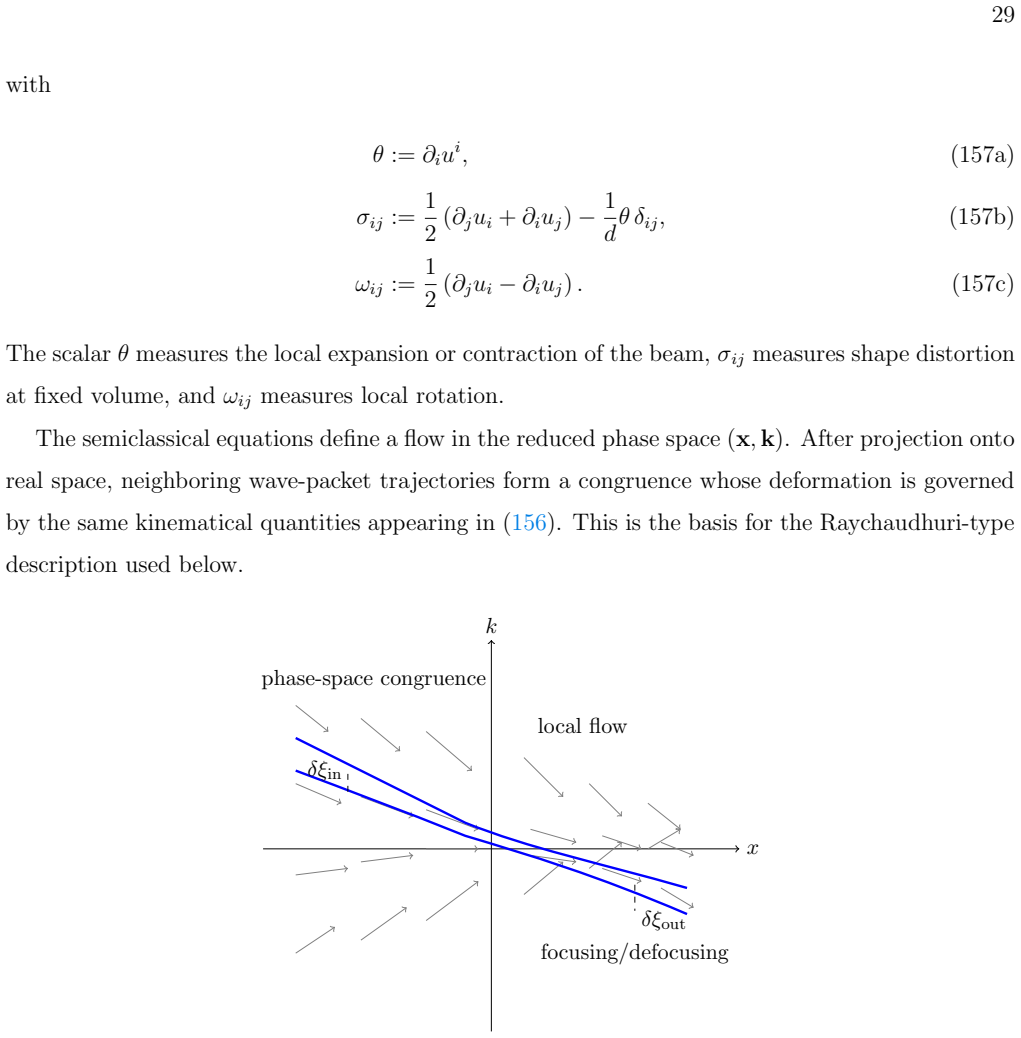
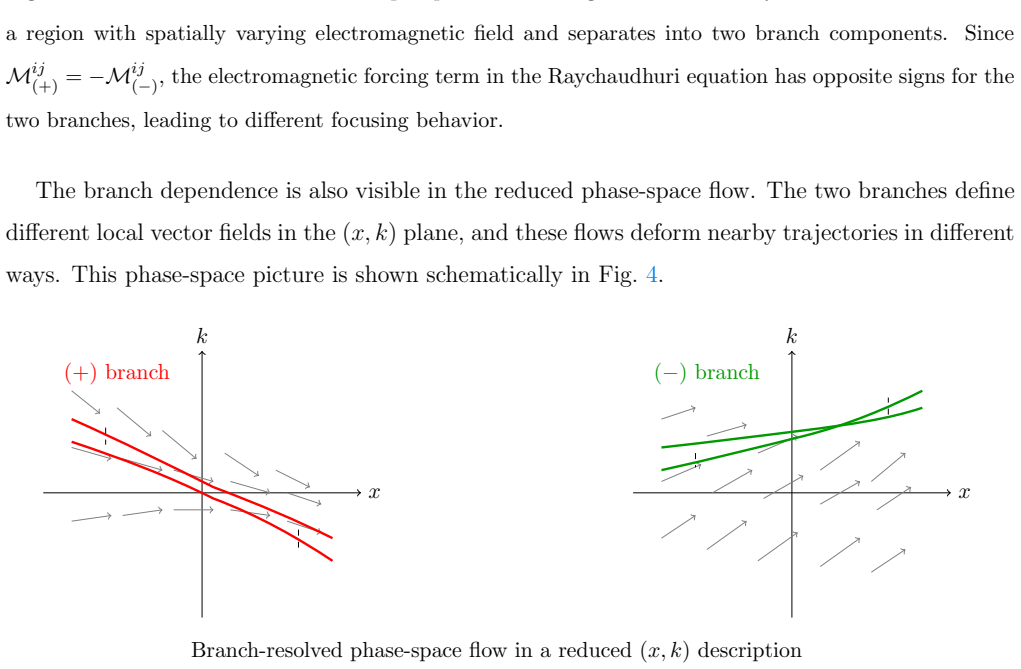
- In two-branch quasiparticle systems the opposite Hessians lead to branch-dependent birefringence realized as focusing versus defocusing of the beams.
Where Pith is reading between the lines
- This structure may be applied to study the stability of charged particle flows in Lorentz-violating cosmological models containing electromagnetic fields.
- The quasiparticle realization suggests that electromagnetic textures in condensed-matter systems could be used to control beam convergence in a branch-selective manner.
- Extensions to include gravitational fields could reveal how Lorentz violation interacts with standard gravitational focusing.
Load-bearing premise
The free functional form of each dispersion branch D^(±)(P) remains unchanged when the minimal electromagnetic coupling is introduced through the gauge-covariant momentum.
What would settle it
Compute the expansion scalar for a congruence obeying the b_μ dispersion relation in a uniform electric field and check whether it matches the value predicted by the derived branch-dependent source term.
Figures


read the original abstract
We investigate the Raychaudhuri dynamics of charged spin--nondegenerate Lorentz--violating particle congruences under minimal electromagnetic coupling. The coupling is introduced through the gauge--covariant momentum $P_{\mu}=\pi_{\mu}-qA_{\mu}$, so that the branch dispersion relation keeps its free functional form, while the electromagnetic field enters through the evolution of $P_{\mu}$. For a generic branch $\mathcal D^{(\pm)}(P)$, the tangent $k^{\mu}_{(\pm)}$ and the momentum Hessian $M^{\mu\nu}_{(\pm)}$ determine the covariant acceleration, $a^{\mu}_{(\pm)}=-qM^{\mu\nu}_{(\pm)}F_{\nu\rho}k^{\rho}_{(\pm)}$. As a consequence, the Raychaudhuri equation acquires the branch-dependent electromagnetic source $-q\nabla_{\mu}\!\left(M^{\mu\nu}_{(\pm)}F_{\nu\rho}k^{\rho}_{(\pm)}\right)$. We apply this construction to the $b_{\mu}$, $H_{\mu\nu}$, and $d_{\mu\nu}$ sectors, obtaining the corresponding branch tangents, Hessians, accelerations, and focusing equations. In flat spacetime, the electromagnetic field modifies the expansion through the divergence of the effective branch force. Therefore, uniform fields may bend the trajectories, whereas local focusing requires field gradients or, in the magnetic case, a coupling to an already deformed congruence. We also develop the analogous description for semiclassical quasiparticle beams, where the band Hessian plays the role of an effective electromagnetic response tensor. For anisotropic parabolic, Dirac--like, and Weyl--type dispersions, the same geometric structure relates electromagnetic textures to beam focusing. In two-branch systems, the opposite Hessians of the branches can produce focusing in one congruence and defocusing in the other, giving a quasiparticle realization of branch--dependent birefringence.
Editorial analysis
A structured set of objections, weighed in public.
Referee Report
Summary. The paper claims to derive a gauge-covariant extension of the Raychaudhuri equation for charged spin-nondegenerate Lorentz-violating particle congruences under minimal electromagnetic coupling. By replacing the ordinary momentum with the gauge-covariant P_μ = π_μ − q A_μ, each branch dispersion D^(±)(P) retains its free functional form; the on-shell condition then yields the covariant acceleration a^μ_(±) = −q M^μν_(±) F_νρ k^ρ_(±) via the momentum Hessian M^μν_(±). The resulting Raychaudhuri equation acquires the branch-dependent source −q ∇_μ (M^μν_(±) F_νρ k^ρ_(±)). The construction is specialized to the b_μ, H_μν and d_μν sectors of the Lorentz-violating SME, and an analogous treatment is given for semiclassical quasiparticle beams with anisotropic parabolic, Dirac-like and Weyl dispersions, where opposite Hessians produce branch-dependent focusing or defocusing.
Significance. If the derivation is correct, the work supplies an explicit geometric relation between electromagnetic field textures and congruence evolution that applies uniformly across Lorentz-violating sectors and their condensed-matter analogs. The concrete statements that uniform fields bend trajectories but produce no local focusing without gradients (or preexisting deformation in the magnetic case), together with the two-branch birefringence analogy, are falsifiable predictions that can be checked in both gravitational and material contexts. The absence of additional free parameters beyond the standard minimal-coupling prescription is a methodological strength.
major comments (2)
- [Derivation of the acceleration (abstract and § on generic branch)] The central step from the on-shell condition D(P(τ)) = 0 to the acceleration formula a^μ = −q M^μν F_νρ k^ρ relies on the chain rule and the definition of the Hessian; however, the manuscript does not explicitly verify that the normalization k_μ k^μ = constant is preserved under the flow for the chosen LV dispersions, which is required for the source term to enter the Raychaudhuri equation without extra normalization factors.
- [Sector applications] Application to the b_μ, H_μν and d_μν sectors is announced, yet the explicit expressions for the branch tangents k^μ_(±) and Hessians M^μν_(±) are not displayed; without these, it is impossible to confirm that the claimed source term reduces to the stated flat-space statements about uniform versus gradient fields.
minor comments (2)
- [Abstract] The abstract is information-dense; separating the quasiparticle-beam discussion into its own sentence would improve readability.
- [Notation] Notation for the two branches is introduced as (±) but the normalization convention for k^μ_(±) is not stated at first use; adding a brief parenthetical definition would prevent ambiguity when the Hessian is contracted.
Simulated Author's Rebuttal
We thank the referee for their careful reading of the manuscript and for the constructive comments, which help strengthen the presentation. We address each major comment point by point below and will revise the manuscript to incorporate the suggested clarifications.
read point-by-point responses
-
Referee: [Derivation of the acceleration (abstract and § on generic branch)] The central step from the on-shell condition D(P(τ)) = 0 to the acceleration formula a^μ = −q M^μν F_νρ k^ρ relies on the chain rule and the definition of the Hessian; however, the manuscript does not explicitly verify that the normalization k_μ k^μ = constant is preserved under the flow for the chosen LV dispersions, which is required for the source term to enter the Raychaudhuri equation without extra normalization factors.
Authors: We agree that an explicit check of normalization preservation strengthens the derivation. For the Lorentz-violating dispersions under consideration, which are homogeneous of degree one in P, differentiation of the on-shell condition D(P(τ)) = 0 along the flow, combined with the definition k^μ = ∂D/∂P_μ (normalized appropriately), directly implies that k_μ k^μ remains constant without additional factors. We will insert a short verification paragraph immediately after the acceleration formula in the revised manuscript to make this step fully transparent. revision: yes
-
Referee: [Sector applications] Application to the b_μ, H_μν and d_μν sectors is announced, yet the explicit expressions for the branch tangents k^μ_(±) and Hessians M^μν_(±) are not displayed; without these, it is impossible to confirm that the claimed source term reduces to the stated flat-space statements about uniform versus gradient fields.
Authors: We acknowledge that the explicit expressions were derived during the analysis but omitted from the main text for brevity. In the revised manuscript we will add these explicit forms for k^μ_(±) and M^μν_(±) in each of the b_μ, H_μν, and d_μν sectors (either in the main text or a short appendix), together with the resulting accelerations and source terms. This will permit direct verification that the source reduces to the stated behavior for uniform versus gradient fields in flat spacetime. revision: yes
Circularity Check
No significant circularity; derivation is self-contained via standard minimal coupling
full rationale
The paper's central construction substitutes the gauge-covariant momentum P_μ = π_μ - q A_μ into the free dispersion D^(±)(P) by definition of minimal coupling, then differentiates the on-shell condition D(P(τ)) = 0 along the flow using the chain rule and the Hessian M^μν = ∂²D/∂P_μ ∂P_ν to obtain a^μ = -q M^μν F_νρ k^ρ. This yields the source term in the Raychaudhuri equation directly from the chosen prescription and standard GR identities, without reducing to any fitted parameter, self-defined quantity, or prior self-citation. The assumption that D keeps its free form is an explicit modeling choice, not a derived result that loops back on itself. Applications to specific LV sectors (b, H, d) and quasiparticle cases insert explicit D(P) into the same structure, preserving independence from the target claims. No load-bearing self-citations, ansatze smuggled via citation, or renaming of known results are present.
Axiom & Free-Parameter Ledger
axioms (3)
- domain assumption The dispersion relation for each Lorentz-violating branch maintains its free functional form when the ordinary momentum is replaced by the gauge-covariant momentum P_μ = π_μ − q A_μ.
- domain assumption The particle congruences under consideration are spin-nondegenerate.
- domain assumption Minimal electromagnetic coupling is realized solely through the replacement in the momentum.
Reference graph
Works this paper leans on
-
[1]
Definitions Letu i(x, t) be the velocity field of the quasiparticle congruence. The deformation tensor is defined as Bij :=∂ jui.(A1) The derivative along the flow is the convective derivative D Dt =∂ t +u k∂k,(A2) and the acceleration field is ai = Dui Dt .(A3)
-
[2]
Evolution of the deformation tensor We start from D Dt Bij = D Dt (∂jui) =∂ t (∂jui) +u k∂k (∂jui).(A4) The first term can be written as ∂t (∂jui) =∂ j (∂tui).(A5) For the convective part, the product rule gives uk∂k (∂jui) =∂ j uk∂kui − ∂juk (∂kui).(A6) 55 Therefore, D Dt Bij =∂ j ∂tui +u k∂kui − ∂juk (∂kui).(A7) Using ∂tui +u k∂kui =a i,(A8) and the def...
-
[3]
Trace and Raychaudhuri-type equation The expansion scalar is the trace of the deformation tensor, θ=B i i.(A10) Taking the trace of Eq. (A9), we find Dθ Dt =∂ iai − BikBki.(A11) We now decomposeB ij into trace, symmetric traceless, and antisymmetric parts, Bij = 1 d θ δij +σ ij +ω ij,(A12) whereσ ij is symmetric and traceless, whileω ij is antisymmetric. ...
work page 2025
-
[4]
A. K. Raychaudhuri, Relativistic cosmology. i, Physical Review98, 1123 (1955)
work page 1955
-
[5]
J. Ehlers, Contributions to the relativistic mechanics of continuous media, General Relativity and Gravitation25, 1225 (1993)
work page 1993
-
[6]
R. K. Sachs, Gravitational waves in general relativity. vi. the outgoing radiation condition, Proceedings of the Royal Society of London A264, 309 (1961)
work page 1961
-
[7]
S. W. Hawking and G. F. R. Ellis,The Large Scale Structure of Space-Time(Cambridge University Press, Cambridge, 1973)
work page 1973
-
[8]
R. M. Wald,General Relativity(University of Chicago Press, Chicago, 1984)
work page 1984
-
[9]
E. Poisson,A Relativist’s Toolkit: The Mathematics of Black-Hole Mechanics(Cambridge University Press, Cambridge, 2004)
work page 2004
- [10]
-
[11]
Penrose, Gravitational collapse and space-time singularities, Physical Review Letters14, 57 (1965)
R. Penrose, Gravitational collapse and space-time singularities, Physical Review Letters14, 57 (1965)
work page 1965
-
[12]
S. W. Hawking, The occurrence of singularities in cosmology, Proceedings of the Royal Society of London A294, 511 (1966)
work page 1966
-
[13]
F. J. Tipler, General relativity and conjugate ordinary differential equations, Journal of Differential Equations30, 165 (1978)
work page 1978
-
[14]
J. M. M. Senovilla, Singularity theorems and their consequences, General Relativity and Gravitation 30, 701 (1998)
work page 1998
-
[15]
G. J. Galloway and J. M. M. Senovilla, Singularity theorems based on trapped submanifolds of arbi- trary co-dimension, Classical and Quantum Gravity27, 152002 (2010). 57
work page 2010
-
[16]
V. A. Kosteleck´ y and S. Samuel, Spontaneous breaking of lorentz symmetry in string theory, Physical Review D39, 683 (1989)
work page 1989
-
[17]
D. Colladay and V. A. Kosteleck´ y, CPT violation and the standard model, Physical Review D55, 6760 (1997)
work page 1997
-
[18]
D. Colladay and V. A. Kosteleck´ y, Lorentz-violating extension of the standard model, Physical Review D58, 116002 (1998)
work page 1998
-
[19]
V. A. Kosteleck´ y, Gravity, lorentz violation, and the standard model, Physical Review D69, 105009 (2004)
work page 2004
-
[20]
V. A. Kosteleck´ y and N. Russell, Data tables for lorentz and CPT violation, Reviews of Modern Physics83, 11 (2011)
work page 2011
-
[21]
Q. G. Bailey and V. A. Kosteleck´ y, Signals for lorentz violation in post-newtonian gravity, Physical Review D74, 045001 (2006)
work page 2006
-
[22]
V. A. Kosteleck´ y and J. D. Tasson, Matter-gravity couplings and lorentz violation, Physical Review D83, 016013 (2011)
work page 2011
-
[23]
Mattingly, Modern tests of lorentz invariance, Living Reviews in Relativity8, 5 (2005)
D. Mattingly, Modern tests of lorentz invariance, Living Reviews in Relativity8, 5 (2005)
work page 2005
-
[24]
Liberati, Tests of lorentz invariance: A 2013 update, Classical and Quantum Gravity30, 133001 (2013)
S. Liberati, Tests of lorentz invariance: A 2013 update, Classical and Quantum Gravity30, 133001 (2013)
work page 2013
-
[25]
R. Bluhm, Overview of the standard-model extension: Implications and phenomenology of lorentz violation, inSpecial Relativity: Will It Survive the Next 101 Years?, Lecture Notes in Physics, Vol. 702 (Springer, Berlin, 2006) pp. 191–226
work page 2006
-
[26]
V. A. Kosteleck´ y and N. Russell, Classical kinematics for lorentz violation, Physics Letters B693, 443 (2010)
work page 2010
-
[27]
V. A. Kosteleck´ y, Riemann-finsler geometry and lorentz-violating kinematics, Physics Letters B701, 137 (2011)
work page 2011
-
[28]
V. A. Kosteleck´ y, N. Russell, and R. Tso, Bipartite riemann-finsler geometry and lorentz violation, Physics Letters B716, 470 (2012)
work page 2012
-
[29]
G. Randers, On an asymmetrical metric in the four-space of general relativity, Physical Review59, 195 (1941)
work page 1941
-
[30]
D. Bao, S. S. Chern, and Z. Shen,An Introduction to Riemann-Finsler Geometry(Springer, New York, 2000)
work page 2000
-
[31]
G. W. Gibbons, J. Gomis, and C. N. Pope, General very special relativity is finsler geometry, Physical Review D76, 081701 (2007)
work page 2007
-
[32]
A. G. Cohen and S. L. Glashow, Very special relativity, Physical Review Letters97, 021601 (2006)
work page 2006
-
[33]
C. Pfeifer and M. N. R. Wohlfarth, Causal structure and electrodynamics on finsler spacetimes, Phys- ical Review D84, 044039 (2011). 58
work page 2011
-
[34]
M. A. Javaloyes and M. S´ anchez, Finsler metrics and relativistic spacetimes, International Journal of Geometric Methods in Modern Physics11, 1460032 (2014)
work page 2014
-
[35]
J. D. Jackson,Classical Electrodynamics, 3rd ed. (Wiley, New York, 1999)
work page 1999
-
[36]
L. D. Landau and E. M. Lifshitz,The Classical Theory of Fields, 4th ed. (Butterworth-Heinemann, Oxford, 1975)
work page 1975
-
[37]
H. Goldstein, C. Poole, and J. Safko,Classical Mechanics, 3rd ed. (Addison-Wesley, San Francisco, 2002)
work page 2002
-
[38]
V. I. Arnold,Mathematical Methods of Classical Mechanics, 2nd ed. (Springer, New York, 1989)
work page 1989
-
[39]
F. Bloch, ¨Uber die quantenmechanik der elektronen in kristallgittern, Zeitschrift f¨ ur Physik52, 555 (1929)
work page 1929
-
[40]
R. Peierls, Zur theorie des diamagnetismus von leitungselektronen, Zeitschrift f¨ ur Physik80, 763 (1933)
work page 1933
-
[41]
E. N. Adams and E. I. Blount, Energy bands in the presence of an external force field–ii: Anomalous velocities, Journal of Physics and Chemistry of Solids10, 286 (1959)
work page 1959
-
[42]
N. W. Ashcroft and N. D. Mermin,Solid State Physics(Holt, Rinehart and Winston, New York, 1976)
work page 1976
-
[43]
Kittel,Introduction to Solid State Physics, 8th ed
C. Kittel,Introduction to Solid State Physics, 8th ed. (Wiley, Hoboken, 2005)
work page 2005
-
[44]
J. M. Ziman,Principles of the Theory of Solids, 2nd ed. (Cambridge University Press, Cambridge, 1972)
work page 1972
-
[45]
M. V. Berry, Quantal phase factors accompanying adiabatic changes, Proceedings of the Royal Society of London A392, 45 (1984)
work page 1984
-
[46]
R. Karplus and J. M. Luttinger, Hall effect in ferromagnetics, Physical Review95, 1154 (1954)
work page 1954
-
[47]
D. J. Thouless, M. Kohmoto, M. P. Nightingale, and M. den Nijs, Quantized hall conductance in a two-dimensional periodic potential, Physical Review Letters49, 405 (1982)
work page 1982
-
[48]
M.-C. Chang and Q. Niu, Berry phase, hyperorbits, and the hofstadter spectrum, Physical Review Letters75, 1348 (1995)
work page 1995
-
[49]
M.-C. Chang and Q. Niu, Berry phase, hyperorbits, and the hofstadter spectrum: Semiclassical dy- namics in magnetic bloch bands, Physical Review B53, 7010 (1996)
work page 1996
-
[50]
G. Sundaram and Q. Niu, Wave-packet dynamics in slowly perturbed crystals: Gradient corrections and berry-phase effects, Physical Review B59, 14915 (1999)
work page 1999
-
[51]
D. Xiao, M.-C. Chang, and Q. Niu, Berry phase effects on electronic properties, Reviews of Modern Physics82, 1959 (2010)
work page 1959
-
[52]
Vanderbilt,Berry Phases in Electronic Structure Theory(Cambridge University Press, Cambridge, 2018)
D. Vanderbilt,Berry Phases in Electronic Structure Theory(Cambridge University Press, Cambridge, 2018). 59
work page 2018
-
[53]
F. D. M. Haldane, Berry curvature on the fermi surface: Anomalous hall effect as a topological fermi- liquid property, Physical Review Letters93, 206602 (2004)
work page 2004
-
[54]
P. A. M. Dirac, The quantum theory of the electron, Proceedings of the Royal Society of London A 117, 610 (1928)
work page 1928
-
[55]
Weyl, Elektron und gravitation
H. Weyl, Elektron und gravitation. i, Zeitschrift f¨ ur Physik56, 330 (1929)
work page 1929
-
[56]
P. R. Wallace, The band theory of graphite, Physical Review71, 622 (1947)
work page 1947
-
[57]
K. S. Novoselov, A. K. Geim, S. V. Morozov, D. Jiang, M. I. Katsnelson, I. V. Grigorieva, S. V. Dubonos, and A. A. Firsov, Two-dimensional gas of massless dirac fermions in graphene, Nature438, 197 (2005)
work page 2005
-
[58]
Y. Zhang, Y.-W. Tan, H. L. Stormer, and P. Kim, Experimental observation of the quantum hall effect and berry’s phase in graphene, Nature438, 201 (2005)
work page 2005
-
[59]
A. H. Castro Neto, F. Guinea, N. M. R. Peres, K. S. Novoselov, and A. K. Geim, The electronic properties of graphene, Reviews of Modern Physics81, 109 (2009)
work page 2009
-
[60]
M. Z. Hasan and C. L. Kane, Colloquium: Topological insulators, Reviews of Modern Physics82, 3045 (2010)
work page 2010
-
[61]
X.-L. Qi and S.-C. Zhang, Topological insulators and superconductors, Reviews of Modern Physics 83, 1057 (2011)
work page 2011
-
[62]
X. Wan, A. M. Turner, A. Vishwanath, and S. Y. Savrasov, Topological semimetal and fermi-arc surface states in the electronic structure of pyrochlore iridates, Physical Review B83, 205101 (2011)
work page 2011
-
[63]
A. A. Burkov and L. Balents, Weyl semimetal in a topological insulator multilayer, Physical Review Letters107, 127205 (2011)
work page 2011
-
[64]
N. P. Armitage, E. J. Mele, and A. Vishwanath, Weyl and dirac semimetals in three-dimensional solids, Reviews of Modern Physics90, 015001 (2018)
work page 2018
-
[65]
O. Vafek and A. Vishwanath, Dirac fermions in solids: From high-t c cuprates and graphene to topo- logical insulators and weyl semimetals, Annual Review of Condensed Matter Physics5, 83 (2014)
work page 2014
-
[66]
T. O. Wehling, A. M. Black-Schaffer, and A. V. Balatsky, Dirac materials, Advances in Physics63, 1 (2014)
work page 2014
-
[67]
M. O. Goerbig, Electronic properties of graphene in a strong magnetic field, Reviews of Modern Physics83, 1193 (2011)
work page 2011
discussion (0)
Sign in with ORCID, Apple, or X to comment. Anyone can read and Pith papers without signing in.