Recognition: 2 theorem links
· Lean TheoremClustering constraints on super-early galaxy formation scenarios
Pith reviewed 2026-05-13 01:02 UTC · model grok-4.3
The pith
Galaxy clustering measurements can distinguish between models explaining the bright high-redshift galaxies seen by JWST.
A machine-rendered reading of the paper's core claim, the machinery that carries it, and where it could break.
Core claim
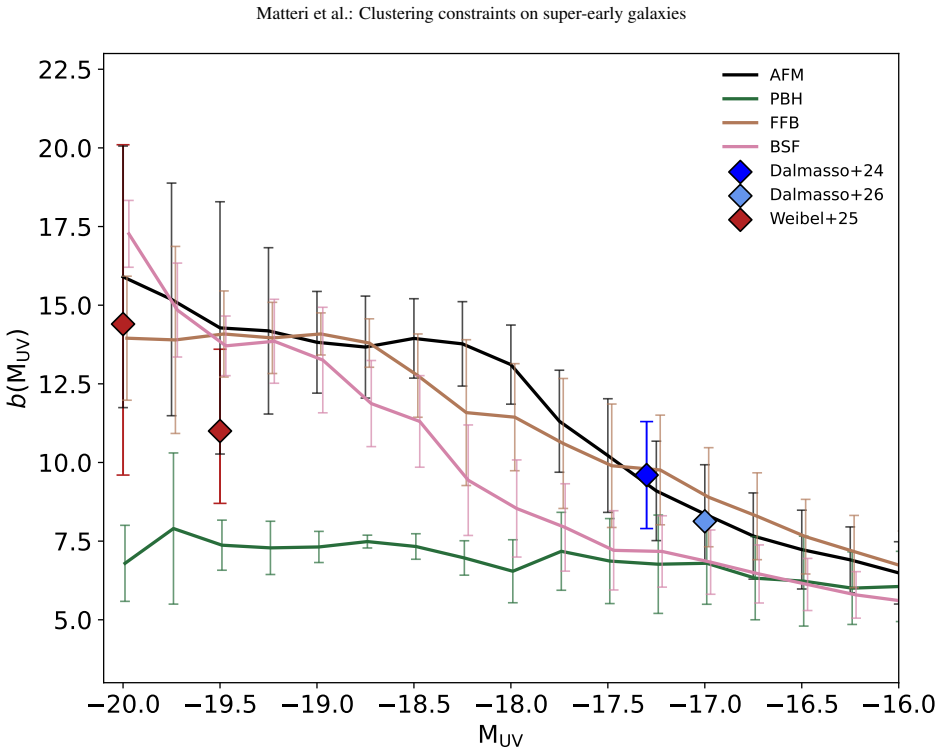
Using the Shin-Uchuu dark-matter-only simulation to populate z ≈ 11 halos with galaxies according to attenuation-free, feedback-free burst, bursty star formation, and primordial black hole models, all of which reproduce the observed UV luminosity function, the two-point correlation function yields similar bias values of approximately 7 for faint galaxies at M_UV ≈ -16. The models diverge at M_UV ≲ -18, with the primordial black hole scenario producing nearly luminosity-independent bias while the others show increasing bias that reaches approximately 14 at M_UV ≈ -19. Current observations cannot yet exclude any scenario at high , but measurements of complete samples with M_UV < -18 would take
What carries the argument
The luminosity-dependent galaxy bias obtained from the two-point correlation function after assigning galaxies to halos via each scenario's distinct halo-mass to M_UV relation.
If this is right
- All models agree on bias at faint luminosities but diverge at the bright end.
- The primordial black hole scenario alone predicts nearly constant bias across luminosities.
- The other three scenarios predict bias rising with luminosity up to about 14 at M_UV ≈ -19.
- Future JWST data on complete samples brighter than M_UV = -18 can exploit these differences.
- Refined theoretical predictions including baryonic effects will be needed to interpret the observations.
Where Pith is reading between the lines
- This clustering approach could be applied to other high-redshift observables where multiple models fit the luminosity function but differ in spatial distribution.
- Favoring one model would imply that feedback, bursts, or black holes shape not only galaxy numbers but also their large-scale placement at early times.
- Combining bias measurements with other probes such as galaxy sizes might tighten constraints beyond what clustering alone provides.
Load-bearing premise
The chosen relations between halo mass and UV luminosity for each of the four scenarios correctly reflect the true physics, and the dark-matter simulation captures the clustering without needing baryonic corrections.
What would settle it
A precise measurement showing galaxy bias remaining near 7 at M_UV ≈ -19 with little increase toward brighter magnitudes would favor the primordial black hole model and weaken the others.
Figures


read the original abstract
The unexpectedly high abundance of bright, blue, super-early galaxies ($z\gtrsim10$) has challenged most pre-JWST models of early galaxy formation and motivated a wide range of proposed explanations. We systematically investigate whether galaxy clustering can discriminate among representative scenarios that reproduce the observed UV luminosity function. Using the Shin-Uchuu dark-matter-only simulation, we populate $z \approx 11$ halos with galaxies according to solutions based on i) attenuation-free, ii) feedback-free bursts, iii) bursty star formation, and iv) primordial black hole models. For each model, we compute the two-point correlation function and predict the galaxy bias for flux-limited samples at different thresholds in the $-20 < {\rm M_{UV}} < -16$ magnitude range. We find that all models predict similar bias values ($b \approx 7$) for faint galaxies (${\rm M_{UV}}\approx-16$), but diverge at ${\rm M_{UV}}\lesssim-18$, as the underlying halo-mass to ${\rm M_{UV}}$ relations differ significantly. In particular, the primordial black hole scenario predicts an almost luminosity-independent bias, whereas the other models generally predict increasing bias with luminosity, reaching $b \approx 14$ for ${\rm M_{UV}} \approx -19$. Current observational estimates of the bias cannot yet rule out any of the models at a significant statistical confidence. More precise measurements from future JWST programs, together with improved theoretical predictions, will be required to break the present degeneracies. Ideally, constraints from a complete sample of galaxies with ${\rm M_{UV}} < -18$ would probe the knee of the $b({\rm M_{UV}})$ function, taking advantage of the difference in model predictions and strengthening our analysis. Although requiring further refinement, galaxy clustering is confirmed to be a promising probe of the physical origin of the JWST high-redshift luminosity function.
Editorial analysis
A structured set of objections, weighed in public.
Referee Report
Summary. The paper claims that populating the Shin-Uchuu dark-matter-only N-body simulation at z≈11 with galaxies according to four literature-derived M_UV-halo mass relations (attenuation-free, feedback-free bursts, bursty star formation, and primordial black holes) yields similar galaxy biases (b≈7) for faint samples (M_UV≈-16) but strong divergence at brighter luminosities (M_UV≲-18), with the PBH model nearly luminosity-independent while others reach b≈14; this suggests clustering measurements can discriminate the physical origin of the JWST high-z luminosity function, though current data cannot yet rule out models.
Significance. If the bias divergence is robust, the work establishes galaxy clustering as a useful complementary observable to the UV luminosity function for testing super-early galaxy formation scenarios. It supplies explicit, model-specific predictions for flux-limited samples across -20 < M_UV < -16 and identifies the bright-end regime where differences are largest, which can inform JWST observing strategies. The direct use of a large public simulation to compute the two-point correlation function provides a reproducible baseline for such tests.
major comments (2)
- [Methods (halo population)] The halo-population procedure (described in the methods) imports distinct M_UV-halo mass relations for each of the four scenarios directly from the cited literature papers without any parameter variation, re-derivation, or propagation of their uncertainties into the correlation-function or bias results. Consequently the reported divergence at M_UV ≲ -18 is not demonstrated to be robust within this manuscript.
- [Results (bias predictions)] All bias predictions rest on the dark-matter-only Shin-Uchuu simulation. At z≈11 the omission of baryonic processes (gas cooling, stellar feedback, possible AGN) can modify both the halo mass function and the spatial clustering of the halos that host UV-bright galaxies; any model-dependent baryonic suppression would alter the effective bias and could reduce or erase the claimed divergence between b≈14 and luminosity-independent values.
minor comments (1)
- [Abstract] The abstract states the magnitude range as -20 < M_UV < -16 yet highlights divergence only for M_UV ≲ -18; a brief clarification of the exact luminosity thresholds used for the faint-end agreement (b≈7) would improve readability.
Simulated Author's Rebuttal
We thank the referee for their thoughtful and constructive report. The comments have helped us identify areas where the manuscript can be clarified and strengthened, particularly regarding methodological limitations. We address each major comment below and indicate the revisions we will make.
read point-by-point responses
-
Referee: [Methods (halo population)] The halo-population procedure (described in the methods) imports distinct M_UV-halo mass relations for each of the four scenarios directly from the cited literature papers without any parameter variation, re-derivation, or propagation of their uncertainties into the correlation-function or bias results. Consequently the reported divergence at M_UV ≲ -18 is not demonstrated to be robust within this manuscript.
Authors: We appreciate the referee highlighting this methodological choice. The M_UV-halo mass relations were taken directly from the published literature to faithfully represent the distinct physical assumptions of each scenario (attenuation-free, feedback-free bursts, bursty star formation, and primordial black holes). Our focus was on comparing the clustering implications of these existing relations rather than re-fitting or varying parameters within them. We agree that a full propagation of uncertainties would provide a more quantitative assessment of robustness. In the revised manuscript, we will add explicit statements in the Methods and Discussion sections noting this limitation and clarifying that the reported divergence reflects the central relations from the literature. We will also suggest that future analyses could incorporate parameter variations to test sensitivity. revision: partial
-
Referee: [Results (bias predictions)] All bias predictions rest on the dark-matter-only Shin-Uchuu simulation. At z≈11 the omission of baryonic processes (gas cooling, stellar feedback, possible AGN) can modify both the halo mass function and the spatial clustering of the halos that host UV-bright galaxies; any model-dependent baryonic suppression would alter the effective bias and could reduce or erase the claimed divergence between b≈14 and luminosity-independent values.
Authors: This is a valid and important caveat. The Shin-Uchuu dark-matter-only simulation was selected for its large volume and resolution, which are necessary to reliably measure clustering for the rare bright galaxies at z≈11. The differences in bias between models arise from the distinct halo-mass selections implied by each M_UV-halo mass relation applied to the same underlying halo catalog. We acknowledge that baryonic processes could modify the halo mass function and clustering in a model-dependent way, potentially affecting the absolute bias values and the degree of divergence. In the revised manuscript, we will add a dedicated paragraph in the Discussion section addressing this limitation, explaining that our results provide a baseline using dark-matter clustering and that hydrodynamical simulations would be required to fully assess baryonic impacts. This does not change our conclusion that clustering can serve as a complementary probe, but it underscores the need for more advanced modeling. revision: yes
Circularity Check
No significant circularity; bias predictions are computed from external inputs.
full rationale
The paper takes the Shin-Uchuu dark-matter-only simulation as an external input and populates its z≈11 halos using M_UV–halo-mass relations taken directly from the four cited scenario papers. It then computes the two-point correlation function and bias values for flux-limited samples in the stated magnitude range. No equation or procedure inside the paper fits any parameter to clustering data, re-derives the halo-mass mappings, or defines bias in terms of itself; the reported divergence at M_UV ≲ −18 simply reflects the differences among the imported relations. The derivation chain is therefore self-contained against external benchmarks and contains no self-definitional, fitted-input, or self-citation-load-bearing steps.
Axiom & Free-Parameter Ledger
free parameters (1)
- halo-mass to M_UV mapping per scenario
axioms (2)
- domain assumption Shin-Uchuu N-body simulation accurately represents halo clustering at z≈11
- standard math Two-point correlation function of populated galaxies directly yields the linear bias
Lean theorems connected to this paper
-
IndisputableMonolith/Cost/FunctionalEquation.leanwashburn_uniqueness_aczel unclearUsing the Shin-Uchuu dark-matter-only simulation, we populate z≈11 halos with galaxies according to solutions based on i) attenuation-free, ii) feedback-free bursts, iii) bursty star formation, and iv) primordial black hole models. … compute the two-point correlation function and predict the galaxy bias
-
IndisputableMonolith/Foundation/DimensionForcing.leanalexander_duality_circle_linking unclearthe bias … b=σ_{8,g}/σ_8 … fitted with a power-law
Reference graph
Works this paper leans on
-
[1]
Adams, N. J., Conselice, C. J., Ferreira, L., et al. 2023, MNRAS, 518, 4755 Arrabal Haro, P., Dickinson, M., Bagley, M., et al. 2022, JWST Proposal. Cycle 1, 2750 Arrabal Haro, P., Dickinson, M., Finkelstein, S. L., et al. 2023, ApJL, 951, L22 Astropy Collaboration, Price-Whelan, A. M., Lim, P. L., et al. 2022, ApJL, 935, 167 Astropy Collaboration, Price-...
work page 2023
- [2]
-
[3]
Behroozi, P., Wechsler, R. H., Hearin, A. P., & Conroy, C. 2019, MNRAS, 488, 3143
work page 2019
-
[4]
Bouwens, R. J., Illingworth, G., Ellis, R. S., Oesch, P., & Stefanon, M. 2022, ApJL, 940, 55
work page 2022
- [5]
-
[6]
Bunker, A. J., Saxena, A., Cameron, A. J., et al. 2023, A&A, 677, A88
work page 2023
-
[7]
Carniani, S., Hainline, K., D’Eugenio, F., et al. 2024, Nature, 633, 318
work page 2024
-
[8]
Carvajal-Bohorquez, C., Ciesla, L., Laporte, N., et al. 2025, A&A, 704, A290
work page 2025
- [9]
-
[10]
Castellano, M., Fontana, A., Merlin, E., et al. 2025, A&A, 704, A158
work page 2025
-
[11]
Castellano, M., Fontana, A., Treu, T., et al. 2022, ApJL, 938, L15
work page 2022
-
[12]
Castellano, M., Napolitano, L., Fontana, A., et al. 2024, ApJL, 972, 143
work page 2024
- [13]
- [14]
-
[15]
J., Adams, N., Harvey, T., et al
Conselice, C. J., Adams, N., Harvey, T., et al. 2025, ApJL, 983, 30
work page 2025
-
[16]
2023, Nature Astronomy, 7, 622
Curtis-Lake, E., Carniani, S., Cameron, A., et al. 2023, Nature Astronomy, 7, 622
work page 2023
-
[17]
Dalmasso, N., Ferrami, G., Leethochawalit, N., Ventura, E. M., & Trenti, M. 2026, MNRAS, 546, stag001
work page 2026
-
[18]
Dalmasso, N., Leethochawalit, N., Trenti, M., & Boyett, K. 2024, MNRAS, 533, 2391
work page 2024
-
[19]
Dayal, P., Ferrara, A., Dunlop, J. S., & Pacucci, F. 2014, MNRAS, 445, 2545
work page 2014
-
[20]
C., Birnboim, Y ., Mandelker, N., & Li, Z
Dekel, A., Sarkar, K. C., Birnboim, Y ., Mandelker, N., & Li, Z. 2023, MNRAS, 523, 3201
work page 2023
-
[21]
Dekel, A., Zolotov, A., Tweed, D., et al. 2013, MNRAS, 435, 999
work page 2013
-
[22]
Desjacques, V ., Jeong, D., & Schmidt, F. 2018, Physics Reports, 733, 1
work page 2018
-
[23]
Donnan, C. T., McLure, R. J., Dunlop, J. S., et al. 2024, MNRAS, 533, 3222
work page 2024
-
[24]
E., Villasenor, B., Robertson, B
Drakos, N. E., Villasenor, B., Robertson, B. E., et al. 2022, ApJL, 926, 194 Euclid Collaboration, Allen, N., Oesch, P. A., et al. 2025a Euclid Collaboration, Mellier, Y ., Abdurro’uf, et al. 2025b, A&A, 697, A1
work page 2022
- [25]
-
[26]
Ferrara, A., Pallottini, A., & Dayal, P. 2023, MNRAS, 522, 3986
work page 2023
-
[27]
Finkelstein, S. L., Bagley, M. B., Arrabal Haro, P., et al. 2022, ApJL, 940, L55
work page 2022
-
[28]
Finkelstein, S. L., Bagley, M. B., Ferguson, H. C., et al. 2023, ApJL, 946, L13
work page 2023
-
[29]
Finkelstein, S. L., Leung, G. C. K., Bagley, M. B., et al. 2024, ApJL, 969, L2
work page 2024
-
[30]
Fujimoto, S., Arrabal Haro, P., Dickinson, M., et al. 2023, ApJL, 949, L25
work page 2023
-
[31]
J., Shuntov, M., Atek, H., et al
Furtak, L. J., Shuntov, M., Atek, H., et al. 2023, MNRAS, 519, 3064
work page 2023
-
[32]
Gelli, V ., Mason, C., & Hayward, C. C. 2024, ApJL, 975, 192
work page 2024
-
[33]
Hainline, K. N., Johnson, B. D., Robertson, B., et al. 2024, ApJL, 964, 71
work page 2024
- [34]
-
[35]
Harris, C. R., Millman, K. J., van der Walt, S. J., et al. 2020, Nature, 585, 357
work page 2020
-
[36]
Haslbauer, M., Kroupa, P., Zonoozi, A. H., & Haghi, H. 2022, ApJL, 939, L31
work page 2022
-
[37]
Y .-Y ., Abdurro’uf, Coe, D., et al
Hsiao, T. Y .-Y ., Abdurro’uf, Coe, D., et al. 2024, ApJL, 973, 8
work page 2024
-
[38]
Hunter, J. D. 2007, Computing in Science and Engineering, 9, 90
work page 2007
-
[39]
Hutter, A., Cueto, E. R., Dayal, P., et al. 2025, A&A, 694, A254
work page 2025
- [40]
- [41]
-
[42]
Kannan, R., Garaldi, E., Smith, A., et al. 2022, MNRAS, 511, 4005
work page 2022
-
[43]
Kerscher, M., Szapudi, I., & Szalay, A. S. 2000, ApJL, 535, L13
work page 2000
- [44]
-
[45]
Lam, S. K., Pitrou, A., & Seibert, S. 2015, in Proc. Second Workshop on the LLVM Compiler Infrastructure in HPC, 1–6
work page 2015
-
[46]
Landy, S. D. & Szalay, A. S. 1993, ApJL, 412, 64
work page 1993
- [47]
-
[48]
Leung, G. C. K., Bagley, M. B., Finkelstein, S. L., et al. 2023, ApJL, 954, L46
work page 2023
- [49]
- [50]
- [51]
- [52]
- [53]
-
[54]
McKerns, M. M. & Aivazis, M. A. G. 2010
work page 2010
-
[55]
M., Strand, L., Sullivan, T., Fang, A., & Aivazis, M
McKerns, M. M., Strand, L., Sullivan, T., Fang, A., & Aivazis, M. A. G. 2012
work page 2012
-
[56]
McLeod, D. J., Donnan, C. T., McLure, R. J., et al. 2024, MNRAS, 527, 5004
work page 2024
- [57]
-
[58]
Mohammad, F. G. & Percival, W. J. 2022, MNRAS, 514, 1289 Muñoz, J. B., Chisholm, J., Sun, G., et al. 2026 Muñoz, J. B., Mirocha, J., Furlanetto, S., & Sabti, N. 2023, MNRAS, 526, L47
work page 2022
-
[59]
Murray, S. G., Power, C., & Robotham, A. S. G. 2013, Astronomy and Comput- ing, 3, 23
work page 2013
- [60]
- [61]
-
[62]
Pallottini, A., Ferrara, A., Gallerani, S., et al. 2025, A&A, 699, A6
work page 2025
- [63]
-
[64]
Peebles, P. J. E. 1980, The Large-Scale Structure of the Universe Pérez-González, P. G., Östlin, G., Costantin, L., et al. 2025, ApJL, 991, 179 Planck Collaboration, Ade, P. A. R., Aghanim, N., et al. 2016, A&A, 594, A13
work page 1980
-
[65]
Robertson, B., Johnson, B. D., Tacchella, S., et al. 2024, ApJL, 970, 31
work page 2024
-
[66]
Robertson, B. E., Tacchella, S., Johnson, B. D., et al. 2023, Nature Astronomy, 7, 611
work page 2023
-
[67]
Santini, P., Fontana, A., Castellano, M., et al. 2023, ApJL, 942, L27
work page 2023
-
[68]
F., Faucher-Giguère, C.-A., et al
Shen, X., Hopkins, P. F., Faucher-Giguère, C.-A., et al. 2020, MNRAS, 495, 3252
work page 2020
-
[69]
Shen, X., V ogelsberger, M., Boylan-Kolchin, M., Tacchella, S., & Naidu, R. P. 2024, MNRAS, 533, 3923
work page 2024
-
[70]
Sinha, M. & Garrison, L. H. 2019, in Software Challenges to Exascale Comput- ing (Singapore: Springer Singapore), 3–20
work page 2019
- [71]
-
[72]
Somerville, R. S., Yung, L. Y . A., Lancaster, L., et al. 2025, MNRAS, 544, 3774
work page 2025
- [73]
-
[74]
Tacchella, S., Johnson, B. D., Robertson, B. E., et al. 2023, MNRAS, 522, 6236
work page 2023
-
[75]
Tinker, J. L., Robertson, B. E., Kravtsov, A. V ., et al. 2010, ApJL, 724, 878
work page 2010
-
[76]
Trinca, A., Schneider, R., Valiante, R., et al. 2024, MNRAS, 529, 3563
work page 2024
-
[77]
Trusov, S., Zarrouk, P., Cole, S., et al. 2024, MNRAS, 527, 9048
work page 2024
- [78]
- [79]
-
[80]
Wechsler, R. H. & Tinker, J. L. 2018, ARA&A, 56, 435
work page 2018
discussion (0)
Sign in with ORCID, Apple, or X to comment. Anyone can read and Pith papers without signing in.