Recognition: 2 theorem links
· Lean TheoremTowards the Realization of the Dark Dimension Scenario in Hov{r}ava-Witten Theory
Pith reviewed 2026-05-13 00:50 UTC · model grok-4.3
The pith
Hořava-Witten theory offers a potential string embedding of the dark dimension by localizing the Standard Model on the 11th interval, with symmetric tadpole cancellation and an infinite-distance limit helping derive the scalar potential and couplings from Schwinger integrals.
A machine-rendered reading of the paper's core claim, the machinery that carries it, and where it could break.
Core claim
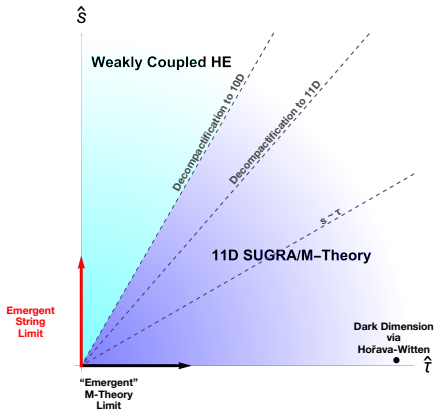
By taking not only the hierarchically small value of the dark energy but also the size of the Standard Model gauge couplings into account, one is driven to a special infinite distance limit, which is the Hořava-Witten analogue of a limit recently at the focus of the M-theoretic Emergence Proposal. Extrapolating results obtained for BPS-saturated amplitudes, we speculate about the possibility of obtaining the moduli dependence of the scalar potential, the gauge couplings and the Planck scale by simple one-loop Schwinger integrals over towers of states.
Load-bearing premise
That symmetric tadpole cancellation on the E8 walls works for generic Calabi-Yau manifolds with abelian factors and that extrapolating BPS-saturated amplitudes to the full moduli dependence of the potential and couplings is valid without additional corrections.
Figures
read the original abstract
It has been suggested that Ho\v{r}ava-Witten theory could provide a concrete realization of the Dark Dimension Scenario. In this context, the observable Standard Model sector is naturally localized in the micron-sized large dimension, which is the interval in the eleventh direction. Considering Calabi-Yau manifolds supporting generic vector bundles including also abelian factors, we point out that symmetric tadpole cancellation on the $E_8$ walls has the potential to ameliorate some of the issues of such a realization, including too fast proton decay. By taking not only the hierarchically small value of the dark energy but also the size of the Standard Model gauge couplings into account, one is driven to a special infinite distance limit, which is the Ho\v{r}ava-Witten analogue of a limit recently at the focus of the M-theoretic Emergence Proposal. Extrapolating results obtained for BPS-saturated amplitudes, we speculate about the possibility of obtaining the moduli dependence of the scalar potential, the gauge couplings and the Planck scale by simple one-loop Schwinger integrals over towers of states.
Editorial analysis
A structured set of objections, weighed in public.
Referee Report
Summary. The manuscript suggests that Hořava-Witten theory can realize the Dark Dimension Scenario, with the Standard Model localized in the large eleventh dimension. It points out that symmetric tadpole cancellation on the E8 walls may ameliorate issues such as rapid proton decay for generic Calabi-Yau threefolds supporting vector bundles with abelian factors. Incorporating both the small dark energy scale and Standard Model gauge couplings drives the setup to a special infinite-distance limit analogous to those in the M-theoretic Emergence Proposal. The authors speculate that the moduli dependence of the scalar potential, gauge couplings, and Planck scale can be obtained from one-loop Schwinger integrals over towers of states by extrapolating BPS-saturated amplitude results.
Significance. If the key extrapolation from BPS amplitudes were justified and the tadpole cancellation mechanism were shown to work for generic bundles, the paper would provide a concrete string embedding of the dark dimension idea that links small dark energy, gauge couplings, and the Planck scale through an infinite-distance limit. The identification of this limit and the suggestion of a Schwinger-integral approach are potentially useful organizing ideas, but the absence of any derivation or check means the significance remains prospective rather than demonstrated.
major comments (2)
- [Abstract and the discussion of the infinite-distance limit] The central speculation that one-loop Schwinger integrals over towers of states yield the moduli dependence of the scalar potential, gauge couplings, and Planck scale (as stated in the abstract) rests on extrapolating results obtained only for BPS-saturated amplitudes. No argument is supplied showing why this dependence survives the inclusion of non-BPS states or higher-order corrections; this assumption is load-bearing for the proposed realization.
- [Abstract] The claim that symmetric tadpole cancellation on the E8 walls 'has the potential to ameliorate' issues including too-fast proton decay (abstract) is presented without an explicit check or derivation for generic Calabi-Yau threefolds with abelian factors in the bundles. This assumption underpins the phenomenological viability of the setup.
minor comments (1)
- The distinction between established results from prior BPS calculations and the new speculations could be made sharper to help readers assess the strength of the proposal.
Simulated Author's Rebuttal
We thank the referee for their careful reading and constructive comments on our manuscript. We address the major comments point by point below. Revisions have been made to clarify the speculative and conjectural nature of the proposals while preserving the core ideas.
read point-by-point responses
-
Referee: [Abstract and the discussion of the infinite-distance limit] The central speculation that one-loop Schwinger integrals over towers of states yield the moduli dependence of the scalar potential, gauge couplings, and Planck scale (as stated in the abstract) rests on extrapolating results obtained only for BPS-saturated amplitudes. No argument is supplied showing why this dependence survives the inclusion of non-BPS states or higher-order corrections; this assumption is load-bearing for the proposed realization.
Authors: We agree that the proposal relies on an extrapolation from known BPS-saturated amplitude results, and that a full justification for the persistence of the leading moduli dependence in the presence of non-BPS states and higher-order corrections is not provided. The manuscript already presents this explicitly as a speculation ('we speculate about the possibility'), motivated by the analogy to the M-theoretic Emergence Proposal where BPS states are expected to dominate the leading behavior in the infinite-distance limit. A complete derivation would require detailed non-BPS computations that lie beyond the scope of the present work. We have revised the abstract and the relevant discussion sections to more prominently emphasize the conjectural character of the extrapolation and to note the assumption that BPS contributions control the leading moduli dependence. revision: partial
-
Referee: [Abstract] The claim that symmetric tadpole cancellation on the E8 walls 'has the potential to ameliorate' issues including too-fast proton decay (abstract) is presented without an explicit check or derivation for generic Calabi-Yau threefolds with abelian factors in the bundles. This assumption underpins the phenomenological viability of the setup.
Authors: The abstract employs the phrasing 'has the potential to ameliorate' precisely to signal that this is an observation with suggestive implications rather than a fully derived result. Symmetric tadpole cancellation is a standard feature of Hořava-Witten compactifications on the E8 walls, and for vector bundles containing abelian factors it can lead to cancellations among certain higher-dimensional operators that might otherwise mediate rapid proton decay. We acknowledge, however, that an explicit check or derivation for arbitrary Calabi-Yau threefolds is not carried out in the manuscript; such a check would require a systematic analysis of the matter spectrum and operator coefficients for generic bundles. We have updated the abstract and the corresponding discussion to underscore that this remains a promising direction for future model-building rather than a completed demonstration. revision: partial
Circularity Check
Moduli dependence of potential and couplings obtained by extrapolating BPS amplitudes fitted to dark energy and gauge coupling scales
specific steps
-
fitted input called prediction
[Abstract]
"By taking not only the hierarchically small value of the dark energy but also the size of the Standard Model gauge couplings into account, one is driven to a special infinite distance limit... Extrapolating results obtained for BPS-saturated amplitudes, we speculate about the possibility of obtaining the moduli dependence of the scalar potential, the gauge couplings and the Planck scale by simple one-loop Schwinger integrals over towers of states."
The infinite-distance limit is chosen to reproduce the input values of dark energy and gauge couplings; the subsequent claim that Schwinger integrals over towers give the moduli dependence is an extrapolation of BPS results rather than a derivation, so the functional form is forced by the same data used to select the limit.
full rationale
The paper selects a special infinite-distance limit by requiring the observed dark energy scale and SM gauge couplings to match, then extrapolates prior BPS-saturated amplitude results to claim that one-loop Schwinger integrals yield the full moduli dependence of the scalar potential, gauge couplings, and Planck scale. This reduces the claimed 'prediction' to a functional form already constrained by the input scales and the BPS results being extrapolated, with no independent derivation shown for non-BPS states or generic Calabi-Yau cases. The central claim therefore contains a fitted-input-called-prediction step rather than a first-principles derivation.
Axiom & Free-Parameter Ledger
free parameters (2)
- size of the large 11th dimension
- moduli values in the infinite-distance limit
axioms (3)
- domain assumption Hořava-Witten theory provides a consistent M-theory compactification on an interval with E8 walls
- domain assumption Calabi-Yau manifolds admit generic vector bundles including abelian factors with symmetric tadpole cancellation
- ad hoc to paper BPS-saturated amplitudes can be extrapolated to give the full moduli dependence of the scalar potential and couplings
Lean theorems connected to this paper
-
IndisputableMonolith/Cost/FunctionalEquation.leanwashburn_uniqueness_aczel unclear?
unclearRelation between the paper passage and the cited Recognition theorem.
Extrapolating results obtained for BPS-saturated amplitudes, we speculate about the possibility of obtaining the moduli dependence of the scalar potential, the gauge couplings and the Planck scale by simple one-loop Schwinger integrals over towers of states.
-
IndisputableMonolith/Foundation/RealityFromDistinction.leanreality_from_one_distinction unclear?
unclearRelation between the paper passage and the cited Recognition theorem.
symmetric tadpole cancellation on the E8 walls ... Tr(Fi ∧ Fi) − 1/2 Tr(R ∧ R) = 0
What do these tags mean?
- matches
- The paper's claim is directly supported by a theorem in the formal canon.
- supports
- The theorem supports part of the paper's argument, but the paper may add assumptions or extra steps.
- extends
- The paper goes beyond the formal theorem; the theorem is a base layer rather than the whole result.
- uses
- The paper appears to rely on the theorem as machinery.
- contradicts
- The paper's claim conflicts with a theorem or certificate in the canon.
- unclear
- Pith found a possible connection, but the passage is too broad, indirect, or ambiguous to say the theorem truly supports the claim.
Reference graph
Works this paper leans on
-
[1]
The Swampland: Introduction and Review
E. Palti, “The Swampland: Introduction and Review,”Fortsch. Phys.67(2019), no. 6, 1900037,1903.06239
work page Pith review arXiv 2019
-
[2]
M. van Beest, J. Calder´ on-Infante, D. Mirfendereski, and I. Valenzuela, “Lectures on the Swampland Program in String Compactifications,”Phys. Rept.989(2022) 1–50, 2102.01111
-
[3]
M. Gra˜ na and A. Herr´ aez, “The Swampland Conjectures: A Bridge from Quantum Gravity to Particle Physics,”Universe7(2021), no. 8, 273,2107.00087
-
[4]
Lectures on the string landscape and the Swampland,
N. B. Agmon, A. Bedroya, M. J. Kang, and C. Vafa, “Lectures on the string landscape and the Swampland,”2212.06187
-
[5]
The Dark Dimension and the Swampland,
M. Montero, C. Vafa, and I. Valenzuela, “The dark dimension and the Swampland,” JHEP02(2023) 022,2205.12293
-
[6]
Swamplandish Unification of the Dark Sector,
C. Vafa, “Swamplandish Unification of the Dark Sector,”2402.00981
-
[7]
Landscape, Swampland, and Extra Dimensions,
L. A. Anchordoqui, I. Antoniadis, and D. L¨ ust, “Landscape, Swampland, and Extra Dimensions,”PoSCORFU2023(2024) 215,2405.04427
- [8]
-
[9]
Emergent strings from infinite distance limits,
S.-J. Lee, W. Lerche, and T. Weigand, “Emergent strings from infinite distance limits,”JHEP02(2022) 190,1910.01135
-
[10]
N. Arkani-Hamed, S. Dimopoulos, and G. R. Dvali, “Phenomenology, astrophysics and cosmology of theories with submillimeter dimensions and TeV scale quantum gravity,” Phys. Rev. D59(1999) 086004,hep-ph/9807344
-
[11]
The Dark Dimension, the Swampland, and the Dark Matter Fraction Composed of Primordial Black Holes,
L. A. Anchordoqui, I. Antoniadis, and D. L¨ ust, “Two Micron-Size Dark Dimensions,” Fortsch. Phys.73(2025), no. 8, e70015,2501.11690
-
[12]
Stellar cooling limits on KK gravitons and dark dimensions,
E. Hardy, A. Sokolov, and H. Stubbs, “Stellar cooling limits on KK gravitons and dark dimensions,”2510.18975
-
[13]
Dark dimension gravitons as dark matter,
E. Gonzalo, M. Montero, G. Obied, and C. Vafa, “Dark dimension gravitons as dark matter,”JHEP11(2023) 109,2209.09249
-
[14]
Dark dimension, the swampland, and the dark matter fraction composed of primordial black holes,
L. A. Anchordoqui, I. Antoniadis, and D. L¨ ust, “Dark dimension, the swampland, and the dark matter fraction composed of primordial black holes,”Phys. Rev. D106 (2022), no. 8, 086001,2206.07071. 24 [15]DESICollaboration, M. Abdul Karimet al., “DESI DR2 results. II. Measurements of baryon acoustic oscillations and cosmological constraints,”Phys. Rev. D112...
-
[15]
Evolving Dark Sector and the Dark Dimension Scenario,
A. Bedroya, G. Obied, C. Vafa, and D. H. Wu, “Evolving Dark Sector and the Dark Dimension Scenario,”2507.03090
-
[16]
The dark dimension in a warped throat,
R. Blumenhagen, M. Brinkmann, and A. Makridou, “The dark dimension in a warped throat,”Phys. Lett. B838(2023) 137699,2208.01057
-
[17]
Comments concerning a hypothetical mesoscopic dark dimension,
J. H. Schwarz, “Comments concerning a hypothetical mesoscopic dark dimension,”Int. J. Mod. Phys. A39(2024), no. 36, 2447010,2403.12899
- [18]
-
[19]
Heterotic and Type I String Dynamics from Eleven Dimensions
P. Horava and E. Witten, “Heterotic and Type I string dynamics from eleven dimensions,”Nucl. Phys. B460(1996) 506–524,hep-th/9510209
work page Pith review arXiv 1996
-
[20]
Eleven-Dimensional Supergravity on a Manifold with Boundary
P. Horava and E. Witten, “Eleven-dimensional supergravity on a manifold with boundary,”Nucl. Phys. B475(1996) 94–114,hep-th/9603142
work page Pith review arXiv 1996
-
[21]
Symmetric vacua in heterotic M theory,
A. Lukas and B. A. Ovrut, “Symmetric vacua in heterotic M theory,”Int. J. Mod. Phys. A15(2000) 5161,hep-th/9908100
-
[22]
The Weak Gravity Conjecture and Emergence from an Ultraviolet Cutoff
B. Heidenreich, M. Reece, and T. Rudelius, “The Weak Gravity Conjecture and Emergence from an Ultraviolet Cutoff,”Eur. Phys. J. C78(2018), no. 4, 337, 1712.01868
work page Pith review arXiv 2018
-
[23]
Infinite Distances in Field Space and Massless Towers of States,
T. W. Grimm, E. Palti, and I. Valenzuela, “Infinite Distances in Field Space and Massless Towers of States,”JHEP08(2018) 143,1802.08264
-
[24]
Emergence and the Swampland Conjectures
B. Heidenreich, M. Reece, and T. Rudelius, “Emergence of Weak Coupling at Large Distance in Quantum Gravity,”Phys. Rev. Lett.121(2018), no. 5, 051601, 1802.08698
work page Pith review arXiv 2018
-
[25]
F. Marchesano and L. Melotti, “EFT strings and emergence,”JHEP02(2023) 112, 2211.01409
-
[26]
The emergence proposal in quantum gravity and the species scale,
A. Castellano, A. Herr´ aez, and L. E. Ib´ a˜ nez, “The emergence proposal in quantum gravity and the species scale,”JHEP06(2023) 047,2212.03908. 25
-
[27]
The emergence proposal and the emergent string,
R. Blumenhagen, A. Gligovic, and A. Paraskevopoulou, “The emergence proposal and the emergent string,”JHEP10(2023) 145,2305.10490
-
[28]
On the particle picture of Emergence,
J. Hattab and E. Palti, “On the particle picture of Emergence,”JHEP03(2024) 065, 2312.15440
-
[29]
Emergence in string theory and Fermi gases,
J. Hattab and E. Palti, “Emergence in string theory and Fermi gases,”JHEP07 (2024) 144,2404.05176
-
[30]
Notes on integrating out M2 branes,
J. Hattab and E. Palti, “Notes on integrating out M2 branes,”Eur. Phys. J. C85 (2025), no. 1, 107,2410.15809
-
[31]
Demystifying the Emergence Proposal,
R. Blumenhagen, N. Cribiori, A. Gligovic, and A. Paraskevopoulou, “Demystifying the Emergence Proposal,”JHEP04(2024) 053,2309.11551
-
[32]
R. Blumenhagen, N. Cribiori, A. Gligovic, and A. Paraskevopoulou, “Emergent M-theory limit,”Phys. Rev. D109(2024), no. 2, L021901,2309.11554
-
[33]
Emergence of R4-terms in M-theory,
R. Blumenhagen, N. Cribiori, A. Gligovic, and A. Paraskevopoulou, “Emergence of R4-terms in M-theory,”JHEP07(2024) 018,2404.01371
-
[34]
Emergence ofF 4-couplings in heterotic/type IIA dual string theories,
M. Artime, R. Blumenhagen, and A. Paraskevopoulou, “Emergence ofF 4-couplings in Heterotic/Type IIA Dual String Theories,”2504.05392
-
[35]
The Swampland Distance Conjecture for K¨ ahler moduli,
P. Corvilain, T. W. Grimm, and I. Valenzuela, “The Swampland Distance Conjecture for K¨ ahler moduli,”JHEP08(2019) 075,1812.07548
-
[36]
Reflections on an M-theoretic Emergence Proposal,
R. Blumenhagen, N. Cribiori, A. Gligovic, and A. Paraskevopoulou, “Reflections on an M-theoretic Emergence Proposal,”PoSCORFU2023(2024) 238,2404.05801
-
[37]
Aspects of (2,0) String Compactifications,
J. Distler and B. R. Greene, “Aspects of (2,0) String Compactifications,”Nucl. Phys. B304(1988) 1–62
work page 1988
-
[38]
Heterotic anomaly cancellation in five-dimensions,
A. Lukas and K. S. Stelle, “Heterotic anomaly cancellation in five-dimensions,”JHEP 01(2000) 010,hep-th/9911156
-
[39]
Loop-corrected compactifications of the heterotic string with line bundles,
R. Blumenhagen, G. Honecker, and T. Weigand, “Loop-corrected compactifications of the heterotic string with line bundles,”JHEP06(2005) 020,hep-th/0504232
-
[40]
Heterotic GUT and standard model vacua from simply connected Calabi-Yau manifolds,
R. Blumenhagen, S. Moster, and T. Weigand, “Heterotic GUT and standard model vacua from simply connected Calabi-Yau manifolds,”Nucl. Phys. B751(2006) 186–221,hep-th/0603015. 26
-
[41]
Two Hundred Heterotic Standard Models on Smooth Calabi-Yau Threefolds,
L. B. Anderson, J. Gray, A. Lukas, and E. Palti, “Two Hundred Heterotic Standard Models on Smooth Calabi-Yau Threefolds,”Phys. Rev. D84(2011) 106005, 1106.4804
-
[42]
Strong coupling expansion of Calabi-Yau compactification,
E. Witten, “Strong coupling expansion of Calabi-Yau compactification,”Nucl. Phys. B 471(1996) 135–158,hep-th/9602070
-
[43]
M. Cvetiˇ c and M. Wiesner, “Nonperturbative resolution of strong coupling singularities in 4D N=1 heterotic M-theory,”Phys. Rev. D110(2024), no. 10, 106008,2408.12458
-
[44]
Four flux and warped heterotic M theory compactifications,
G. Curio and A. Krause, “Four flux and warped heterotic M theory compactifications,” Nucl. Phys. B602(2001) 172–200,hep-th/0012152
-
[45]
The dark dimension, proton decay, and the length of the M-theory interval,
M. Reig and I. Ruiz, “The dark dimension, proton decay, and the length of the M-theory interval,”2510.25832
-
[46]
Quantum obstructions for $N=1$ infinite distance limits -- Part I: $g_s$ obstructions
L. Kaufmann, J. Monnee, T. Weigand, and M. Wiesner, “Quantum obstructions for N= 1 infinite distance limits – Part I:g s obstructions,”2603.12315
work page internal anchor Pith review Pith/arXiv arXiv
-
[47]
L. Kaufmann, J. Monnee, T. Weigand, and M. Wiesner, “Quantum obstructions for N= 1 infinite distance limits – Part II: K¨ ahler obstructions,”2603.13470
-
[48]
On Quantum Obstructions in Type IIA Orientifolds
L. Kaufmann, T. Weigand, and M. Wiesner, “On Quantum Obstructions in Type IIA Orientifolds,”2604.25988
work page internal anchor Pith review Pith/arXiv arXiv
-
[49]
Beyond the standard embedding in M theory on S**1 / Z(2),
Z. Lalak, S. Pokorski, and S. Thomas, “Beyond the standard embedding in M theory on S**1 / Z(2),”Nucl. Phys. B549(1999) 63–97,hep-ph/9807503
-
[50]
Low-Energy Remnants of Superstring Anomaly Cancellation Terms,
L. E. Ibanez and H. P. Nilles, “Low-Energy Remnants of Superstring Anomaly Cancellation Terms,”Phys. Lett. B169(1986) 354–358
work page 1986
-
[51]
Couplings and Scales in Strongly Coupled Heterotic String Theory
T. Banks and M. Dine, “Couplings and scales in strongly coupled heterotic string theory,”Nucl. Phys. B479(1996) 173–196,hep-th/9605136
work page Pith review arXiv 1996
-
[52]
Large-N bounds on, and compositeness limit of, gauge and gravitational interactions
G. Veneziano, “Large N bounds on, and compositeness limit of, gauge and gravitational interactions,”JHEP06(2002) 051,hep-th/0110129
work page Pith review arXiv 2002
-
[53]
Black Holes and Large N Species Solution to the Hierarchy Problem
G. Dvali, “Black Holes and Large N Species Solution to the Hierarchy Problem,” Fortsch. Phys.58(2010) 528–536,0706.2050
work page Pith review arXiv 2010
-
[54]
On Gauge couplings in string theory,
V. Kaplunovsky and J. Louis, “On Gauge couplings in string theory,”Nucl. Phys. B 444(1995) 191–244,hep-th/9502077
-
[55]
Type I/heterotic duality and M-theory amplitudes,
M. B. Green and A. Rudra, “Type I/heterotic duality and M-theory amplitudes,” JHEP12(2016) 060,1604.00324. 27
-
[56]
Heterotic type I superstring duality and low-energy effective actions,
A. A. Tseytlin, “Heterotic type I superstring duality and low-energy effective actions,” Nucl. Phys. B467(1996) 383–398,hep-th/9512081
-
[57]
Gravitational Threshold Corrections in Non-Supersymmetric Heterotic Strings,
I. Florakis, “Gravitational Threshold Corrections in Non-Supersymmetric Heterotic Strings,”Nucl. Phys. B916(2017) 484–509,1611.10323
-
[58]
Dark dimension and the grand unification of forces,
J. J. Heckman, C. Vafa, T. Weigand, and F. Xu, “Dark dimension and the grand unification of forces,”Phys. Rev. D111(2025), no. 4, 046014,2409.01405
- [59]
-
[60]
The EFT stringy viewpoint on large distances,
S. Lanza, F. Marchesano, L. Martucci, and I. Valenzuela, “The EFT stringy viewpoint on large distances,”JHEP09(2021) 197,2104.05726
-
[61]
Large Field Distances from EFT strings,
S. Lanza, F. Marchesano, L. Martucci, and I. Valenzuela, “Large Field Distances from EFT strings,”PoSCORFU2021(2022) 169,2205.04532
-
[62]
Taxonomy of Instanton Corrections in Infinite Distance Limits
M. Artime, R. Blumenhagen, and P. Leivadaros, “Taxonomy of Instanton Corrections in Infinite Distance Limits,”2605.03005
work page internal anchor Pith review Pith/arXiv arXiv
-
[63]
Heterotic M theory in five-dimensions,
A. Lukas, B. A. Ovrut, K. S. Stelle, and D. Waldram, “Heterotic M theory in five-dimensions,”Nucl. Phys. B552(1999) 246–290,hep-th/9806051
-
[64]
M theory and topological strings. 1.,
R. Gopakumar and C. Vafa, “M theory and topological strings. 1.,”hep-th/9809187
-
[65]
M theory and topological strings. 2.,
R. Gopakumar and C. Vafa, “M theory and topological strings. 2.,”hep-th/9812127
-
[66]
On $R^4$ threshold corrections in IIB string theory and (p,q) string instantons
E. Kiritsis and B. Pioline, “On R**4 threshold corrections in IIb string theory and (p, q) string instantons,”Nucl. Phys. B508(1997) 509–534,hep-th/9707018
work page Pith review arXiv 1997
-
[67]
One Loop Threshold Effects in String Unification,
V. S. Kaplunovsky, “One Loop Threshold Effects in String Unification,”Nucl. Phys. B 307(1988) 145–156,hep-th/9205068. [Erratum: Nucl.Phys.B 382, 436–438 (1992)]
work page internal anchor Pith review arXiv 1988
-
[68]
Moduli dependence of string loop corrections to gauge coupling constants,
L. J. Dixon, V. Kaplunovsky, and J. Louis, “Moduli dependence of string loop corrections to gauge coupling constants,”Nucl. Phys. B355(1991) 649–688
work page 1991
-
[69]
Threshold corrections to gauge couplings in orbifold compactifications,
P. Mayr and S. Stieberger, “Threshold corrections to gauge couplings in orbifold compactifications,”Nucl. Phys. B407(1993) 725–748,hep-th/9303017
-
[70]
SUSY quivers, intersecting branes and the modest hierarchy problem,
D. Cremades, L. E. Ibanez, and F. Marchesano, “SUSY quivers, intersecting branes and the modest hierarchy problem,”JHEP07(2002) 009,hep-th/0201205
-
[71]
Hypercharge Flux in Heterotic Compactifications,
L. B. Anderson, A. Constantin, S.-J. Lee, and A. Lukas, “Hypercharge Flux in Heterotic Compactifications,”Phys. Rev. D91(2015), no. 4, 046008,1411.0034. 28
discussion (0)
Sign in with ORCID, Apple, or X to comment. Anyone can read and Pith papers without signing in.