Recognition: no theorem link
A correlation predicting galaxies without dark matter
Pith reviewed 2026-05-13 00:45 UTC · model grok-4.3
The pith
Baryonic fraction scales inversely with expected baryonic acceleration, placing dark-matter-deficient galaxies at the extreme and predicting low dark matter in brighter ultra-diffuse galaxies.
A machine-rendered reading of the paper's core claim, the machinery that carries it, and where it could break.
Core claim
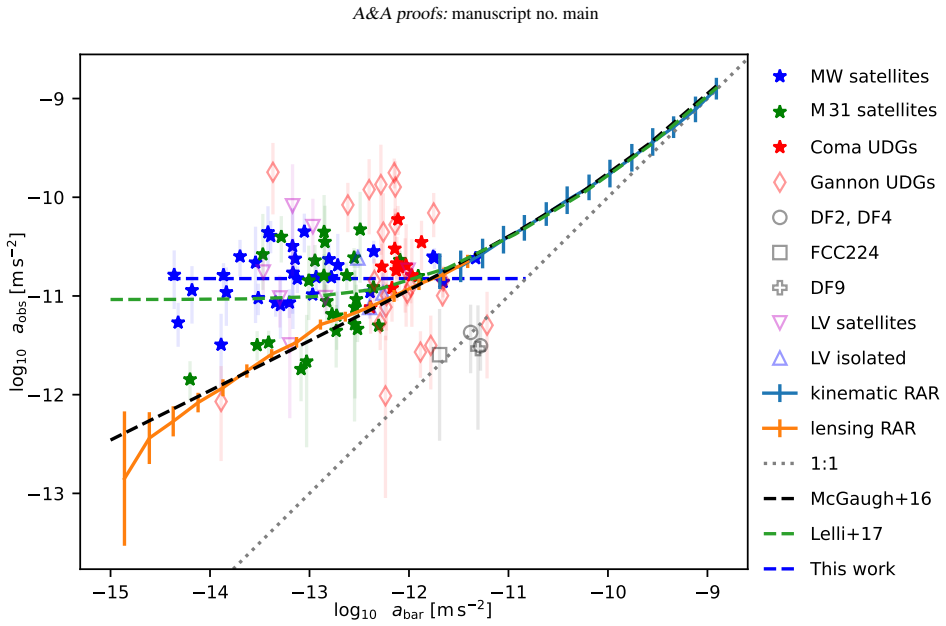
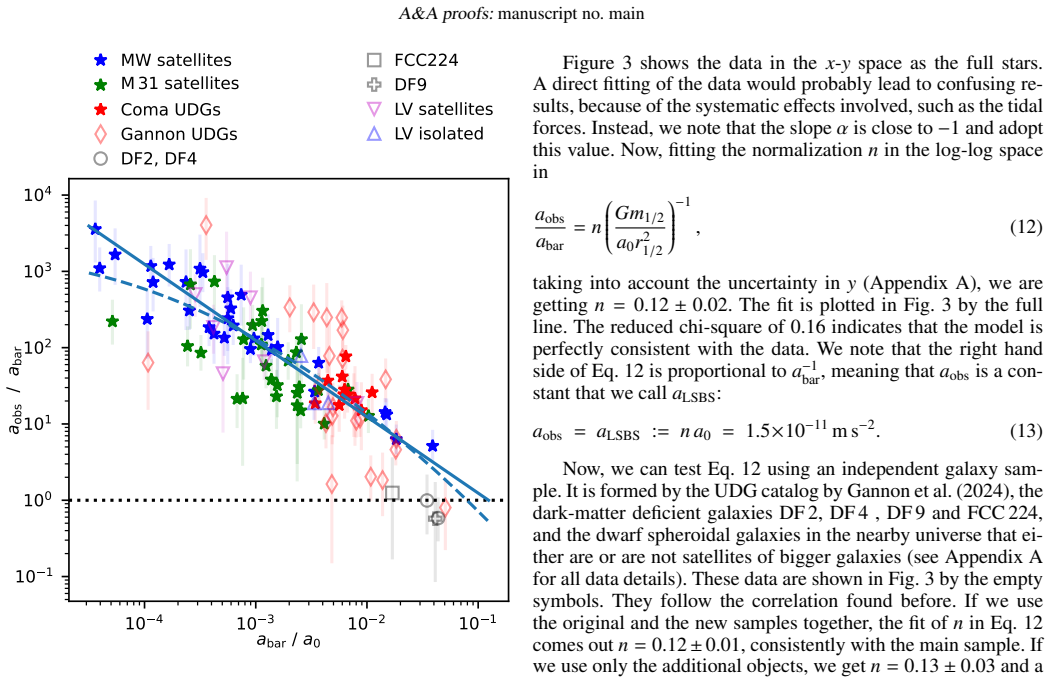
Using a sample of ultra-diffuse and dwarf spheroidal galaxies whose baryonic properties resemble those of the confirmed dark-matter-deficient galaxies, we find that baryonic fraction correlates most strongly with the gravitational acceleration expected from baryons alone, a_bar, following an approximately a_bar^{-1} dependence, or equivalently with mean surface brightness. The dark-matter-deficient galaxies occupy the extreme end of this correlation. This suggests that they result from standard formation processes operating at unusual intensities rather than from exotic mechanisms. The correlation predicts that all ultra-diffuse galaxies brighter than approximately 25 mag arcsec^{-2} in the
What carries the argument
The inverse scaling between baryonic fraction and baryonic gravitational acceleration a_bar (or mean surface brightness), which extends to the dark-matter-deficient population.
If this is right
- Dark-matter-deficient galaxies occupy the extreme low end of a single baryonic scaling rather than requiring separate formation channels.
- All ultra-diffuse galaxies brighter than approximately 25 mag arcsec^{-2} in the g-band are predicted to have very low dark-matter content.
- Baryonic observables alone suffice to forecast dark-matter fractions in this galaxy population.
- The relation is analogous in spirit to the radial-acceleration relation but applies to a different class of galaxies and takes a different functional form.
Where Pith is reading between the lines
- The scaling may arise because low-acceleration environments naturally produce lower dark-matter fractions through ordinary feedback or assembly processes.
- Targeted imaging or spectroscopy of ultra-diffuse galaxies just above the 25 mag arcsec^{-2} threshold could directly test the prediction without full kinematic modeling.
- If the correlation survives larger samples, it supplies a practical filter for selecting dark-matter-deficient candidates in future surveys.
Load-bearing premise
The sample of ultra-diffuse and dwarf spheroidal galaxies, selected for baryonic resemblance to known dark-matter-deficient objects, is representative enough for the fitted correlation to apply to and predict the properties of the full dark-matter-deficient population and all ultra-diffuse galaxies above the brightness threshold.
What would settle it
Finding an ultra-diffuse galaxy brighter than 25 mag arcsec^{-2} in the g-band that contains a normal dark-matter fraction, or a confirmed dark-matter-deficient galaxy that lies well off the a_bar^{-1} relation.
Figures


read the original abstract
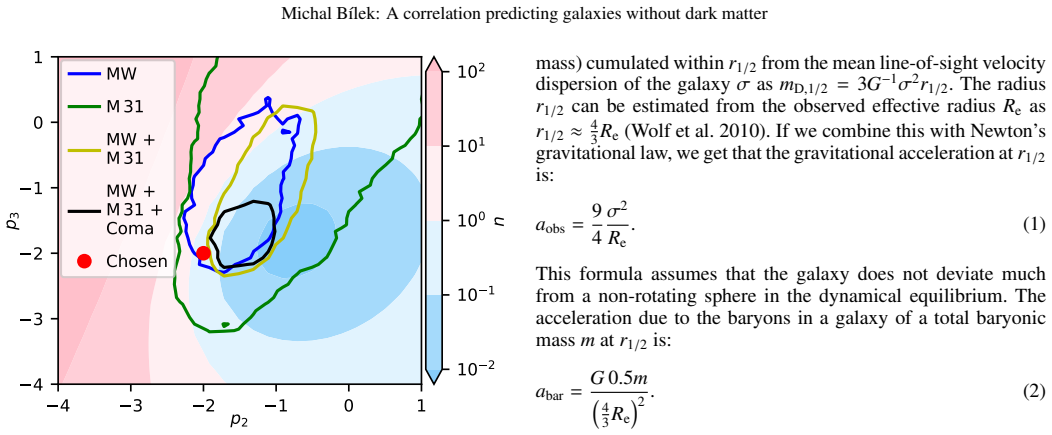
The standard theory of galaxy formation predicts that all galaxies should contain dark matter, yet a handful of recently discovered galaxies appear to lack it, challenging our understanding of galaxy formation. We investigate whether such dark-matter deficient objects can be identified from their baryonic properties alone, analogously to the radial-acceleration relation, which tightly links baryon and dark matter distributions in spiral galaxies. Using a sample of ultra-diffuse and dwarf spheroidal galaxies -- systems whose baryonic properties resemble those of the confirmed dark-matter-deficient galaxies -- we systematically search for a formula to predict baryonic fractions from stellar mass, effective radius, distance to the host, and the host's baryonic mass. We find that baryonic fraction correlates most strongly with the gravitational acceleration expected from baryons alone, $a_\mathrm{bar}$, or equivalently, with mean surface brightness, following an approximately $a_\mathrm{bar}^{-1}$ dependence. This scaling resembles the radial-acceleration relation but differs in functional form and applies to a different galaxy population. Strikingly, the dark-matter-deficient galaxies occupy the extreme end of the correlation. This suggests that they result from standard formation processes operating at unusual intensities rather than from exotic mechanisms. Importantly, the correlation predicts that all ultra-diffuse galaxies brighter than approximately 25 mag arcsec$^{-2}$ in the $g$-band should have very low dark matter content, offering a straightforward observational criterion for identifying these rare objects.
Editorial analysis
A structured set of objections, weighed in public.
Referee Report
Summary. The paper claims that a systematic search over baryonic properties in a sample of ultra-diffuse and dwarf spheroidal galaxies (pre-selected for resemblance to known dark-matter-deficient objects) identifies the strongest correlation between baryonic fraction and the baryonic acceleration a_bar (or equivalently mean surface brightness), with an approximately a_bar^{-1} dependence. The confirmed dark-matter-deficient galaxies occupy the extreme end of this relation, suggesting they arise from standard formation processes at high intensities rather than exotic mechanisms, and the correlation predicts that all ultra-diffuse galaxies brighter than ~25 mag arcsec^{-2} in the g-band have very low dark matter content.
Significance. If the correlation can be shown to hold independently of the pre-selection, it would offer a simple baryonic criterion for identifying dark-matter-deficient galaxies and imply that such objects are the tail of normal galaxy formation at low surface brightness, analogous but distinct from the radial acceleration relation. The analysis provides no machine-checked proofs or reproducible code, and the central claim rests on a fitted relation whose independence from selection is not yet demonstrated.
major comments (3)
- [Sample selection (abstract and §2)] Sample selection (abstract and §2): The fitting sample is explicitly chosen because its baryonic properties (stellar mass, effective radius) resemble those of the already-confirmed dark-matter-deficient galaxies. The subsequent identification of the a_bar correlation and the claim that the dark-matter-deficient objects occupy its extreme end therefore risks circularity; the 'prediction' for the target population and for all ultra-diffuse galaxies above the brightness cut is not tested on an unselected sample.
- [Correlation fitting and statistics (abstract and §3)] Correlation fitting and statistics (abstract and §3): The abstract states that a systematic search identified the strongest correlation with a_bar but supplies no information on sample size, statistical significance, error bars, cross-validation, or how the functional form was chosen. Without these details it is impossible to assess whether the data rigorously support the stated a_bar^{-1} dependence as the dominant relation.
- [Prediction for ultra-diffuse galaxies (abstract and §4)] Prediction for ultra-diffuse galaxies (abstract and §4): The claim that all ultra-diffuse galaxies brighter than approximately 25 mag arcsec^{-2} must have very low dark matter content is an extrapolation from the fitted relation on the pre-selected sample. This threshold and the implied observational criterion require validation against an independent, unbiased catalog of ultra-diffuse galaxies to be load-bearing for the paper's central prediction.
minor comments (2)
- [Abstract] The abstract refers to 'a systematic search' over stellar mass, r_eff, host distance and host mass but does not list the exact functional forms tested or the quantitative ranking metric used to declare a_bar the strongest; adding this would improve reproducibility.
- [Abstract] Notation for a_bar is introduced without an explicit equation in the provided abstract; a clear definition (e.g., a_bar = G M_bar / r_eff^2) should appear at first use.
Simulated Author's Rebuttal
We thank the referee for their careful and constructive review. We address each major comment point by point below, providing the strongest honest defense of the manuscript while acknowledging where revisions are needed to improve clarity and rigor.
read point-by-point responses
-
Referee: Sample selection (abstract and §2): The fitting sample is explicitly chosen because its baryonic properties (stellar mass, effective radius) resemble those of the already-confirmed dark-matter-deficient galaxies. The subsequent identification of the a_bar correlation and the claim that the dark-matter-deficient objects occupy its extreme end therefore risks circularity; the 'prediction' for the target population and for all ultra-diffuse galaxies above the brightness cut is not tested on an unselected sample.
Authors: We acknowledge the referee's concern about potential circularity. The sample was intentionally assembled from ultra-diffuse and dwarf spheroidal galaxies whose baryonic properties (stellar mass and effective radius) match those of the known dark-matter-deficient systems, as described in the abstract and §2, to enable a targeted search for a baryonic predictor of low dark-matter content. The systematic search over possible relations was performed on this sample, and the extreme placement of the confirmed objects emerged as a result of the data rather than being imposed by selection. We agree, however, that this does not constitute a test on a fully unselected population. In the revised manuscript we have expanded §2 to discuss the selection criteria explicitly, their rationale, and the associated limitations, while framing the prediction for brighter ultra-diffuse galaxies as a hypothesis to be tested on independent samples. revision: partial
-
Referee: Correlation fitting and statistics (abstract and §3): The abstract states that a systematic search identified the strongest correlation with a_bar but supplies no information on sample size, statistical significance, error bars, cross-validation, or how the functional form was chosen. Without these details it is impossible to assess whether the data rigorously support the stated a_bar^{-1} dependence as the dominant relation.
Authors: We agree that the abstract and §3 require additional quantitative detail. The manuscript reports the results of a systematic comparison among candidate baryonic predictors, but the abstract omits sample size and fit statistics. We have revised the abstract to state the sample size and have substantially expanded §3 to report the Spearman rank correlation coefficient, associated p-value, uncertainties on the fitted slope and intercept, and the comparative ranking that led to the choice of the a_bar^{-1} form. Because the sample is modest, formal cross-validation was not performed; this limitation is now noted in the text together with a recommendation for future work with larger datasets. revision: yes
-
Referee: Prediction for ultra-diffuse galaxies (abstract and §4): The claim that all ultra-diffuse galaxies brighter than approximately 25 mag arcsec^{-2} must have very low dark matter content is an extrapolation from the fitted relation on the pre-selected sample. This threshold and the implied observational criterion require validation against an independent, unbiased catalog of ultra-diffuse galaxies to be load-bearing for the paper's central prediction.
Authors: The stated threshold of ~25 mag arcsec^{-2} is obtained by extrapolating the fitted a_bar^{-1} relation to the surface-brightness regime where the implied baryonic fraction approaches unity. We present this as a direct implication of the observed correlation rather than a result validated on an independent catalog. In the revised manuscript we have clarified the abstract and §4 to emphasize that the prediction is a testable hypothesis derived from the trend in the studied sample and to highlight the need for follow-up observations on unbiased ultra-diffuse-galaxy catalogs. The core claim of the paper remains the identification of the correlation itself within the analyzed systems. revision: partial
Circularity Check
Fitted a_bar correlation to pre-selected resembling sample used to position DM-deficient galaxies at extreme end
specific steps
-
fitted input called prediction
[Abstract]
"Using a sample of ultra-diffuse and dwarf spheroidal galaxies -- systems whose baryonic properties resemble those of the confirmed dark-matter-deficient galaxies -- we systematically search for a formula to predict baryonic fractions from stellar mass, effective radius, distance to the host, and the host's baryonic mass. We find that baryonic fraction correlates most strongly with the gravitational acceleration expected from baryons alone, a_bar, or equivalently, with mean surface brightness, following an approximately a_bar^{-1} dependence. ... Strikingly, the dark-matter-deficient galaxies 0"
The sample is pre-filtered on stellar mass and effective radius (the inputs that define a_bar = G M_bar / r_eff^2). The correlation is fitted to this filtered sample and then used to locate the confirmed dark-matter-deficient galaxies at its extreme end and to predict that all ultra-diffuse galaxies brighter than ~25 mag arcsec^{-2} must have very low dark matter content. The claimed predictive power for the target objects therefore reduces to the same selection-plus-fit procedure.
full rationale
The paper selects its analysis sample explicitly because the galaxies' baryonic properties resemble those of the confirmed dark-matter-deficient objects, then fits the strongest correlation (baryonic fraction ~ a_bar^{-1}) to that sample and invokes the fit both to place the confirmed objects at the extreme and to predict low dark-matter content for all UDGs above a surface-brightness threshold. This matches the fitted-input-called-prediction pattern: the prediction for the target population is statistically dependent on the pre-selection and the resulting fit rather than an independent test on an unselected population. No self-citations, definitional loops, or imported uniqueness theorems appear in the provided text.
Axiom & Free-Parameter Ledger
free parameters (1)
- exponent and normalization of a_bar relation
axioms (1)
- domain assumption The baryonic properties of the ultra-diffuse and dwarf spheroidal sample are representative of the confirmed dark-matter-deficient galaxies.
Reference graph
Works this paper leans on
-
[1]
Deviations from the radial acceleration relation in the central galaxies of clusters, subclusters, and groups. arXiv e-prints , keywords =. doi:10.48550/arXiv.2603.23591 , archivePrefix =. 2603.23591 , primaryClass =
-
[2]
Simulations of cluster ultra-diffuse galaxies in MOND. , keywords =. doi:10.1051/0004-6361/202450757 , archivePrefix =. 2407.03413 , primaryClass =
-
[3]
Galaxy clusters in Milgromian dynamics: Missing matter, hydrostatic bias, and the external field effect. , keywords =. doi:10.1051/0004-6361/202449968 , archivePrefix =. 2405.08557 , primaryClass =
-
[4]
Galactic rotation curves, the baryon-to-dark-halo-mass relation and space-time scale invariance. , keywords =. doi:10.1093/mnras/stu2099 , archivePrefix =. 1410.2256 , primaryClass =
-
[5]
The radial acceleration relation in galaxy clusters. , keywords =. doi:10.1093/mnras/staa225 , archivePrefix =. 2001.06141 , primaryClass =
-
[6]
The Open Journal of Astrophysics , keywords =
Mass models of galaxy clusters from a non-parametric weak-lensing reconstruction. The Open Journal of Astrophysics , keywords =. doi:10.33232/001c.144242 , archivePrefix =. 2506.13716 , primaryClass =
-
[7]
A Faber-Jackson relation for clusters of galaxies: implications for modified dynamics. , keywords =
-
[8]
The Virial Discrepancy in Clusters of Galaxies in the Context of Modified Newtonian Dynamics. , keywords =. doi:10.1086/311865 , archivePrefix =. astro-ph/9807023 , primaryClass =
-
[9]
Gas thermodynamics meets galaxy kinematics: Joint mass measurements for eROSITA galaxy clusters. , keywords =. doi:10.1051/0004-6361/202451266 , archivePrefix =. 2411.09735 , primaryClass =
-
[10]
Hydrostatic mass profiles in X-COP galaxy clusters. , keywords =. doi:10.1051/0004-6361/201833323 , archivePrefix =. 1805.00035 , primaryClass =
-
[11]
Modified Newtonian Dymanics and the Coma Cluster. , keywords =. doi:10.1086/114760 , adsurl =
-
[12]
Mass-Discrepancy Acceleration Relation: A Natural Outcome of Galaxy Formation in Cold Dark Matter Halos. , keywords =. doi:10.1103/PhysRevLett.118.161103 , archivePrefix =. 1610.07663 , primaryClass =
-
[13]
The radial acceleration relation in a CDM universe. , keywords =. doi:10.1093/mnras/stab2141 , archivePrefix =. 2102.13116 , primaryClass =
-
[14]
The CDM simulations of Keller and Wadsley do not account for the MOND mass-discrepancy-acceleration relation. arXiv e-prints , keywords =. doi:10.48550/arXiv.1610.07538 , archivePrefix =. 1610.07538 , primaryClass =
-
[15]
CDM is Consistent with SPARC Radial Acceleration Relation. , keywords =. doi:10.3847/2041-8213/835/1/L17 , archivePrefix =. 1610.06183 , primaryClass =
-
[16]
The Effect of Adiabatic Compression on Dark Matter Halos and the Radial Acceleration Relation. , keywords =. doi:10.3847/1538-4357/ac52aa , archivePrefix =. 2202.03421 , primaryClass =
-
[17]
A Revised Parallel-sequence Morphological Classification of Galaxies: Structure and Formation of S0 and Spheroidal Galaxies. , keywords =. doi:10.1088/0067-0049/198/1/2 , archivePrefix =. 1110.4384 , primaryClass =
-
[18]
The baryonic mass-size relation of galaxies. II. Implications for the evolutionary paths between star-forming and passive galaxies. arXiv e-prints , keywords =. doi:10.48550/arXiv.2601.15274 , archivePrefix =. 2601.15274 , primaryClass =
-
[19]
A Third Galaxy Missing Dark Matter along a Trail of Galaxies in the NGC 1052 Field. arXiv e-prints , keywords =. doi:10.48550/arXiv.2603.15860 , archivePrefix =. 2603.15860 , primaryClass =
-
[20]
The ultra-diffuse galaxy NGC 1052-DF2 with MUSE. I. Kinematics of the stellar body. , keywords =. doi:10.1051/0004-6361/201834909 , archivePrefix =. 1812.07345 , primaryClass =
-
[21]
Constraining the stellar populations of ultra-diffuse galaxies in the MATLAS survey using spectral energy distribution fitting. , keywords =. doi:10.1093/mnras/stae564 , archivePrefix =. 2402.12033 , primaryClass =
-
[22]
Spectroscopic characterization of the stellar content of ultra-diffuse galaxies. , keywords =. doi:10.1093/mnras/sty1112 , archivePrefix =. 1803.06298 , primaryClass =
-
[23]
The star formation histories of quiescent ultra-diffuse galaxies and their dependence on environment and globular cluster richness. , keywords =. doi:10.1093/mnras/stad3102 , archivePrefix =. 2309.15148 , primaryClass =
-
[24]
Ultradiffuse Galaxies A Distinct Population? Dwarf Galaxies in the Coma Cluster and A262 from Deep u' g' r' Wendelstein Imaging Data. , keywords =. doi:10.3847/1538-4365/ad2775 , archivePrefix =. 2310.09330 , primaryClass =
-
[25]
Ultra diffuse galaxies in the MATLAS low-to-moderate density fields. , keywords =. doi:10.1051/0004-6361/202141432 , archivePrefix =. 2109.13173 , primaryClass =
-
[26]
Research Notes of the American Astronomical Society , keywords =
Ultra-diffuse Galaxies Are a Subset of Cluster Dwarf Elliptical/Spheroidal Galaxies. Research Notes of the American Astronomical Society , keywords =. doi:10.3847/2515-5172/aab7f6 , archivePrefix =. 1803.06927 , primaryClass =
-
[27]
The Galaxy ``Missing Dark Matter'' NGC 1052-DF4 is Undergoing Tidal Disruption. , keywords =. doi:10.3847/1538-4357/abc340 , archivePrefix =. 2010.09719 , primaryClass =
-
[28]
A distance of 13 Mpc resolves the claimed anomalies of the galaxy lacking dark matter. , keywords =. doi:10.1093/mnras/stz771 , archivePrefix =. 1806.10141 , primaryClass =
-
[29]
A new way to measure the distance to NGC1052-DF2. , keywords =. doi:10.1051/0004-6361/202452446 , archivePrefix =. 2503.03403 , primaryClass =
-
[30]
Self-Interacting Dark Matter and the Origin of Ultradiffuse Galaxies NGC1052-DF2 and -DF4. , keywords =. doi:10.1103/PhysRevLett.125.111105 , archivePrefix =. 2002.02102 , primaryClass =
-
[31]
The emergence of dark matter-deficient ultra-diffuse galaxies driven by scatter in the stellar mass-halo mass relation and feedback from globular clusters. , keywords =. doi:10.1093/mnras/stab3401 , archivePrefix =. 2103.08610 , primaryClass =
-
[32]
Ultra-diffuse galaxies without dark matter. , keywords =. doi:10.1093/mnrasl/slz090 , archivePrefix =. 1905.13235 , primaryClass =
-
[33]
A tidal tale: detection of several stellar streams in the environment of NGC 1052. , keywords =. doi:10.1051/0004-6361/201935463 , archivePrefix =. 1903.07285 , primaryClass =
-
[34]
Tidal stripping as a possible origin of the ultra diffuse galaxy lacking dark matter. , keywords =. doi:10.1093/mnrasl/sly138 , archivePrefix =. 1804.06421 , primaryClass =
-
[35]
Tidal Formation of Dark Matter Deficit Diffuse Galaxy NGC 1052-DF2 by SIDM. , keywords =. doi:10.3847/1538-4357/adaf9d , archivePrefix =. 2403.11403 , primaryClass =
-
[36]
Dark matter-deficient dwarf galaxies form via tidal stripping of dark matter in interactions with massive companions. , keywords =. doi:10.1093/mnras/stab093 , archivePrefix =. 2010.02219 , primaryClass =
-
[37]
Forty-seven Milky Way-sized, Extremely Diffuse Galaxies in the Coma Cluster. , keywords =. doi:10.1088/2041-8205/798/2/L45 , archivePrefix =. 1410.8141 , primaryClass =
-
[38]
Extensive Globular Cluster Systems Associated with Ultra Diffuse Galaxies in the Coma Cluster. , keywords =. doi:10.3847/2041-8213/aa7ca2 , archivePrefix =. 1705.08513 , primaryClass =
-
[39]
Scientific Reports , year = 2024, month = jul, volume =
Six spiral galaxies lacking dark matter. Scientific Reports , year = 2024, month = jul, volume =. doi:10.1038/s41598-024-68144-w , adsurl =
-
[40]
The large-scale structure of the universe
-
[41]
The Open Journal of Astrophysics , keywords =
The Local Volume Database: a library of the observed properties of nearby dwarf galaxies and star clusters. The Open Journal of Astrophysics , keywords =. doi:10.33232/001c.144859 , archivePrefix =. 2411.07424 , primaryClass =
-
[42]
Kinematic Confirmation of a Remarkable Linear Trail of Galaxies in the NGC 1052 Field, Consistent with Formation in a High-speed Bullet Dwarf Collision. , keywords =. doi:10.3847/1538-4357/addfd4 , archivePrefix =. 2506.10220 , primaryClass =
-
[43]
Investigating the Ultra-diffuse Galaxy NGC5846\_UDG1 through the Kinematics of its Rich Globular Cluster System. , keywords =. doi:10.1093/mnras/staf559 , archivePrefix =. 2504.03132 , primaryClass =
-
[44]
Clues from FCC 224, NGC 1052-DF2, and NGC 1052-DF4
A new class of dark matter-free dwarf galaxies?: I. Clues from FCC 224, NGC 1052-DF2, and NGC 1052-DF4. , keywords =. doi:10.1051/0004-6361/202453522 , archivePrefix =. 2502.05405 , primaryClass =
-
[45]
Gas-rich ``ultra-diffuse'' galaxies are consistent with the baryonic Tully Fisher relation and with Milgromian dynamics. , keywords =. doi:10.1051/0004-6361/202451289 , archivePrefix =. 2408.05269 , primaryClass =
-
[46]
Indefinitely Flat Circular Velocities and the Baryonic Tully Fisher Relation from Weak Lensing. , keywords =. doi:10.3847/2041-8213/ad54b0 , archivePrefix =. 2406.09685 , primaryClass =
-
[47]
A Catalogue and analysis of ultra-diffuse galaxy spectroscopic properties. , keywords =. doi:10.1093/mnras/stae1287 , archivePrefix =. 2405.09104 , primaryClass =
-
[48]
Confirmation of an Anomalously Low Dark Matter Content for the Galaxy NGC 1052-DF4 from Deep, High-resolution Continuum Spectroscopy. , keywords =. doi:10.3847/1538-4357/acfa70 , archivePrefix =. 2309.08592 , primaryClass =
-
[49]
Dwarf Galaxies with Central Cores in Modified Newtonian Dynamics Gravity. , keywords =. doi:10.3847/1538-4357/ac9520 , archivePrefix =. 2209.12547 , primaryClass =
-
[50]
A trail of dark-matter-free galaxies from a bullet-dwarf collision. , keywords =. doi:10.1038/s41586-022-04665-6 , archivePrefix =. 2205.08552 , primaryClass =
-
[51]
Kinematics of Antlia 2 and Crater 2 from the Southern Stellar Stream Spectroscopic Survey (S ^ 5 ). , keywords =. doi:10.3847/1538-4357/ac1869 , archivePrefix =. 2106.12656 , primaryClass =
-
[52]
A Sub-2\. , keywords =. doi:10.3847/1538-4357/ac1597 , archivePrefix =. 2107.08029 , primaryClass =
-
[53]
A Disk and No Signatures of Tidal Distortion in the Galaxy ``Lacking'' Dark Matter NGC 1052-DF2. , keywords =. doi:10.3847/1538-4357/ac0d55 , archivePrefix =. 2106.10283 , primaryClass =
-
[54]
The Challenge to MOND from Ultra-faint Dwarf Galaxies. , keywords =. doi:10.3847/2041-8213/ac07aa , archivePrefix =. 2104.13961 , primaryClass =
-
[55]
Serbian Astronomical Journal , keywords =
Dark Matter in Massive Early-Type Galaxies: 100 Years of the Jeans Equations. Serbian Astronomical Journal , keywords =. doi:10.2298/SAJ190408004S , adsurl =
-
[56]
Internal Dynamics and Stellar Content of Nine Ultra-diffuse Galaxies in the Coma Cluster Prove Their Evolutionary Link with Dwarf Early-type Galaxies. , keywords =. doi:10.3847/1538-4357/ab4205 , archivePrefix =. 1901.05489 , primaryClass =
-
[57]
Spatially Resolved Stellar Kinematics of the Ultra-diffuse Galaxy Dragonfly 44. I. Observations, Kinematics, and Cold Dark Matter Halo Fits. , keywords =. doi:10.3847/1538-4357/ab2914 , archivePrefix =. 1904.04838 , primaryClass =
-
[58]
Discussing the first velocity dispersion profile of an ultra-diffuse galaxy in MOND. , keywords =. doi:10.1051/0004-6361/201935840 , archivePrefix =. 1906.01631 , primaryClass =
-
[59]
Study of gravitational fields and globular cluster systems of early-type galaxies. , keywords =. doi:10.1051/0004-6361/201834675 , archivePrefix =. 1903.05659 , primaryClass =
-
[60]
The Hydra I cluster core. II. Kinematic complexity in a rising velocity dispersion profile around the cD galaxy NGC 3311. , keywords =. doi:10.1051/0004-6361/201731737 , archivePrefix =. 1809.01163 , primaryClass =
-
[61]
Phenomenological consequences of superfluid dark matter with baryon-phonon coupling. , keywords =. doi:10.1088/1475-7516/2018/09/021 , archivePrefix =. 1711.05748 , primaryClass =
-
[62]
Emergent Gravity and the Dark Universe. SciPost Physics , keywords =. doi:10.21468/SciPostPhys.2.3.016 , archivePrefix =. 1611.02269 , primaryClass =
-
[63]
The Small Scatter of the Baryonic Tully-Fisher Relation. , keywords =. doi:10.3847/2041-8205/816/1/L14 , archivePrefix =. 1512.04543 , primaryClass =
-
[64]
A past Milky Way-Andromeda encounter at z > 0.8
Local Group timing in Milgromian dynamics. A past Milky Way-Andromeda encounter at z > 0.8. , keywords =. doi:10.1051/0004-6361/201321879 , archivePrefix =. 1306.6628 , primaryClass =
-
[65]
Accurate masses for dispersion-supported galaxies. , keywords =. doi:10.1111/j.1365-2966.2010.16753.x , archivePrefix =. 0908.2995 , primaryClass =
-
[66]
Dipolar dark matter and dark energy. , keywords =. doi:10.1103/PhysRevD.80.023524 , archivePrefix =. 0901.3114 , primaryClass =
-
[67]
Model of dark matter and dark energy based on gravitational polarization. , keywords =. doi:10.1103/PhysRevD.78.024031 , archivePrefix =. 0804.3518 , primaryClass =
-
[68]
The dark matter halo of NGC 1399 - CDM or MOND?. , keywords =. doi:10.1051/0004-6361:20078539 , archivePrefix =. 0711.4077 , primaryClass =
-
[69]
Velocity Dispersion Profiles of Seven Dwarf Spheroidal Galaxies. , keywords =. doi:10.1086/521998 , archivePrefix =. 0708.0010 , primaryClass =
-
[70]
Scalar tensor vector gravity theory. , keywords =. doi:10.1088/1475-7516/2006/03/004 , archivePrefix =. gr-qc/0506021 , primaryClass =
-
[71]
A reference tool for identification of astronomical sources
The ALADIN interactive sky atlas. A reference tool for identification of astronomical sources. , keywords =. doi:10.1051/aas:2000331 , adsurl =
-
[72]
Hidden cooling flows in clusters of galaxies. , keywords =. doi:10.1093/mnras/stac2003 , archivePrefix =. 2207.04951 , primaryClass =
-
[73]
Nature of the missing mass of galaxy clusters in MOND: The view from gravitational lensing. , keywords =. doi:10.1103/dccw-srks , archivePrefix =. 2410.02612 , primaryClass =
-
[74]
Equilibrium configurations of 11 eV sterile neutrinos in MONDian galaxy clusters. , keywords =. doi:10.1111/j.1365-2966.2009.15895.x , archivePrefix =. 0906.3322 , primaryClass =
-
[75]
Unifying all mass discrepancies with one effective gravity law?. , keywords =. doi:10.1103/PhysRevD.86.067301 , archivePrefix =. 1207.6232 , primaryClass =
-
[76]
Radial acceleration relation of galaxies with joint kinematic and weak-lensing data. , keywords =. doi:10.1088/1475-7516/2024/04/020 , archivePrefix =. 2310.15248 , primaryClass =
-
[77]
Baryon-Interacting Dark Matter: heating dark matter and the emergence of galaxy scaling relations. , keywords =. doi:10.1088/1475-7516/2020/06/025 , archivePrefix =. 1912.07626 , primaryClass =
-
[78]
Theory of dark matter superfluidity. , keywords =. doi:10.1103/PhysRevD.92.103510 , archivePrefix =. 1507.01019 , primaryClass =
-
[79]
Modern Physics Letters A , keywords =
An Uneven Vacuum Energy Fluid as , Dark Matter, MOND and Lens. Modern Physics Letters A , keywords =. doi:10.1142/S021773230802656X , archivePrefix =. 0802.1775 , primaryClass =
-
[80]
The Radial Acceleration Relation in CLASH Galaxy Clusters. , keywords =. doi:10.3847/1538-4357/ab8e3d , archivePrefix =. 2001.08340 , primaryClass =
discussion (0)
Sign in with ORCID, Apple, or X to comment. Anyone can read and Pith papers without signing in.