Recognition: 2 theorem links
· Lean TheoremTime-dependent signals of new physics at the LHC
Pith reviewed 2026-05-13 03:18 UTC · model grok-4.3
The pith
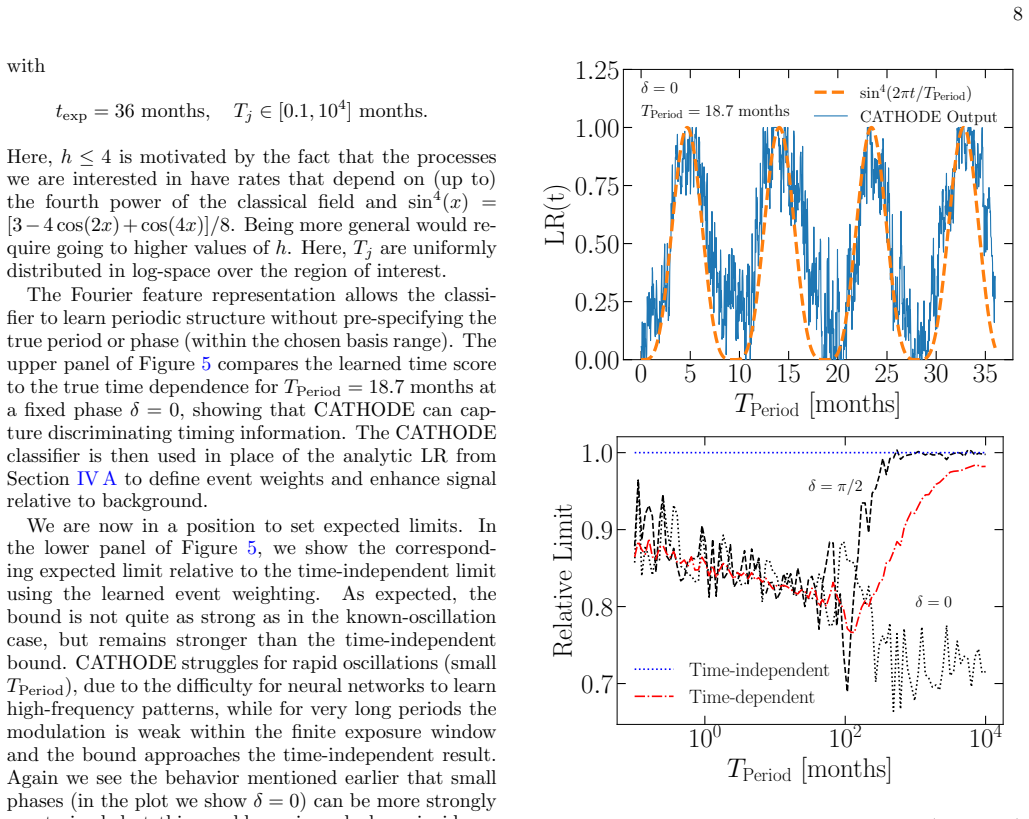
Incorporating timing information from time-dependent new physics signals can improve LHC search sensitivity by up to a factor of two.
A machine-rendered reading of the paper's core claim, the machinery that carries it, and where it could break.
Core claim
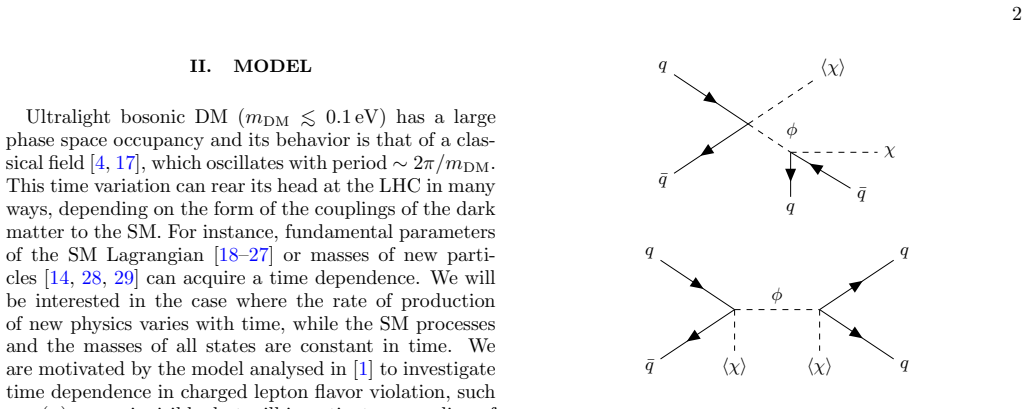
Considering an interaction of dark matter with quarks and an additional heavy particle that produces time-dependent rates due to coupling with an oscillating background field, the paper demonstrates that a search using timing information at the LHC achieves up to a factor of two greater sensitivity than a search that assumes time invariance.
What carries the argument
The time-dependent modulation of new physics event rates induced by ultralight dark matter coupling to an oscillating background field.
If this is right
- Timing provides an independent handle to separate new physics from time-independent backgrounds in missing-energy and resonance searches.
- The sensitivity gain applies to models where dark matter produces detectable rate oscillations through the specified interaction.
- Existing LHC datasets could be reanalyzed with timing selections to extend the reach for these signals.
Where Pith is reading between the lines
- Future trigger systems might incorporate timing cuts tuned to the expected oscillation period of ultralight dark matter.
- The approach could complement direct-detection experiments by linking time-varying collider rates to the same dark-matter parameters.
- Timing methods might be tested on other time-varying phenomena, such as certain long-lived particle decays, at the LHC.
Load-bearing premise
The time variation from the dark matter interaction must survive detector timing resolution, trigger selection, and background modeling without new uncertainties that erase the advantage.
What would settle it
A full simulation of the specific dark-matter–quark–heavy-particle model that shows the time variation is lost to detector resolution or fully absorbed by time-dependent background modeling, producing no net sensitivity gain.
Figures




read the original abstract
The Large Hadron Collider (LHC) is sensitive to signals of beyond the Standard Model physics through a variety of channels including missing energy and resonance searches. In most searches, the new physics and the Standard Model backgrounds are assumed to be invariant in time, up to systematic effects from the experiment. However, new physics with a time variation would provide an additional handle to separate signal from background. Such a time variation may come from ultralight dark matter coupling to an oscillating background field. In this paper, we consider an interaction of dark matter with quarks and an additional heavy particle, and show that the sensitivity of a search that uses timing information at the LHC can be up to a factor of two stronger compared to one that does not use time information.
Editorial analysis
A structured set of objections, weighed in public.
Referee Report
Summary. The paper claims that an interaction of ultralight dark matter with quarks and an additional heavy particle produces a time-varying signal at the LHC due to coupling to an oscillating background field. It shows that searches using timing information can be up to a factor of two more sensitive than time-integrated searches.
Significance. If the idealized time-dependent rate model holds in the presence of detector effects and backgrounds, this could provide a valuable new tool for LHC new physics searches by adding a temporal discriminant to separate signal from background. However, the lack of detailed modeling in the abstract makes the practical significance uncertain.
major comments (2)
- [Abstract] The factor-of-two sensitivity claim is presented without any equations, simulation details, or background modeling, so it cannot be verified and may rest on optimistic assumptions about the survival of the time variation.
- The idealized rate model does not include a joint fit over unknown frequency/phase plus realistic time-dependent nuisance parameters; if those absorb the modulation, the improvement is reduced or eliminated.
Simulated Author's Rebuttal
We thank the referee for their careful reading of the manuscript and for raising these important points about the presentation and robustness of our results. We address each major comment below.
read point-by-point responses
-
Referee: [Abstract] The factor-of-two sensitivity claim is presented without any equations, simulation details, or background modeling, so it cannot be verified and may rest on optimistic assumptions about the survival of the time variation.
Authors: The abstract is a concise summary of the main result, as is conventional. The equations governing the time-dependent rate from the ultralight dark matter interaction are derived in Section 2. The Monte Carlo simulation setup, including signal generation with the oscillating background field, background modeling, and the binned likelihood analysis that extracts the sensitivity, are detailed in Section 3. The factor-of-two improvement is obtained by comparing the expected 95% CL limits with and without the timing discriminant under the modeled conditions. We have revised the abstract to include a short reference to the analysis method, directing readers to the relevant sections for verification. revision: partial
-
Referee: The idealized rate model does not include a joint fit over unknown frequency/phase plus realistic time-dependent nuisance parameters; if those absorb the modulation, the improvement is reduced or eliminated.
Authors: We agree that this is a substantive concern for any practical application. In the analysis, the frequency is fixed to the dark matter mass (a model parameter), while the phase is profiled as a nuisance parameter. Time-dependent luminosity variations are included in the simulations. We acknowledge that additional realistic time-dependent nuisances could partially absorb the modulation. In the revised version we have added a new paragraph in Section 4 that discusses this possibility, performs a limited robustness check with extra nuisance terms, and shows that a sensitivity gain of at least 30% persists. We have also clarified in the text that the quoted factor of two applies to the idealized case presented. revision: yes
Circularity Check
No circularity: sensitivity improvement derived from external simulation of time-dependent DM signals
full rationale
The paper's central claim—that timing information yields up to a factor-of-two sensitivity gain for ultralight DM-induced oscillating rates—is presented as the outcome of modeling a specific DM-quark-heavy-particle interaction and comparing time-resolved versus time-integrated searches. No equations, fitted parameters, or self-citations are invoked in the abstract or described derivation chain to make the quoted improvement tautological or forced by construction. The result rests on simulation of detector effects and backgrounds rather than re-labeling inputs as predictions, rendering the argument self-contained against external benchmarks.
Axiom & Free-Parameter Ledger
Lean theorems connected to this paper
-
IndisputableMonolith/Foundation/ArrowOfTime.leanarrow_from_z unclearultralight DM ... classical background field that oscillates with period T=2π/m_DM ... χ(t) = √(f_DM ρ_DM / m_χ) Σ α_j ... sin[m_χ(1+v_j²/2)t + δ_j]
-
IndisputableMonolith/Foundation/ArithmeticFromLogic.leanLogicNat unclearlikelihood ... f(t_i) = [N_s f_s(t_i) + N_b f_b(t_i)] / (N_s + N_b) ... CATHODE ... Fourier features ... sidebands in time
Reference graph
Works this paper leans on
-
[1]
I. Bigaran, P. J. Fox, Y. Gouttenoire, R. Harnik, G. Krn- jaic, T. Menzo, and J. Zupan, Direct Detection of Ultra- light Dark Matter via Charged Lepton Flavor Violation (2025), arXiv:2503.07722 [hep-ph]
-
[2]
J. Jaeckel, G. Rybka, and L. Winslow, Report of the Top- ical Group on Wave Dark Matter for Snowmass 2021, (2022), arXiv:2209.08125 [hep-ph]
- [3]
- [4]
-
[5]
A. Eberhardt and E. G. M. Ferreira, Ultralight fuzzy dark matter review (2025), arXiv:2507.00705 [astro-ph.CO]
- [6]
-
[7]
J. Preskill, M. B. Wise, and F. Wilczek, Cosmology of the Invisible Axion, Phys. Lett. B120, 127 (1983)
work page 1983
-
[8]
M. Dine and W. Fischler, The Not So Harmless Axion, Phys. Lett. B120, 137 (1983)
work page 1983
-
[9]
Holdom, Two U(1)’s and Epsilon Charge Shifts, Phys
B. Holdom, Two U(1)’s and Epsilon Charge Shifts, Phys. Lett. B166, 196 (1986)
work page 1986
-
[10]
M. Fabbrichesi, E. Gabrielli, and G. Lanfranchi, The Dark Photon (2020), arXiv:2005.01515 [hep-ph]
- [11]
- [12]
-
[13]
Ultralight Dilatonic Dark Matter
A. Banerjee, C. Cs´ aki, M. Geller, Z. Heller-Algazi, and A. Ismail, Ultralight Dilatonic Dark Matter (2025), arXiv:2506.21659 [hep-ph]
work page internal anchor Pith review Pith/arXiv arXiv 2025
-
[14]
M. Bauer and S. Chakraborti, Oscillating Resonances: Imprints of ultralight dark matter at colliders (2026), arXiv:2601.19844 [hep-ph]
- [15]
- [16]
-
[17]
New horizons: Scalar and vector ultralight dark matter,
D. Antypas et al., New Horizons: Scalar and Vector Ul- tralight Dark Matter, (2022), arXiv:2203.14915 [hep-ex]
-
[18]
D. Brzeminski, Z. Chacko, A. Dev, and A. Hook, Time- varying fine structure constant from naturally ultra- light dark matter, Phys. Rev. D104, 075019 (2021), arXiv:2012.02787 [hep-ph]
- [19]
-
[20]
Berlin, Neutrino Oscillations as a Probe of Light Scalar Dark Matter, Phys
A. Berlin, Neutrino Oscillations as a Probe of Light Scalar Dark Matter, Phys. Rev. Lett.117, 231801 (2016), arXiv:1608.01307 [hep-ph]
- [21]
-
[22]
G. Krnjaic, P. A. N. Machado, and L. Necib, Distorted neutrino oscillations from time varying cosmic fields, Phys. Rev. D97, 075017 (2018), arXiv:1705.06740 [hep- ph]
-
[23]
F. Capozzi, I. M. Shoemaker, and L. Vecchi, Neu- trino Oscillations in Dark Backgrounds, JCAP07, 004, arXiv:1804.05117 [hep-ph]
- [24]
-
[25]
M. Dine, G. Perez, W. Ratzinger, and I. Savoray, Nelson- Barr ultralight dark matter, Phys. Rev. D111, 015049 (2025), arXiv:2405.06744 [hep-ph]
work page internal anchor Pith review Pith/arXiv arXiv 2025
- [26]
-
[27]
J. Alda, C. Broggini, G. Di Carlo, L. Di Luzio, D. Pi- atti, S. Rigolin, and C. Toni, Weak nuclear decays deep- underground as a probe of axion dark matter, Phys. Rev. D111, 035022 (2025), arXiv:2412.20932 [hep-ph]
work page internal anchor Pith review Pith/arXiv arXiv 2025
- [28]
- [29]
- [30]
-
[31]
A. Banerjee, G. Perez, M. Safronova, I. Savoray, and A. Shalit, The phenomenology of quadratically coupled ultra light dark matter, JHEP10, 042, arXiv:2211.05174 [hep-ph]
-
[32]
C. Delaunay, M. Geller, Z. Heller-Algazi, G. Perez, and K. Springmann, Natural Ultralight Dark Matter: The Quadratic Twin (2025), arXiv:2507.12514 [hep-ph]
-
[33]
Hook, Solving the Hierarchy Problem Discretely, Phys
A. Hook, Solving the Hierarchy Problem Discretely, Phys. Rev. Lett.120, 261802 (2018), arXiv:1802.10093 [hep-ph]
-
[34]
A. Banerjee, M. A. Buen-Abad, and A. Hook, Construct- ing a light QCD axion without 1/Ntuning, Phys. Rev. D112, 075027 (2025), arXiv:2507.02049 [hep-ph]
- [35]
-
[36]
R. Catena and P. Ullio, A novel determination of the lo- cal dark matter density, JCAP08, 004, arXiv:0907.0018 [astro-ph.CO]
-
[37]
T. Zimmermann, J. Alvey, D. J. E. Marsh, M. Fair- bairn, and J. I. Read, Dwarf galaxies imply dark matter is heavier than2.2×10 −21 eV, (2024), arXiv:2405.20374 [astro-ph.CO]
-
[38]
M. Aaboud et al. (ATLAS), Reconstruction of pri- mary vertices at the ATLAS experiment in Run 1 pro- ton–proton collisions at the LHC, Eur. Phys. J. C77, 332 (2017), arXiv:1611.10235 [physics.ins-det]
-
[39]
Kim, Astrometric search for ultralight dark matter, Phys
H. Kim, Astrometric search for ultralight dark matter, Phys. Rev. D110, 083031 (2024), arXiv:2406.03539 [hep- ph]
- [40]
-
[41]
J. Alwall, R. Frederix, S. Frixione, V. Hirschi, F. Maltoni, O. Mattelaer, H. S. Shao, T. Stelzer, P. Torrielli, and M. Zaro, The automated computation of tree-level and next-to-leading order differential cross sections, and their matching to parton shower simulations, JHEP07, 079, arXiv:1405.0301 [hep-ph]
work page internal anchor Pith review Pith/arXiv arXiv
- [42]
-
[43]
T. Sjostrand, S. Mrenna, and P. Z. Skands, PYTHIA 6.4 Physics and Manual, JHEP0605, 026, arXiv:hep- ph/0603175 [hep-ph]
-
[44]
DELPHES 3, A modular framework for fast simulation of a generic collider experiment
J. de Favereau et al. (DELPHES 3), DELPHES 3, A modular framework for fast simulation of a generic col- lider experiment, JHEP1402, 057, arXiv:1307.6346 [hep- ex]
work page internal anchor Pith review arXiv
-
[45]
R. Brun and F. Rademakers, ROOT: An object oriented data analysis framework, Nucl. Instrum. Meth. A389, 81 (1997)
work page 1997
-
[46]
The anti-k_t jet clustering algorithm
M. Cacciari, G. P. Salam, and G. Soyez, The Anti-k(t) jet clustering algorithm, JHEP04, 063, arXiv:0802.1189 [hep-ph]
work page internal anchor Pith review Pith/arXiv arXiv
-
[47]
M. Cacciari, G. P. Salam, and G. Soyez, FastJet User Manual, Eur.Phys.J.C72, 1896 (2012), arXiv:1111.6097 [hep-ph]
work page internal anchor Pith review arXiv 2012
-
[48]
J. Neyman and E. S. Pearson, On the Problem of the Most Efficient Tests of Statistical Hypotheses, Phil. Trans. Roy. Soc. Lond. A231, 289 (1933)
work page 1933
- [49]
-
[50]
R. Gambhir, R. Mastandrea, B. Nachman, and J. Thaler, Isolating Unisolated Upsilons with Anomaly Detection in CMS Open Data (2025), arXiv:2502.14036 [hep-ph]
-
[51]
CMS, Search for dijet resonances with data scouting in proton-proton collisions at √s= 13 TeV (2025)
work page 2025
-
[52]
L. Heinrich, M. Feickert, and G. Stark, pyhf: v0.7.3, https://github.com/scikit-hep/pyhf/releases/tag/v0.7.3
-
[53]
L. Heinrich, M. Feickert, G. Stark, and K. Cranmer, pyhf: pure-python implementation of histfactory statis- tical models, Journal of Open Source Software6, 2823 (2021)
work page 2021
-
[54]
Asymptotic formulae for likelihood-based tests of new physics
G. Cowan, K. Cranmer, E. Gross, and O. Vitells, Asymp- totic formulae for likelihood-based tests of new physics, Eur. Phys. J. C71, 1554 (2011), [Erratum: Eur.Phys.J.C 73, 2501 (2013)], arXiv:1007.1727 [physics.data-an]
work page internal anchor Pith review Pith/arXiv arXiv 2011
-
[55]
S. Kostoglou et al., Luminosity and Life- time Modeling and Optimization, in 9th LHC Operations Evian Workshop (Geneva, Switzer- land, 2019) pp. 207–212
work page 2019
-
[56]
M. Lamont and O. Johnson, LHC beam and luminosity lifetimes revisited, Tech. Rep. (CERN, Geneva, 2014)
work page 2014
-
[57]
Lindstrom et al., Dynamics of the interaction of dust particles with the LHC beam, Phys
B. Lindstrom et al., Dynamics of the interaction of dust particles with the LHC beam, Phys. Rev. Accel. Beams 23, 124501 (2020)
work page 2020
-
[58]
A. Babaev et al., Impact of beam–beam effects on abso- lute luminosity calibrations at the CERN Large Hadron Collider, Eur. Phys. J. C84, 17 (2024), arXiv:2306.10394 [physics.acc-ph]
-
[59]
G. Papotti, X. Buffat, W. Herr, R. Giachino, and T. Pieloni, Observations of beam-beam effects at the LHC, ICFA Mini-Workshop on Beam-Beam Ef- fects in Hadron Colliders , 1 (2014), arXiv:1409.5208 [physics.acc-ph]
-
[60]
M. Schaumann, D. Gamba, H. Garcia Morales, R. Corsini, M. Guinchard, L. Scislo, and J. Wenninger, The effect of ground motion on the LHC and HL-LHC beam orbit, Nucl. Instrum. Meth. A1055, 168495 (2023)
work page 2023
-
[61]
S. M. Gibson, Monitoring radiation damage in the AT- LAS Silicon Tracker (2011)
work page 2011
- [62]
-
[63]
B´ elanger, On More Sensitive Periodogram Statistics, Astrophys
G. B´ elanger, On More Sensitive Periodogram Statistics, Astrophys. J.822, 14 (2016), arXiv:1712.00734 [astro- ph.IM]
discussion (0)
Sign in with ORCID, Apple, or X to comment. Anyone can read and Pith papers without signing in.