Recognition: 2 theorem links
· Lean TheoremObservational Signatures and Constraints on the Intermediate Neutron-Capture Process. The Case of the CEMP star TYC 6044-714-1 (RAVE J094921.8-161722)
Pith reviewed 2026-05-13 01:02 UTC · model grok-4.3
The pith
Abundances and barium isotopes in the CEMP star TYC 6044-714-1 are best matched by slow plus rapid neutron captures, not the intermediate process.
A machine-rendered reading of the paper's core claim, the machinery that carries it, and where it could break.
Core claim
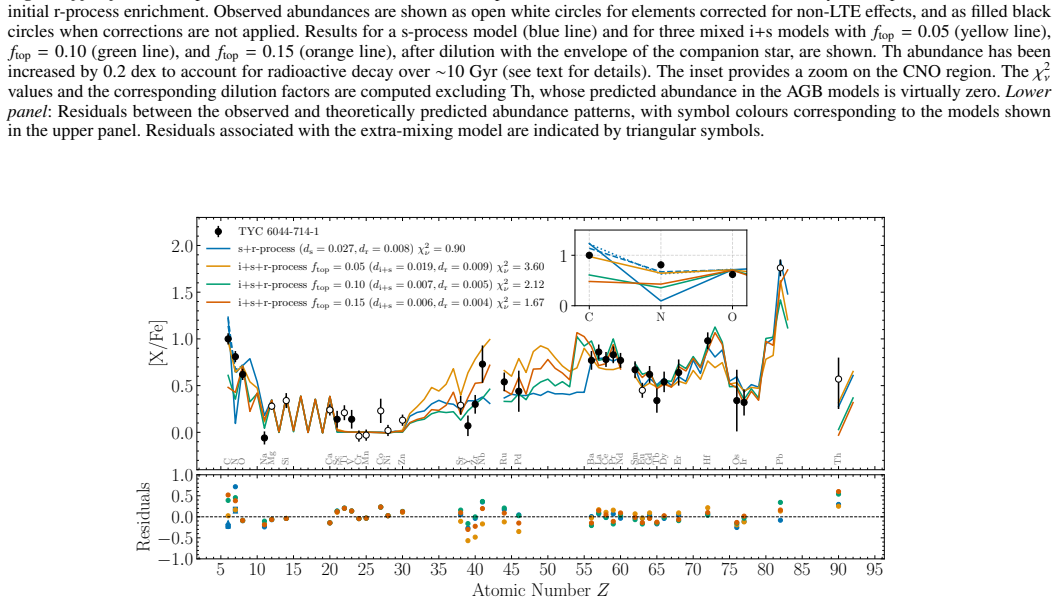
The s+r model provides the best overall reproduction of the observed heavy-element abundance pattern and Ba isotopic ratios, yielding excellent agreement across all three s-process peaks. While i+s+r models with increasing overshooting efficiency improve the fit for specific elements, they do not consistently reproduce the full abundance pattern. The i+s+r models require extreme and physically implausible conditions, and predict s-process Ba fractions inconsistent with those inferred from isotopic ratios of the 4934 Å resonance line.
What carries the argument
Direct comparison of abundances and Ba isotopic ratios measured via 3D non-LTE spectral synthesis against AGB nucleosynthesis models that include varying i-process contributions from overshooting.
If this is right
- The star formed about 13 billion years ago as a normal in-situ halo star pre-enriched by the r-process through standard galactic chemical evolution.
- The i-process is not required to explain the heavy-element pattern of this CEMP-rs star.
- Pure s+r models already achieve excellent agreement across the first, second, and third s-process peaks.
- i-process models that fit some elements fail to match the full pattern and produce inconsistent barium isotope ratios.
Where Pith is reading between the lines
- High-resolution isotopic data may be needed for other CEMP-rs stars to determine how common the pure s+r pathway is versus i-process contributions.
- If the conclusion holds for additional stars, models of early galactic enrichment may not need to invoke widespread i-process events in low-mass AGB stars.
- Future work could test whether modest changes in nuclear reaction rates or convective physics allow i-process models to fit without extreme parameters.
Load-bearing premise
The latest AGB nucleosynthesis models with varying overshooting accurately capture the i-process yields under metal-poor conditions and that the 3D non-LTE spectral synthesis introduces no systematic biases in the derived abundances or isotopic ratios.
What would settle it
A new high-precision measurement or updated model calculation that reproduces the full abundance pattern and Ba isotopic ratios with an i-process component under physically plausible overshooting values would falsify the preference for the pure s+r scenario.
Figures




read the original abstract
Observational abundances of CEMP stars with patterns in between those produced by the rapid and slow nucleosynthesis processes (CEMP-rs stars) are currently invoked as evidence of synthesis via the intermediate process in the early AGB evolutionary phase of metal-poor low mass stars. Nevertheless, discriminating between r+s- and i-process hypotheses requires high-precision abundances obtained through advanced spectral modelling techniques. Theoretical models of the i-process have become more robust, incorporating refined stellar modelling and nuclear reaction physics, providing ranges of probable elemental abundances and isotopic ratios predictions to be confronted with observational determinations. We performed a new analysis of a high resolution and high S/N UVES spectrum of TYC 6044-714-1. We derived accurate effective temperature and highly precise atmospheric parameters, element abundances, and isotopic ratios using state-of-the-art 1D non-LTE and 3D non-LTE spectral line modelling. Using the latest AGB nucleosynthesis models, we assessed the possibility of the i-process to act aside the s-process. We find that TYC~6044-714-1 was likely born as a normal in-situ halo star about 13 Gyr ago, pre-enriched by the r-process through a standard Galactic chemical-evolution pathway. The s+r model provides the best overall reproduction of the observed heavy-element abundance pattern and Ba isotopic ratios, yielding excellent agreement across all three s-process peaks. While i+s+r models with increasing overshooting efficiency improve the fit for specific elements, they do not consistently reproduce the full abundance pattern. The i+s+r models require extreme and physically implausible conditions, and predict s-process Ba fractions inconsistent with those inferred from isotopic ratios of the 4934 \AA\ resonance line. We conclude that the pure s+r scenario is the most plausible explanation.
Editorial analysis
A structured set of objections, weighed in public.
Referee Report
Summary. The paper performs a high-resolution spectroscopic analysis of the CEMP star TYC 6044-714-1 using 1D and 3D non-LTE spectral synthesis on UVES data to derive precise atmospheric parameters, elemental abundances, and Ba isotopic ratios. Comparing these to the latest AGB nucleosynthesis models, it concludes that the observed heavy-element pattern and Ba isotopic ratios are best reproduced by a pure s+r enrichment scenario from standard Galactic chemical evolution, while i+s+r models require extreme overshooting that is physically implausible and fail to match the Ba fractions inferred from the 4934 Å line.
Significance. If the model comparisons hold, the work supplies high-precision observational constraints that challenge the i-process interpretation for at least some CEMP-rs stars and reinforce the viability of combined s- and r-process contributions in metal-poor halo stars. The deployment of state-of-the-art 1D/3D non-LTE modeling and direct confrontation with updated AGB grids constitutes a clear methodological strength that enhances the reliability of the abundance and isotopic determinations.
major comments (3)
- [Abstract] Abstract: The assertion that i+s+r models require 'extreme and physically implausible' overshooting to approach (but not fully match) the observed pattern must be quantified by stating the specific overshooting efficiency values explored, the resulting yields for key elements, and an explicit comparison against the range of overshooting parameters regarded as plausible in the current AGB literature at low metallicity.
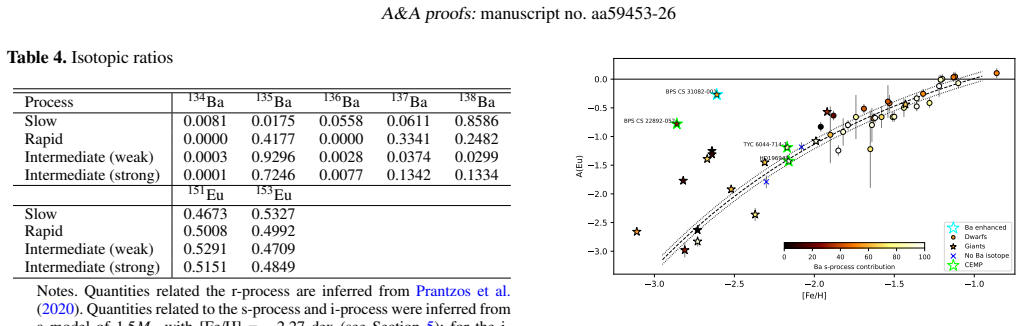
- [Abstract] The Ba isotopic ratio comparison: The claimed inconsistency between i-process predictions and the s-process Ba fraction inferred from the 4934 Å resonance line requires a table or figure showing the model-predicted isotopic fractions (with uncertainties) alongside the observationally derived value and its error budget to allow direct assessment of the discrepancy magnitude.
- [Abstract] Nucleosynthesis model grids: Because i-process yields are known to be sensitive to convective mixing, neutron-source strength, and nuclear rates under metal-poor conditions, the manuscript should demonstrate that the explored i+s+r parameter space is sufficiently broad to exclude viable i-process solutions, for example by referencing the full extent of the model grids or performing a limited sensitivity test.
minor comments (1)
- [Abstract] The abstract states 'excellent agreement across all three s-process peaks' for the s+r model; a supplementary table of observed versus predicted abundances with residuals would improve clarity and allow readers to evaluate the fit quality quantitatively.
Simulated Author's Rebuttal
We thank the referee for the thorough and constructive review. The comments highlight areas where additional quantification and presentation will improve clarity and allow readers to better assess the model comparisons. We have revised the manuscript accordingly, expanding the abstract and main text with the requested details while maintaining the core conclusions supported by the data.
read point-by-point responses
-
Referee: [Abstract] The assertion that i+s+r models require 'extreme and physically implausible' overshooting to approach (but not fully match) the observed pattern must be quantified by stating the specific overshooting efficiency values explored, the resulting yields for key elements, and an explicit comparison against the range of overshooting parameters regarded as plausible in the current AGB literature at low metallicity.
Authors: We agree that explicit quantification strengthens the argument. In the revised manuscript we have added a dedicated paragraph and accompanying table in Section 4.2 that lists the overshooting efficiencies (f_ov = 0.01, 0.02, 0.05, 0.10) explored in the i+s+r grids. For each value we report the predicted yields of Ba, La, Eu, and Pb at the metallicity of TYC 6044-714-1. We compare these directly to the range f_ov ≲ 0.02 that is considered physically plausible in the low-metallicity AGB literature (citing the relevant stellar-evolution studies). The table shows that only models with f_ov ≥ 0.05 begin to approach the observed pattern, but even these fail to reproduce the full set of elements simultaneously. This addition makes the claim of 'extreme and physically implausible' conditions quantitative and traceable. revision: yes
-
Referee: [Abstract] The Ba isotopic ratio comparison: The claimed inconsistency between i-process predictions and the s-process Ba fraction inferred from the 4934 Å resonance line requires a table or figure showing the model-predicted isotopic fractions (with uncertainties) alongside the observationally derived value and its error budget to allow direct assessment of the discrepancy magnitude.
Authors: We have inserted a new table (Table 5) in the revised version that tabulates the predicted fractional abundances of the five stable Ba isotopes from both the s+r and i+s+r model sets, including the 1σ uncertainties propagated from the nucleosynthesis grids. These are placed side-by-side with the observationally derived fractions and their full error budget (statistical plus systematic contributions from the 3D non-LTE synthesis of the 4934 Å line). The table demonstrates that the i+s+r predictions lie outside the observed error envelope for the s-process fraction, while the s+r model falls comfortably inside it. A short accompanying figure (Fig. 8) visualizes the same comparison for quick assessment. revision: yes
-
Referee: [Abstract] Nucleosynthesis model grids: Because i-process yields are known to be sensitive to convective mixing, neutron-source strength, and nuclear rates under metal-poor conditions, the manuscript should demonstrate that the explored i+s+r parameter space is sufficiently broad to exclude viable i-process solutions, for example by referencing the full extent of the model grids or performing a limited sensitivity test.
Authors: The i-process component of the grids already spans neutron densities from 10^12 to 10^15 cm^-3, convective mixing efficiencies from 0.01 to 0.1, and variations in the 13C(α,n)16O and 22Ne(α,n)25Mg rates within their current experimental uncertainties, as documented in the methods section and the cited model papers. To address the referee's request explicitly, we have added a limited sensitivity test in the revised Section 4.3: we re-ran the i+s+r calculations with neutron-source strengths scaled by factors of 2 and 5 while holding other parameters at their best-fit values. Even under these excursions the models still fail to reproduce the observed Ba isotopic ratios and the simultaneous match to the three s-process peaks. We now reference the full extent of the underlying grids and note that further expansion would require new stellar-evolution calculations beyond the scope of the present work. revision: yes
Circularity Check
No significant circularity; central claim is external model comparison
full rationale
The derivation chain consists of (1) deriving atmospheric parameters, abundances, and Ba isotopic ratios from the observed UVES spectrum via 1D/3D non-LTE spectral synthesis, then (2) comparing those quantities to independent grids of AGB nucleosynthesis models (s-process, i-process, and s+r combinations) that were computed prior to this work. No equation or step defines a model parameter from the target star's data and then re-uses it as a 'prediction.' Model grids are external theoretical outputs; the ranking of s+r over i+s+r follows directly from the mismatch between observed pattern/isotopic ratios and the i-process yields under the explored parameter ranges. Self-citations to nucleosynthesis codes exist but are not load-bearing in the sense that the models remain falsifiable against this independent dataset.
Axiom & Free-Parameter Ledger
axioms (2)
- domain assumption 1D and 3D non-LTE radiative transfer accurately captures line formation in the stellar atmosphere for the elements studied
- domain assumption AGB nucleosynthesis models with parameterized overshooting correctly predict i-process yields at low metallicity
Lean theorems connected to this paper
-
IndisputableMonolith/Cost/FunctionalEquation.leanwashburn_uniqueness_aczel unclearWe performed a new analysis... using state-of-the-art 1D non-LTE and 3D non-LTE spectral line modelling. Using the latest AGB nucleosynthesis models... assessed the possibility of the i-process...
-
IndisputableMonolith/Foundation/BranchSelection.leanbranch_selection uncleari+s+r models with increasing overshooting efficiency... require extreme and physically implausible conditions
Reference graph
Works this paper leans on
-
[1]
Carbon-enhanced Metal-poor Star Frequencies in the Galaxy: Corrections for the Effect of Evolutionary Status on Carbon Abundances. , keywords =. doi:10.1088/0004-637X/797/1/21 , archivePrefix =. 1410.2223 , primaryClass =
-
[2]
Silver and palladium help unveil the nature of a second r-process. , keywords =. doi:10.1051/0004-6361/201118643 , archivePrefix =. 1205.4744 , primaryClass =
-
[3]
J., & Gallino, R.\ 2008, , 46, 241
Neutron-capture elements in the early galaxy. , year = 2008, month = sep, volume =. doi:10.1146/annurev.astro.46.060407.145207 , adsurl =
- [4]
-
[5]
The puzzle of the CNO isotope ratios in asymptotic giant branch carbon stars. , keywords =. doi:10.1051/0004-6361/201629969 , archivePrefix =. 1611.06400 , primaryClass =
-
[6]
On the Need for Deep-mixing in Asymptotic Giant Branch Stars of Low Mass. , keywords =. doi:10.1088/2041-8205/717/1/L47 , archivePrefix =. 1005.3549 , primaryClass =
-
[7]
Cool Bottom Processes on the Thermally Pulsing Asymptotic Giant Branch and the Isotopic Composition of Circumstellar Dust Grains. , keywords =. doi:10.1086/344817 , archivePrefix =. astro-ph/0211271 , primaryClass =
-
[8]
Canonical Extra Mixing in Low-Mass Red Giants. , keywords =. doi:10.1086/376410 , adsurl =
-
[9]
Three-Dimensional Nonlocal Thermodynamic Equilibrium Abundance Analyses of Late-Type Stars. , keywords =. doi:10.1146/annurev-astro-052722-103557 , archivePrefix =. 2401.00697 , primaryClass =
-
[10]
European Physical Journal A , keywords =
Synthesis of actinides and short-lived radionuclides during i-process nucleosynthesis in AGB stars. European Physical Journal A , keywords =. doi:10.1140/epja/s10050-025-01522-8 , archivePrefix =. 2504.08058 , primaryClass =
-
[11]
Flash-Driven Convective Mixing in Low-Mass, Metal-deficient Asymptotic Giant Branch Stars: A New Paradigm for Lithium Enrichment and a Possible s-Process. , keywords =. doi:10.1086/380989 , adsurl =
-
[12]
, year = 2024, month = may, volume =
First Study of the ^ 139 Ba (n , ) ^ 140 Ba Reaction to Constrain the Conditions for the Astrophysical i Process. , year = 2024, month = may, volume =. doi:10.1103/PhysRevLett.132.202701 , adsurl =
-
[13]
A holistic approach to carbon-enhanced metal-poor stars. , keywords =. doi:10.1051/0004-6361/200911744 , archivePrefix =. 0901.4737 , primaryClass =
-
[14]
Constraints of the Physics of Low-mass AGB Stars from CH and CEMP Stars. , keywords =. doi:10.3847/1538-4357/833/2/181 , archivePrefix =. 1610.05475 , primaryClass =
-
[15]
Evolution, Nucleosynthesis, and Yields of Low-Mass Asymptotic Giant Branch Stars at Different Metallicities. , keywords =. doi:10.1088/0004-637X/696/1/797 , archivePrefix =. 0902.0243 , primaryClass =
-
[16]
Asymptotic-Giant-Branch Models at Very Low Metallicity. , keywords =. doi:10.1071/AS09003 , archivePrefix =. 0904.4173 , primaryClass =
-
[17]
The Origin of Extremely Metal-poor Carbon Stars and the Search for Population III. , keywords =. doi:10.1086/312453 , adsurl =
-
[18]
Neutron-induced astrophysical reaction rates for translead nuclei. , keywords =. doi:10.1051/0004-6361/200911967 , archivePrefix =. 0911.2181 , primaryClass =
-
[19]
Large-scale evaluation of -decay rates of r -process nuclei with the inclusion of first-forbidden transitions. , keywords =. doi:10.1103/PhysRevC.93.025805 , archivePrefix =. 1507.07442 , primaryClass =
-
[20]
Chinese Physics C , keywords =
The NUBASE2020 evaluation of nuclear physics properties. Chinese Physics C , keywords =. doi:10.1088/1674-1137/abddae , adsurl =
-
[21]
TENDL-astro: A new nuclear data set for astrophysics interest. , keywords =. doi:10.1016/j.nuclphysa.2024.122951 , archivePrefix =. 2510.11262 , primaryClass =
-
[22]
Magnetic-buoyancy-induced Mixing in AGB Stars: Presolar SiC Grains. , keywords =. doi:10.3847/2041-8213/ab9fa1 , archivePrefix =. 2006.13729 , primaryClass =
-
[23]
Mixing and Magnetic Fields in Asymptotic Giant Branch Stars in the Framework of FRUITY Models. Universe , keywords =. doi:10.3390/universe8010016 , adsurl =
-
[24]
Magnetic-buoyancy-induced mixing in AGB stars: Fluorine nucleosynthesis at different metallicities. , keywords =. doi:10.1051/0004-6361/202141173 , archivePrefix =. 2106.08241 , primaryClass =
-
[25]
s process in low-mass asymptotic giant branch stars. , keywords =. doi:10.1016/j.nuclphysa.2005.01.011 , archivePrefix =. astro-ph/0501405 , primaryClass =
-
[26]
Origin of neutron-capture elements with the Gaia-ESO survey: the evolution of s- and r-process elements across the Milky Way. , keywords =. doi:10.1093/mnras/stad1577 , archivePrefix =. 2304.06452 , primaryClass =
-
[27]
The Messenger , year = 2011, month = jun, volume =
Phase 3 -- Handling Data Products from ESO Public Surveys, Large Programmes and Other Contributions. The Messenger , year = 2011, month = jun, volume =
work page 2011
-
[28]
Turbospectrum: Code for spectral synthesis
-
[29]
Improved Laboratory Transition Parameters forEu II and Application to the Solar Europium Elemental and Isotopic Composition. , keywords =. doi:10.1086/323407 , adsurl =
-
[30]
Experimental Astronomy , keywords =
Detecting weak beryllium lines with CUBES. Experimental Astronomy , keywords =. doi:10.1007/s10686-022-09845-w , archivePrefix =. 2203.16158 , primaryClass =
-
[31]
Springer Handbook of Atomic , year = 2006, editor =
Hyperfine Structure. Springer Handbook of Atomic , year = 2006, editor =. doi:10.1007/978-0-387-26308-3_16 , adsurl =
-
[32]
Measurement of stellar age from uranium decay. , keywords =. doi:10.1038/35055507 , archivePrefix =. astro-ph/0104357 , primaryClass =
-
[33]
Non-LTE effects on the lead and thorium abundance determinations for cool stars. , keywords =. doi:10.1051/0004-6361/201218790 , archivePrefix =. 1202.2630 , primaryClass =
-
[34]
First stars. I. The extreme r-element rich, iron-poor halo giant CS 31082-001. Implications for the r-process site(s) and radioactive cosmochronology. , keywords =. doi:10.1051/0004-6361:20020434 , archivePrefix =. astro-ph/0203462 , primaryClass =
-
[35]
Thorium and Uranium Chronometers Applied to CS 31082-001. , keywords =. doi:10.1086/342939 , archivePrefix =. astro-ph/0104335 , primaryClass =
-
[36]
Measurement of europium abundance
Origin of the heavy elements in HD 140283. Measurement of europium abundance. , keywords =. doi:10.1051/0004-6361/201220100 , archivePrefix =. 1211.0693 , primaryClass =
-
[37]
Corrigendum to ``Universal factorization of 3n-j (j>2) symbols...'' [J. Phys. A: Math. Gen. 37 (2004) 3259]. doi:10.48550/arXiv.1102.5125 , archivePrefix =. 1102.5125 , primaryClass =
-
[38]
Discovery of a pair of very metal-poor stars enriched in neutron-capture elements: The proto-disk r-II star BPS CS 29529-0089 and the Gaia-Sausage-Enceladus r-I star TYC 9219-2422-1. , keywords =. doi:10.1051/0004-6361/202453295 , archivePrefix =. 2503.04926 , primaryClass =
-
[39]
Experimental Astronomy , keywords =
Beryllium abundances in turn-off stars of globular clusters with the CUBES spectrograph. Experimental Astronomy , keywords =. doi:10.1007/s10686-022-09850-z , archivePrefix =. 2203.15604 , primaryClass =
-
[40]
A benchmark test using the Hyades
Consistent metallicity scale for cool dwarfs and giants. A benchmark test using the Hyades. , keywords =. doi:10.1051/0004-6361/201526783 , archivePrefix =. 1509.07725 , primaryClass =
-
[41]
The most metal-poor tail of the Galactic halo: Hypothesis for its origin from precise spectral analysis. , keywords =. doi:10.1051/0004-6361/202453470 , archivePrefix =. 2503.19472 , primaryClass =
-
[42]
Synthesis of thorium and uranium in asymptotic giant branch stars. , keywords =. doi:10.1051/0004-6361/202244928 , archivePrefix =. 2211.03824 , primaryClass =
-
[43]
The odd-isotope fractions of barium in CEMP-r/s star HE 0338-3945 and r-II star CS 31082-001. , keywords =. doi:10.1051/0004-6361/201527318 , archivePrefix =. 1606.09318 , primaryClass =
-
[44]
Revisiting classification criteria and formation scenarios, highlighting i-process nucleosynthesis
Spectroscopic study of CEMP-(s & r/s) stars. Revisiting classification criteria and formation scenarios, highlighting i-process nucleosynthesis. , keywords =. doi:10.1051/0004-6361/202038258 , archivePrefix =. 2101.09518 , primaryClass =
-
[45]
A new classification scheme based on Sr and Ba
Abundances and kinematics of carbon-enhanced metal-poor stars in the Galactic halo. A new classification scheme based on Sr and Ba. , keywords =. doi:10.1051/0004-6361/201834601 , archivePrefix =. 1901.05968 , primaryClass =
-
[46]
Low-mass low-metallicity AGB stars as an efficient i-process site explaining CEMP-rs stars. , keywords =. doi:10.1051/0004-6361/202038891 , archivePrefix =. 2010.13620 , primaryClass =
-
[47]
Observational constraints on the origin of the elements. II. 3D non-LTE formation of Ba II lines in the solar atmosphere. , keywords =. doi:10.1051/0004-6361/201936104 , archivePrefix =. 1910.03898 , primaryClass =
-
[48]
Evidence for multiple nucleosynthetic processes from carbon-enhanced metal-poor stars in the Carina dwarf spheroidal galaxy. , keywords =. doi:10.1051/0004-6361/202346168 , archivePrefix =. 2305.02316 , primaryClass =
-
[49]
Barium lines in high-quality spectra of two metal-poor giants in the Galactic halo. , keywords =. doi:10.1051/0004-6361/202141355 , archivePrefix =. 2109.00277 , primaryClass =
-
[50]
HRMOS White Paper: Science Motivation. arXiv e-prints , keywords =. doi:10.48550/arXiv.2312.08270 , archivePrefix =. 2312.08270 , primaryClass =
-
[51]
doi:10.1146/annurev-nucl-101917-021141
From Nuclei to the Cosmos: Tracing Heavy-Element Production with the Oldest Stars. Annual Review of Nuclear and Particle Science , keywords =. doi:10.1146/annurev-nucl-101917-021141 , archivePrefix =. 1806.08955 , primaryClass =
-
[52]
Linfor3D User Manual
-
[53]
The R-Process Alliance: First Release from the Northern Search for r-process-enhanced Metal-poor Stars in the Galactic Halo. , keywords =. doi:10.3847/1538-4357/aae9df , archivePrefix =. 1809.09156 , primaryClass =
-
[54]
, year = 2005, month = sep, volume =
The Discovery and Analysis of Very Metal-Poor Stars in the Galaxy. , year = 2005, month = sep, volume =. doi:10.1146/annurev.astro.42.053102.134057 , adsurl =
-
[55]
The R-Process Alliance: Discovery of the First Metal-poor Star with a Combined r- and s-process Element Signature. , keywords =. doi:10.3847/1538-4357/aacbc3 , archivePrefix =. 1806.00645 , primaryClass =
-
[56]
A wide angle view of the Sagittarius dwarf spheroidal galaxy. II. A CEMP-r/s star in the Sagittarius dwarf spheroidal galaxy. , keywords =. doi:10.1051/0004-6361/202037908 , archivePrefix =. 2005.03027 , primaryClass =
-
[57]
How plausible are the proposed formation scenarios of CEMP-r/s stars?. , keywords =. doi:10.1051/0004-6361/201527864 , archivePrefix =. 1601.00976 , primaryClass =
-
[58]
Barium even-to-odd isotope abundance ratios in thick disk and thin disk stars. , keywords =. doi:10.1051/0004-6361:20054749 , archivePrefix =. astro-ph/0604198 , primaryClass =
-
[59]
Universe , year = 2022, month = nov, volume =
The Barium Odd Isotope Fractions in Seven Ba Stars. Universe , year = 2022, month = nov, volume =. doi:10.3390/universe8110596 , adsurl =
-
[60]
The intermediate neutron capture process. I. Development of the i-process in low-metallicity low-mass AGB stars. , keywords =. doi:10.1051/0004-6361/202040170 , archivePrefix =. 2102.08840 , primaryClass =
-
[61]
The NLTE chemical evolution of strontium in extremely metal-poor stars
LTE or non-LTE, that is the question. The NLTE chemical evolution of strontium in extremely metal-poor stars. , keywords =. doi:10.1051/0004-6361/201220584 , adsurl =
-
[62]
Solar Twins and the Barium Puzzle. , keywords =. doi:10.3847/1538-4357/aa81d6 , archivePrefix =. 1707.07051 , primaryClass =
-
[63]
MELCHIORS: The Mercator Library of High Resolution Stellar Spectroscopy. arXiv e-prints , keywords =. doi:10.48550/arXiv.2311.02705 , archivePrefix =. 2311.02705 , primaryClass =
-
[64]
Microturbulent velocity from stellar spectra: a comparison between different approaches. , keywords =. doi:10.1051/0004-6361/201015814 , archivePrefix =. 1101.3426 , primaryClass =
-
[65]
Impact of granulation effects on the use of Balmer lines as temperature indicators. , keywords =. doi:10.1051/0004-6361/200911997 , archivePrefix =. 0906.4697 , primaryClass =
-
[66]
Gaia FGK Benchmark Stars: fundamental Teff and log g of the third version. arXiv e-prints , keywords =. doi:10.48550/arXiv.2310.11302 , archivePrefix =. 2310.11302 , primaryClass =
-
[67]
Accurate effective temperatures of the metal-poor benchmark stars HD 140283, HD 122563, and HD 103095 from CHARA interferometry. , keywords =. doi:10.1093/mnrasl/sly010 , archivePrefix =. 1801.03274 , primaryClass =
-
[68]
Fundamental stellar parameters of benchmark stars from CHARA interferometry. I. Metal-poor stars. , keywords =. doi:10.1051/0004-6361/202037590 , archivePrefix =. 2006.05411 , primaryClass =
-
[69]
The Stagger-grid: A grid of 3D stellar atmosphere models. I. Methods and general properties. , keywords =. doi:10.1051/0004-6361/201321274 , archivePrefix =. 1302.2621 , primaryClass =
-
[70]
A non-LTE study of neutral and singly-ionized iron line spectra in 1D models of the Sun and selected late-type stars. , keywords =. doi:10.1051/0004-6361/201015336 , archivePrefix =. 1101.4570 , primaryClass =
-
[71]
Effects of line-blocking on the non-LTE Fe I spectral line formation. , keywords =. doi:10.1051/0004-6361:20053363 , archivePrefix =. astro-ph/0507375 , primaryClass =
-
[72]
Non-LTE line formation of Fe in late-type stars - I. Standard stars with 1D and <3D> model atmospheres. , keywords =. doi:10.1111/j.1365-2966.2012.21687.x , archivePrefix =. 1207.2455 , primaryClass =
-
[73]
The Gaia-ESO survey: 3D NLTE abundances in the open cluster NGC 2420 suggest atomic diffusion and turbulent mixing are at the origin of chemical abundance variations. , keywords =. doi:10.1051/0004-6361/202038833 , archivePrefix =. 2007.09153 , primaryClass =
-
[74]
Abundance of lithium in unevolved stars and old disk stars : Interpretation and consequences. , keywords =
-
[75]
Gaia Data Release 3: Summary of the content and survey properties. arXiv e-prints , keywords =. doi:10.48550/arXiv.2208.00211 , archivePrefix =. 2208.00211 , primaryClass =
-
[76]
Implications for Chemical Tagging
18 Sco: A Solar Twin Rich in Refractory and Neutron-capture Elements. Implications for Chemical Tagging. , keywords =. doi:10.1088/0004-637X/791/1/14 , archivePrefix =. 1406.5244 , primaryClass =
-
[77]
Implications of 3D non-LTE spectral line formation
Carbon, oxygen, and iron abundances in disk and halo stars. Implications of 3D non-LTE spectral line formation. , keywords =. doi:10.1051/0004-6361/201936265 , archivePrefix =. 1908.10319 , primaryClass =
-
[78]
, year = 2015, month = may, volume =
A major upgrade of the VALD database. , year = 2015, month = may, volume =. doi:10.1088/0031-8949/90/5/054005 , adsurl =
-
[79]
Revista Mexicana de Astronomia y Astrofisica , year = 1992, month = mar, volume =
Atomic and Molecular Data for Opacity Calculations. Revista Mexicana de Astronomia y Astrofisica , year = 1992, month = mar, volume =
work page 1992
-
[80]
CH in stellar atmospheres: an extensive linelist. , keywords =. doi:10.1051/0004-6361/201423956 , archivePrefix =. 1410.4005 , primaryClass =
discussion (0)
Sign in with ORCID, Apple, or X to comment. Anyone can read and Pith papers without signing in.