Recognition: 2 theorem links
· Lean TheoremTolerating Device Failure in Distributed Quantum Computing
Pith reviewed 2026-05-13 03:08 UTC · model grok-4.3
The pith
Distributed quantum error correction lets modular devices fail or be swapped with little effect on logical errors.
A machine-rendered reading of the paper's core claim, the machinery that carries it, and where it could break.
Core claim
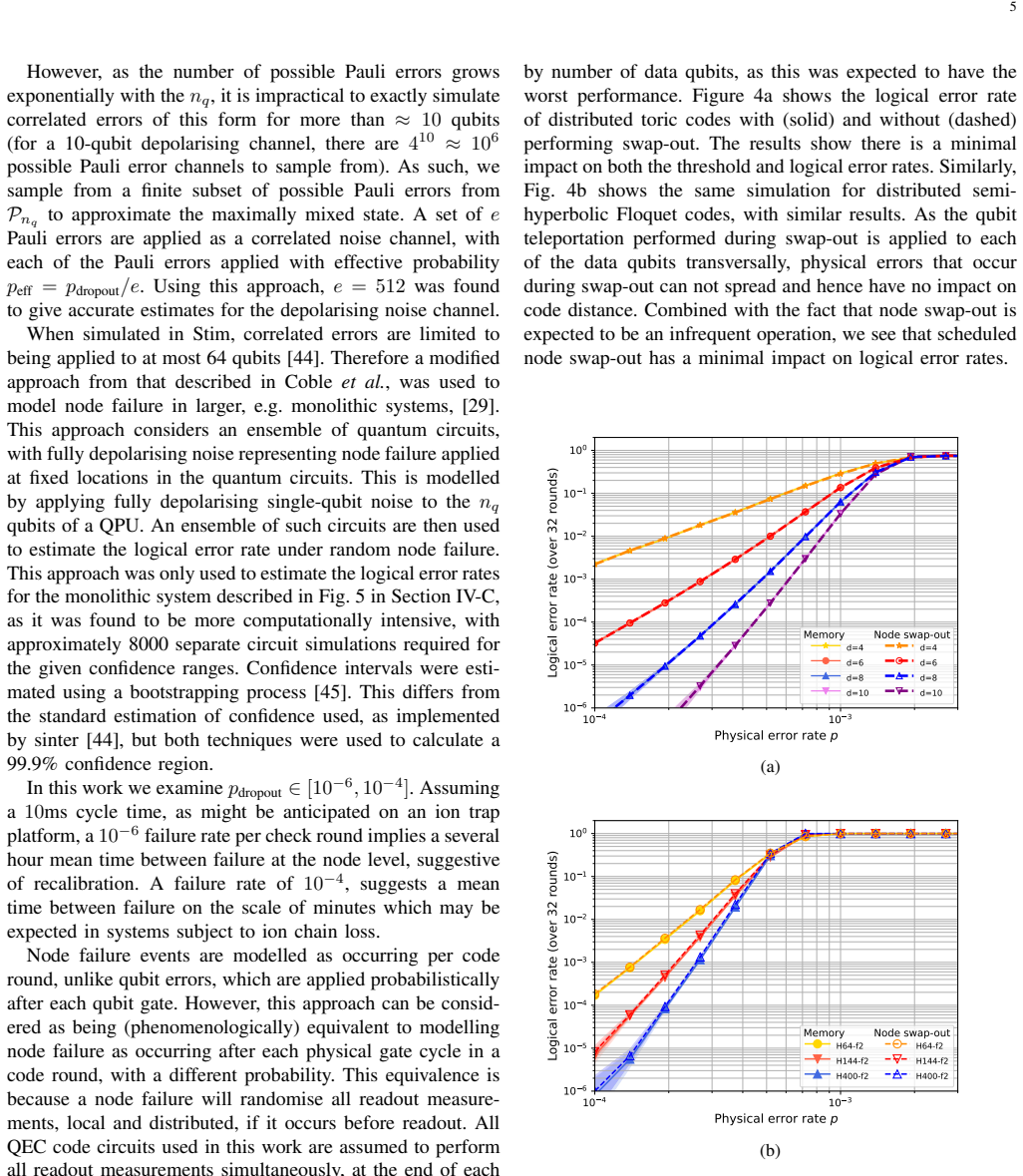
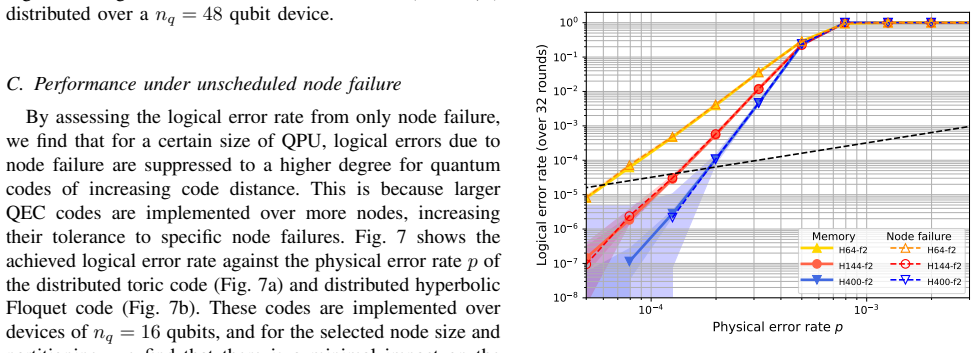
When quantum error correction is performed over a modular quantum network, quantum devices can be swapped out or replaced during operation with minimal impact on logical error rates. The toric and hyperbolic Floquet quantum error correcting codes protect logical information under low rates of modular node failure. For catastrophic node failure of probability p/100, a distributed toric code outperforms one implemented on a monolithic device below a physical error rate of 0.05 percent.
What carries the argument
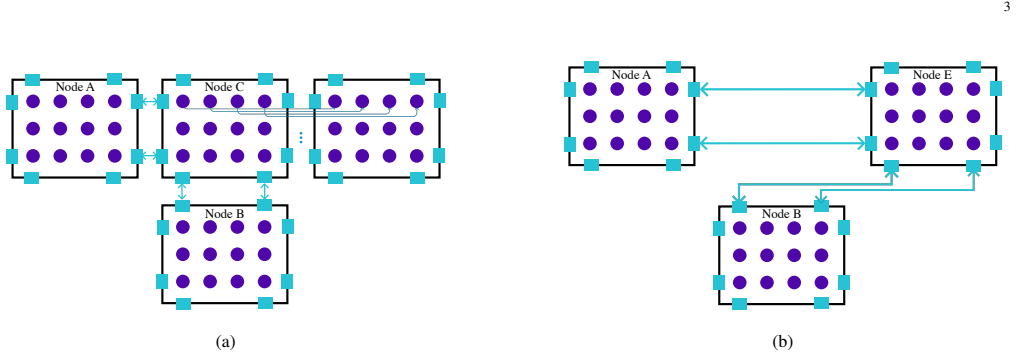
Distributed application of the toric and hyperbolic Floquet codes across a modular quantum network, which spreads logical qubits so that loss of any single node leaves the remaining code space intact.
If this is right
- Individual modules can be removed and replaced mid-computation without a large rise in logical errors.
- Logical error suppression continues when entire nodes fail at low probabilities.
- The distributed toric code crosses below the logical error rate of a monolithic toric code at physical error rates under 0.05 percent for node failure probability p/100.
- Hyperbolic Floquet codes also sustain useful error suppression under the same node-failure regime.
Where Pith is reading between the lines
- Modular architectures could allow incremental hardware upgrades without stopping a running computation.
- Network connectivity requirements become a new design parameter for fault-tolerant quantum hardware.
- The threshold improvement suggests that distributed systems may reach useful scales before monolithic devices do.
- Real-device tests with measured node-failure statistics would be needed to confirm the modeled advantage.
Load-bearing premise
The analysis assumes a particular independent-error model and a specific pattern of catastrophic node failures that may not match all hardware imperfections or network-wide correlations.
What would settle it
Measure the logical error rate of a small toric-code instance implemented on a network of four or more modules while forcing node failures at probability p/100 and compare it directly against the same code size run on a single device at physical error rates near 0.05 percent.
Figures




read the original abstract
It is desirable that a distributed quantum computer can operate despite the replacement or failure of its constituent components, allowing the reliability of the distributed system to exceed that of its subcomponents. We first show that when quantum error correction is performed over a modular quantum network, quantum devices can be swapped out or replaced, during operation, with minimal impact on logical error rates. We also investigate the ability of the toric and hyperbolic Floquet quantum error correcting codes to protect logical information under low rates of modular node failure. In particular, we show that under the proposed distributed quantum error scheme, the selected codes are able to maintain good logical error suppression during the failure of entire nodes. For catastrophic node failure of probability p/100, we suggest that a distributed toric code would outperform one implemented on a monolithic device below a physical error rate of 0.05%.
Editorial analysis
A structured set of objections, weighed in public.
Referee Report
Summary. The paper claims that performing quantum error correction over a modular quantum network allows constituent devices to be swapped or replaced during operation with minimal impact on logical error rates. It investigates the toric and hyperbolic Floquet codes under low rates of modular node failure, showing that these codes maintain good logical error suppression. In particular, for catastrophic node failure of probability p/100, the authors suggest that a distributed toric code would outperform a monolithic implementation below a physical error rate of 0.05%.
Significance. If the simulation results hold under the stated error model, the work is significant for practical distributed quantum computing, as it provides evidence that modular architectures can achieve higher reliability than their subcomponents by tolerating node failures while preserving logical error suppression. The focus on concrete codes (toric and Floquet) and the reported performance crossover are strengths that could guide hardware design, though the result is tied to the specific failure model.
major comments (1)
- [Abstract] Abstract: The central outperformance claim—that a distributed toric code outperforms a monolithic device below 0.05% physical error rate for catastrophic node failure probability p/100—is load-bearing on the details of the node-failure error model and its integration into syndrome extraction for the toric code. The abstract provides no indication that alternative models (e.g., spatially correlated failures across nodes or non-Pauli noise during replacement) were tested; if the chosen model underestimates correlations, the reported crossover threshold would shift and the claim would not hold.
minor comments (1)
- The abstract would benefit from a short parenthetical note on the assumed error model for node failures to allow immediate assessment of the 0.05% threshold.
Simulated Author's Rebuttal
We thank the referee for their careful reading and constructive feedback on our manuscript. We appreciate the recognition of the work's potential relevance to modular quantum architectures. We address the major comment below and will revise the manuscript accordingly.
read point-by-point responses
-
Referee: [Abstract] Abstract: The central outperformance claim—that a distributed toric code outperforms a monolithic device below 0.05% physical error rate for catastrophic node failure probability p/100—is load-bearing on the details of the node-failure error model and its integration into syndrome extraction for the toric code. The abstract provides no indication that alternative models (e.g., spatially correlated failures across nodes or non-Pauli noise during replacement) were tested; if the chosen model underestimates correlations, the reported crossover threshold would shift and the claim would not hold.
Authors: We agree that the abstract should more explicitly reference the node-failure model and that the outperformance claim is tied to its specific assumptions. In the revised manuscript, we will update the abstract to clarify: 'For catastrophic node failure of probability p/100 under an independent failure model, we suggest that a distributed toric code would outperform one implemented on a monolithic device below a physical error rate of 0.05%.' We will also expand the methods and discussion sections to detail how node failures are modeled (as complete erasure of the node's qubits) and integrated into the toric code's syndrome extraction circuits, with no additional noise during replacement. We did not test alternative models such as spatially correlated failures across nodes or non-Pauli noise, as the present work focuses on baseline performance under this standard independent model. We will add an explicit caveat noting that stronger correlations could shift the reported crossover and identify this as an avenue for future study. These changes will temper the claim appropriately while preserving the concrete results under the stated model. revision: yes
Circularity Check
No significant circularity; performance claims rest on independent simulation analysis
full rationale
The paper's central claims—that modular node replacement has minimal impact on logical error rates and that a distributed toric code outperforms a monolithic implementation below 0.05% physical error rate under p/100 node failure—are presented as outcomes of numerical investigations under a proposed distributed QEC scheme. No equations or steps reduce by construction to self-definitions, fitted parameters renamed as predictions, or load-bearing self-citations. The derivation chain relies on external simulation benchmarks and the stated error model rather than internal fitting loops or ansatzes imported from prior author work. This is the expected non-circular outcome for a simulation-driven performance study.
Axiom & Free-Parameter Ledger
free parameters (1)
- node failure probability
axioms (1)
- domain assumption Quantum error correction can be performed across modular network links with standard stabilizer measurements.
Lean theorems connected to this paper
-
IndisputableMonolith/Foundation/RealityFromDistinction.leanreality_from_one_distinction unclear?
unclearRelation between the paper passage and the cited Recognition theorem.
For catastrophic node failure of probability p/100, we suggest that a distributed toric code would outperform one implemented on a monolithic device below a physical error rate of 0.05%.
-
IndisputableMonolith/Cost/FunctionalEquation.leanwashburn_uniqueness_aczel unclear?
unclearRelation between the paper passage and the cited Recognition theorem.
We use a distributed QEC noise model... non-local noise probability p_nl = 10p... node failure modelled as n_q-qubit depolarising channel.
What do these tags mean?
- matches
- The paper's claim is directly supported by a theorem in the formal canon.
- supports
- The theorem supports part of the paper's argument, but the paper may add assumptions or extra steps.
- extends
- The paper goes beyond the formal theorem; the theorem is a base layer rather than the whole result.
- uses
- The paper appears to rely on the theorem as machinery.
- contradicts
- The paper's claim conflicts with a theorem or certificate in the canon.
- unclear
- Pith found a possible connection, but the passage is too broad, indirect, or ambiguous to say the theorem truly supports the claim.
Reference graph
Works this paper leans on
-
[1]
Quantum algorithms: an overview,
A. Montanaro, “Quantum algorithms: an overview,”npj Quantum Information, vol. 2, no. 1, p. 15023, Jan 2016. [Online]. Available: https://doi.org/10.1038/npjqi.2015.23
-
[2]
Algorithms for quantum computation: discrete logarithms and factoring,
P. W. Shor, “Algorithms for quantum computation: discrete logarithms and factoring,” inProceedings 35th Annual Symposium on F oundations of Computer Science, 1994, pp. 124–134
work page 1994
-
[3]
Quantum error correction: an introductory guide,
J. Roffe, “Quantum error correction: an introductory guide,” Contemporary Physics, vol. 60, no. 3, pp. 226–245, 2019. [Online]. Available: https://doi.org/10.1080/00107514.2019.1667078
-
[4]
Surface codes: Towards practical large-scale quantum computation,
A. G. Fowler, M. Mariantoni, J. M. Martinis, and A. N. Cleland, “Surface codes: Towards practical large-scale quantum computation,” Physical Review A—Atomic, Molecular , and Optical Physics, vol. 86, no. 3, p. 032324, 2012
work page 2012
-
[5]
Perspective on the current state-of-the-art of quantum computing for drug discovery applications,
N. S. Bluntet al., “Perspective on the current state-of-the-art of quantum computing for drug discovery applications,”Journal of Chemical Theory and Computation, vol. 18, no. 12, pp. 7001–7023, Dec. 2022, publisher: American Chemical Society. [Online]. Available: https://doi.org/10.1021/acs.jctc.2c00574
-
[6]
How to factor 2048 bit RSA integers with less than a million noisy qubits
C. Gidney, “How to factor 2048 bit rsa integers with less than a million noisy qubits,”arXiv preprint arXiv:2505.15917, 2025
work page internal anchor Pith review arXiv 2048
-
[7]
P. Webster, L. Berent, O. Chandra, E. T. Hockings, N. Baspin, F. Thomsen, S. C. Smith, and L. Z. Cohen, “The pinnacle architecture: Reducing the cost of breaking rsa-2048 to 100 000 physical qubits using quantum ldpc codes,”arXiv preprint arXiv:2602.11457, 2026
work page internal anchor Pith review Pith/arXiv arXiv 2048
-
[8]
Quantum computing with atomic qubits and rydberg interactions: progress and challenges,
M. Saffman, “Quantum computing with atomic qubits and rydberg interactions: progress and challenges,”Journal of Physics B: Atomic, Molecular and Optical Physics, vol. 49, no. 20, p. 202001, 2016. [Online]. Available: https://doi.org/10.1088/0953-4075/49/20/202001
-
[9]
Detecting crosstalk errors in quantum information processors,
M. Sarovar, T. Proctor, K. Rudinger, K. Young, E. Nielsen, and R. Blume-Kohout, “Detecting crosstalk errors in quantum information processors,”Quantum, vol. 4, p. 321, 2020. [Online]. Available: http://arxiv.org/abs/1908.09855
-
[10]
Arquin: Architectures for multinode superconducting quantum computers,
J. Ang, G. Carini, Y . Chen, I. Chuang, M. Demarco, S. Economou, A. Eickbusch, A. Faraon, K.-M. Fu, S. Girvin, M. Hatridge, A. Houck, P. Hilaire, K. Krsulich, A. Li, C. Liu, Y . Liu, M. Martonosi, D. McKay, J. Misewich, M. Ritter, R. Schoelkopf, S. Stein, S. Sussman, H. Tang, W. Tang, T. Tomesh, N. Tubman, C. Wang, N. Wiebe, Y . Yao, D. Yost, and Y . Zhou...
-
[11]
Strong coupling of a single ion to an optical cavity,
H. Takahashi, E. Kassa, C. Christoforou, and M. Keller, “Strong coupling of a single ion to an optical cavity,”Phys. Rev. Lett., vol. 124, p. 013602, Jan 2020. [Online]. Available: https: //link.aps.org/doi/10.1103/PhysRevLett.124.013602
-
[12]
Interface between trapped-ion qubits and traveling photons with close-to-optimal efficiency,
J. Schupp, V . Krcmarsky, V . Krutyanskiy, M. Meraner, T. Northup, and B. Lanyon, “Interface between trapped-ion qubits and traveling photons with close-to-optimal efficiency,”PRX Quantum, vol. 2, p. 020331, Jun 2021. [Online]. Available: https://link.aps.org/doi/10. 1103/PRXQuantum.2.020331
work page 2021
-
[13]
Distributed quantum error correction based on hyperbolic floquet codes,
E. Sutcliffe, B. Jonnadula, C. Le Gall, A. E. Moylett, and C. M. Westoby, “Distributed quantum error correction based on hyperbolic floquet codes,” in2025 IEEE International Conference on Quantum Computing and Engineering (QCE), vol. 1. IEEE, 2025, pp. 649– 657
work page 2025
-
[14]
N. H. Nickerson, Y . Li, and S. C. Benjamin, “Topological quantum computing with a very noisy network and local error rates approaching one percent,”Nature communications, vol. 4, no. 1, p. 1756, 2013
work page 2013
-
[15]
Thresholds for the distributed surface code in the presence of memory decoherence,
S. de Bone, P. M ¨oller, C. E. Bradley, T. H. Taminiau, and D. Elkouss, “Thresholds for the distributed surface code in the presence of memory decoherence,”A VS Quantum Science, vol. 6, no. 3, p. 033801, 07
-
[16]
Available: https://doi.org/10.1116/5.0200190
[Online]. Available: https://doi.org/10.1116/5.0200190
-
[17]
Distributed realization of color codes for quantum error correction,
N. K. Chandra, D. Tipper, R. Nejabati, E. Kaur, and K. P. Seshadreesan, “Distributed realization of color codes for quantum error correction,” in2025 IEEE International Conference on Quantum Computing and Engineering (QCE), vol. 1. IEEE, 2025, pp. 2482–2492
work page 2025
-
[18]
Distributed quantum computing: A survey,
M. Caleffi, M. Amoretti, D. Ferrari, J. Illiano, A. Manzalini, and A. S. Cacciapuoti, “Distributed quantum computing: A survey,” Computer Networks, vol. 254, p. 110672, 2024. [Online]. Available: https://www.sciencedirect.com/science/article/pii/S1389128624005048
work page 2024
-
[19]
Fault- tolerant connection of error-corrected qubits with noisy links,
J. Ramette, J. Sinclair, N. P. Breuckmann, and V . Vuleti ´c, “Fault- tolerant connection of error-corrected qubits with noisy links,”npj Quantum Information, vol. 10, no. 1, p. 58, Jun 2024. [Online]. Available: https://doi.org/10.1038/s41534-024-00855-4
-
[20]
Purification of Noisy Entanglement and Faithful Telepor- tation via Noisy Channels
C. H. Bennett, G. Brassard, S. Popescu, B. Schumacher, J. A. Smolin, and W. K. Wootters, “Purification of noisy entanglement and faithful teleportation via noisy channels,”Physical Review Letters, vol. 76, pp. 722–725, Jan 1996. [Online]. Available: https://link.aps.org/doi/10.1103/PhysRevLett.76.722
-
[21]
Protocols for creating and distilling multipartite GHZ states with bell pairs,
S. de Bone, R. Ouyang, K. Goodenough, and D. Elkouss, “Protocols for creating and distilling multipartite GHZ states with bell pairs,”IEEE Transactions on Quantum Engineering, vol. 1, pp. 1–10, 2020
work page 2020
-
[22]
Modular architectures and entanglement schemes for error- corrected distributed quantum computation,
S. Singh, F. Gu, S. De Bone, E. Villase ˜nor, D. Elkouss, and J. Bor- regaard, “Modular architectures and entanglement schemes for error- corrected distributed quantum computation,”npj Quantum Information, 2025
work page 2025
-
[23]
Fault-tolerant quantum computation,
P. W. Shor, “Fault-tolerant quantum computation,” inProceedings of 37th conference on foundations of computer science. IEEE, 1996, pp. 56–65
work page 1996
-
[24]
Dynamically Generated Logical Qubits,
M. B. Hastings and J. Haah, “Dynamically Generated Logical Qubits,”Quantum, vol. 5, p. 564, Oct. 2021. [Online]. Available: https://doi.org/10.22331/q-2021-10-19-564
-
[25]
Logical gates on floquet codes via folds and twists,
A. E. Moylett and B. Jonnadula, “Logical gates on floquet codes via folds and twists,”arXiv preprint arXiv:2512.17999, 2025
-
[26]
A fault- tolerant honeycomb memory,
C. Gidney, M. Newman, A. Fowler, and M. Broughton, “A fault- tolerant honeycomb memory,”Quantum, vol. 5, p. 605, Dec. 2021. [Online]. Available: https://doi.org/10.22331/q-2021-12-20-605
-
[27]
Boundaries for the Honeycomb Code,
J. Haah and M. B. Hastings, “Boundaries for the Honeycomb Code,”Quantum, vol. 6, p. 693, Apr. 2022. [Online]. Available: https://doi.org/10.22331/q-2022-04-21-693
-
[28]
Constructions and performance of hyperbolic and semi-hyperbolic floquet codes,
O. Higgott and N. P. Breuckmann, “Constructions and performance of hyperbolic and semi-hyperbolic floquet codes,”PRX Quantum, vol. 5, no. 4, p. 040327, 2024
work page 2024
-
[29]
Distributed quantum error correction for chip- level catastrophic errors,
Q. Xu, A. Seif, H. Yan, N. Mannucci, B. O. Sane, R. Van Meter, A. N. Cleland, and L. Jiang, “Distributed quantum error correction for chip- level catastrophic errors,”Physical review letters, vol. 129, no. 24, p. 240502, 2022
work page 2022
-
[30]
Correction of chain losses in trapped ion quantum computers,
N. J. Coble, M. Ye, and N. Delfosse, “Correction of chain losses in trapped ion quantum computers,” 2025. [Online]. Available: https://arxiv.org/abs/2511.16632
-
[31]
Reaching agreement in the presence of faults,
M. Pease, R. Shostak, and L. Lamport, “Reaching agreement in the presence of faults,”Journal of the ACM, vol. 27, no. 2, pp. 228–234, 1980. [Online]. Available: https://dl.acm.org/doi/10.1145/ 322186.322188
-
[32]
DMTCP: Transparent checkpointing for cluster computations and the desktop,
J. Ansel, K. Arya, and G. Cooperman, “DMTCP: Transparent checkpointing for cluster computations and the desktop,” in 2009 IEEE International Symposium on Parallel & Distributed Processing. IEEE, 2009, pp. 1–12. [Online]. Available: http: //ieeexplore.ieee.org/document/5161063/
-
[33]
Making reliable distributed systems in the presence of software errors,
J. Armstrong, “Making reliable distributed systems in the presence of software errors,” Ph.D. dissertation, The Royal Institute of Technology Stockholm, Sweden, 2003. [Online]. Available: https: //erlang.org/download/armstrong thesis 2003.pdf
work page 2003
-
[34]
Detrimen- tal non-markovian errors for surface code memory,
J. F Kam, S. Gicev, K. Modi, A. Southwell, and M. Usman, “Detrimen- tal non-markovian errors for surface code memory,”Quantum Science and Technology, vol. 10, no. 3, p. 035060, 2025
work page 2025
-
[35]
Scaling of silicon spin qubits under correlated noise,
J. S. Rojas-Arias, L. C. Camenzind, Y .-H. Wu, P. Stano, A. Noiri, K. Takeda, T. Nakajima, T. Kobayashi, G. Scappucci, D. Loss, and S. Tarucha, “Scaling of silicon spin qubits under correlated noise,”
-
[36]
Available: https://arxiv.org/abs/2603.03051
[Online]. Available: https://arxiv.org/abs/2603.03051
-
[37]
Optimal calibration of qubit detuning and crosstalk,
D. Shnaiderov, M. B. Dov, Y . Woldiger, A. Hamo, E. Demler, and E. G. D. Torre, “Optimal calibration of qubit detuning and crosstalk,” arXiv preprint arXiv:2507.10661, 2025
-
[38]
IBM Quantum Administration, “About calibration jobs,” accessed on 2026-02-10. [Online]. Available: https://quantum.cloud.ibm.com/docs/ en/guides/calibration-jobs
work page 2026
-
[39]
Teleporting an unknown quantum state via dual classical and einstein-podolsky-rosen channels,
C. H. Bennett, G. Brassard, C. Cr ´epeau, R. Jozsa, A. Peres, and W. K. Wootters, “Teleporting an unknown quantum state via dual classical and einstein-podolsky-rosen channels,”Phys. Rev. Lett., vol. 70, pp. 1895–1899, Mar 1993. [Online]. Available: https://link.aps.org/doi/10.1103/PhysRevLett.70.1895
-
[40]
Fault-tolerant quantum computation by anyons,
A. Kitaev, “Fault-tolerant quantum computation by anyons,”Annals of Physics, vol. 303, no. 1, pp. 2–30, 2003. [Online]. Available: https://www.sciencedirect.com/science/article/pii/S0003491602000180 9
work page 2003
-
[41]
Fault-tolerant hyperbolic floquet quantum error correcting codes,
A. Fahimniya, H. Dehghani, K. Bharti, S. Mathew, A. J. Koll ´ar, A. V . Gorshkov, and M. J. Gullans, “Fault-tolerant hyperbolic floquet quantum error correcting codes,”Quantum, vol. 9, p. 1849, 2025
work page 2025
-
[42]
Spectral partitioning of random graphs,
F. McSherry, “Spectral partitioning of random graphs,” inProceedings 42nd IEEE Symposium on F oundations of Computer Science. IEEE, 2001, pp. 529–537
work page 2001
-
[43]
Pymatching: A python package for decoding quantum codes with minimum-weight perfect matching,
O. Higgott, “Pymatching: A python package for decoding quantum codes with minimum-weight perfect matching,”ACM Transactions on Quantum Computing, vol. 3, no. 3, pp. 1–16, 2022
work page 2022
-
[44]
Quantum data center infrastructures: A scalable architectural design perspective,
H. Shapourian, E. Kaur, T. Sewell, J. Zhao, M. Kilzer, R. Kompella, and R. Nejabati, “Quantum data center infrastructures: A scalable architectural design perspective,”arXiv preprint arXiv:2501.05598, 2025
-
[45]
Distributed quantum-information processing with minimal local resources,
E. T. Campbell, “Distributed quantum-information processing with minimal local resources,”Phys. Rev. A, vol. 76, p. 040302, Oct
-
[46]
[Online]. Available: https://link.aps.org/doi/10.1103/PhysRevA. 76.040302
-
[47]
Stim: a fast stabilizer circuit simulator,
C. Gidney, “Stim: a fast stabilizer circuit simulator,”Quantum, vol. 5, p. 497, Jul. 2021. [Online]. Available: https://doi.org/10.22331/ q-2021-07-06-497
work page 2021
-
[48]
Bootstrap confidence intervals,
T. J. DiCiccio and B. Efron, “Bootstrap confidence intervals,”Statistical science, vol. 11, no. 3, pp. 189–228, 1996
work page 1996
-
[49]
J. Roffe, D. R. White, S. Burton, and E. Campbell, “Decoding across the quantum low-density parity-check code landscape,”Phys. Rev. Res., vol. 2, p. 043423, Dec 2020. [Online]. Available: https://link.aps.org/doi/10.1103/PhysRevResearch.2.043423
-
[50]
Distinguishing types of correlated errors in superconducting qubits,
H. P. Binney, H. D. Pinckney, K. Azar, P. M. Harrington, S. Jha, M. Li, J. Yang, F. Contipelli, R. D. Pi ˜nero, M. Gingraset al., “Distinguishing types of correlated errors in superconducting qubits,”arXiv preprint arXiv:2603.16494, 2026
discussion (0)
Sign in with ORCID, Apple, or X to comment. Anyone can read and Pith papers without signing in.