Recognition: 2 theorem links
· Lean TheoremDistributed estimation of many-body Hamiltonians via punctured surface code
Pith reviewed 2026-05-13 02:57 UTC · model grok-4.3
The pith
Punctured surface codes can map multiple local Z-couplings onto one protected logical operator for distributed estimation of their average.
A machine-rendered reading of the paper's core claim, the machinery that carries it, and where it could break.
Core claim
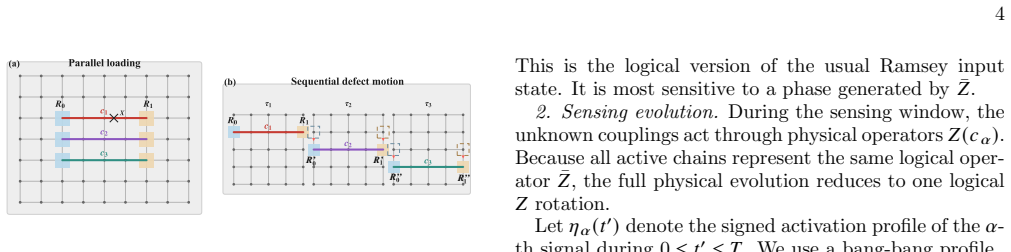
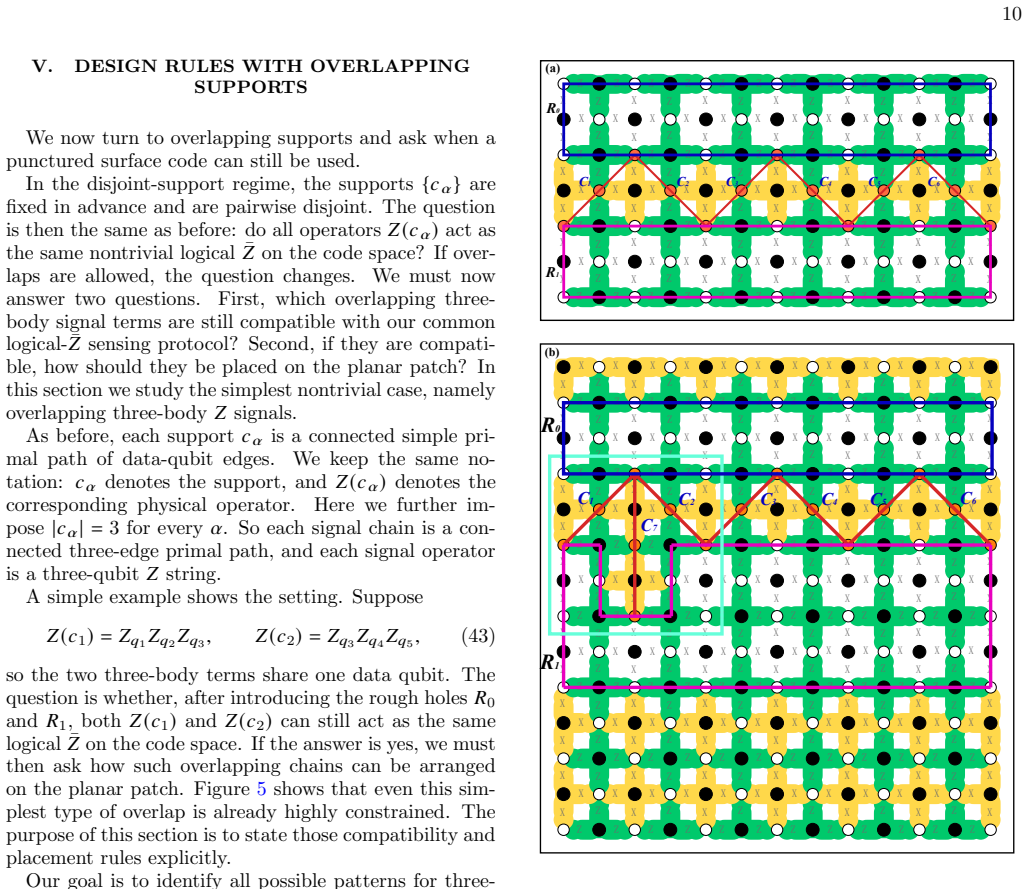
For an ordinary planar patch with two X-cut holes, when the couplings are disjoint, the relevant global condition is equivalent to the existence of a closed dual loop, called a witness, that has an odd number of intersections with every chain. Together with a local clean opening condition, this witness criterion gives a concrete punctured-code construction in which all signal chains implement the same nontrivial logical Z-bar. For three-body interactions with overlapping supports, a class of interactions is identified where the protocol applies.
What carries the argument
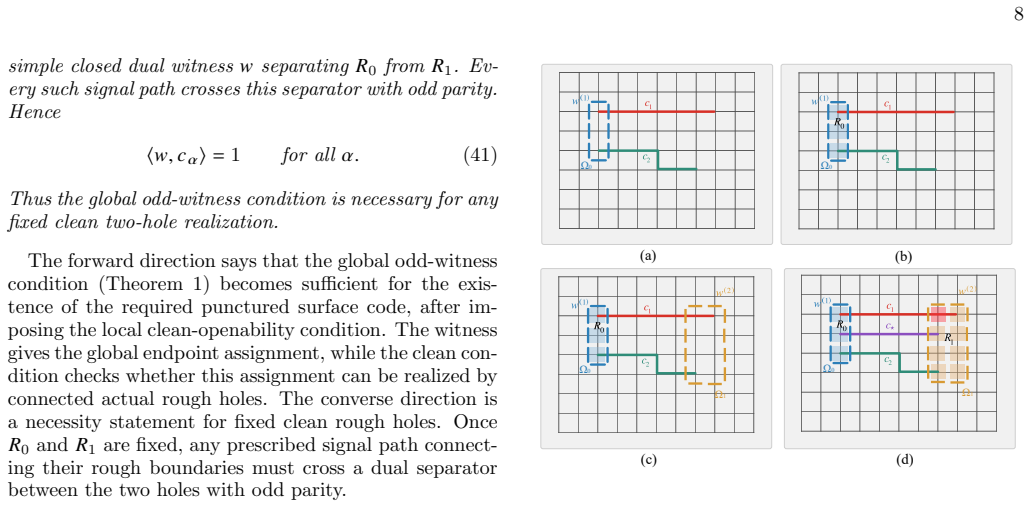
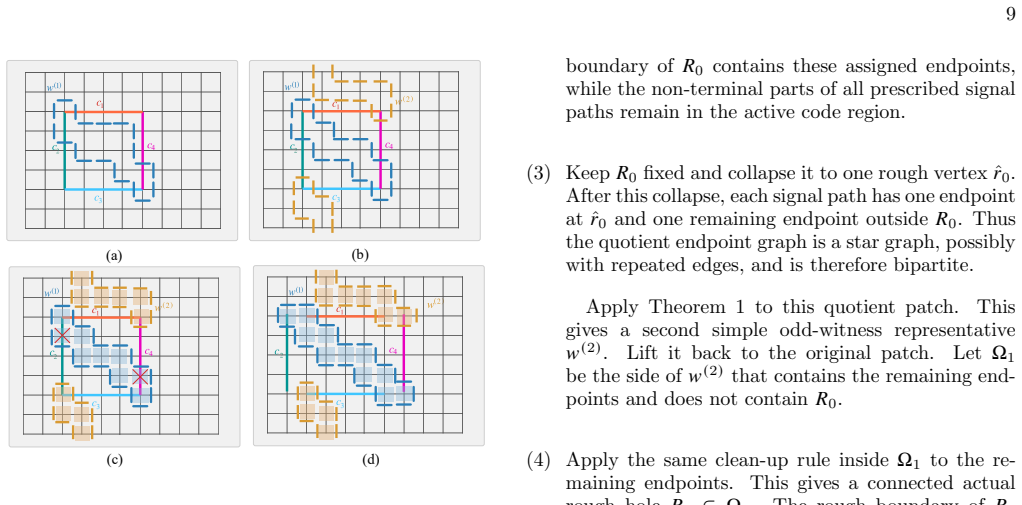
The witness loop: a closed dual loop with odd intersections to every chain, ensuring equivalence to the same logical Z-bar in the punctured surface code on a planar patch with two X-cut holes.
Load-bearing premise
A suitable witness loop exists for the chosen set of couplings that intersects every chain oddly, and the local clean opening condition holds around the punctures in the planar patch.
What would settle it
A set of disjoint Z-couplings where a witness loop with odd intersections exists but the measured logical operator fails to match the expected Z-bar or loses the predicted noise robustness under local errors.
Figures

read the original abstract
We study how a punctured surface code can turn many local $Z$-type couplings into one protected logical signal for distributed quantum metrology, where the goal is to estimate a weighted average of the coupling strengths. We consider an ordinary planar patch with two $X$-cut holes and provide a distributed sensing protocol where all $Z$-type couplings correspond to the same nontrivial logical $\bar{Z}$ for the punctured surface code. When the couplings are disjoint, we show that the relevant global condition is equivalent to the existence of a closed dual loop, called a witness, that has an odd number of intersections with every chain. Together with a local clean opening condition, this witness criterion gives a concrete punctured-code construction in which all signal chains implement the same nontrivial logical $\bar Z$. For three-body interactions with overlapping supports, we also identify the class of interactions where our punctured surface code protocol applies. Overall, our results provide a novel, noise-robust distributed sensing protocol for many-body interactions, with corresponding topological design criteria.
Editorial analysis
A structured set of objections, weighed in public.
Referee Report
Summary. The manuscript proposes using a punctured surface code on a planar patch with two X-cut holes to implement a distributed sensing protocol that maps multiple local Z-type couplings (disjoint or selected overlapping three-body) onto a single protected logical observable for estimating their weighted average. For disjoint couplings the global parity condition on signal chains is shown to be equivalent to the existence of a closed dual witness loop with an odd number of intersections with every chain, together with a local clean-opening condition around the punctures; this guarantees that every coupling implements the same nontrivial logical Z-bar. The construction is extended to a class of three-body interactions with overlapping supports that preserve the same logical equivalence, yielding explicit topological design criteria for noise-robust many-body metrology.
Significance. If the witness equivalence and the three-body extension hold, the work supplies a concrete, homology-based design rule for turning many local interactions into one topologically protected signal. This is a genuine advance for distributed quantum metrology: it replaces ad-hoc coupling choices with falsifiable loop-intersection criteria and supplies a noise-robust protocol whose performance is governed by surface-code distance rather than local error rates. The absence of free parameters in the topological construction and the explicit identification of admissible overlapping interactions are particular strengths.
minor comments (4)
- The local clean-opening condition is invoked repeatedly but never given an explicit mathematical definition or a figure; a short paragraph or diagram showing the required stabilizer pattern around each puncture would remove ambiguity.
- Notation for logical operators is introduced as “nontrivial logical Z-bar” without an early equation defining the homology class or the support of the representative chain; adding Eq. (X) early in §2 would improve readability.
- The extension to three-body terms is stated as “the class of interactions where our punctured surface code protocol applies,” yet no explicit support-overlap condition or small-lattice example is supplied; a single worked example would make the claim immediately verifiable.
- Figure captions and axis labels in the lattice diagrams should explicitly mark the witness loop, the odd-intersection points, and the two X-cuts so that the topological criterion can be read off the figure without returning to the text.
Simulated Author's Rebuttal
We thank the referee for the careful reading of our manuscript and the positive recommendation for minor revision. The referee summary accurately captures our main results on the punctured surface code construction for distributed many-body Hamiltonian estimation, including the witness-loop equivalence for disjoint couplings and the admissible class of overlapping three-body interactions.
Circularity Check
No significant circularity; derivation is self-contained topological equivalence
full rationale
The paper derives an equivalence between a global parity condition on disjoint Z-couplings and the existence of a closed dual witness loop with odd intersections, plus a local clean-opening condition. This is presented as a standard homology argument in the punctured surface-code lattice (planar patch with two X-cuts), not as a self-definition or fitted input renamed as prediction. No equations reduce to their own inputs by construction, no load-bearing self-citations are invoked for uniqueness or ansatz, and the three-body overlap extension is similarly identified by support conditions rather than circular renaming. The central construction therefore remains independent of its own outputs.
Axiom & Free-Parameter Ledger
axioms (2)
- standard math Surface code stabilizers and logical operators are defined on the punctured planar lattice with two X-cut holes.
- domain assumption A closed dual loop (witness) with odd intersections with every chain exists for the chosen coupling set.
Lean theorems connected to this paper
-
IndisputableMonolith/Foundation/AlexanderDuality.leanalexander_duality_circle_linking echoesthe relevant global condition is equivalent to the existence of a closed dual loop, called a witness, that has an odd number of intersections with every chain... ⟨w, cα⟩=1 for all α
-
IndisputableMonolith/Foundation/AlexanderDualityProof.leanlinking_forces_d3_cert echoesB⊤w=0... simple closed dual 1-cochain... endpoint graph Γend is bipartite
Reference graph
Works this paper leans on
-
[1]
Z. Zhang and Q. Zhuang, Distributed quantum sensing, Quantum Sci. Technol.6, 043001 (2021), arXiv:2010.14744 [quant-ph]
-
[2]
Z. Eldredge, M. Foss-Feig, J. A. Gross, S. L. Rolston, and A. V. Gorshkov, Optimal and secure measurement protocols for quantum sensor networks, Phys. Rev. A97, 042337 (2018), arXiv:1607.04646 [quant-ph]
- [3]
- [4]
- [5]
- [6]
-
[7]
W. Ge, K. Jacobs, Z. Eldredge, A. V. Gorshkov, and M. Foss-Feig, Distributed quantum metrology with linear networks and separable inputs, Physical review letters 121, 043604 (2018)
work page 2018
-
[8]
J. Bringewatt, I. Boettcher, P. Niroula, P. Bienias, and A. V. Gorshkov, Protocols for estimating multiple func- tions with quantum sensor networks: Geometry and per- formance, Physical Review Research3, 033011 (2021)
work page 2021
-
[9]
T. Qian, J. Bringewatt, I. Boettcher, P. Bienias, and A. V. Gorshkov, Optimal measurement of field proper- ties with quantum sensor networks, Physical Review A 103, L030601 (2021)
work page 2021
-
[10]
Multiparameter function estimation for general Hamiltonians
E. Abbasgholinejad, S. R. Muleady, J. Bringewatt, L. O. Conlon, and A. V. Gorshkov, Multiparameter function estimation for general hamiltonians (2026), arXiv:2605.04136 [quant-ph]
work page internal anchor Pith review Pith/arXiv arXiv 2026
-
[11]
M. A. Nielsen and I. L. Chuang,Quantum Computation and Quantum Information, 10th ed. (Cambridge Univer- sity Press, Cambridge, 2010)
work page 2010
-
[12]
E. Knill and R. Laflamme, Theory of quantum error- correcting codes, Phys. Rev. A55, 900 (1997)
work page 1997
-
[13]
S. Zhou, M. Zhang, J. Preskill, and L. Jiang, Achiev- ing the heisenberg limit in quantum metrology using quantum error correction, Nature Communications9, 78 (2018)
work page 2018
-
[14]
E. M. Kessler, I. Lovchinsky, A. O. Sushkov, and M. D. Lukin, Quantum error correction for metrology, Phys. Rev. Lett.112, 150802 (2014)
work page 2014
-
[15]
T. Unden, P. Balasubramanian, D. Louzon, Y. Vinkler, M. B. Plenio, M. Markham, D. Twitchen, A. Stacey, I. Lovchinsky, A. O. Sushkov, M. D. Lukin, A. Ret- zker, B. Naydenov, L. P. McGuinness, and F. Jelezko, Quantum metrology enhanced by repetitive quantum er- ror correction, Phys. Rev. Lett.116, 230502 (2016)
work page 2016
-
[16]
S. Zhou and L. Jiang, Asymptotic theory of quantum channel estimation, PRX Quantum2, 010343 (2021)
work page 2021
- [17]
-
[18]
D. Layden and P. Cappellaro, Spatial noise filtering through error correction for quantum sensing, npj Quan- tum Information4, 30 (2018)
work page 2018
-
[19]
H. Chen, Y. Chen, J. Liu, Z. Miao, and H. Yuan, Quantum metrology enhanced by leveraging informative noise with error correction, Phys. Rev. Lett.133, 190801 (2024)
work page 2024
- [20]
-
[21]
Stabilizer Codes and Quantum Error Correction
D. Gottesman, Stabilizer codes and quantum error cor- rection (1997), arXiv:quant-ph/9705052
work page internal anchor Pith review Pith/arXiv arXiv 1997
- [22]
-
[23]
Kitaev, Fault-tolerant quantum computation by anyons, Annals of Physics303, 2 (2003)
A. Kitaev, Fault-tolerant quantum computation by anyons, Annals of Physics303, 2 (2003)
work page 2003
- [24]
-
[25]
A. G. Fowler, M. Mariantoni, J. M. Martinis, and A. N. Cleland, Surface codes: Towards practical large-scale quantum computation, Phys. Rev. A86, 032324 (2012)
work page 2012
-
[26]
R. Raussendorf, J. Harrington, and K. Goyal, A fault- tolerant one-way quantum computer, Annals of Physics 321, 2242 (2006)
work page 2006
-
[27]
D. Horsman, A. G. Fowler, S. Devitt, and R. Van Meter, Surface code quantum computing by lattice surgery, New Journal of Physics14, 123011 (2012). 13
work page 2012
-
[28]
W. Gorecki, S. Zhou, L. Jiang, and R. Demkowicz- Dobrzanski, Optimal probes and error-correction schemes in multi-parameter quantum metrology, Quan- tum4, 288 (2020), arXiv:1901.00896 [quant-ph]. 14 SUP1 LOGICAL INV ARIANCE UNDER ST ABILIZER UPDA TES AND SEQUENTIAL SENSING We work on an𝑛-qubit Hilbert space. The physical space isH= C2 ⊗𝑛 .The𝑛-qubit Pauli...
discussion (0)
Sign in with ORCID, Apple, or X to comment. Anyone can read and Pith papers without signing in.