Recognition: no theorem link
Survey Footprint Explorer: A Browser-Based Interactive Tool for Visualizing and Cross-Matching Astronomical Survey Footprints
Pith reviewed 2026-05-13 00:55 UTC · model grok-4.3
The pith
A browser-based tool performs all survey footprint intersections and catalog cross-matching entirely client-side.
A machine-rendered reading of the paper's core claim, the machinery that carries it, and where it could break.
Core claim
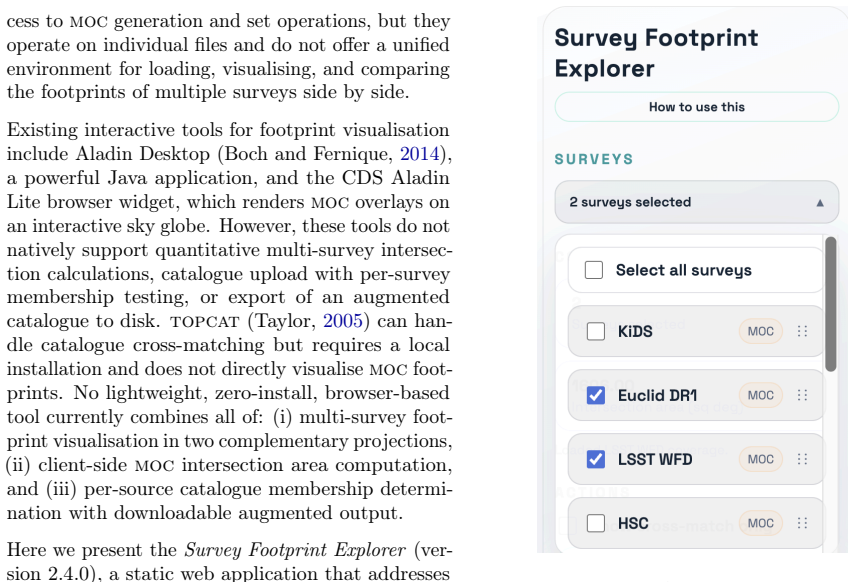
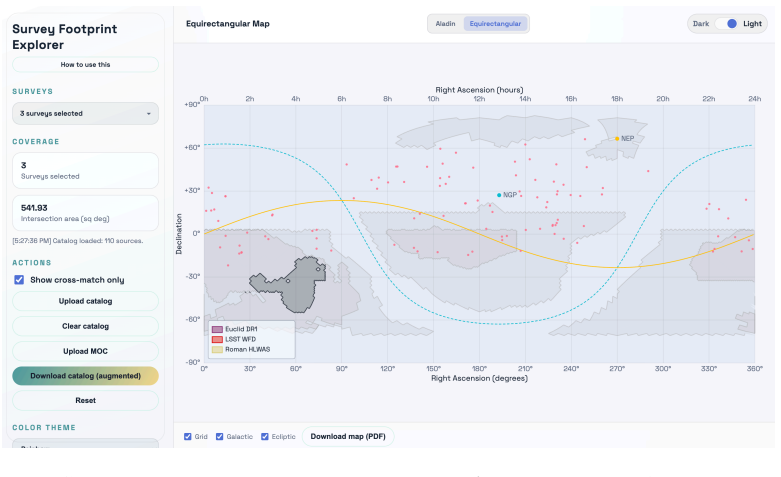
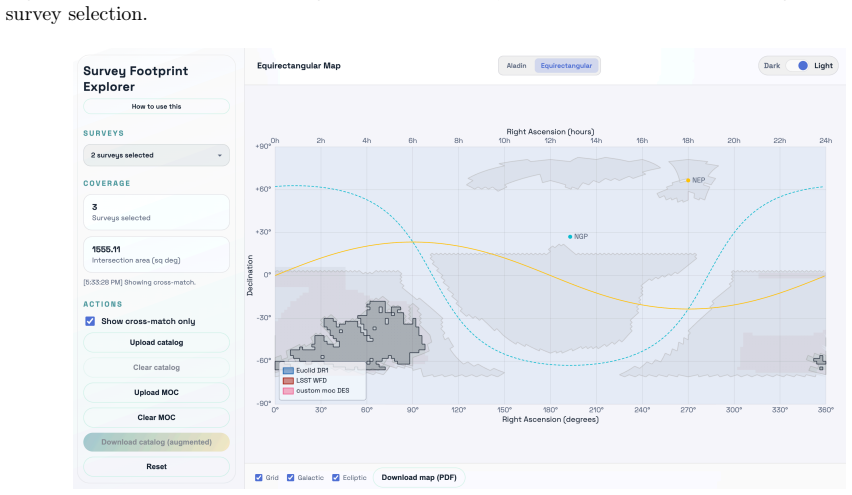
The paper describes the Survey Footprint Explorer v2.5.0, which encodes thirteen survey footprints as MOC maps and renders them via Aladin Lite v2 on an interactive globe and an equirectangular projection, while executing all intersection calculations, overlap area computations, and per-source membership tests entirely in client-side JavaScript.
What carries the argument
Client-side JavaScript implementation of MOC map intersections combined with Aladin Lite v2 for interactive visualization and support for uploading source catalogs to append survey membership flags.
Load-bearing premise
The MOC maps accurately represent the true survey footprints and the JavaScript code handles intersection logic and large catalog processing correctly and efficiently.
What would settle it
Running the tool on a test catalog where the membership of specific sources in a known survey is verified against an independent calculation and finding mismatches in the boolean flags or overlap areas.
Figures

read the original abstract
We present the Survey Footprint Explorer (v2.5.0), a browser-based interactive tool for visualising and comparing the sky footprints of major astronomical imaging surveys. The tool is implemented entirely in client-side JavaScript and requires no server infrastructure, making it immediately accessible from any modern web browser. Thirteen survey footprints are currently included: Euclid DR1, LSST Wide-Fast-Deep, the Nancy Grace Roman HLWAS and HLTDS (full and deep tiers), DESI Legacy Imaging Survey DR9, the Dark Energy Survey (DES), the Subaru Hyper Suprime-Cam survey (HSC), the Kilo-Degree Survey (KiDS), the Ultraviolet Near-Infrared Optical Northern Survey (UNIONS), the eROSITA All-Sky Survey (eRASS1), and the Atacama Cosmology Telescope Legacy (ACT) survey spanning wavelengths from X-ray to near-infrared and covering footprints from 7.7 deg$^{2}$ to 21,524.4 deg$^{2}$. Survey footprints are encoded as Multi-Order Coverage (MOC) maps and rendered via two complementary views: an interactive globe powered by Aladin Lite v2, and a full-sky equirectangular projection. All MOC intersection calculations, including multi-survey overlap area computation and per-source membership testing, are performed client-side. Users may upload source catalogues in CSV or TSV format and download an augmented version with boolean survey membership columns appended. The link to access the tool is provided at the end of the Summary section.
Editorial analysis
A structured set of objections, weighed in public.
Referee Report
Summary. The manuscript presents the Survey Footprint Explorer (v2.5.0), a browser-based interactive tool for visualizing and cross-matching the footprints of 13 major astronomical surveys. Footprints are represented as Multi-Order Coverage (MOC) maps and displayed in both an Aladin Lite-powered interactive globe and a full-sky equirectangular projection. All computations, including overlap areas and catalog membership testing, are performed entirely in client-side JavaScript, with no server required. Users can upload CSV/TSV catalogs and download augmented versions with membership flags.
Significance. If the implementation performs as described, this tool offers practical value to the astronomical community by providing an immediately accessible, server-free platform for exploring survey overlaps and performing basic cross-matches. The fully client-side design using established MOC standards and Aladin Lite v2 is a clear strength, eliminating infrastructure barriers and supporting reproducibility. This could streamline tasks such as survey planning and source selection, provided scalability is demonstrated.
major comments (1)
- Abstract: The central claim that 'All MOC intersection calculations, including multi-survey overlap area computation and per-source membership testing, are performed client-side' is presented without any benchmarks, timing data, memory usage analysis, or tests for realistic catalog sizes (e.g., 10^5–10^6 sources) against the largest MOC (21,524.4 deg²). Browser JS constraints on memory and single-threaded execution make this a load-bearing assumption for the tool's claimed usability; explicit performance evaluation or documented limitations are needed to substantiate the feature.
Simulated Author's Rebuttal
We thank the referee for their constructive review and positive assessment of the Survey Footprint Explorer's practical value to the community. We address the single major comment below and have revised the manuscript accordingly to strengthen the performance claims.
read point-by-point responses
-
Referee: Abstract: The central claim that 'All MOC intersection calculations, including multi-survey overlap area computation and per-source membership testing, are performed client-side' is presented without any benchmarks, timing data, memory usage analysis, or tests for realistic catalog sizes (e.g., 10^5–10^6 sources) against the largest MOC (21,524.4 deg²). Browser JS constraints on memory and single-threaded execution make this a load-bearing assumption for the tool's claimed usability; explicit performance evaluation or documented limitations are needed to substantiate the feature.
Authors: We agree that the absence of explicit performance benchmarks leaves the client-side claim insufficiently substantiated, particularly given known browser constraints on memory and execution. In the revised manuscript we will add a dedicated performance evaluation subsection (placed after the description of the MOC intersection algorithms) that reports wall-clock timing and peak memory usage for catalog sizes from 10^4 to 10^6 sources. Tests will be performed against the largest included MOC (21,524.4 deg²) in representative modern browsers (Chrome, Firefox, Safari) on both desktop and laptop hardware. We will also document any observed limitations (e.g., browser tab memory caps or single-thread slowdowns) and provide guidance on expected run times. These additions directly address the referee's concern and allow readers to assess the tool's usability for realistic workloads. revision: yes
Circularity Check
No circularity: pure software tool description with no derivations
full rationale
The paper describes the implementation and features of a client-side JavaScript web tool for visualizing and cross-matching survey footprints using MOC maps. There are no mathematical derivations, predictions, fitted parameters, uniqueness theorems, or ansatzes presented. Claims about client-side computation are statements of design and implementation, not reductions of outputs to inputs by construction. No self-citations are load-bearing for any central result. The work is self-contained as a tool announcement.
Axiom & Free-Parameter Ledger
Reference graph
Works this paper leans on
-
[1]
Fernique, P. and Allen, M. and Boch, T. and Chaitra and Donaldson, T. and Durand, D. and Genova, F. and Good, J. and Grabowski, M. and Hanisch, R. and Louys, M. and Mann, R. and Ochsenbein, F. and Taylor, M. and Wicenec, A. , title =. , year =. doi:10.1051/0004-6361/201526075 , adsurl =
-
[2]
Fernique, P. and Boch, T. and Donaldson, T. and Durand, D. and Genova, F. and Louys, M. and Taylor, M. and Wicenec, A. , title =. 2022 , url =
work page 2022
-
[3]
G. , year =. doi:10.1086/427976 , adsurl =
work page internal anchor Pith review doi:10.1086/427976
-
[4]
healpy: equal area pixelization and spherical harmonics transforms for data on the sphere in Python
Zonca, A. and Singer, L. P. and Lenz, D. and Reinecke, M. and Rosset, C. and Hivon, E. and G. Journal of Open Source Software , year =. doi:10.21105/joss.01298 , adsurl =
-
[5]
Boch, T. and Donaldson, T. and Durand, D. and Fernique, P. and Pineau, F.-X. , title =. 2023 , url =
work page 2023
-
[6]
Boch, T. and Fernique, P. , title =. Astronomical Data Analysis Software and Systems XXIII , series =. 2014 , pages =
work page 2014
-
[7]
Bostock, M. and Ogievetsky, V. and Heer, J. , title =. IEEE Transactions on Visualization and Computer Graphics , year =
-
[8]
Taylor, M. B. , title =. Astronomical Data Analysis Software and Systems XIV , series =. 2005 , pages =
work page 2005
- [9]
-
[10]
Euclid: I. Overview of the Euclid mission. A&A , keywords =. doi:10.1051/0004-6361/202450810 , archivePrefix =. 2405.13491 , primaryClass =
-
[11]
LSST: from Science Drivers to Reference Design and Anticipated Data Products
Ivezi. , year =. doi:10.3847/1538-4357/ab042c , adsurl =
-
[12]
Akeson, R. and Armus, L. and Bachelet, E. and Bailey, V. and Bartusek, L. and Bellini, A. and others , title =. 2019 , url =
work page 2019
- [13]
-
[14]
Dey, A. and Schlegel, D. J. and Lang, D. and Blum, R. and Burleigh, K. and Fan, X. and others , title =. , year =. doi:10.3847/1538-3881/ab089d , adsurl =
-
[15]
doi:10.1093/mnras/stw641 , adsurl =
, year =. doi:10.1093/mnras/stw641 , adsurl =
-
[16]
Aihara, H. and Arimoto, N. and Armstrong, R. and Arnouts, S. and Bahcall, N. A. and Bickerton, S. and others , title =. PASJ , year =. doi:10.1093/pasj/psx066 , adsurl =
-
[17]
de Jong, J. T. A. and Verdoes Kleijn, G. A. and Kuijken, K. H. and Valentijn, E. A. , title =. Experimental Astronomy , year =. doi:10.1007/s10686-012-9306-1 , adsurl =
-
[18]
2024, A&A, 682, A34, doi: 10.1051/0004-6361/202347165
Merloni, A. and Lamer, G. and Liu, T. and Ramos-Ceja, M. E. and Brunner, H. and Bulbul, E. and others , title =. , year =. doi:10.1051/0004-6361/202347165 , adsurl =
work page internal anchor Pith review doi:10.1051/0004-6361/202347165
-
[19]
UNIONS: The Ultraviolet Near-Infrared Optical Northern Survey. arXiv e-prints , keywords =. doi:10.48550/arXiv.2503.13783 , archivePrefix =. 2503.13783 , primaryClass =
-
[20]
The Open Journal of Astrophysics , keywords =
The Atacama Cosmology Telescope: DR6 Sunyaev-Zel'dovich Selected Galaxy Clusters Catalog. The Open Journal of Astrophysics , keywords =. doi:10.33232/001c.155863 , archivePrefix =. 2507.21459 , primaryClass =
-
[21]
Roman Observations Time Allocation Committee: Final Report and Recommendations. arXiv e-prints , keywords =. doi:10.48550/arXiv.2505.10574 , archivePrefix =. 2505.10574 , primaryClass =
discussion (0)
Sign in with ORCID, Apple, or X to comment. Anyone can read and Pith papers without signing in.