Recognition: 2 theorem links
· Lean TheoremContrasting structural reversibility and magnetic correlations in isostructural honeycomb magnets CrCl₃ and α-RuCl₃
Pith reviewed 2026-05-13 00:44 UTC · model grok-4.3
The pith
CrCl3 remains structurally reversible across its layer transition while α-RuCl3 degrades, due to differences in electronic configuration despite identical honeycomb structures.
A machine-rendered reading of the paper's core claim, the machinery that carries it, and where it could break.
Core claim
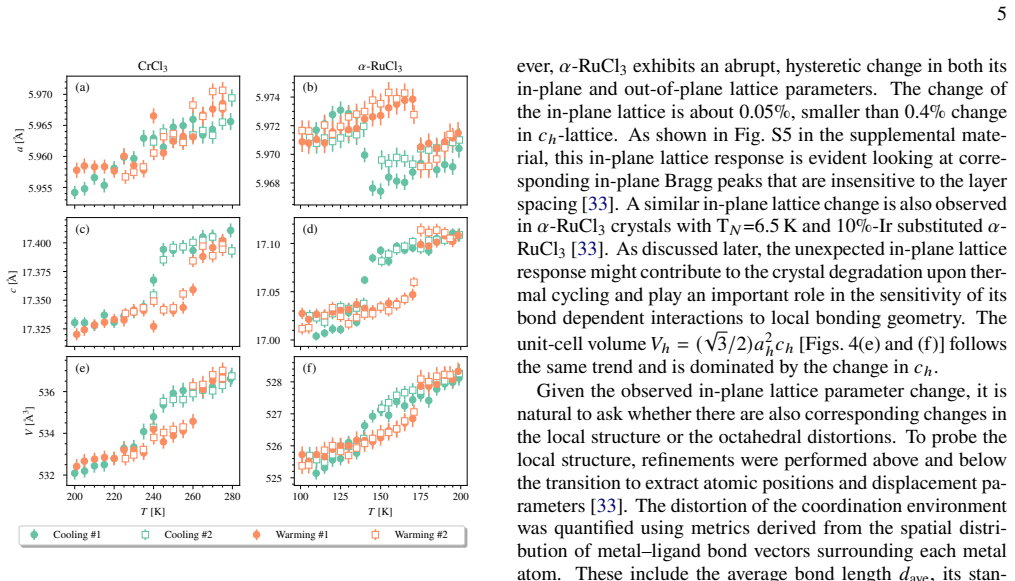
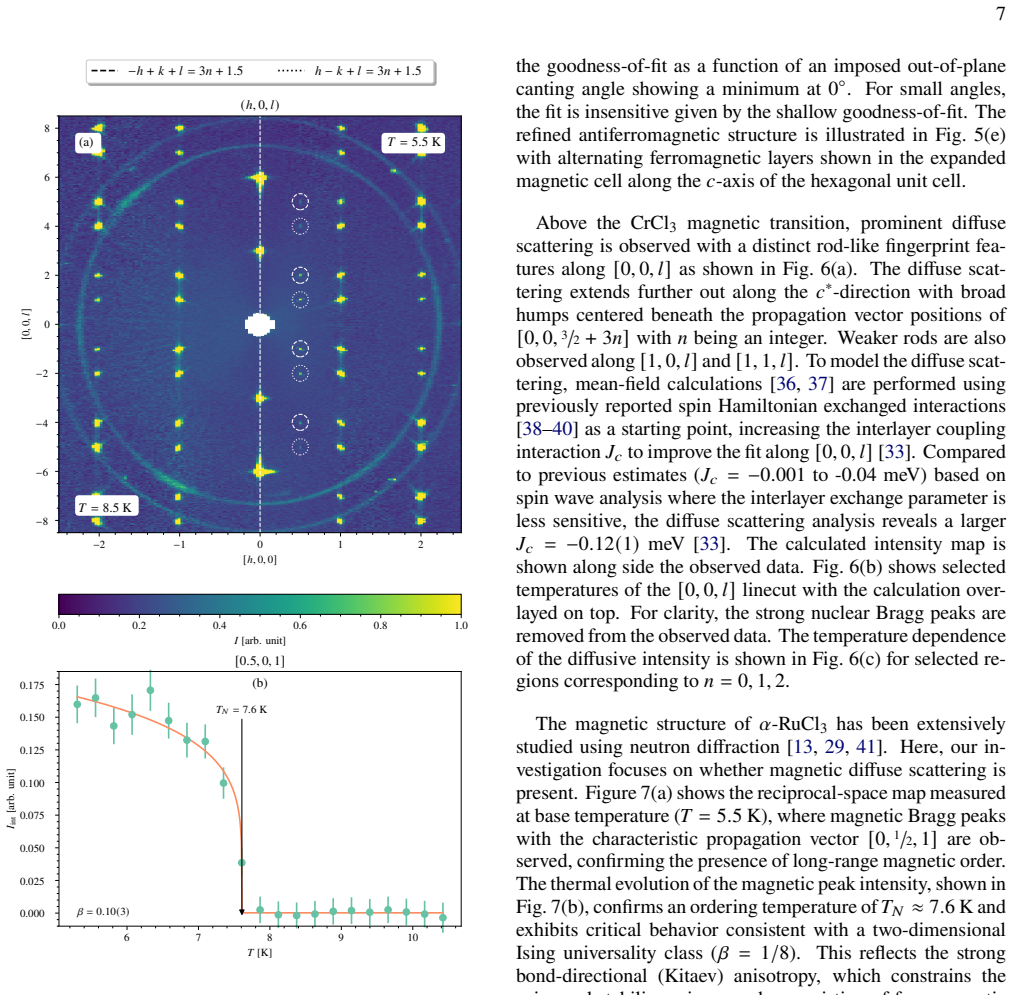
Both compounds undergo the same first-order structural transition involving stacking rearrangement, yet their in-plane lattice responses diverge: α-RuCl3 exhibits abrupt, hysteretic in-plane contraction and irreversible degradation upon cycling, while CrCl3 shows continuous, reversible evolution. Magnetically, CrCl3 orders antiferromagnetically at 14 K with pronounced diffuse scattering extending to 40 K, indicating persistent correlations, whereas α-RuCl3 orders at 7.6 K without observable diffuse scattering above TN. The contrasting behaviors are attributed to differences in interlayer sliding energetics governed by the electronic configurations of the transition-metal ions.
What carries the argument
Interlayer sliding energetics modulated by the distinct electronic configurations of Cr3+ (3d3) and Ru3+ (4d5) ions.
If this is right
- α-RuCl3 develops irreversible crystalline degradation upon thermal cycling through the structural transition.
- CrCl3 maintains structural robustness with smooth in-plane lattice evolution across the same transition.
- Diffuse magnetic scattering appears above TN in CrCl3 but is absent above TN in α-RuCl3.
- Both materials order antiferromagnetically but with different structures and transition temperatures linked to their electronic configurations.
Where Pith is reading between the lines
- The electronic-configuration dependence suggests that ion substitution or alloying could be used to tune structural reversibility in related honeycomb halides.
- Stronger or more localized magnetic correlations in CrCl3 may arise from weaker interlayer coupling compared with α-RuCl3.
- If sliding energetics control degradation, pressure or strain could be applied to switch the reversible/irreversible character in either compound.
Load-bearing premise
The observed differences in in-plane lattice response and diffuse magnetic scattering are driven primarily by electronic configuration rather than by defects, stacking-fault details, or sample-to-sample variations.
What would settle it
Measuring the same structural and diffuse-scattering contrasts in multiple crystals of both compounds with quantified defect densities or directly comparing computed interlayer shear barriers would test whether electronic configuration is the dominant cause.
Figures



read the original abstract
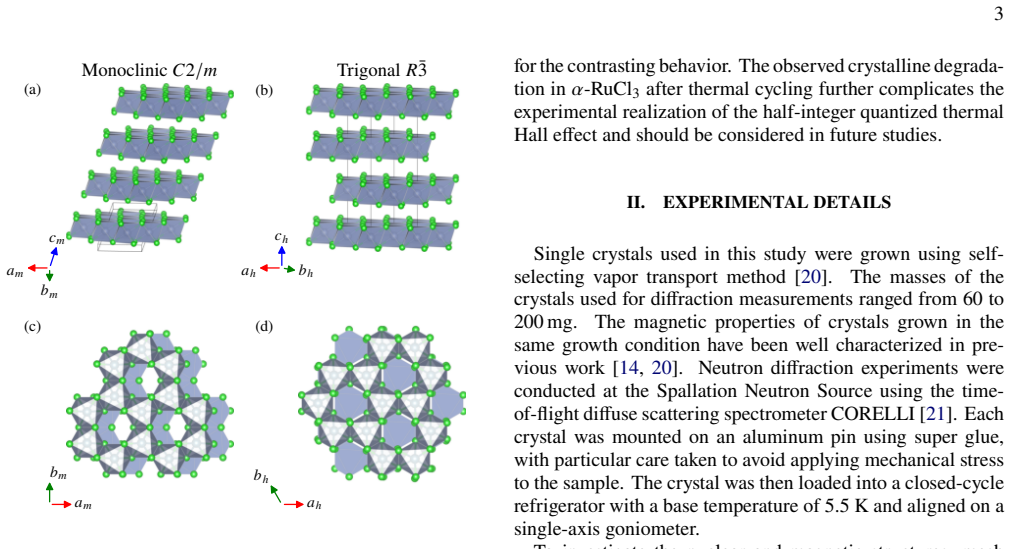
We report a comparative neutron single crystal diffraction study of the structural and magnetic properties of layered halides CrCl$_3$ and $\alpha$-RuCl$_3$, which host a honeycomb arrangement of transition metal ions with distinct electronic configurations and undergo a first-order structural transition between high-temperature \textit{C}2/\textit{m} and low-temperature \textit{R}$\bar{3}$. Both compounds show a step-like change in the $c$-lattice, consistent with an expected stacking rearrangement. In contrast, the in-plane lattice response is quite different: $\alpha$-RuCl$_3$ exhibits an abrupt hysteretic change across the transition accompanied by progressive crystalline degradation upon thermal cycling, whereas CrCl$_3$ shows a smooth in-plane lattice evolution and remains structurally robust. Magnetically, CrCl$_3$ orders into an A-type antiferromagnetic structure at T$_N$=14\,K and exhibits pronounced diffuse magnetic scattering extending up to about 40\,K. $\alpha$-RuCl$_3$ shows no observable magnetic diffuse scattering above its zig-zag antiferromagnetic ordering temperature T$_N$=7.6\,K. These results suggest that the contrasting structural and magnetic behaviors arise from an interplay between interlayer sliding energetics and the fundamentally different electronic configurations of the two compounds.
Editorial analysis
A structured set of objections, weighed in public.
Referee Report
Summary. The paper reports a comparative single-crystal neutron diffraction study of CrCl₃ and α-RuCl₃, both undergoing a first-order structural transition from C2/m to R-3 with a step-like c-axis change. CrCl₃ exhibits smooth in-plane lattice evolution, structural robustness under thermal cycling, A-type antiferromagnetic order at TN=14 K, and diffuse magnetic scattering up to ~40 K. α-RuCl₃ shows abrupt hysteretic in-plane changes with crystalline degradation, zig-zag antiferromagnetic order at TN=7.6 K, and no diffuse scattering above TN. The authors interpret the contrasts as arising from an interplay between interlayer sliding energetics and the distinct electronic configurations (d³ Cr³⁺ vs. d⁵ Ru³⁺).
Significance. If the attribution to electronic configuration differences holds, the work offers useful experimental benchmarks for how d-electron count modulates structural reversibility and magnetic fluctuations in honeycomb halides, with relevance to Kitaev physics in α-RuCl₃. The use of neutron diffraction for direct comparison of lattice and magnetic responses is appropriate and yields clear qualitative distinctions that could inform models of interlayer energetics.
major comments (2)
- [Discussion / Interpretation of results] The central interpretive claim (abstract and discussion) that contrasting in-plane response, structural reversibility, and magnetic diffuse scattering arise primarily from the interplay of interlayer sliding with electronic configurations (d³ vs d⁵) is not fully supported. The study examines individual single crystals without reported quantitative defect densities, stacking-fault statistics, rocking-curve widths, or cross-batch comparisons, leaving open that the hysteretic degradation and suppressed fluctuations in α-RuCl₃ could stem from compound-specific defect sensitivity or residual strain rather than intrinsic electronic differences. A direct test would require defect characterization or multi-sample statistics.
- [Results (lattice parameters and magnetic scattering)] Quantitative support for the lattice-parameter evolution and magnetic ordering is limited by the absence of reported error bars, full data tables, or detailed fitting procedures for the c-axis step, in-plane changes, and diffuse scattering intensity, as noted in the soundness assessment. This affects assessment of the claimed smoothness vs. hysteresis and the temperature extent of diffuse scattering.
minor comments (2)
- [Introduction / Discussion] The abstract and text would benefit from explicit reference to prior work on stacking-fault energetics in these specific compounds to contextualize the interlayer sliding discussion.
- [Throughout] Notation for the low-temperature space group should consistently use R-3 with the bar symbol rendered clearly in all figures and text.
Simulated Author's Rebuttal
We thank the referee for their careful reading of our manuscript and for the constructive comments, which help clarify the scope and limitations of our comparative study. We respond to each major comment below and indicate the revisions planned for the next version of the manuscript.
read point-by-point responses
-
Referee: The central interpretive claim (abstract and discussion) that contrasting in-plane response, structural reversibility, and magnetic diffuse scattering arise primarily from the interplay of interlayer sliding with electronic configurations (d³ vs d⁵) is not fully supported. The study examines individual single crystals without reported quantitative defect densities, stacking-fault statistics, rocking-curve widths, or cross-batch comparisons, leaving open that the hysteretic degradation and suppressed fluctuations in α-RuCl₃ could stem from compound-specific defect sensitivity or residual strain rather than intrinsic electronic differences. A direct test would require defect characterization or multi-sample statistics.
Authors: We agree that the absence of quantitative defect characterization and multi-sample statistics means we cannot definitively exclude sample-specific effects as a contributing factor. Our interpretation is offered as the most plausible explanation for the observed contrasts, given that both compounds are isostructural, the differences align with their distinct d-electron counts, and the lack of diffuse scattering above TN in α-RuCl₃ is consistent with prior reports on this material. In the revised manuscript we will expand the discussion section to explicitly acknowledge alternative explanations, including possible roles of defects or residual strain, and to state that dedicated defect studies or cross-batch comparisons would be required to test the interpretation more rigorously. We do not claim the electronic-configuration difference is the sole cause, only that it provides a coherent framework for the contrasting behaviors reported. revision: partial
-
Referee: Quantitative support for the lattice-parameter evolution and magnetic ordering is limited by the absence of reported error bars, full data tables, or detailed fitting procedures for the c-axis step, in-plane changes, and diffuse scattering intensity, as noted in the soundness assessment. This affects assessment of the claimed smoothness vs. hysteresis and the temperature extent of diffuse scattering.
Authors: We accept this criticism and will strengthen the quantitative presentation. Error bars will be added to all lattice-parameter and intensity plots in the revised figures. A supplementary table will be included that lists the refined lattice parameters (with uncertainties) at representative temperatures, together with the fitted parameters for the magnetic ordering and diffuse-scattering intensities. The methods section will be expanded to describe the data-reduction and fitting procedures used for the c-axis step, in-plane lattice changes, and the temperature dependence of the diffuse magnetic scattering. revision: yes
Circularity Check
No circularity: purely observational experimental comparison
full rationale
The paper reports neutron single-crystal diffraction results on structural transitions and magnetic ordering in CrCl3 and α-RuCl3. The central claim is an interpretive suggestion linking observed differences (smooth vs. hysteretic lattice response, presence vs. absence of diffuse scattering) to interlayer energetics and electronic configurations (d3 vs. d5). No derivations, equations, fitted parameters presented as predictions, or load-bearing self-citations appear in the provided text or abstract. The observations are independent of any self-referential construction, making the report self-contained against external benchmarks.
Axiom & Free-Parameter Ledger
Lean theorems connected to this paper
-
IndisputableMonolith/Foundation/RealityFromDistinction.leanreality_from_one_distinction unclear?
unclearRelation between the paper passage and the cited Recognition theorem.
comparative neutron single crystal diffraction study of the structural and magnetic properties of layered halides CrCl3 and α-RuCl3... contrasting structural reversibility and magnetic correlations arise from an interplay between interlayer sliding energetics and the fundamentally different electronic configurations
-
IndisputableMonolith/Cost/FunctionalEquation.leanwashburn_uniqueness_aczel unclear?
unclearRelation between the paper passage and the cited Recognition theorem.
CrCl3 orders into an A-type antiferromagnetic structure at TN=14 K... α-RuCl3 shows no observable magnetic diffuse scattering above its zig-zag antiferromagnetic ordering temperature TN=7.6 K
What do these tags mean?
- matches
- The paper's claim is directly supported by a theorem in the formal canon.
- supports
- The theorem supports part of the paper's argument, but the paper may add assumptions or extra steps.
- extends
- The paper goes beyond the formal theorem; the theorem is a base layer rather than the whole result.
- uses
- The paper appears to rely on the theorem as machinery.
- contradicts
- The paper's claim conflicts with a theorem or certificate in the canon.
- unclear
- Pith found a possible connection, but the passage is too broad, indirect, or ambiguous to say the theorem truly supports the claim.
Reference graph
Works this paper leans on
-
[1]
K. S. Burch, D. Mandrus, and J.-G. Park, Magnetism in two- dimensional van der waals materials, Nature563, 47 (2018)
work page 2018
-
[2]
C. Gong and X. Zhang, Two-dimensional magnetic crystals and emergent heterostructure devices, Science363, eaav4450 (2019)
work page 2019
- [3]
- [4]
-
[5]
A. Banerjee, C. A. Bridges, J.-Q. Yan, A. A. Aczel, L. Li, M. B. Stone, G. E. Granroth, M. D. Lumsden, Y. Yiu, J. Knolle, S. Bhattacharjee, D. L. Kovrizhin, R. Moessner, D. A. Tennant, D. G. Mandrus, and S. E. Nagler, Proximate kitaev quantum spin liquid behaviour in a honeycomb magnet, Nature Mater15, 733 (2016)
work page 2016
-
[6]
B. Huang, G. Clark, E. Navarro-Moratalla, D. R. Klein, R. Cheng, K. L. Seyler, D. Zhong, E. Schmidgall, M. A. McGuire, D. H. Cobden, W. Yao, D. Xiao, P. Jarillo-Herrero, and X. Xu, Layer-dependent ferromagnetism in a van der waals crystal down to the monolayer limit, Nature546, 270 (2017)
work page 2017
-
[7]
L. Chen, J.-H. Chung, B. Gao, T. Chen, M. B. Stone, A. I. Kolesnikov, Q. Huang, and P. Dai, Topological spin excitations in honeycomb ferromagnet cri3, Phys. Rev. X8, 041028 (2018)
work page 2018
-
[8]
Z. Cai, S. Bao, Z.-L. Gu, Y.-P. Gao, Z. Ma, Y. Shangguan, W. Si, Z.-Y. Dong, W. Wang, Y. Wu, D. Lin, J. Wang, K. Ran, S. Li, D. Adroja, X. Xi, S.-L. Yu, X. Wu, J.-X. Li, and J. Wen, Topo- logical magnon insulator spin excitations in the two-dimensional ferromagnet crbr3, Phys. Rev. B104, L020402 (2021)
work page 2021
-
[9]
S. Gao, M. A. McGuire, Y. Liu, D. L. Abernathy, C. d. Cruz, M. Frontzek, M. B. Stone, and A. D. Christianson, Spiral spin liquid on a honeycomb lattice, Phys. Rev. Lett.128, 227201 (2022)
work page 2022
-
[10]
M. A. McGuire, Crystal and magnetic structures in layered, transition metal dihalides and trihalides, Crystals7, 121 (2017)
work page 2017
-
[11]
M. A. McGuire, H. Dixit, V. R. Cooper, and B. C. Sales, Cou- pling of crystal structure and magnetism in the layered, ferro- magnetic insulator cri3, Chem. Mater.27, 612 (2015)
work page 2015
-
[12]
M. Kratochv ´ılov´a, P. Doleˇ zal, D. Hovanˇc´ık, J. Posp´ıˇsil, A. Ben- dov´a, M. Duˇsek, V. Hol` y, and V. Sechovsk` y, Crystal structure evolution in the van der waals vanadium trihalides, Journal of Physics: Condensed Matter34, 294007 (2022)
work page 2022
-
[13]
S.-Y. Park, S.-H. Do, K.-Y. Choi, D. Jang, T.-H. Jang, J. Scheffer, C.-M. Wu, J. S. Gardner, J. M. S. Park, J.-H. Park, and S. Ji, Emergence of the isotropic kitaev honeycomb lattice\alpha- rucl3 and its magnetic properties, J. Phys.: Condens. Matter36, 215803 (2024)
work page 2024
- [14]
-
[15]
J. W. Cable, M. K. Wilkinson, and E. O. Wollan, Neutron diffraction investigation of antiferromagnetism in crcl3, Journal of Physics and Chemistry of Solids19, 29 (1961)
work page 1961
-
[16]
J. A. Sears, M. Songvilay, K. W. Plumb, J. P. Clancy, Y. Qiu, Y. Zhao, D. Parshall, and Y.-J. Kim, Magnetic order in $\ensuremath{\alpha}\ensuremath{- }{\text{RuCl}} {3}$: A honeycomb-lattice quantum magnet with strong spin-orbit coupling, Phys. Rev. B91, 144420 (2015)
work page 2015
-
[17]
R. D. Johnson, S. C. Williams, A. A. Haghighirad, J. Singleton, V. Zapf, P. Manuel, I. I. Mazin, Y. Li, H. O. Jeschke, R. Valent ´ı, and R. Coldea, Mono- clinic crystal structure of $\ensuremath{\alpha}\ensuremath{- 10 }{\mathrm{RuCl}} {3}$ and the zigzag antiferromagnetic ground state, Phys. Rev. B92, 235119 (2015)
work page 2015
-
[18]
A. Banerjee, J. Yan, J. Knolle, C. A. Bridges, M. B. Stone, M. D. Lumsden, D. G. Mandrus, D. A. Tennant, R. Moessner, and S. E. Nagler, Neutron scattering in the proximate quantum spin liquid𝛼-RuCl3, Science356, 1055 (2017)
work page 2017
-
[19]
F. Lang, P. Baker, A. Haghighirad, Y. Li, D. Prabhakaran, R. Va- lent´ı, and S. Blundell, Unconventional magnetism on a honey- comb lattice in𝛼-rucl 3 studied by muon spin rotation, Physical Review B94, 020407 (2016)
work page 2016
- [20]
-
[21]
F. Ye, Y. Liu, R. Whitfield, R. Osborn, and S. Rosenkranz, Implementation of cross correlation for energy discrimination on the time-of-flight spectrometer corelli, J. Appl. Crystallogr. 51, 315 (2018)
work page 2018
-
[22]
H.-S. Kim and H.-Y. Kee, Crystal structure and magnetism in $\ensuremath{\alpha}\ensuremath{- }{\mathrm{RuCl}} {3}$: An ab initio study, Phys. Rev. B93, 155143 (2016)
work page 2016
-
[23]
H. B. Cao, A. Banerjee, J.-Q. Yan, C. A. Bridges, M. D. Lums- den, D. G. Mandrus, D. A. Tennant, B. C. Chakoumakos, and S. E. Nagler, Low-temperature crystal and magnetic structure of ??-rucl3, Phys. Rev. B93, 134423 (2016)
work page 2016
-
[24]
M. A. McGuire, G. Clark, S. KC, W. M. Chance, G. E. Jellison, V. R. Cooper, X. Xu, and B. C. Sales, Magnetic behavior and spin-lattice coupling in cleavable van der waals layered crcl3 crystals, Phys. Rev. Mater.1, 014001 (2017)
work page 2017
-
[25]
M. Kratochv ´ılov´a, P. Doleˇ zal, D. Hovanˇc´ık, J. Posp´ıˇsil, A. Ben- dov´a, M. Duˇsek, V. Hol´ y, and V. Sechovsk´ y, Crystal structure evolution in the van der waals vanadium trihalides, J. Phys.: Condens. Matter34, 294007 (2022)
work page 2022
-
[26]
S. Mu, K. D. Dixit, X. Wang, D. L. Abernathy, H. Cao, S. E. Nagler, J. Yan, P. Lampen-Kelley, D. Mandrus, C. A. Polanco, L. Liang, G. B. Hal ´asz, Y. Cheng, A. Banerjee, and T. Berlijn, Role of the third dimension in searching for majorana fermions in𝛼- rucl 3 via phonons, Phys. Rev. Res.4, 013067 (2022)
work page 2022
-
[27]
J. Sears, Y. Shen, M. J. Krogstad, H. Miao, J. Yan, S. Kim, W. He, E. S. Bozin, I. K. Robinson, R. Osborn, S. Rosenkranz, Y.-J. Kim, and M. P. M. Dean, Stack- ing disorder in $\ensuremath{\alpha}\text{\ensuremath{- }}{\mathrm{RuCl}} {3}$ investigated via x-ray three- dimensional difference pair distribution function analysis, Phys. Rev. B108, 144419 (2023)
work page 2023
- [28]
- [29]
-
[30]
J. A. Schneeloch, A. A. Aczel, F. Ye, and D. Louca, Role of stacking defects on the magnetic behavior of crcl3, Phys. Rev. B110, 144439 (2024)
work page 2024
-
[31]
S.-J. Hong, T. Y. Kim, and C.-H. Park, First- principles study of bulk stacking, ${J} {\mathrm{eff}}$ picture, magnetic hamiltonian, $g$ factors, and struc- tural distortions of $\ensuremath{\alpha}\text{\ensuremath{- }}{\mathrm{RuCl}} {3}$, Phys. Rev. B113, 014427 (2026)
work page 2026
-
[32]
S. Kim, E. Horsley, J. P. Ruff, B. D. Moreno, and Y.-J. Kim, Structural transition and magnetic anisotropy in𝛼-rucl 3, Phys- ical Review B109, L140101 (2024)
work page 2024
-
[33]
See supplemental material at [url] for further details regarding the structural, magnetic, and diffuse scattering analysis which includes [10, 34–39, 54–58]
-
[34]
R. Herbst-Irmer and G. M. Sheldrick, Refinement of ob- verse/reverse twins, Acta Cryst B58, 477 (2002)
work page 2002
-
[35]
J. Perez-Mato, S. Gallego, E. Tasci, L. Elcoro, G. De La Flor, and M. Aroyo, Symmetry-based computational tools for magnetic crystallography, Annu. Rev. Mater. Res.45, 217 (2015)
work page 2015
-
[36]
J. A. M. Paddison, Scattering signatures of bond-dependent magnetic interactions, Phys. Rev. Lett.125, 247202 (2020)
work page 2020
-
[37]
S. Gao, V. Kocsis, M. Soda, F. Ye, Y. Liu, A. F. May, Y. Taguchi, Y. Tokura, T.-h. Arima, W. Schweika, A. D. Christianson, and M. B. Stone, Suppressed incommensurate order in swedenbor- gite ca0.5y0.5baco4o7, Phys. Rev. B104, L140408 (2021)
work page 2021
-
[38]
L. Chen, M. B. Stone, A. I. Kolesnikov, B. Winn, W. Shon, P. Dai, and J.-H. Chung, Massless dirac magnons in the two dimensional van der waals honeycomb magnet crcl3, 2D Mater. 9, 015006 (2021)
work page 2021
-
[39]
S.-H. Do, J. A. M. Paddison, G. Sala, T. J. Williams, K. Kaneko, K. Kuwahara, A. F. May, J. Yan, M. A. McGuire, M. B. Stone, M. D. Lumsden, and A. D. Christianson, Gaps in topological magnon spectra: Intrinsic versus extrinsic effects, Phys. Rev. B 106, L060408 (2022)
work page 2022
-
[40]
J. A. Schneeloch, Y. Tao, Y. Cheng, L. Daemen, G. Xu, Q. Zhang, and D. Louca, Gapless dirac magnons in crcl3, npj Quantum Mater.7, 1 (2022)
work page 2022
-
[41]
C. Ritter, Zigzag type magnetic structure of the spin jeff =½ compound𝛼-RuCl3 as determined by neutron powder diffrac- tion, J. Phys.: Conf. Ser.746, 012060 (2016)
work page 2016
-
[42]
X. Wang, F. Zhu, M. Braden, K. Schmalzl, W. Schmidt, M. Meven, E. Feng, Y. Zhu, A. Bertin, P. Steffens, and Y. Su, Tilted and twisted magnetic moments in the kitaev magnet𝛼- RuCl3, Chinese Phys. Lett. (2026)
work page 2026
-
[43]
R. Havemann, F. Hammerath, P. Lepucki, P. Fritsch, A. P. Dio- guardi, M. Gr ¨onke, M. Valldor, M. Roslova, A. U. B. Wolter, S. Hampel, T. Doert, H.-J. Grafe, S. Wurmehl, and B. B¨ uchner, Comparison of local structure of ${\mathrm{CrCl}} {3}$ bulk and nanocrystals above and below the structural phase transition, Phys. Rev. B110, 024202 (2024)
work page 2024
-
[44]
A. G. Khachaturyan, Theory of structural transformations in solids (Courier Corporation, 2013)
work page 2013
- [45]
- [46]
-
[47]
P. Doleˇ zal, M. Kratochv´ılov´a, D. Hovan ˇc´ık, V. Hol´ y, V. Se- chovsk´ y, and J. Posp´ıˇsil, Formation of domains within a lower- to-higher symmetry structural transition in cri 3, Inorg. Chem. 63, 976 (2024)
work page 2024
-
[48]
P. Laurell and S. Okamoto, Dynamical and thermal magnetic properties of the kitaev spin liquid candidate𝛼-RuCl3, npj Quantum Mater.5, 2 (2020)
work page 2020
-
[49]
A. Revelli, M. Moretti Sala, G. Monaco, C. Hickey, P. Becker, F. Freund, A. Jesche, P. Gegenwart, T. Eschmann, F. L. Buessen, S. Trebst, P. H. M. van Loosdrecht, J. van den Brink, and M. Gr¨ uninger, Fingerprints of Kitaev physics in the magnetic excitations of honeycomb iridates, Phys. Rev. Res.2, 043094 (2020), Publisher: American Physical Society
work page 2020
-
[50]
M. Yamashita, J. Gouchi, Y. Uwatoko, N. Kurita, and H. Tanaka, Sample dependence of half-integer quantized thermal hall effect in the kitaev spin-liquid candidate𝛼-rucl 3, Physical Review B 11 102, 220404 (2020)
work page 2020
-
[51]
Y. Kasahara, S. Suetsugu, T. Asaba, S. Kasahara, T. Shibauchi, N. Kurita, H. Tanaka, and Y. Matsuda, Quantized and unquan- tized thermal hall conductance of the kitaev spin liquid candidate 𝛼-rucl 3, Physical Review B106, L060410 (2022)
work page 2022
- [52]
-
[53]
K. Momma and F. Izumi, Vesta 3 for three-dimensional visu- alization of crystal, volumetric and morphology data, J Appl Cryst44, 1272 (2011)
work page 2011
-
[54]
T. M. Michels-Clark, A. T. Savici, V. E. Lynch, X. Wang, and C. M. Hoffmann, Expanding lorentz and spectrum corrections to large volumes of reciprocal space for single-crystal time-of- flight neutron diffraction, J Appl Crystallogr49, 497 (2016)
work page 2016
-
[55]
C. W. Dwiggins, Rapid calculation of x-ray absorption correc- tion factors for spheres to an accuracy of 0.05%, Acta Cryst A 31, 395 (1975)
work page 1975
-
[56]
V. Petˇr´ıˇcek, L. Palatinus, J. Pl ´aˇsil, and M. Du ˇsek, Jana2020 – a new version of the crystallographic computing system jana, Zeitschrift f¨ ur Kristallographie - Crystalline Materials238, 271 (2023)
work page 2023
-
[57]
P. J. Becker and P. Coppens, Extinction within the limit of validity of the darwin transfer equations. i. general formalism for primary and secondary extinction and their applications to spherical crystals, Acta Cryst A30, 129 (1974)
work page 1974
-
[58]
c: Mathematical, phys- ical and chemical tables / hrsg
International tables for crystallography. c: Mathematical, phys- ical and chemical tables / hrsg. e. prince, Springer Netherland, Berlin, , 3. ed., 1. online ed ed., 2007
work page 2007
discussion (0)
Sign in with ORCID, Apple, or X to comment. Anyone can read and Pith papers without signing in.