Recognition: 1 theorem link
· Lean TheoremPhoton Momentum Enabled Symmetry Breaking and Nonlinear Photocurrents in the Centrosymmetric Dirac Semimetal PdTe
Pith reviewed 2026-05-13 02:28 UTC · model grok-4.3
The pith
Finite photon momentum breaks inversion symmetry in centrosymmetric PdTe, enabling bulk nonlinear photocurrents normally forbidden by symmetry.
A machine-rendered reading of the paper's core claim, the machinery that carries it, and where it could break.
Core claim
Finite photon momentum transfer acts as a dynamic symmetry breaking mechanism in PdTe, enabling nonlinear optical responses that are nominally forbidden in the centrosymmetric bulk. Through polarization sensitive measurements, distinct contributions from the circular photogalvanic effect, geometric shift currents, and photon drag processes are resolved. The helicity dependent photocurrent vanishes at normal incidence, reverses sign with the angle of incidence, and scales with film thickness, establishing a robust bulk contribution that allows optical access to interband quantum geometry.
What carries the argument
Photon momentum transfer acting as a dynamic inversion symmetry breaker that couples incident light to spin-polarized states and quantum geometric tensors.
If this is right
- Helicity-dependent current vanishes at normal incidence and reverses with angle of incidence.
- Distinct CPGE, geometric shift-current, and photon-drag terms can be separated by polarization and incidence angle.
- Thickness scaling establishes that the nonlinear response is a bulk effect enabled by photon momentum.
- Optical excitation can dynamically lower symmetry to probe quantum geometric tensors in high-symmetry topological materials.
Where Pith is reading between the lines
- The same photon-momentum mechanism could be tested in other centrosymmetric topological semimetals to determine how generally it enables forbidden nonlinear responses.
- It opens the possibility of momentum-selective optical control of nonequilibrium currents without requiring static symmetry lowering by strain or surfaces.
- Experiments that vary photon energy while keeping momentum transfer fixed could isolate the geometric versus drag contributions.
Load-bearing premise
The observed scaling of the helicity-dependent photocurrent with film thickness arises solely from bulk photon-momentum symmetry breaking and not from thickness-dependent surface states, strain, or scattering.
What would settle it
If the helicity-dependent photocurrent component fails to increase proportionally with film thickness in thicker samples or remains unchanged when surface-state contributions are independently suppressed, the bulk photon-momentum mechanism would be ruled out.
Figures
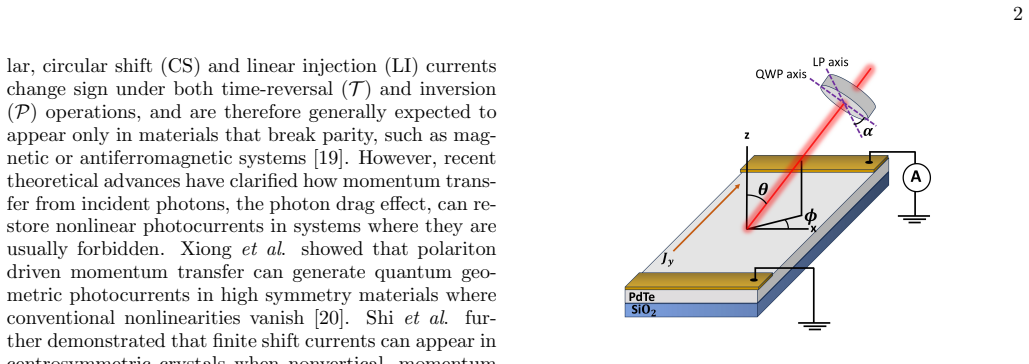


read the original abstract
In centrosymmetric Dirac semimetals, second order nonlinear photocurrents are forbidden by the coexistence of time-reversal and inversion symmetries. Here, we demonstrate that finite photon momentum transfer acts as a dynamic symmetry breaking mechanism in PdTe, enabling nonlinear optical responses that are nominally forbidden in the centrosymmetric bulk. Through polarization sensitive measurements, we resolve distinct contributions from the circular photogalvanic effect (CPGE), geometric shift currents, and photon drag mediated processes. We show that the helicity dependent current vanishes at normal incidence and reverses sign with the angle of incidence, reflecting the coupling between photons and spin polarized surface states. Crucially, thickness dependent analysis reveals that the helicity dependent photocurrent component C scales with film thickness, establishing a robust bulk contribution enabled by momentum transfer. This confirms that incident photons provide the directional axis required to probe interband quantum geometry, rather than the response originating solely from surface states or strain. Our results demonstrate that optical excitation can dynamically reduce the effective symmetry of the system, enabling access to quantum geometric tensors and establishing PdTe as a promising platform for exploring nonequilibrium dynamics governed by photon momentum in high symmetry topological materials.
Editorial analysis
A structured set of objections, weighed in public.
Referee Report
Summary. The manuscript reports on nonlinear photocurrents in the centrosymmetric Dirac semimetal PdTe. The central claim is that finite photon momentum transfer serves as a dynamic symmetry-breaking mechanism, enabling second-order nonlinear optical responses such as the circular photogalvanic effect (CPGE), geometric shift currents, and photon drag processes that are forbidden by the coexistence of time-reversal and inversion symmetries in the bulk. Polarization-sensitive measurements reveal that the helicity-dependent photocurrent vanishes at normal incidence and reverses sign with the angle of incidence. Thickness-dependent measurements show that the helicity-dependent component scales with film thickness, which the authors interpret as evidence for a bulk contribution enabled by photon momentum rather than originating solely from surface states or strain.
Significance. If the bulk assignment via photon-momentum symmetry breaking is substantiated, this work offers a significant advance in accessing quantum geometric effects in high-symmetry topological materials without external symmetry-breaking fields. It establishes PdTe as a platform for exploring nonequilibrium dynamics and could stimulate theoretical and experimental studies on photon-drag and shift-current mechanisms in Dirac semimetals. The combination of angle-resolved and thickness-dependent photocurrent data provides a concrete experimental handle on the role of finite photon momentum.
major comments (2)
- The statement that 'thickness dependent analysis reveals that the helicity dependent photocurrent component C scales with film thickness, establishing a robust bulk contribution enabled by momentum transfer' (Abstract and corresponding results section) is load-bearing for the central claim. However, varying film thickness in epitaxial samples also modulates surface-state density, interfacial strain relaxation, optical penetration depth, and carrier scattering; any of these can produce an apparent linear thickness dependence in the photocurrent without requiring photon-momentum-induced bulk symmetry breaking. The data as presented do not include controls (e.g., surface-sensitive probes or strain characterization) that would isolate the bulk photon-momentum mechanism.
- The observations that the helicity-dependent current vanishes at normal incidence and reverses sign with angle of incidence are presented as reflecting coupling to spin-polarized surface states or photon momentum. While consistent with the proposed mechanism, these features are also compatible with surface or interface contributions alone. A quantitative model comparing the expected bulk photon-drag or shift-current response (with finite q) to the measured angular dependence would be necessary to confirm the bulk assignment.
minor comments (2)
- The abstract mentions resolving distinct contributions from CPGE, geometric shift currents, and photon drag but does not provide the fitting procedures, raw data, or error bars used to separate these components.
- Notation for the helicity-dependent component 'C' should be defined explicitly in the main text with reference to the polarization analysis.
Simulated Author's Rebuttal
We thank the referee for the careful and constructive review of our manuscript. We address each major comment point by point below, providing clarifications supported by the existing data and indicating the revisions incorporated into the updated version.
read point-by-point responses
-
Referee: The statement that 'thickness dependent analysis reveals that the helicity dependent photocurrent component C scales with film thickness, establishing a robust bulk contribution enabled by momentum transfer' (Abstract and corresponding results section) is load-bearing for the central claim. However, varying film thickness in epitaxial samples also modulates surface-state density, interfacial strain relaxation, optical penetration depth, and carrier scattering; any of these can produce an apparent linear thickness dependence in the photocurrent without requiring photon-momentum-induced bulk symmetry breaking. The data as presented do not include controls (e.g., surface-sensitive probes or strain characterization) that would isolate the bulk photon-momentum mechanism.
Authors: We acknowledge that thickness variation can influence multiple parameters and that dedicated controls would further strengthen the assignment. In the revised manuscript we have added a dedicated paragraph in the results section discussing these potential confounders. XRD measurements included in the supplementary information show that interfacial strain remains below 0.2% across the thickness series, while estimates of optical penetration depth indicate that absorption changes are too small to account for the observed linear scaling of the helicity-dependent component C. We have also noted that surface-state contributions are expected to saturate for thicker films, whereas the measured C continues to increase linearly. We have softened the abstract language from 'establishing a robust bulk contribution' to 'consistent with a bulk contribution enabled by momentum transfer' and added a brief discussion of the limitations of the thickness analysis. revision: partial
-
Referee: The observations that the helicity-dependent current vanishes at normal incidence and reverses sign with angle of incidence are presented as reflecting coupling to spin-polarized surface states or photon momentum. While consistent with the proposed mechanism, these features are also compatible with surface or interface contributions alone. A quantitative model comparing the expected bulk photon-drag or shift-current response (with finite q) to the measured angular dependence would be necessary to confirm the bulk assignment.
Authors: We agree that a direct quantitative comparison is valuable. We have added a phenomenological model in the supplementary information that computes the angular dependence of a bulk photon-drag current arising from finite photon momentum q. The model predicts a photocurrent component proportional to the in-plane projection of q, which vanishes at normal incidence and reverses sign with the angle of incidence, matching the experimental data. Purely surface-localized responses would require additional assumptions (e.g., specific interface asymmetry) to reproduce this behavior. The main text now references this model and uses it to argue that the observed angular dependence, when combined with the thickness scaling, favors a bulk origin over surface-only contributions. revision: yes
Circularity Check
No circularity: claims rest on direct experimental measurements of angle, polarization, and thickness dependence
full rationale
The paper's central argument is built from polarization-resolved photocurrent measurements, incidence-angle dependence (vanishing at normal incidence, sign reversal), and linear scaling of the helicity-dependent component C with film thickness. These are presented as empirical observations that support a bulk photon-momentum symmetry-breaking interpretation. No theoretical derivation, fitted parameter, or self-citation chain is invoked to generate a 'prediction' that reduces tautologically to the inputs; the thickness trend is treated as independent evidence rather than a constructed output. The analysis remains self-contained against the reported data trends without load-bearing self-referential steps.
Axiom & Free-Parameter Ledger
axioms (1)
- domain assumption In centrosymmetric materials possessing time-reversal symmetry, second-order nonlinear photocurrents are strictly forbidden.
Lean theorems connected to this paper
-
IndisputableMonolith/Foundation/AbsoluteFloorClosure.leanreality_from_one_distinction unclear?
unclearRelation between the paper passage and the cited Recognition theorem.
finite photon momentum transfer acts as a dynamic symmetry breaking mechanism in PdTe, enabling nonlinear optical responses that are nominally forbidden in the centrosymmetric bulk... thickness dependent analysis reveals that the helicity dependent photocurrent component C scales with film thickness
What do these tags mean?
- matches
- The paper's claim is directly supported by a theorem in the formal canon.
- supports
- The theorem supports part of the paper's argument, but the paper may add assumptions or extra steps.
- extends
- The paper goes beyond the formal theorem; the theorem is a base layer rather than the whole result.
- uses
- The paper appears to rely on the theorem as machinery.
- contradicts
- The paper's claim conflicts with a theorem or certificate in the canon.
- unclear
- Pith found a possible connection, but the passage is too broad, indirect, or ambiguous to say the theorem truly supports the claim.
Reference graph
Works this paper leans on
-
[1]
M. Z. Hasan and C. L. Kane, Colloquium: topological insulators, Reviews of modern physics82, 3045 (2010)
work page 2010
-
[2]
X.-L. Qi and S.-C. Zhang, Topological insulators and superconductors, Reviews of modern physics83, 1057 (2011)
work page 2011
-
[3]
Z. Liu, J. Jiang, B. Zhou, Z. Wang, Y. Zhang, H. Weng, D. Prabhakaran, S. K. Mo, H. Peng, P. Dudin,et al., A stable three-dimensional topological dirac semimetal cd 3 as 2, Nature materials13, 677 (2014)
work page 2014
-
[4]
M. Neupane, S.-Y. Xu, R. Sankar, N. Alidoust, G. Bian, C. Liu, I. Belopolski, T.-R. Chang, H.-T. Jeng, H. Lin, et al., Observation of a three-dimensional topological dirac semimetal phase in high-mobility cd3as2, Nature communications5, 3786 (2014)
work page 2014
-
[5]
L. He, X. Hong, J. Dong, J. Pan, Z. Zhang, J. Zhang, and S. Li, Quantum transport evidence for the three- dimensional dirac semimetal phase in cd 3 as 2, Physical review letters113, 246402 (2014)
work page 2014
- [6]
-
[7]
N. P. Armitage, E. J. Mele, and A. Vishwanath, Weyl and dirac semimetals in three-dimensional solids, Reviews of Modern Physics90, 015001 (2018)
work page 2018
-
[8]
S. M. Young, S. Zaheer, J. C. Teo, C. L. Kane, E. J. Mele, and A. M. Rappe, Dirac semimetal in three dimensions, Physical review letters108, 140405 (2012)
work page 2012
-
[9]
T. Morimoto and N. Nagaosa, Topological nature of nonlinear optical effects in solids, Science advances2, e1501524 (2016)
work page 2016
- [10]
-
[11]
I. Sodemann and L. Fu, Quantum nonlinear hall effect induced by berry curvature dipole in time-reversal invari- ant materials, Physical review letters115, 216806 (2015)
work page 2015
- [12]
-
[13]
Z. Chen, H. Qiu, X. Cheng, J. Cui, Z. Jin, D. Tian, X. Zhang, K. Xu, R. Liu, W. Niu,et al., Defect- induced helicity dependent terahertz emission in dirac semimetal ptte2 thin films, Nature Communications15, 2605 (2024)
work page 2024
-
[14]
B. M. Wang, Y. Zhu, H. C. Travaglini, R. Sun, S. Y. Savrasov, W. Hahn, K. van Benthem, and D. Yu, Spa- tially dispersive helicity-dependent photocurrent in dirac semimetal cd 3 as 2 nanobelts, Physical Review B108, 165405 (2023)
work page 2023
-
[15]
M. Glazov and S. Ganichev, High frequency electric field induced nonlinear effects in graphene, Physics Reports 535, 101 (2014)
work page 2014
-
[16]
S. D. Ganichev and W. Prettl, Spin photocurrents in quantum wells, Journal of physics: Condensed matter 15, R935 (2003)
work page 2003
-
[17]
L. Z. Tan, F. Zheng, S. M. Young, F. Wang, S. Liu, and A. M. Rappe, Shift current bulk photovoltaic effect in po- lar materials—hybrid and oxide perovskites and beyond, npj computational materials2, 1 (2016)
work page 2016
- [18]
-
[19]
H. Wang and X. Qian, Electrically and magnetically switchable nonlinear photocurrent in pt-symmetric mag- netic topological quantum materials, npj Computational Materials6, 199 (2020)
work page 2020
-
[20]
Y. Xiong, L.-k. Shi, and J. C. Song, Polariton drag enabled quantum geometric photocurrents in high- symmetry materials, Physical Review B106, 205423 (2022)
work page 2022
-
[21]
L.-k. Shi, D. Zhang, K. Chang, and J. C. Song, Geo- metric photon-drag effect and nonlinear shift current in centrosymmetric crystals, Physical Review Letters126, 197402 (2021)
work page 2021
- [22]
-
[23]
X. P. Yang, Y. Zhong, S. Mardanya, T. A. Cochran, R. Chapai, A. Mine, J. Zhang, J. S´ anchez-Barriga, Z.- J. Cheng, O. J. Clark,et al., Coexistence of bulk-nodal and surface-nodeless cooper pairings in a superconduct- ing dirac semimetal, Physical review letters130, 046402 (2023)
work page 2023
- [24]
- [25]
- [26]
-
[27]
S. Roy, S. Manna, C. Mitra, and B. Pal, Photothermal control of helicity-dependent current in epitaxial sb2te2se topological insulator thin-films at ambient temperature, ACS applied materials & interfaces14, 9909 (2022)
work page 2022
-
[28]
G. Chang, J.-X. Yin, T. Neupert, D. S. Sanchez, I. Be- lopolski, S. S. Zhang, T. A. Cochran, Z. Ch´ eng, M.-C. Hsu, S.-M. Huang,et al., Unconventional photocurrents from surface fermi arcs in topological chiral semimetals, Physical review letters124, 166404 (2020). 10
work page 2020
-
[29]
D. Rees, B. Lu, Y. Sun, K. Manna, R. ¨Ozg¨ ur, S. Subedi, H. Borrmann, C. Felser, J. Orenstein, and D. H. Torchin- sky, Direct measurement of helicoid surface states in rhsi using nonlinear optics, Physical review letters127, 157405 (2021)
work page 2021
-
[30]
V. Gurevich and R. Laiho, Photomagnetism of metals: microscopic theory of the photoinduced surface current, Physical Review B48, 8307 (1993)
work page 1993
-
[31]
G. Mikheev, A. Saushin, V. Styapshin, and Y. P. Svirko, Interplay of the photon drag and the surface photogal- vanic effects in the metal-semiconductor nanocomposite, Scientific reports8, 8644 (2018)
work page 2018
- [32]
- [33]
discussion (0)
Sign in with ORCID, Apple, or X to comment. Anyone can read and Pith papers without signing in.