Recognition: no theorem link
A Cyclic Burst Rate Behavior of a Persistent X-ray Burster: Recent XMM-Newton and NuSTAR Observations of 4U 1323-62
Pith reviewed 2026-05-13 02:16 UTC · model grok-4.3
The pith
4U 1323-62 shows a cyclic variation in burst rate with a period of about 10 years.
A machine-rendered reading of the paper's core claim, the machinery that carries it, and where it could break.
Core claim
Based on the long-term behavior of 4U 1323-62, the central claim is that the burst rate exhibits a cyclic trend with a period of about 10 years, established by placing the new 2024 observations alongside historical burst-rate points.
What carries the argument
Long-term compilation of burst occurrence rates across multiple observing epochs, used to reveal the approximate 10-year periodicity.
If this is right
- The source should return to a high burst-rate phase around 2034 if the 10-year cycle holds.
- The cyclic modulation may reflect long-term changes in mass-transfer rate or disk properties within the binary.
- Similar decade-scale cycles could appear in other persistent bursters once sufficient monitoring baselines exist.
Where Pith is reading between the lines
- If the cycle is real, it may link to orbital evolution or magnetic activity in the companion star on timescales not usually probed in X-ray binaries.
- Targeted campaigns timed to predicted high-rate phases could increase the yield of rare double-burst events for detailed study.
Load-bearing premise
That the limited historical burst-rate measurements are dense and accurate enough to confirm a genuine 10-year cycle instead of a statistical fluctuation or sampling artifact.
What would settle it
Burst-rate monitoring over the next 5-10 years that shows no repetition of the reported high and low activity phases at the expected intervals.
Figures





read the original abstract
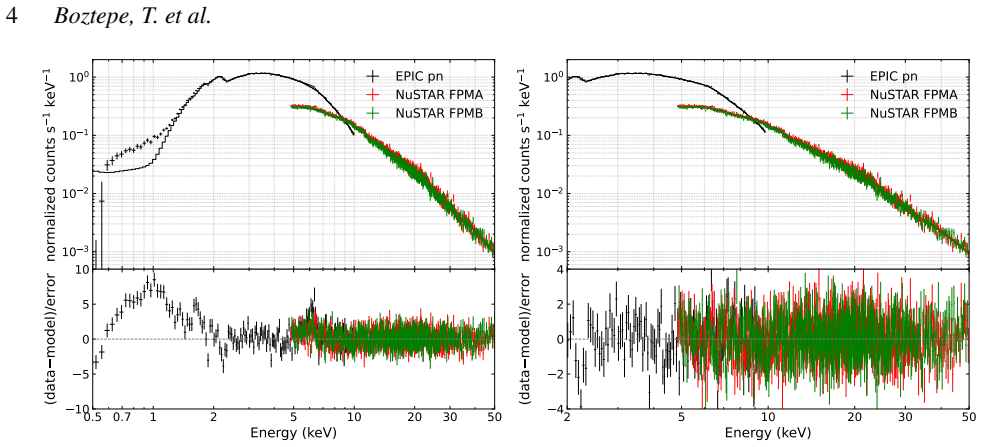
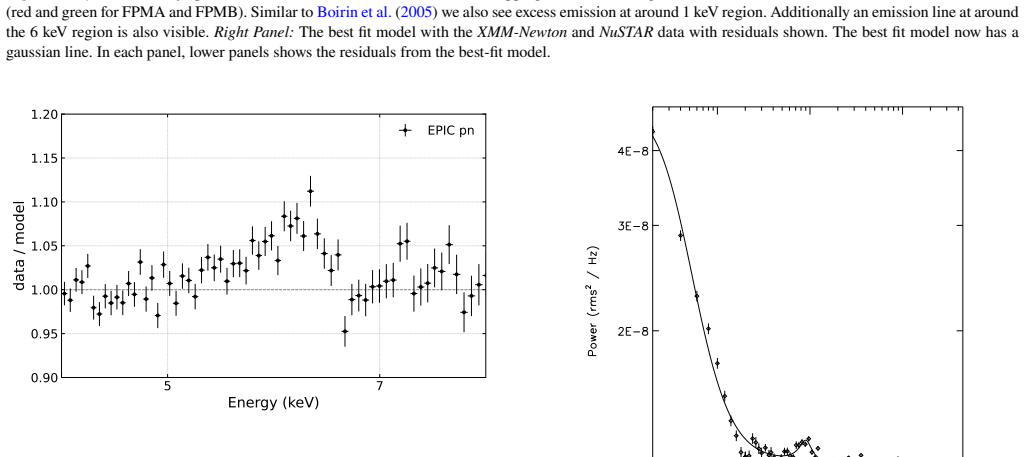
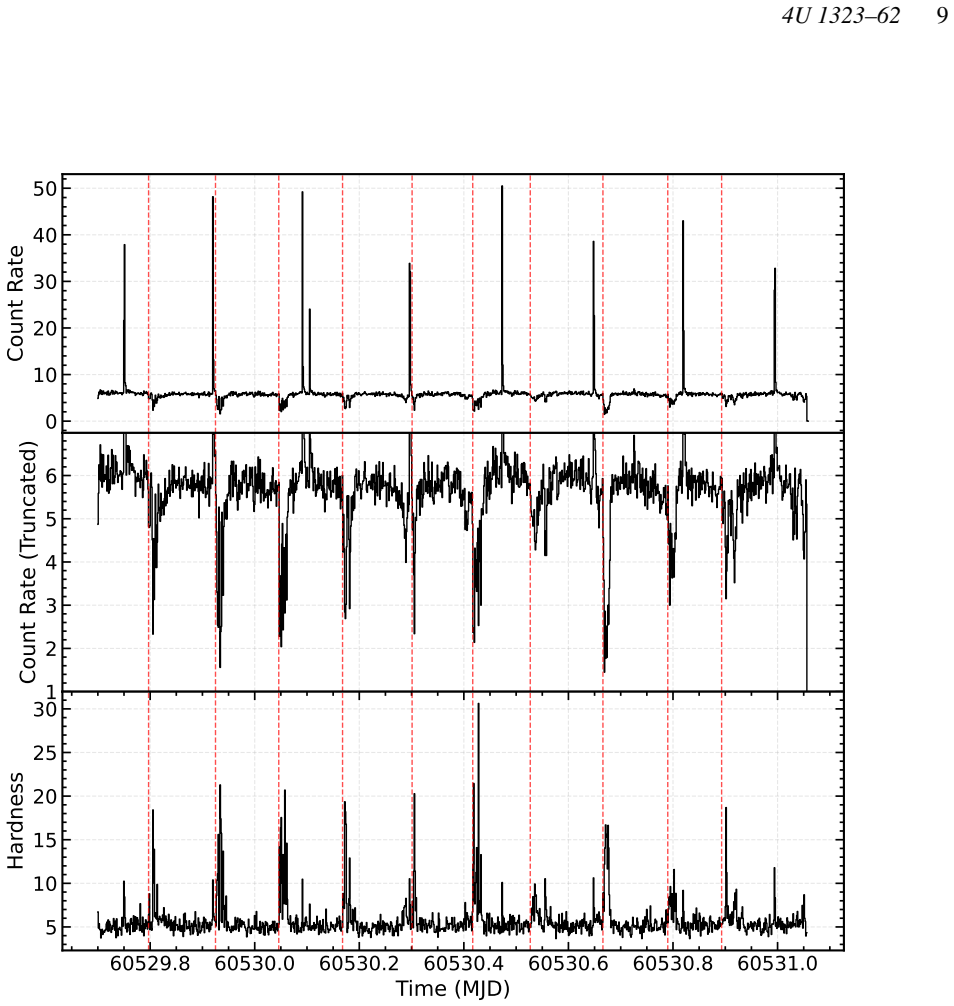
In this study, we report partly simultaneous XMM-Newton and NuSTAR observations of the bursting, dipping low mass X-ray binary, 4U 1323-62 obtained in 2024. 4U 1323-62 is one of the well-known persistent bursters, with bursts occurring roughly every three hours. It is also one of the few sources for which the orbital period is known, and shows dips in X-rays. In this paper, we report the detection of 12 unique bursts with XMM-Newton and NuSTAR, 6 of them observed jointly. We detected two double burst events, one with the NuSTAR and another one observed with both missions. Based on the long-term behavior of 4U 1323-62, we unveil a cyclic trend in its burst rate, with a period of about 10 years. During our observations we detected 10 X-ray dips with a periodicity of 2.942 hours, in line with previous measurements. We also present the results of the time resolved X-ray spectral analysis of the bursts and show the limits on the cooling of the corona heated by the burst emission. We also found a 0.898 +/- 0.017 Hz quasi-periodic oscillation (QPO) during the non-bursting and non-dipping times confirming previous detections.
Editorial analysis
A structured set of objections, weighed in public.
Referee Report
Summary. The manuscript reports new partly simultaneous XMM-Newton and NuSTAR observations of the persistent X-ray burster and dipper 4U 1323-62 obtained in 2024. It describes the detection of 12 unique bursts (including two double-burst events), 10 X-ray dips with a 2.942-hour periodicity, a 0.898 ± 0.017 Hz QPO, time-resolved burst spectroscopy with limits on coronal cooling, and—based on long-term monitoring—a cyclic variation in burst rate with a period of approximately 10 years.
Significance. If the claimed ~10-year cyclic burst-rate behavior is confirmed with adequate statistical support, the result would be of moderate significance for understanding long-term accretion or ignition-cycle modulation in persistent neutron-star LMXBs. The new 2024 data on bursts, dips, and the QPO are consistent with prior work and add useful multi-mission coverage, but the headline periodicity claim is the element that would most affect the paper’s impact.
major comments (2)
- [Long-term behavior discussion (Abstract + relevant results section)] The central claim of a ~10-year cyclic burst-rate behavior (Abstract and the long-term behavior section) is presented without specifying the number of historical burst-rate measurements, their individual values and uncertainties, the exact fitting or period-search method employed, or any quantitative significance metric (e.g., false-alarm probability or reduced χ² comparison to a constant-rate model). With only a handful of sparse archival points typically available for such sources, this information is required to demonstrate that the apparent cycle is not an artifact of sampling or aliasing.
- [Abstract and long-term results] No uncertainty is provided for the reported ~10-year period, in contrast to the QPO frequency (0.898 ± 0.017 Hz). This omission prevents assessment of the precision and robustness of the cycle detection.
minor comments (2)
- [Observations / Abstract] The abstract states that the observations are “partly simultaneous” but does not quantify the temporal overlap between XMM-Newton and NuSTAR; a brief statement or table in the observations section would improve clarity.
- [Spectral analysis section] The manuscript mentions “limits on the cooling of the corona” but does not specify the quantitative upper limits or the spectral model components used to derive them; adding these values would strengthen the spectral results.
Simulated Author's Rebuttal
We thank the referee for their constructive and detailed comments, which help clarify the presentation of our long-term burst-rate analysis. We address each major comment below and will revise the manuscript to incorporate the requested details and quantitative support.
read point-by-point responses
-
Referee: [Long-term behavior discussion (Abstract + relevant results section)] The central claim of a ~10-year cyclic burst-rate behavior (Abstract and the long-term behavior section) is presented without specifying the number of historical burst-rate measurements, their individual values and uncertainties, the exact fitting or period-search method employed, or any quantitative significance metric (e.g., false-alarm probability or reduced χ² comparison to a constant-rate model). With only a handful of sparse archival points typically available for such sources, this information is required to demonstrate that the apparent cycle is not an artifact of sampling or aliasing.
Authors: We agree that additional quantitative details are required for a robust assessment of the cyclic behavior. In the revised manuscript we will expand the long-term behavior section (and update the abstract) to explicitly list the historical burst-rate measurements drawn from the literature and our new data, including their individual values, uncertainties, and references. We will describe the period-search approach (visual identification of the trend followed by a least-squares sinusoidal fit to the sparse time series) and provide a quantitative significance metric, specifically the reduced χ² of the periodic model versus a constant-rate null hypothesis. These additions will allow readers to evaluate whether the apparent ~10-year cycle could arise from sampling or aliasing. revision: yes
-
Referee: [Abstract and long-term results] No uncertainty is provided for the reported ~10-year period, in contrast to the QPO frequency (0.898 ± 0.017 Hz). This omission prevents assessment of the precision and robustness of the cycle detection.
Authors: We will add the formal uncertainty on the reported period in both the abstract and the long-term results section of the revised manuscript. The period was obtained from the sinusoidal fit to the available burst-rate points; the revised text will quote the 1σ uncertainty returned by that fit so that the precision and robustness of the cycle can be directly compared with other measured quantities such as the QPO frequency. revision: yes
Circularity Check
Observational periodicity claim from sparse burst-rate data shows no circularity
full rationale
The paper's central claim of a ~10-year cyclic trend in burst rate is presented as an empirical inference drawn directly from combining a small number of archival burst-rate measurements with the new 2024 XMM-Newton/NuSTAR points. No model equations, fitted parameters renamed as predictions, self-citations, or uniqueness theorems are used to derive the period; the abstract and description frame it as an observational finding from long-term behavior. The derivation chain therefore remains self-contained against external data and does not reduce any result to its own inputs by construction.
Axiom & Free-Parameter Ledger
Reference graph
Works this paper leans on
-
[1]
Research in Astronomy and Astrophysics , keywords =
Detection of thermonuclear X-ray bursts and dips from the X-ray binary 4U 1323-62 with AstroSat/LAXPC. Research in Astronomy and Astrophysics , keywords =. doi:10.1088/1674-4527/20/6/98 , archivePrefix =. 2002.08140 , primaryClass =
-
[2]
Sherpa: An Open-source Python Fitting Package. , keywords =. doi:10.3847/1538-4365/ad7bab , archivePrefix =. 2409.10400 , primaryClass =
-
[3]
Astronomical Data Analysis Software and Systems V , year = 1996, editor =
XSPEC: The First Ten Years. Astronomical Data Analysis Software and Systems V , year = 1996, editor =
work page 1996
-
[4]
The Ariel V (3A) catalogue of X-ray sources. I. , keywords =. doi:10.1093/mnras/197.4.865 , adsurl =
-
[5]
The fourth Uhuru catalog of X-ray sources. , keywords =. doi:10.1086/190561 , adsurl =
-
[6]
Type-I X-Ray Bursts Reveal a Fast Co-evolving Behavior of the Corona in an X-Ray Binary. , keywords =. doi:10.1088/2041-8205/752/2/L34 , archivePrefix =. 1304.5370 , primaryClass =
- [7]
-
[8]
Buisson, D. J. K. and others , journal =
-
[9]
Koljonen, K. I. I. and others , journal =
- [10]
-
[11]
Ballantyne, D. R. and Strohmayer, T. E. , journal =
-
[12]
Keek, L. and Ballantyne, D. R. and Bhattacharyya, S. and Strohmayer, T. E. and Watts, A. L. , journal =
-
[13]
Speagle, J. S. , title =. , year = 2020, volume = 493, pages =
work page 2020
-
[14]
doi:10.5281/zenodo.17268284 , url =
Sergey Koposov and Josh Speagle and Kyle Barbary and Gregory Ashton and Ed Bennett and Johannes Buchner and Carl Scheffler and Colm Talbot and Ben Cook and James Guillochon and Patricio Cubillos and Andrés Asensio Ramos and Matthieu Dartiailh and Ilya and Erik Tollerud and Dustin Lang and Ben Johnson and jtmendel and Edward Higson and Thomas Vandal and Ta...
- [15]
-
[16]
Newton, M. A. and Raftery, A. E. , journal =
- [17]
- [18]
-
[19]
Kass, R. E. and Raftery, A. E. , journal =
- [20]
-
[21]
First Detection of an X-Ray Burst and a One-Hour Intensity Dip in 4U1323-62. , keywords =. doi:10.1007/BF00212900 , adsurl =
-
[22]
The Discovery of 2.93 Hour Periodic Intensity Dips from X1323-619. , keywords =. doi:10.1086/167255 , adsurl =
-
[23]
A highly-ionized absorber in the X-ray binary 4U 1323-62: A new explanation for the dipping phenomenon. , keywords =. doi:10.1051/0004-6361:20041940 , archivePrefix =. astro-ph/0410385 , primaryClass =
-
[24]
New orbital ephemerides for the dipping source 4U 1323-619: constraining the distance to the source. , keywords =. doi:10.1051/0004-6361/201527512 , archivePrefix =. 1603.04403 , primaryClass =
-
[25]
Infrared identification of 4U1323-619 revisited. , keywords =. doi:10.1111/j.1745-3933.2009.00768.x , archivePrefix =. 0908.4335 , primaryClass =
-
[26]
Thermonuclear (Type I) X-Ray Bursts Observed by the Rossi X-Ray Timing Explorer. , keywords =. doi:10.1086/592044 , archivePrefix =. astro-ph/0608259 , primaryClass =
-
[27]
The Multi-INstrument Burst ARchive (MINBAR). , keywords =. doi:10.3847/1538-4365/ab9f2e , archivePrefix =. 2003.00685 , primaryClass =
-
[28]
, year = 1993, month = sep, volume =
X-Ray Bursts. , year = 1993, month = sep, volume =. doi:10.1007/BF00196124 , adsurl =
-
[29]
Cooling of accretion disc coronae by Type I X-ray bursts. , keywords =. doi:10.1093/mnras/staa3137 , archivePrefix =. 2010.05791 , primaryClass =
-
[30]
Bayesian Blocks: Detecting and characterizing local variability in time series
-
[31]
Studies in Astronomical Time Series Analysis. V. Bayesian Blocks, a New Method to Analyze Structure in Photon Counting Data. , keywords =. doi:10.1086/306064 , archivePrefix =. astro-ph/9711233 , primaryClass =
-
[32]
doi:10.1046/j.1365-8711.2002.05889.x , archiveprefix =
Short-time-scale correlations between line and continuum fluxes in Cygnus X-1. , keywords =. doi:10.1046/j.1365-8711.2002.05640.x , archivePrefix =. astro-ph/0204160 , primaryClass =
-
[33]
Spectral fits to the 1999 Aql X-1 outburst data. , keywords =. doi:10.1051/0004-6361:20021881 , archivePrefix =. astro-ph/0301091 , primaryClass =
-
[34]
Time Domain Analysis of Variability in Cygnus X-1: Constraints on the Emission Models. , keywords =. doi:10.1086/312778 , archivePrefix =. astro-ph/0006042 , primaryClass =
-
[35]
The Nuclear Spectroscopic Telescope Array (NuSTAR) High-energy X-Ray Mission. , keywords =. doi:10.1088/0004-637X/770/2/103 , archivePrefix =. 1301.7307 , primaryClass =
-
[36]
Wilms, J. and Allen, A. and. The Astrophysical Journal , issn =. 2000 , title =. doi:10.1086/317016 , pages =
work page internal anchor Pith review doi:10.1086/317016 2000
-
[37]
Publications of The Korean Astronomical Society , issn =. 2015 , title =. doi:10.5303/pkas.2015.30.2.585 , pages =
-
[38]
The Astronomer's Telegram , keywords =
Discovery of mHz QPOs from the LMXB 4U 1323-619. The Astronomer's Telegram , keywords =
-
[39]
A simple test for periodic signals in red noise. , keywords =. doi:10.1051/0004-6361:20041453 , archivePrefix =. astro-ph/0412697 , primaryClass =
-
[40]
Detection of millihertz quasi-periodic oscillations in the X-Ray binary 1RXS J180408.9-342058. , keywords =. doi:10.1093/mnras/staa3224 , archivePrefix =. 2009.01536 , primaryClass =
-
[41]
Millihertz Oscillation Frequency Drift Predicts the Occurrence of Type I X-Ray Bursts. , keywords =. doi:10.1086/527355 , archivePrefix =. 0711.4790 , primaryClass =
-
[42]
2010, MNRAS, 408, 2115, doi: 10.1111/j.1365-2966.2010.17291.x
Frequency-resolved spectroscopy of XB1323-619 using XMM-Newton data: detection of a reflection region in the disc. , keywords =. doi:10.1111/j.1365-2966.2010.17033.x , archivePrefix =. 1005.3498 , primaryClass =
-
[43]
A Persistent -0.5ex 1 HZ Quasi-periodic Oscillation in the Dipping Low-Mass X-Ray Binary 4U 1323-62. , keywords =. doi:10.1086/311840 , archivePrefix =. astro-ph/9811404 , primaryClass =
-
[44]
Journal of High Energy Astrophysics , keywords =
Exploring the spectral characteristics of the periodic burster 4U 1323-62: Type-I X-ray burst and persistent emission. Journal of High Energy Astrophysics , keywords =. doi:10.1016/j.jheap.2025.100545 , archivePrefix =. 2511.03172 , primaryClass =
-
[45]
Discovery of millihertz quasi-periodic oscillations in the X-ray binary EXO 0748-676. , keywords =. doi:10.1093/mnrasl/slz057 , archivePrefix =. 1905.01956 , primaryClass =
-
[46]
The Global Normal Disk Oscillations and the Persistent Low-Frequency Quasi-periodic Oscillations in X-Ray Binaries. , keywords =. doi:10.1086/312935 , archivePrefix =. astro-ph/0008515 , primaryClass =
-
[47]
doi:10.1111/j.1365-2966.2005.09360.x , eprint =
Discovery of absorption features of the accretion disc corona and systematic acceleration of the X-ray burst rate in XB1323-619. , keywords =. doi:10.1111/j.1365-2966.2005.08728.x , archivePrefix =. astro-ph/0412228 , primaryClass =
-
[48]
Neutral absorber dips in the periodic burster LMXB XB 1323-619 from Suzaku. , keywords =. doi:10.1051/0004-6361/200811215 , archivePrefix =. 0905.0618 , primaryClass =
-
[49]
The Infrared Counterpart of X1323-619. , keywords =. doi:10.1086/117603 , adsurl =
-
[50]
A study of the spectral evolution during dipping in XB 1323-619 with Rossi-XTE and BeppoSAX. , keywords =. doi:10.1051/0004-6361:20011363 , archivePrefix =. astro-ph/0111379 , primaryClass =
-
[51]
Line Profiles from a Disk around a Rotating Black Hole. , keywords =. doi:10.1086/170257 , adsurl =
-
[52]
X-ray fluorescence from the inner disc in Cygnus X-1. , keywords =. doi:10.1093/mnras/238.3.729 , adsurl =
-
[53]
A NICER look at thermonuclear X-ray bursts from Aql X-1. , keywords =. doi:10.1093/mnras/stab3422 , archivePrefix =. 2111.12105 , primaryClass =
-
[54]
Burst-Disk Interaction in 4U 1636-536 as Observed by NICER. , keywords =. doi:10.3847/1538-4357/ac8106 , archivePrefix =. 2207.04107 , primaryClass =
-
[55]
Thermonuclear X-Ray Bursts with Late Secondary Peaks Observed from 4U 1608-52. , keywords =. doi:10.3847/1538-4357/abe1ae , archivePrefix =. 2101.11637 , primaryClass =
-
[56]
NICER Observations of Thermonuclear Bursts from 4U 1728-34: Detection of Oscillations prior to the Onset of Two Bursts. , keywords =. doi:10.3847/1538-4357/acfc4c , archivePrefix =. 2309.10041 , primaryClass =
-
[57]
Evidence for a Millisecond Pulsar in 4U 1636-53 during a Superburst. , keywords =. doi:10.1086/342152 , archivePrefix =. astro-ph/0205435 , primaryClass =
-
[58]
Timing Neutron Stars: Pulsations, Oscillations and Explosions , year = 2021, editor =
Thermonuclear X-ray Bursts. Timing Neutron Stars: Pulsations, Oscillations and Explosions , year = 2021, editor =. doi:10.1007/978-3-662-62110-3_5 , archivePrefix =. 1712.06227 , primaryClass =
-
[59]
The study of multipeaked type-I X-ray bursts in the neutron star low-mass X-ray binary 4U 1636 - 536 with RXTE. , keywords =. doi:10.1093/mnras/staa3539 , archivePrefix =. 2011.02736 , primaryClass =
-
[60]
Discovery of X-ray burst triplets in EXO 0748-676. , keywords =. doi:10.1051/0004-6361:20066204 , archivePrefix =. astro-ph/0701575 , primaryClass =
-
[61]
NICER Observes a Secondary Peak in the Decay of a Thermonuclear Burst from 4U 1608-52. , keywords =. doi:10.3847/1538-4357/ab3a37 , archivePrefix =. 1908.03373 , primaryClass =
-
[62]
Advances in Space Research , keywords =
A highly-ionized absorber as a new explanation for the spectral changes during dips from X-ray binaries. Advances in Space Research , keywords =. doi:10.1016/j.asr.2005.10.055 , archivePrefix =. astro-ph/0511191 , primaryClass =
-
[63]
The Thermonuclear X-Ray Bursts of 4U 1730-22. , keywords =. doi:10.3847/1538-4357/ac9b26 , archivePrefix =. 2210.09079 , primaryClass =
-
[64]
A Variable 0.58-2.44 HZ Quasi-periodic Oscillation in the Eclipsing and Dipping Low-Mass X-Ray Binary EXO 0748-676. , keywords =. doi:10.1086/312000 , archivePrefix =. astro-ph/9903148 , primaryClass =
- [65]
-
[66]
Measurements of accretion disc corona size in LMXB: consequences for Comptonization and LMXB models. , keywords =. doi:10.1111/j.1365-2966.2004.07162.x , archivePrefix =. astro-ph/0309212 , primaryClass =
-
[67]
Spectral changes during dipping in low-mass X-ray binaries due to highly-ionized absorbers. , keywords =. doi:10.1051/0004-6361:20053586 , archivePrefix =. astro-ph/0509342 , primaryClass =
-
[68]
The Prolific Thermonuclear X-Ray Bursts from the Outburst of the Newly Discovered Millisecond Pulsar MAXI J1816-195 Observed by Insight-HXMT and NICER. , keywords =. doi:10.3847/2041-8213/ac8c2c , archivePrefix =. 2208.12124 , primaryClass =
-
[69]
New insight into the hard X-ray emission influenced by the type I bursts observed by Insight-HXMT during the outburst of 4U 1636-536. , keywords =. doi:10.1051/0004-6361/202347534 , archivePrefix =. 2503.03092 , primaryClass =
-
[70]
Characterizing X-ray binary long-term variability. , keywords =. doi:10.1111/j.1365-2966.2011.20146.x , archivePrefix =. 1111.1296 , primaryClass =
-
[71]
Decades-long variations in NS-LMXBs observed with MAXI/GSC, RXTE/ASM, and Ginga/ASM. , keywords =. doi:10.1093/pasj/psac049 , archivePrefix =. 2206.02299 , primaryClass =
-
[72]
Irradiation-driven mass transfer in low-mass X-ray binaries. , keywords =. doi:10.1038/350136a0 , adsurl =
discussion (0)
Sign in with ORCID, Apple, or X to comment. Anyone can read and Pith papers without signing in.