Recognition: 2 theorem links
· Lean TheoremSensitivity Analysis of Performance-Based Partitioning in District Heating Networks
Pith reviewed 2026-05-13 02:24 UTC · model grok-4.3
The pith
A nominally designed partition for district heating networks maintains near-optimal performance under most operating perturbations.
A machine-rendered reading of the paper's core claim, the machinery that carries it, and where it could break.
Core claim
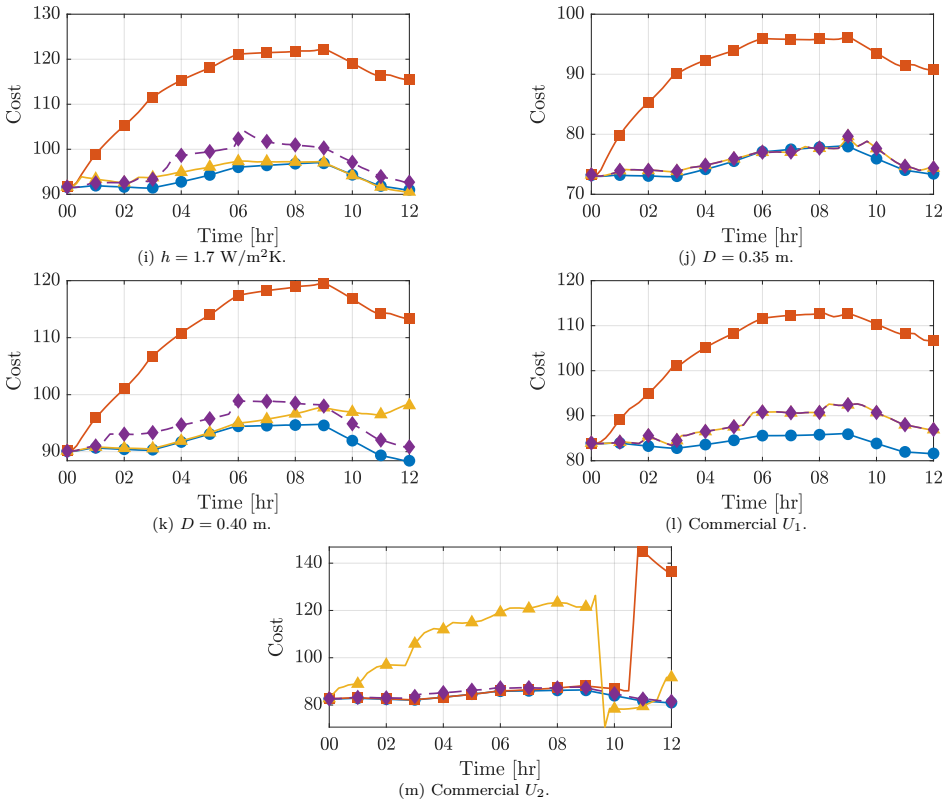
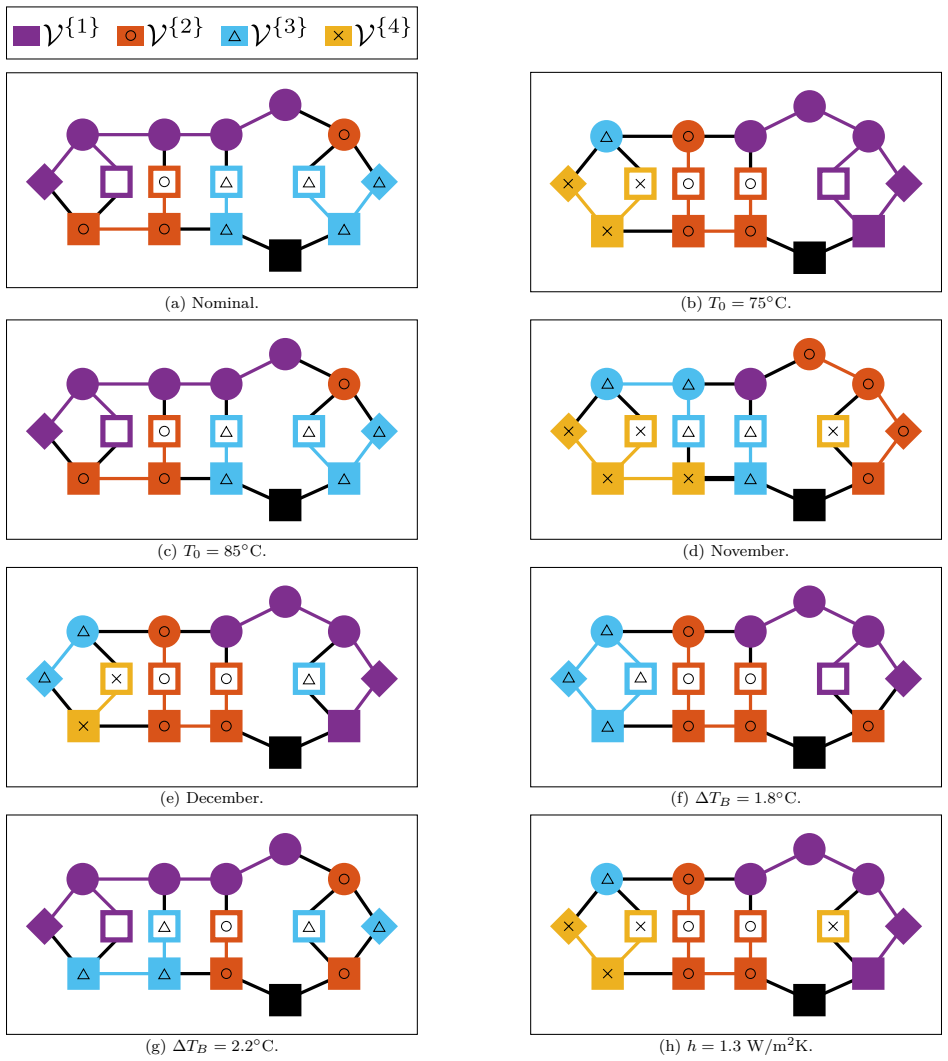
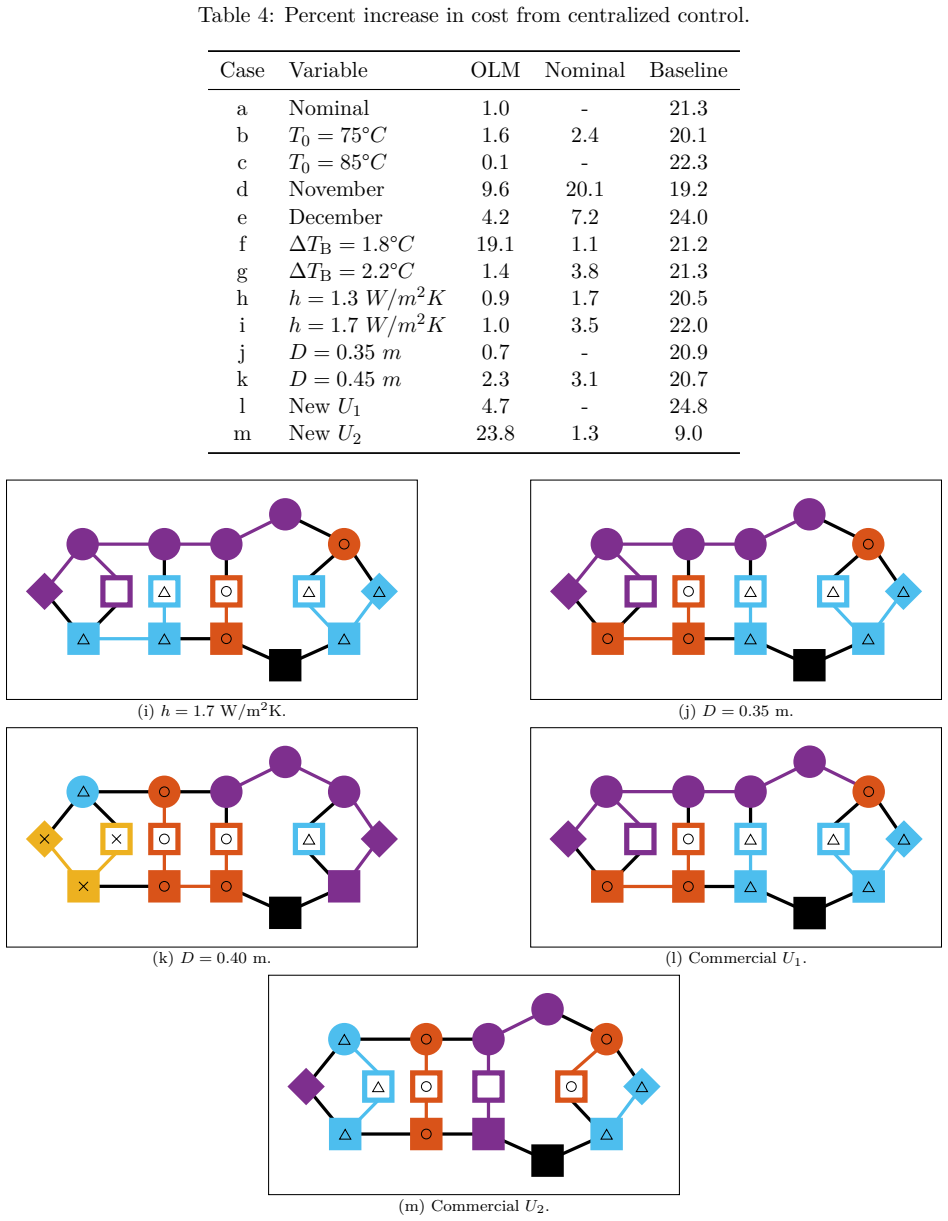
The simulation study shows that a well-designed nominal partition exhibits an average cost increase of only 2.8% relative to centralized control across eleven of the twelve cases, with three cases identifying the nominal partition as globally optimal under the perturbed conditions. The robustness study is followed by an analysis of the sensitivity of the optimality loss metric, revealing that in five of twelve cases the case-specific OLM-minimizing partitions underperform the nominally optimal one due to shifts in the relative magnitude of heat loss versus flexibility costs. This indicates that proper tuning of cost function weights and initial conditions for the performance optimization is
What carries the argument
The learning-enhanced branch-and-bound search that culls the space of possible partitions and evaluates them using a physics-based distributed model predictive control framework to find the performance-based optimal partition.
Load-bearing premise
The physics-based distributed model predictive control framework and the learning-enhanced branch-and-bound search accurately identify true optimal partitions and faithfully represent real district heating dynamics under all tested perturbations.
What would settle it
A physical district heating network test in which the cost increase under one or more of the twelve perturbations exceeds several times the simulated 2.8 percent average, or in which a different partition consistently outperforms the nominal one.
Figures




read the original abstract
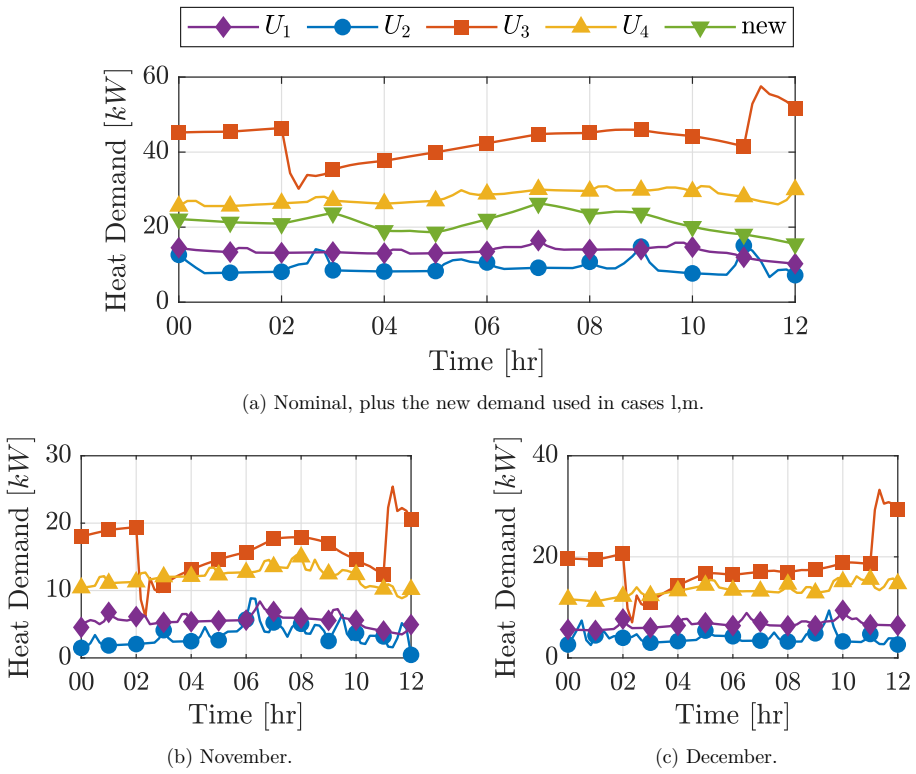
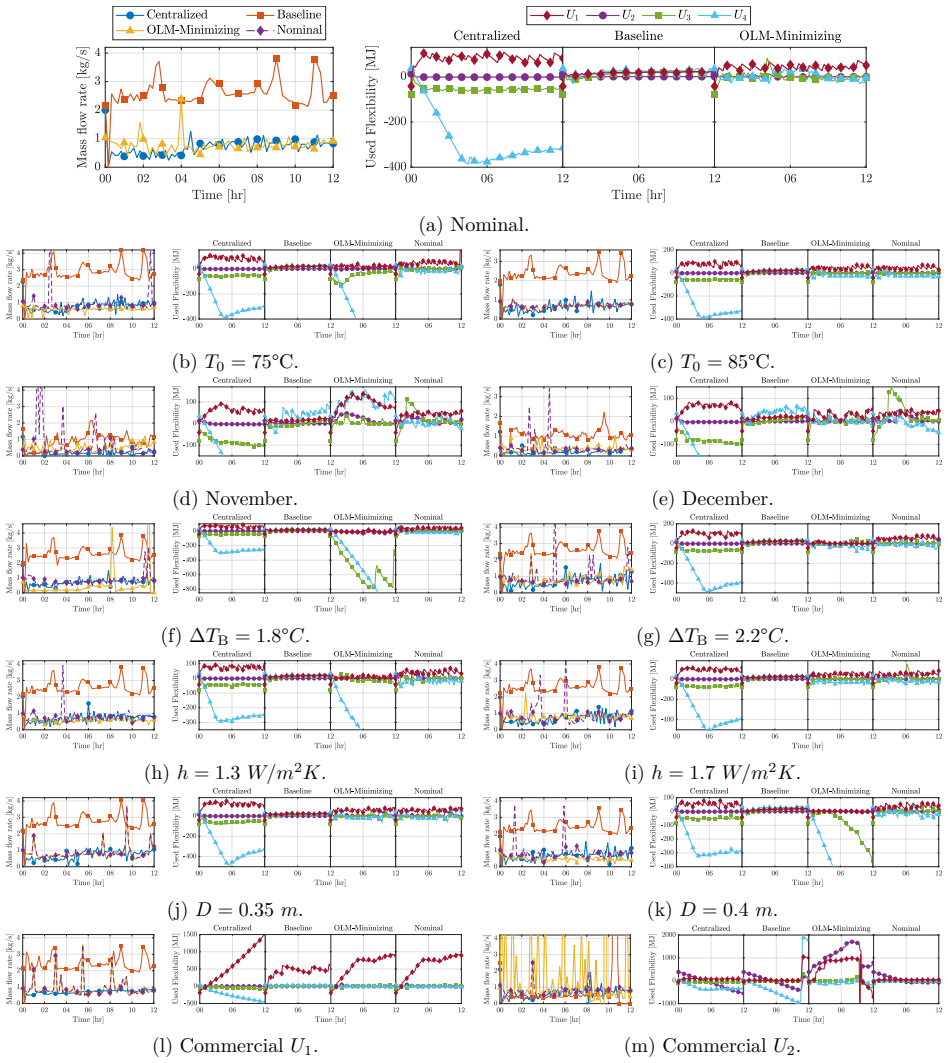
The paper presents a sensitivity analysis of the factors affecting the optimal partitioning of a district heating network for distributed control. Leveraging a physics-based, distributed model predictive control framework and a performance-based partitioning method, this work studies the relationship between variations in system parameters and the resulting optimal partition, providing insight into the robustness of a nominally designed partition to perturbed operating conditions. The enabling methodology is a learning-enhanced branch and bound method that culls the search space, reducing the number of partitions evaluated for each case. The sensitivity of the nominally optimal partition is characterized across twelve parameter variations, including supply temperature, operating season, building flexibility, pipe characteristics, and building type. This simulation study shows that a well-designed nominal partition exhibits an average cost increase of only 2.8% relative to centralized control across eleven of the twelve cases, with three cases identifying the nominal partition as globally optimal under the perturbed conditions. The robustness study is followed by an analysis of the sensitivity of the optimality loss metric (OLM), revealing that, in five of twelve cases, the case-specific OLM-minimizing partitions underperform the nominally optimal one due to shifts in the relative magnitude of heat loss versus flexibility costs. This indicates that proper tuning of cost function weights and initial conditions for the performance optimization problem is essential for reliable partition selection, and that seasonal repartitioning is warranted when demand profiles deviate substantially from the nominal, as observed in the November operating case.
Editorial analysis
A structured set of objections, weighed in public.
Referee Report
Summary. The manuscript presents a sensitivity analysis of performance-based partitioning for distributed model predictive control in district heating networks. Using a physics-based model and a learning-enhanced branch-and-bound algorithm to search for optimal partitions, the authors evaluate the robustness of a nominally optimal partition under twelve parameter variations (supply temperature, season, flexibility, pipe characteristics, building type). Key findings include an average 2.8% cost increase relative to centralized control in eleven cases, with the nominal partition being globally optimal in three cases, and an analysis showing that the optimality loss metric (OLM) can lead to suboptimal partitions in five cases due to shifts in cost components.
Significance. If the reported partitions are verifiably optimal, the results offer practical insights into when nominal partitions remain effective under perturbations and when seasonal repartitioning is advisable. The concrete quantitative outcomes from multiple simulation scenarios (including specific percentages and case counts) strengthen the contribution to control design for district heating systems. The direct simulation comparison against centralized control is a positive aspect, as it avoids circularity in the performance metrics.
major comments (3)
- [Methodology section on the learning-enhanced branch-and-bound procedure] The description of the learning-enhanced branch-and-bound method indicates that it culls the search space to reduce the number of partitions evaluated, but no suboptimality bounds, duality gaps, or cross-validation against exhaustive enumeration (even on a single small instance) are provided. Since the central claims of a 2.8% average cost increase and global optimality in three cases depend on these partitions being the true minima, this is load-bearing for the headline result.
- [Results section on sensitivity analysis and OLM] The sensitivity analysis reports concrete outcomes (2.8% average cost increase across eleven cases, three globally optimal cases, five underperforming OLM cases) from twelve parameter variations, yet provides no model validation details, error bars, or statistical measures on the simulation runs. This undermines assessment of whether the physics-based distributed MPC framework faithfully represents dynamics under all tested perturbations.
- [Analysis of the optimality loss metric (OLM)] The finding that OLM-minimizing partitions underperform the nominal in five cases is attributed to shifts in the relative magnitude of heat loss versus flexibility costs, but the manuscript does not report the specific cost function weights used or their tuning procedure. As these are free parameters, this directly affects the reliability of the OLM-based partition selection claim.
minor comments (2)
- [Abstract] The abstract states results 'across eleven of the twelve cases' but does not identify the deviating case (likely the November operating season) or report its specific cost increase.
- [Throughout manuscript] Ensure all acronyms (e.g., OLM, MPC, DHN) are defined at first use and that figure captions for any partition or cost plots include axis labels and legend details for clarity.
Simulated Author's Rebuttal
We thank the referee for the constructive review and positive assessment of the manuscript's significance. We address each major comment below with clarifications and indicate where revisions will be incorporated to improve rigor and transparency.
read point-by-point responses
-
Referee: [Methodology section on the learning-enhanced branch-and-bound procedure] The description of the learning-enhanced branch-and-bound method indicates that it culls the search space to reduce the number of partitions evaluated, but no suboptimality bounds, duality gaps, or cross-validation against exhaustive enumeration (even on a single small instance) are provided. Since the central claims of a 2.8% average cost increase and global optimality in three cases depend on these partitions being the true minima, this is load-bearing for the headline result.
Authors: We agree that explicit suboptimality guarantees would strengthen the claims. The learning-enhanced branch-and-bound combines a trained model to prioritize branches with standard bounding and pruning to reduce evaluations while targeting the global minimum. We will revise the methodology section to describe the pruning criteria in more detail and add a validation subsection showing results on a small 4-building instance where exhaustive enumeration is tractable; in that case the method recovers the true optimum. This supports the reliability of the partitions used for the reported sensitivity outcomes. revision: yes
-
Referee: [Results section on sensitivity analysis and OLM] The sensitivity analysis reports concrete outcomes (2.8% average cost increase across eleven cases, three globally optimal cases, five underperforming OLM cases) from twelve parameter variations, yet provides no model validation details, error bars, or statistical measures on the simulation runs. This undermines assessment of whether the physics-based distributed MPC framework faithfully represents dynamics under all tested perturbations.
Authors: The referee is correct that additional validation and statistical details are needed. The underlying physics-based model follows standard district-heating dynamics validated in our prior publications against measured data from the reference network. All reported runs use deterministic dynamics with fixed solver tolerances. We will add a short model-validation paragraph in the results section, reference the prior validation study, and include standard deviations for the cost metrics (computed across the twelve cases) to quantify variability under the parameter perturbations. revision: yes
-
Referee: [Analysis of the optimality loss metric (OLM)] The finding that OLM-minimizing partitions underperform the nominal in five cases is attributed to shifts in the relative magnitude of heat loss versus flexibility costs, but the manuscript does not report the specific cost function weights used or their tuning procedure. As these are free parameters, this directly affects the reliability of the OLM-based partition selection claim.
Authors: We thank the referee for highlighting this omission. The OLM uses weights w_loss = 1.0 for heat-loss cost and w_flex = 0.5 for flexibility deviation, selected so that the two terms contribute comparably under nominal conditions and reflecting typical economic ratios in district-heating operation. The weights were tuned by inspecting the nominal-case cost breakdown and ensuring neither term dominates. We will explicitly state these values and the tuning rationale in the problem-formulation section and add a short discussion of weight sensitivity to the OLM analysis. revision: yes
Circularity Check
No circularity; results from direct physics-based simulation comparisons
full rationale
The paper reports outcomes from a simulation study that evaluates a performance-based partitioning method against centralized control using a physics-based distributed MPC model across twelve parameter perturbations. The headline metrics (2.8% average cost increase, identification of nominal partition as optimal in three cases) are computed directly from the simulated costs of the selected partitions. No derivation chain reduces these quantities to fitted parameters by construction, self-defines the optimality metric, or relies on load-bearing self-citations whose validity is internal to the paper. The learning-enhanced branch-and-bound procedure is presented as a search heuristic to identify candidate partitions; the reported costs are those of the evaluated partitions, not tautologically forced by the culling rule itself. The analysis of the optimality loss metric (OLM) similarly compares case-specific outcomes without circular redefinition. This is a standard empirical sensitivity study whose claims remain falsifiable against the underlying model.
Axiom & Free-Parameter Ledger
free parameters (1)
- cost function weights
axioms (1)
- domain assumption Physics-based models accurately capture heat transfer, flow dynamics, and building thermal response in district heating networks.
Lean theorems connected to this paper
-
IndisputableMonolith/Cost/FunctionalEquation.leanwashburn_uniqueness_aczel unclearThe enabling methodology is a learning-enhanced branch and bound method that culls the search space... OLM = wmPoA·cmPoA + wsz·csz + witerciter
-
IndisputableMonolith/Foundation/BranchSelection.leanbranch_selection unclearsensitivity analysis... twelve parameter variations... nominal partition exhibits an average cost increase of only 2.8%
Reference graph
Works this paper leans on
-
[1]
Optimality Loss Minimization in Distributed Control with Application to District Heating, July 2025
Audrey Blizard and Stephanie Stockar. Optimality Loss Minimization in Distributed Control with Application to District Heating, July 2025
work page 2025
-
[2]
Davood Babaei Pourkargar, Ali Almansoori, and Prodromos Daoutidis. Comprehensive study of decomposition effects on distributed output tracking of an integrated process over a wide operating range. Chemical Engineering Research and Design , 134:553–563, June 2018
work page 2018
-
[3]
A multi-period topology and design optimization approach for district heating networks
Yannick Wack, Martin Sollich, Robbe Salenbien, Jan Diriken, Martine Baelmans, and Maarten Blommaert. A multi-period topology and design optimization approach for district heating networks. Applied Energy, 367:123380, August 2024
work page 2024
-
[4]
Francisco Javier Muros, José María Maestre, Carlos Ocampo-Martinez, EncarnacióN Algaba, and Eduardo F. Camacho. A Game Theoretical Randomized Method for Large-Scale Systems Partitioning. IEEE Access, 6:42245–42263, 2018
work page 2018
-
[5]
Relative time-averaged gain array (RTAGA) for distributed control-oriented network decomposition
Wentao Tang, Davood Babaei Pourkargar, and Prodromos Daoutidis. Relative time-averaged gain array (RTAGA) for distributed control-oriented network decomposition. AIChE Journal , 64(5):1682–1690, 2018
work page 2018
-
[6]
AmirMohammad Ebrahimi and Davood B. Pourkargar. An adaptive distributed architecture for multi-agent state estimation and control of complex process systems. Chemical Engineering Research and Design , 210:594–604, October 2024
work page 2024
-
[7]
Ulrik Brandes, Daniel Delling, Marco Gaertler, Robert Gorke, Martin Hoefer, Zoran Nikoloski, and Dorothea Wagner. On Modularity Clustering. IEEE Transactions on Knowledge and Data Engineering, 20(2):172–188, February 2008
work page 2008
-
[8]
Sujit S. Jogwar. Distributed control architecture synthesis for integrated process networks through maximization of strength of input–output impact. Journal of Process Control , 83:77– 87, November 2019
work page 2019
-
[9]
C. Ocampo-Martinez, S. Bovo, and V. Puig. Partitioning approach oriented to the decen- tralised predictive control of large-scale systems. Journal of Process Control , 21(5):775–786, June 2011
work page 2011
-
[10]
Audrey Blizard and Stephanie Stockar. Accelerating Distributed Control Design for District Heating Networks via Learning of Critical Communication Links. In IF AC-PapersOnLine, volume 59 of 5th Conference on Modeling, Estimation and Control MECC 2025 , pages 419– 424, Pittsburgh, Pennsylvania, October 2025. IF AC
work page 2025
-
[11]
Joshua H. Seaton and Philip N. Brown. On the Intrinsic Fragility of the Price of Anarchy. IEEE Control Systems Letters , 7:3573–3578, 2023. 23
work page 2023
-
[12]
Jianbo Shi and J. Malik. Normalized cuts and image segmentation. IEEE Transactions on Pattern Analysis and Machine Intelligence , 22(8):888–905, August 2000
work page 2000
-
[13]
An Introduction to Statistical Learning: With Applications in R
Gareth James, Daniela Witten, Trevor Hastie, and Robert Tibshirani, editors. An Introduction to Statistical Learning: With Applications in R . Number 103 in Springer Texts in Statistics. Springer, New York, 2013
work page 2013
- [14]
-
[15]
CasADi – A software framework for nonlinear optimization and optimal control
Joel A E Andersson, Joris Gillis, Greg Horn, James B Rawlings, and Moritz Diehl. CasADi – A software framework for nonlinear optimization and optimal control. Mathematical Pro- gramming Computation , 11(1):1–36, 2019
work page 2019
-
[16]
Andreas Wächter and Lorenz T. Biegler. On the implementation of an interior-point fil- ter line-search algorithm for large-scale nonlinear programming. Mathematical Programming, 106(1):25–57, March 2006
work page 2006
-
[17]
Community-based synthesis of distributed control architectures for integrated process networks
Sujit Suresh Jogwar and Prodromos Daoutidis. Community-based synthesis of distributed control architectures for integrated process networks. Chemical Engineering Science, 172:434– 443, November 2017. 24 A Extended Results This appendix presents additional figures used in the analysis of the control performance. It shows both the plant mass flow rates and ...
work page 2017
discussion (0)
Sign in with ORCID, Apple, or X to comment. Anyone can read and Pith papers without signing in.