Recognition: 2 theorem links
· Lean TheoremEnabling Small-Signal Stability Analysis of Black-Box Voltage Source Converters in Large-Scale Modern Power Systems
Pith reviewed 2026-05-13 02:08 UTC · model grok-4.3
The pith
A fitted state-space method lets engineers run full small-signal stability analysis on black-box voltage source converters without internal details.
A machine-rendered reading of the paper's core claim, the machinery that carries it, and where it could break.
Core claim
The SSA-FITSS methodology produces reduced-order state-space models of black-box VSCs that reproduce converter and system dynamics accurately enough to support complete eigenvalue-based modal analysis, including sensitivities and participation factors, in networks containing multiple black-box converters operating in both grid-following and grid-forming modes.
What carries the argument
The SSA-FITSS fitted state-space model, constructed through frequency-domain identification, adaptive pole expansion, reduced-order realization, and automated assignment of states to control-loop categories based on dominant frequency ranges.
If this is right
- The models reproduce both local converter dynamics and inter-area modes in large grids.
- Full participation-factor and sensitivity analysis becomes possible without proprietary data.
- Stability limits can be mapped as synchronous generation share and grid-following penetration vary.
- The same workflow applies to systems mixing grid-following and grid-forming converters.
Where Pith is reading between the lines
- The approach could be applied to other black-box power-electronic devices such as STATCOMs or HVDC links.
- If the identification step runs periodically from online measurements, it might support near-real-time stability monitoring.
- Grid planners could reduce dependence on detailed manufacturer models when screening future converter-rich scenarios.
Load-bearing premise
Frequency-domain data plus adaptive fitting and state labeling yield a representation accurate enough for system-wide modal analysis even when converter internals remain unknown.
What would settle it
Compare eigenvalues and stability margins predicted by the SSA-FITSS model against those from a known white-box model of the same converter embedded in the New England system under identical operating points.
Figures





read the original abstract
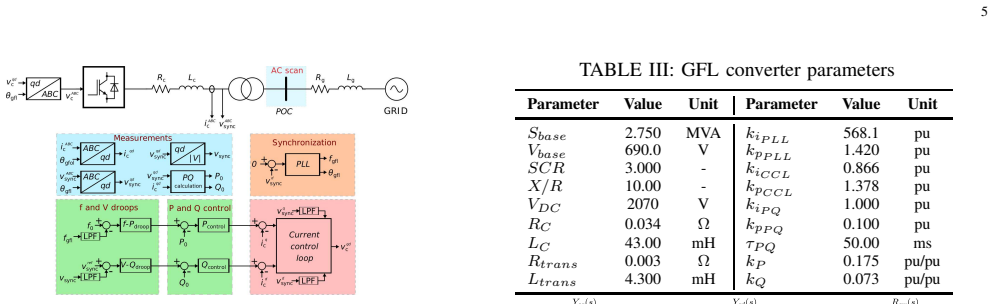
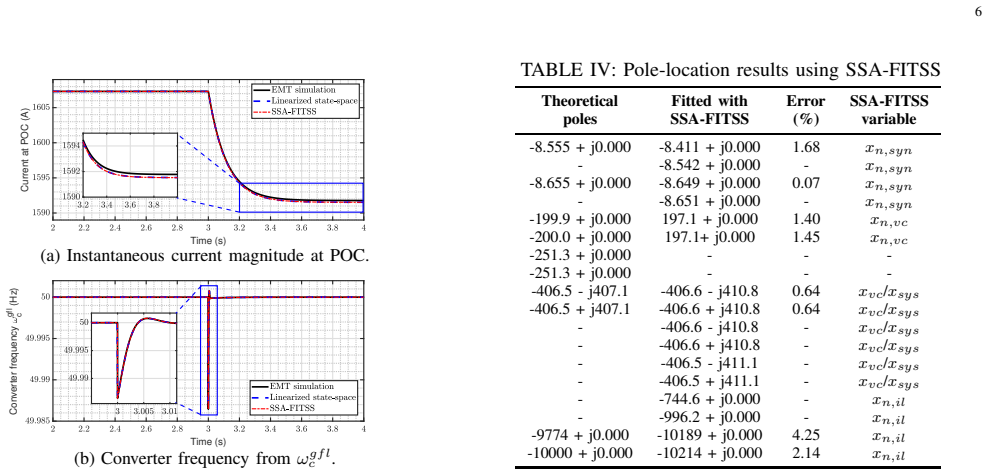
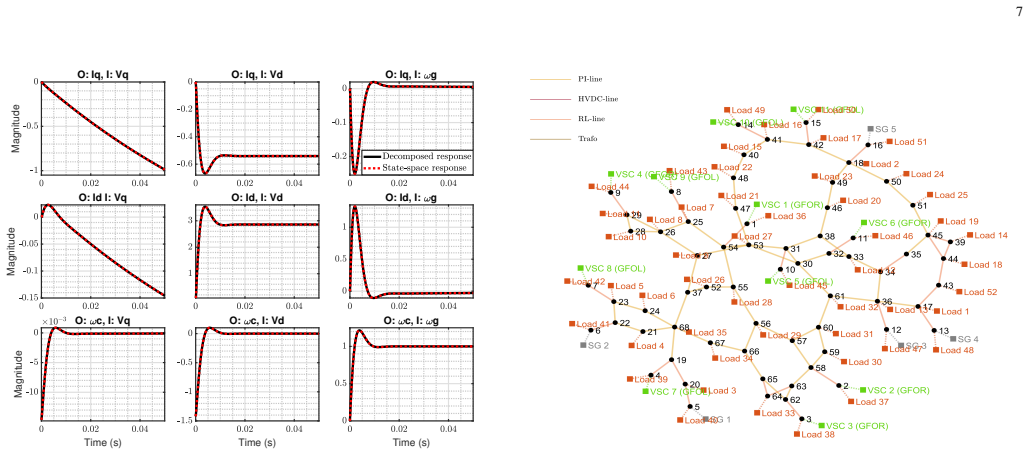
Modern power systems increasingly rely on power electronic converters, yet many of these devices are provided as black-box models, limiting the applicability of conventional small-signal analysis (SSA) tools. This work presents a unified multi-variable fitted state-space (SSA-FITSS) methodology that enables accurate small-signal modeling of black-box Voltage Source Converters (VSCs) using frequency-domain (FD) identification, adaptive pole-expansion, and reduced-order realization. The method includes an automated state-interpretation strategy that assigns fitted states to representative control-loop categories based on their dominant frequency ranges, providing an approximate but meaningful physical interpretation of the identified dynamics. This capability allows extensive modal analysis, including eigenvalue sensitivities and participation factors, in systems where internal converter details are unavailable. The methodology is validated on a grid-following (GFL) VSC and applied to the New England system, which contains multiple black-box converters operating in both GFL and grid-forming (GFM) modes. Results show that the SSA-FITSS models accurately reproduce converter and system dynamics, support full eigenvalue-based analysis, and reveal stability limits under varying synchronous generation and GFL penetration levels. The approach overcomes key limitations of existing identification-based techniques by enabling scalable, interpretable, and system-wide stability assessment.
Editorial analysis
A structured set of objections, weighed in public.
Referee Report
Summary. The paper proposes the SSA-FITSS methodology, which combines frequency-domain identification, adaptive pole-expansion, and reduced-order realization to derive state-space models of black-box VSCs. An automated state-interpretation step assigns states to control-loop categories by dominant frequency ranges. The approach is validated on a single GFL VSC via time-domain and frequency-response matching and then applied to the New England 39-bus system containing multiple black-box GFL and GFM converters, enabling eigenvalue analysis, sensitivity studies, and identification of stability limits under varying synchronous generation and GFL penetration levels.
Significance. If the reduced-order models preserve modal properties (eigenvalues, sensitivities, participation factors) with sufficient fidelity when embedded in large systems, the work would be significant: it directly addresses the practical barrier of black-box converter models in modern grids, allowing conventional SSA tools to be applied at scale without requiring internal converter details. The combination of data-driven fitting with approximate physical interpretability is a practical advance over purely black-box or white-box alternatives.
major comments (2)
- [Validation and New England application] The central claim that SSA-FITSS models 'accurately reproduce converter and system dynamics' and 'reveal stability limits' rests on the reduced-order realizations preserving not only input-output behavior but also eigenvalue locations and participation factors to within tolerances that do not change stability conclusions. The manuscript reports time-domain and frequency-response agreement for the isolated GFL VSC but provides no quantitative error metrics (e.g., relative eigenvalue error, participation-factor deviation, or sensitivity error) when the fitted models are inserted into the full 39-bus New England system. This omission is load-bearing for the multi-converter modal-analysis results.
- [Methodology (reduced-order realization)] The adaptive pole-expansion and reduced-order realization steps are described as producing models suitable for system-wide eigenvalue analysis, yet no bounds are given on truncation or order-reduction error in the 10–100 Hz range that is typically critical for converter-driven modes. Without such bounds, it is unclear whether systematic bias could shift reported stability limits under changing GFL/GFM penetration.
minor comments (2)
- The automated state-interpretation strategy is presented as providing an 'approximate but meaningful' physical mapping; a brief discussion of how frequency-range thresholds are selected and any sensitivity of the interpretation to those thresholds would improve clarity.
- The abstract states that the method 'overcomes key limitations of existing identification-based techniques,' but the manuscript would benefit from a concise table or paragraph explicitly contrasting SSA-FITSS against the cited prior methods on the dimensions of scalability, interpretability, and modal-property preservation.
Simulated Author's Rebuttal
We are grateful to the referee for the thorough review and valuable suggestions. The comments on validation metrics and error bounds are well-taken and will help improve the clarity and rigor of our work. We have prepared responses to each major comment and will revise the manuscript accordingly to incorporate additional quantitative analyses.
read point-by-point responses
-
Referee: [Validation and New England application] The central claim that SSA-FITSS models 'accurately reproduce converter and system dynamics' and 'reveal stability limits' rests on the reduced-order realizations preserving not only input-output behavior but also eigenvalue locations and participation factors to within tolerances that do not change stability conclusions. The manuscript reports time-domain and frequency-response agreement for the isolated GFL VSC but provides no quantitative error metrics (e.g., relative eigenvalue error, participation-factor deviation, or sensitivity error) when the fitted models are inserted into the full 39-bus New England system. This omission is load-bearing for the multi-converter modal-analysis results.
Authors: We thank the referee for highlighting this critical aspect of validation. Our primary validation for the SSA-FITSS method was conducted on the isolated GFL VSC, where we showed excellent agreement in both time-domain responses and frequency-domain characteristics. For the New England 39-bus system application, the focus was on demonstrating the feasibility of performing full modal analysis with black-box models and identifying stability trends with varying generation mixes. However, we recognize that without quantitative error metrics on the system-level eigenvalues and participation factors, the robustness of the stability limit findings could be questioned. Since the VSCs are black-box, a ground-truth small-signal model for the entire system is not available for direct comparison. To address this, we will revise the manuscript to include a sensitivity analysis with respect to the reduced model order. Specifically, we will report the variation in critical eigenvalues and participation factors as the model order is increased, demonstrating that the stability conclusions (e.g., the penetration levels at which instability occurs) remain unchanged beyond a certain order. This will provide indirect but quantitative support that the modal properties are preserved sufficiently for the reported results. We will add corresponding figures and tables in the revised version. revision: yes
-
Referee: [Methodology (reduced-order realization)] The adaptive pole-expansion and reduced-order realization steps are described as producing models suitable for system-wide eigenvalue analysis, yet no bounds are given on truncation or order-reduction error in the 10–100 Hz range that is typically critical for converter-driven modes. Without such bounds, it is unclear whether systematic bias could shift reported stability limits under changing GFL/GFM penetration.
Authors: We agree that explicit bounds on the approximation error in the frequency range of interest would strengthen the methodology section. The adaptive pole-expansion step iteratively adds poles to minimize the fitting error across the frequency range, and the subsequent reduced-order realization employs a method (such as balanced truncation) where the order is selected based on the decay of Hankel singular values. In the revised manuscript, we will include a detailed error analysis, reporting the maximum relative error in the frequency response magnitude and phase within the 10-100 Hz band for the fitted models used in the study. Additionally, we will provide guidelines or criteria used for selecting the reduced order to ensure that the error in this critical range does not exceed a threshold that could impact the low-frequency stability modes. This will clarify that systematic bias is minimized and does not alter the stability limit identifications. revision: yes
Circularity Check
No circularity in data-driven SSA-FITSS identification and validation pipeline
full rationale
The paper presents an empirical methodology for black-box VSC modeling via frequency-domain identification, adaptive pole-expansion, reduced-order realization, and approximate state interpretation. All central claims rest on direct comparisons of the resulting state-space models against reference time-domain and frequency-response data on both single-converter and full New England 39-bus test systems. No derivation step reduces a reported prediction or eigenvalue result to a fitted parameter by construction; the fitted models are treated as approximations whose accuracy is externally checked rather than assumed. No load-bearing self-citations, uniqueness theorems, or ansatzes imported from prior author work appear in the core pipeline. The work is therefore self-contained against external simulation benchmarks.
Axiom & Free-Parameter Ledger
Lean theorems connected to this paper
-
IndisputableMonolith.Cost.FunctionalEquationwashburn_uniqueness_aczel unclearfrequency-domain identification, adaptive pole-expansion, and reduced-order realization
-
IndisputableMonolith.Foundation.AlexanderDualityalexander_duality_circle_linking unclearautomated state-interpretation strategy based on dominant frequency ranges
Reference graph
Works this paper leans on
-
[1]
M. Cheah-Mane, A. Egea-Alvarez, E. Prieto-Araujo, H. Me hrjerdi, O. Gomis-Bellmunt, and L. Xu, “Modeling and analysis approa ches for small-signal stability assessment of power-electroni c-dominated systems,” WIREs Energy and Environment, vol. 12, no. 1, p. e453, 2023. 10
work page 2023
-
[2]
M. Cheah-Mane, J. Arevalo-Soler, D. Moutevelis, E. Mate u-Barriendos, E. Prieto-Araujo, O. Gomis-Bellmunt, J. Renedo, M. Martin- Almenta, E. Nuño-Martinez, S. Martinez-Villanueva, J. Jung, N. Kim, and Y . Kwon, “A new paradigm for small-signal stability analysi s in modern power systems: Challenges, models, and methods in power sys tems rich in power elec...
work page 2026
-
[3]
Nonlinear black-box models in sys tem identification: Mathematical foundations,
A. Juditsky, H. Hjalmarsson, A. Benveniste, B. Delyon, L . Ljung, J. SjÖberg, and Q. Zhang, “Nonlinear black-box models in sys tem identification: Mathematical foundations,” Automatica, vol. 31, no. 12, pp. 1725–1750, 1995, trends in System Identification
work page 1995
-
[4]
Perspectives on system identification,
L. Ljung, “Perspectives on system identification,” Annual Reviews in Control, vol. 34, no. 1, pp. 1–12, 2010
work page 2010
-
[5]
Small-signa l stability analysis of inverter-fed power systems using component con nection method,
Y . Wang, X. Wang, Z. Chen, and F. Blaabjerg, “Small-signa l stability analysis of inverter-fed power systems using component con nection method,” IEEE Transactions on Smart Grid , vol. 9, no. 5, pp. 5301–5310, 2018
work page 2018
-
[6]
Harmonic sta bility analysis of inverter-fed power systems using component con nection method,
Y . Wang, X. Wang, F. Blaabjerg, and Z. Chen, “Harmonic sta bility analysis of inverter-fed power systems using component con nection method,” in 2016 IEEE 8th International Power Electronics and Motion Control Conference (IPEMC-ECCE Asia) , 2016, pp. 2667–2674
work page 2016
-
[7]
Multi-frequency stability of con verter-based modern power systems,
L. Kocewiak and et al, “Multi-frequency stability of con verter-based modern power systems,” CIGRE, Technical Brochure TB 928, 2024, working Group C4.49. [Online]. Available: https://www.e-cigre.org/publications/detail/928-multi-frequency-stability-of-converter-based-modern-po wer-systems.html
work page 2024
-
[8]
D. Y ang and Y . Sun, “Siso impedance-based stability anal ysis for system-level small-signal stability assessment of lar ge-scale power electronics-dominated power systems,” IEEE Transactions on Sustainable Energy , vol. 13, no. 1, pp. 537–550, 2022
work page 2022
-
[9]
J. Arevalo-Soler, D. Moutevelis, E. Mateu-Barriendos, O. Alican, C. Collados-Rodriguez, M. Cheah-Mañe, E. Prieto-Araujo, a nd O. Gomis-Bellmunt, “A matlab-based toolbox for automatic e mt modeling and small-signal stability analysis of modern pow er systems,”
-
[10]
Available: https://arxiv.org/abs/2506
[Online]. Available: https://arxiv.org/abs/2506. 22201
-
[11]
Small-signal modeling of ac power e lectronic systems: Critical review and unified modeling,
Y . Liao and X. Wang, “Small-signal modeling of ac power e lectronic systems: Critical review and unified modeling,” IEEE Open Journal of Power Electronics, vol. 2, pp. 424–439, 2021
work page 2021
-
[12]
Composi ng small-signal models via the component connection method wi th python and excel,
B. Vilmann, O. Saborío-Romano, and D. Müller, “Composi ng small-signal models via the component connection method wi th python and excel,” in 2024 59th International Universities Power Engineering Conference (UPEC) , 2024, pp. 1–6
work page 2024
-
[13]
I. J. Perez-arriaga, G. C. V erghese, and F. C. Schweppe, “Selective modal analysis with applications to electric power systems, part i: Heuristic introduction,” IEEE Transactions on Power Apparatus and Systems , vol. PAS-101, no. 9, pp. 3117–3125, 1982
work page 1982
-
[14]
F. L. Pagola, I. J. Pérez-Arriaga, and G. C. V erghese, “O n sensitivities, residues and participations: Applications to oscillatory stability analysis and control,” IEEE Transactions on Power Systems , vol. 4, no. 1, pp. 278–285, 1989
work page 1989
-
[15]
L. A. Garcia-Reyes, O. Gomis-Bellmunt, E. Prieto-Arau jo, V . A. Lacerda, and M. Cheah-Mañe, “Siad-tool: A comprehensive frequency-domain tool for small-signal stability and inte raction assessment in modern power systems,” 2026. [Online]. Avail able: https://arxiv.org/abs/2601.05519
-
[16]
M. Amin, C. Zhang, A. Rygg, M. Molinas, E. Unamuno, and M. Belkhayat, Nyquist Stability Criterion and its Application to Power Electronics Systems. John Wiley & Sons, Ltd, 2019, pp. 1–22
work page 2019
-
[17]
General rules of using bode plots fo r impedance-based stability analysis,
Y . Liao and X. Wang, “General rules of using bode plots fo r impedance-based stability analysis,” in 2018 IEEE 19th W orkshop on Control and Modeling for Power Electronics (COMPEL) , 2018, pp. 1–6
work page 2018
-
[18]
State-space black-box model identification of a vo ltage-source converter with lcl filter,
F. Huerta, S. Cóbreces, F. J. Rodríguez, M. Moranchel, a nd I. Sanz, “State-space black-box model identification of a vo ltage-source converter with lcl filter,” in 2012 3rd IEEE International Symposium on Power Electronics for Distributed Generation Systems (PED G), 2012, pp. 550–557
work page 2012
-
[19]
Black-box impedance-based stability assessment of dynamic interact ions between converters and grid,
N. Cifuentes, M. Sun, R. Gupta, and B. C. Pal, “Black-box impedance-based stability assessment of dynamic interact ions between converters and grid,” IEEE Transactions on Power Systems , vol. 37, no. 4, pp. 2976–2987, 2022
work page 2022
-
[20]
Y . Zhu, I. Kocar, S. Bu, T. Xue, and U. Karaagac, “Applica tion of frequency-domain fitting and descriptor state-space mod eling for the analysis of sub-synchronous oscillations in multi-ibr systems,” International Journal of Electrical Power & Energy Systems , vol. 177, p. 111778, 2026
work page 2026
-
[21]
Imp roved pole placement and compaction of mimo vector fitting applied to sy stem identification,
A. M. Smith, S. D’Arco, J. A. Suul, and B. Gustavsen, “Imp roved pole placement and compaction of mimo vector fitting applied to sy stem identification,” IEEE Transactions on Power Delivery , vol. 39, no. 2, pp. 1259–1270, 2024
work page 2024
-
[22]
A robust approach for syst em identification in the frequency domain,
B. Gustavsen and A. Semlyen, “A robust approach for syst em identification in the frequency domain,” IEEE Transactions on Power Delivery, vol. 19, no. 3, pp. 1167–1173, 2004
work page 2004
-
[23]
A. Ramirez, “V ector fitting-based calculation of frequ ency-dependent network equivalents by frequency partitioning and model-o rder reduction,” IEEE Transactions on Power Delivery , vol. 24, no. 1, pp. 410–415, 2009
work page 2009
-
[24]
Data-driven state-space modeling for small-si gnal stability analysis of black-box power converters,
L. A. Garcia-Reyes, E. Prieto-Araujo, V . A. Lacerda, J. Arévalo-Soler, O. Gomis-Bellmunt, M. Martin-Almenta, E. Nuño-Martínez, a nd J. Renedo, “Data-driven state-space modeling for small-si gnal stability analysis of black-box power converters,” in 2025 IEEE PES Innovative Smart Grid Technologies Europe (ISGT EUROPE) , 2025, pp. 1–6
work page 2025
-
[25]
Electrochemical system analysis from impedance data to system identification,
M. A. Danzer, C. Plank, and T. Rüther, “Electrochemical system analysis from impedance data to system identification,” Cell Reports Physical Science, vol. 5, no. 7, p. 102091, 2024
work page 2024
-
[26]
D ominant modes identification of linear systems via geometrical sear ch,
A. Semlyen, A. Ramirez, B. Gustavsen, and R. Iravani, “D ominant modes identification of linear systems via geometrical sear ch,” IEEE Transactions on Power Delivery , vol. 36, no. 6, pp. 3289–3298, 2021
work page 2021
-
[27]
Iter ative matrix fitting approach of frequency dependent matrices bas ed on vector fitting,
E. Bañuelos-Cabral, J. Gutiérrez-Robles, J. Nuño-Ayó n, M. V ega-Grijalva, J. Naredo, and J. Sotelo-Castañón, “Iter ative matrix fitting approach of frequency dependent matrices bas ed on vector fitting,” Electric Power Systems Research , vol. 252, p. 112346, 2026
work page 2026
-
[28]
M. Amin and M. Molinas, “Small-signal stability assess ment of power electronics based power systems: A discussion of impe dance- and eigenvalue-based methods,” IEEE Transactions on Industry Applications, vol. 53, no. 5, pp. 5014–5030, 2017
work page 2017
-
[29]
L. A. Garcia-Reyes, “Siad-tool: A comprehensive frequ ency-domain tool for small-signal stability and interaction assessment in m odern power systems,” https://github.com/luisangelgare/SIaD-Tool , 2025
work page 2025
-
[30]
Rational approximation o f frequency domain responses by vector fitting,
B. Gustavsen and A. Semlyen, “Rational approximation o f frequency domain responses by vector fitting,” IEEE Transactions on Power Delivery, vol. 14, no. 3, pp. 1052–1061, 1999
work page 1999
-
[31]
SINTEF Energy Research, “V ector fitting,” https://www.sintef.no/en/software/vector-fitting/ , 20 26, accessed: 2026-02-13
work page 2026
-
[32]
MathWorks, Balanced state-space realization , https://es.mathworks.com/help/control/ref/dynamicsystem.balreal.html, The MathWorks, Inc., Natick, Massachusetts, United States , 2023
work page 2023
-
[33]
R. Teodorescu, M. Liserre, and P . Rodriguez, Grid Converters for Photovoltaic and Wind Power Systems . John Wiley & Sons, Ltd, 2011
work page 2011
-
[34]
A dynamic similarity index for assessing voltage source be haviour in power systems,
O. Alican, D. Moutevelis, J. Arévalo-Soler, C. Collado s-Rodriguez, J. Amorós, O. Gomis-Bellmunt, M. Cheah-Mañe, and E. Prieto- Araujo, “A dynamic similarity index for assessing voltage source be haviour in power systems,” IEEE Transactions on Power Systems , pp. 1–14, 2025
work page 2025
-
[35]
J. M. Guerrero, J. C. V asquez, J. Matas, L. G. de Vicuna, a nd M. Castilla, “Hierarchical control of droop-controlled ac and dc microg rids—a general approach toward standardization,” IEEE Transactions on Industrial Electronics, vol. 58, no. 1, pp. 158–172, 2011
work page 2011
-
[36]
P . Rodríguez, R. Teodorescu, I. Candela, A. V . Timbus, M . Liserre, and F. Blaabjerg, “New positive-sequence voltage detector for grid synchronization of power converters under faulty grid cond itions,” in 2006 37th IEEE Power Electronics Specialists Conference , 2006
work page 2006
-
[37]
Grid-synchronization methods for power conve rters,
F. D. Freijedo, J. Doval-Gandoy, O. Lopez, C. Martinez- Peñalver, A. G. Y epes, P . Fernandez-Comesaña, J. Malvar, A. Nogueiras, J. M arcos, and A. Lago, “Grid-synchronization methods for power conve rters,” in 2009 35th Annual Conference of IEEE Industrial Electronics , 2009, pp. 522–529
work page 2009
-
[38]
Modeling, an alysis and testing of autonomous operation of an inverter-based micro grid,
N. Pogaku, M. Prodanovic, and T. C. Green, “Modeling, an alysis and testing of autonomous operation of an inverter-based micro grid,” IEEE Transactions on Power Electronics , vol. 22, no. 2, pp. 613–625, 2007
work page 2007
-
[39]
Q.-C. Zhong and T. Hornik, Control of Power Inverters in Renewable Energy and Smart Grid Integration . John Wiley & Sons, Ltd, 2012, ch. 18, pp. 277–296
work page 2012
-
[40]
Fr equency domain inertia design of grid-forming converters,
S. Jiang, Y . Zhu, T. Xu, X. Wang, and G. Konstantinou, “Fr equency domain inertia design of grid-forming converters,” IEEE Transactions on Power Electronics , vol. 40, no. 7, pp. 8886–8898, 2025
work page 2025
-
[41]
Definition and classification of power system stability – revisited & exten ded,
N. Hatziargyriou, J. Milanovic, C. Rahmann, and et al., “Definition and classification of power system stability – revisited & exten ded,” IEEE Transactions on Power Systems , vol. 36, no. 4, pp. 3271–3281, 2021
work page 2021
-
[42]
Stability and operation limits of powe r systems with high penetration of power electronics,
C. Collados-Rodriguez, M. Cheah-Mane, E. Prieto-Arau jo, and O. Gomis-Bellmunt, “Stability and operation limits of powe r systems with high penetration of power electronics,” International Journal of Electrical Power & Energy Systems , vol. 138, p. 107728, 2022
work page 2022
discussion (0)
Sign in with ORCID, Apple, or X to comment. Anyone can read and Pith papers without signing in.