Recognition: no theorem link
Quantifying the Reconstructability of Astrophysical Methods with Large Language Models and Information Theory: A Case Study in Spectral Reconstruction
Pith reviewed 2026-05-13 00:45 UTC · model grok-4.3
The pith
Increasing text clarifies astrophysical method structure but leaves an entropy floor of implementation variance.
A machine-rendered reading of the paper's core claim, the machinery that carries it, and where it could break.
Core claim
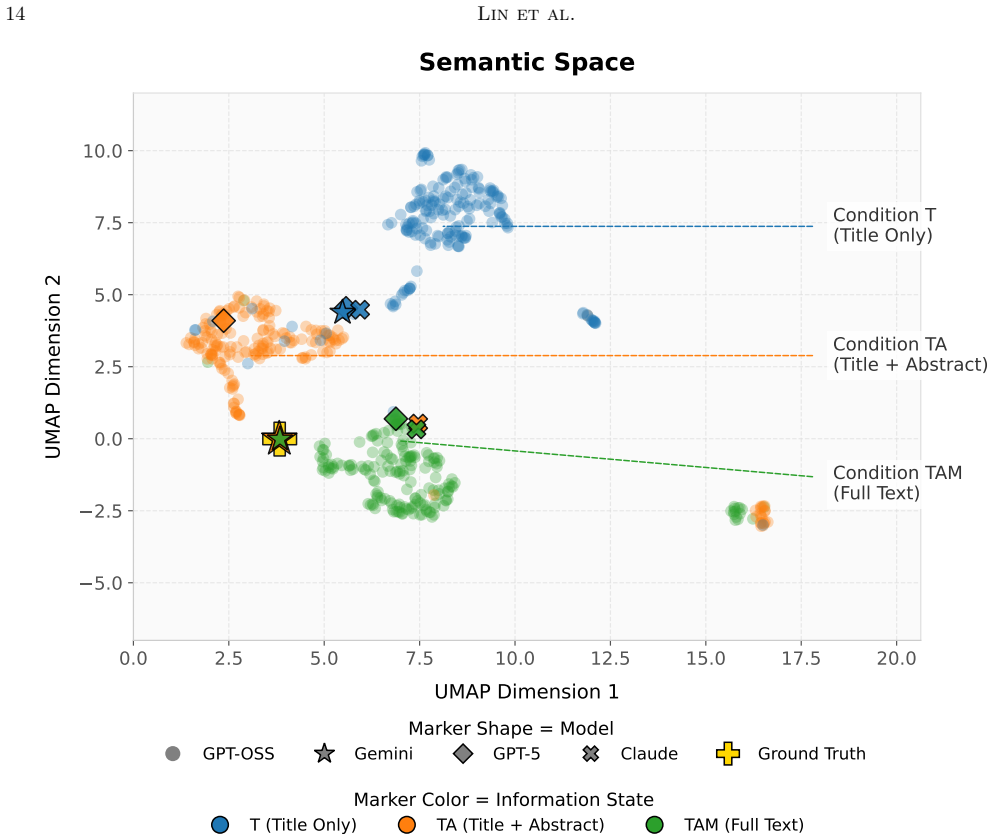
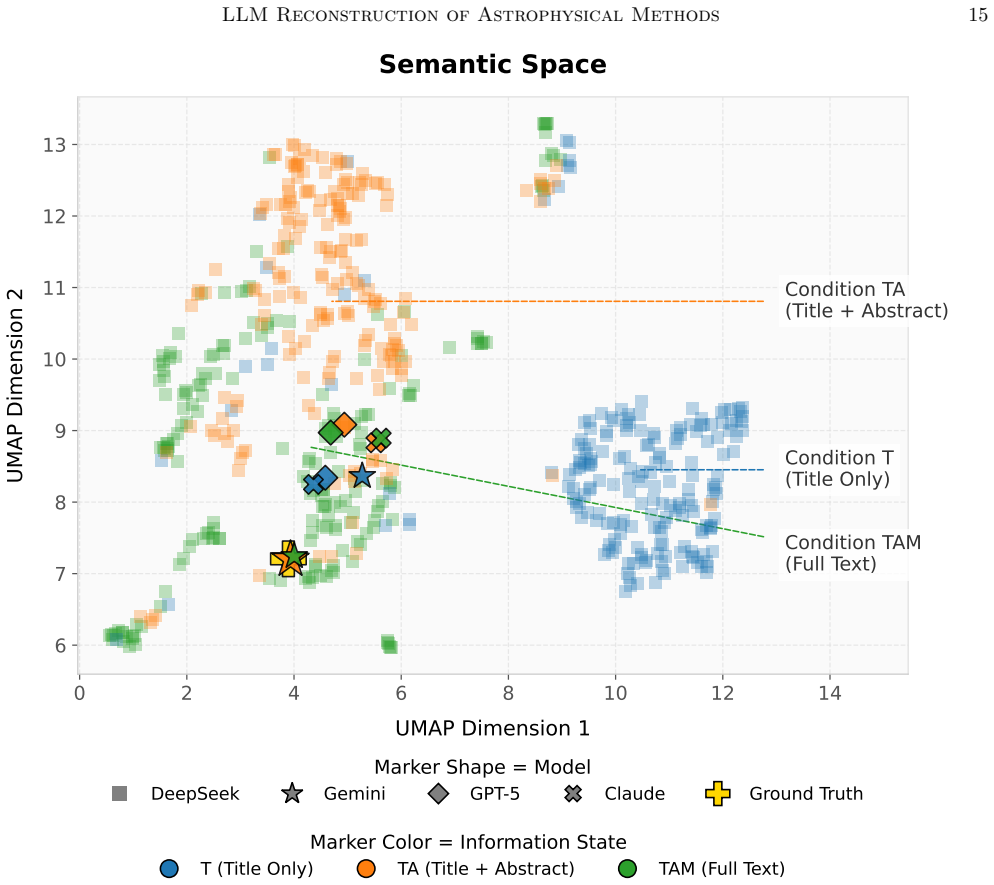
By treating algorithmic reconstruction as a probability distribution generated by LLMs, Shannon entropy and Jensen-Shannon divergence quantify how strongly text constrains the hypothesis space of valid implementations. For TNO spectral reconstruction from sparse photometry, increasing manuscript text from title through abstract to full methods clarifies overall algorithmic structure yet fails to eliminate variance at the implementation level, establishing an entropy floor. Multiple divergent implementations remain consistent with explicit instructions. LLMs easily recover core functional methodologies but systematically fail to infer the tacit expert knowledge required for strict scientific
What carries the argument
LLM-generated probability distributions over implementations, measured by Shannon entropy to establish the entropy floor and Jensen-Shannon divergence to compare distributions across levels of prompt text.
If this is right
- Authors can prompt LLMs with their own methods text to identify sections that still permit high implementation variance.
- Reproducibility in astrophysics is limited by inherent ambiguity in natural-language descriptions even when core logic is recovered.
- The TNO spectral case shows that functional methodology is recovered while strict calibration steps are not.
- LLMs can serve as zero-shot tools to audit methodological transparency in published pipelines.
Where Pith is reading between the lines
- The entropy floor diagnostic could be applied to method sections in other fields to flag insufficient detail.
- Including pseudocode or executable examples in papers may lower the floor more than additional prose alone.
- If model capabilities advance, the measured floor could drop, altering standards for sufficient method description.
Load-bearing premise
That LLM-generated distributions accurately sample the full space of valid implementations consistent with the text, and that remaining variance is caused by missing tacit knowledge rather than limitations of the models or prompting.
What would settle it
Human experts implementing the TNO spectral method from the same text levels produce distributions with lower variance than the LLM outputs, or adding explicit calibration details reduces measured entropy to near zero.
Figures

read the original abstract
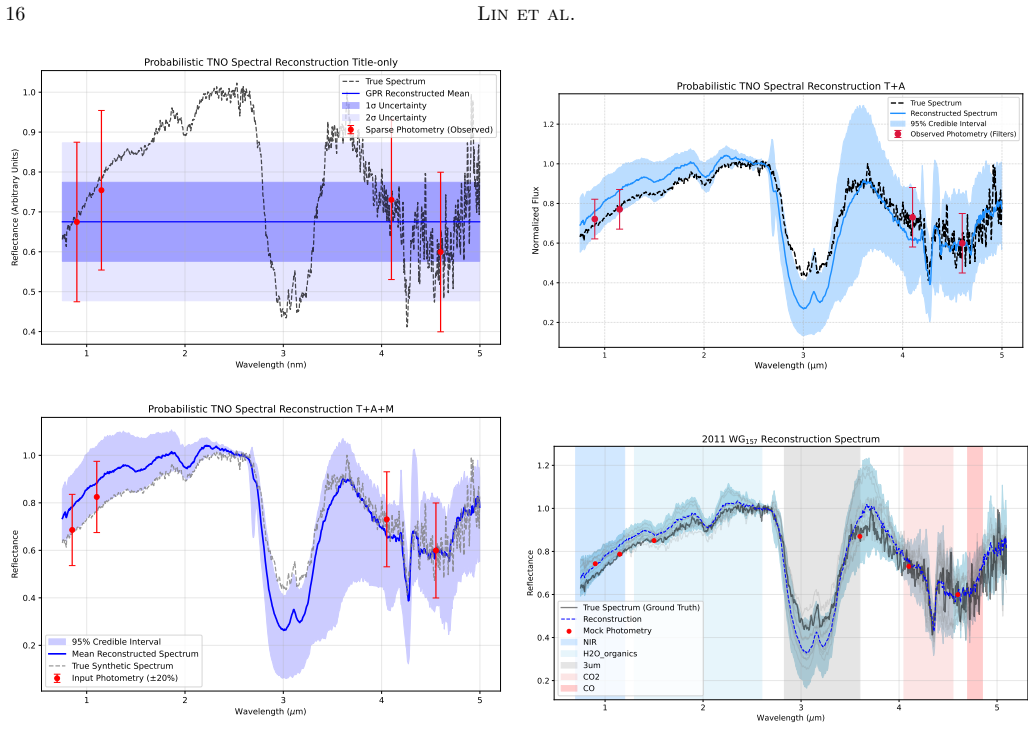
Modern astrophysical studies rely heavily on complex data analysis pipelines; however, published descriptions often lack the detail required for computational reproducibility. In this work, we present an information-theoretic framework to quantify how effectively a method can be reconstructed from its written description. By treating algorithmic reconstruction as a probability distribution generated by Large Language Models (LLMs), we utilize Shannon entropy and Jensen-Shannon divergence to measure how strongly text constrains the hypothesis space of valid implementations. We demonstrate this approach through a case study of Trans-Neptunian Object (TNO) spectral reconstruction from sparse photometry. By prompting frontier LLMs with varying levels of manuscript text (Title, Abstract, and Methods), we find that while increasing text successfully clarifies the overall algorithmic structure, it fails to eliminate variance at the implementation level. This persistent variance establishes an "entropy floor," demonstrating that multiple divergent implementations remain consistent with explicit instructions. To evaluate practical reproducibility, we convert these reconstructed algorithms into executable pipelines. Our results reveal that, while LLMs easily recover core functional methodologies, they systematically fail to infer the tacit expert knowledge required for strict scientific calibration. This pilot study demonstrates that LLMs can be repurposed as a zero-shot diagnostic tool to audit methodological transparency, helping authors identify missing structural constraints and preserve scientific integrity in an era of automated research.
Editorial analysis
A structured set of objections, weighed in public.
Referee Report
Summary. The manuscript presents an information-theoretic framework for quantifying the reconstructability of astrophysical methods from their textual descriptions. It uses LLMs to sample possible implementations and applies Shannon entropy and Jensen-Shannon divergence to assess how much the description constrains the space of valid algorithms. The approach is illustrated with a case study on spectral reconstruction of Trans-Neptunian Objects from sparse photometry, where increasing the provided text from title to full methods reduces but does not eliminate variance in LLM-generated implementations, leading to an 'entropy floor' attributed to missing tacit knowledge. The study also converts the reconstructed algorithms into executable code to evaluate practical reproducibility.
Significance. If validated, this framework could serve as a valuable diagnostic for methodological transparency in astronomy, helping to identify gaps in published descriptions that affect reproducibility. The information-theoretic metrics provide a quantitative way to evaluate how well methods are communicated, which is particularly relevant in an era of complex pipelines and automated analysis. The pilot nature on one case study limits immediate impact, but the idea of repurposing LLMs for auditing descriptions has potential for broader application if controls and details are strengthened.
major comments (2)
- [Case Study] The central finding of a persistent 'entropy floor' is interpreted as evidence that multiple divergent implementations are consistent with the explicit instructions due to missing tacit knowledge. However, this interpretation requires that the LLM sampling accurately reflects only valid implementations and would converge for fully specified methods. No control experiment is described using a trivial, completely specified algorithm (e.g., a standard photometric zero-point calculation with every step and parameter enumerated) to demonstrate that entropy approaches zero when all details are provided. This control is necessary to rule out that the floor arises from LLM stochasticity, temperature sampling, or prompting limitations rather than the TNO method's description.
- [Methods] The methods for generating the LLM distributions, including exact prompt templates, temperature settings, number of samples, and the precise procedure for computing Jensen-Shannon divergence from outputs, lack sufficient detail to allow independent verification or reproduction of the reported entropy values and floor.
minor comments (2)
- [Abstract] The abstract refers to 'frontier LLMs' without naming the specific models; this should be stated explicitly in the main text along with version information.
- Figure captions and axis labels should be expanded to include units and a brief description of what the plotted entropy/divergence values represent.
Simulated Author's Rebuttal
We thank the referee for their constructive comments, which identify key areas for improving the rigor and reproducibility of our framework. We address each major comment below.
read point-by-point responses
-
Referee: [Case Study] The central finding of a persistent 'entropy floor' is interpreted as evidence that multiple divergent implementations are consistent with the explicit instructions due to missing tacit knowledge. However, this interpretation requires that the LLM sampling accurately reflects only valid implementations and would converge for fully specified methods. No control experiment is described using a trivial, completely specified algorithm (e.g., a standard photometric zero-point calculation with every step and parameter enumerated) to demonstrate that entropy approaches zero when all details are provided. This control is necessary to rule out that the floor arises from LLM stochasticity, temperature sampling, or prompting limitations rather than the TNO method's description.
Authors: We agree that a control experiment with a fully specified trivial algorithm is required to confirm that the entropy floor arises from missing tacit knowledge rather than LLM stochasticity or prompting artifacts. We will add this control to the revised manuscript, using a standard photometric zero-point calculation with every step and parameter explicitly enumerated, and show that entropy approaches zero under complete specification. revision: yes
-
Referee: [Methods] The methods for generating the LLM distributions, including exact prompt templates, temperature settings, number of samples, and the precise procedure for computing Jensen-Shannon divergence from outputs, lack sufficient detail to allow independent verification or reproduction of the reported entropy values and floor.
Authors: We acknowledge the need for greater methodological transparency. In the revised manuscript we will include the exact prompt templates, temperature settings, number of samples per condition, and the full procedure for parsing outputs and computing Jensen-Shannon divergence, enabling independent reproduction of the entropy values. revision: yes
Circularity Check
No significant circularity detected
full rationale
The paper applies standard Shannon entropy and Jensen-Shannon divergence directly to empirical distributions of implementations generated by prompting LLMs with varying levels of manuscript text. The entropy floor is computed as an observed quantity from those LLM outputs rather than being defined in terms of the target result or fitted to it. No equations or steps reduce a claimed prediction to its own inputs by construction, and the central claim does not rely on self-citations or uniqueness theorems imported from the authors' prior work. The derivation is self-contained against external benchmarks because it uses LLMs as an independent diagnostic probe on the provided descriptions.
Axiom & Free-Parameter Ledger
axioms (2)
- domain assumption LLM outputs can be treated as probability distributions over valid algorithm implementations
- standard math Shannon entropy and Jensen-Shannon divergence quantify the constraining power of text on implementation space
Reference graph
Works this paper leans on
-
[1]
2026, Nature Astronomy, 10, 467, doi: 10.1038/s41550-026-02858-x
-
[2]
2024, arXiv e-prints, arXiv:2412.19941, doi: 10.48550/arXiv.2412.19941
Allen, A., & DuPrie, K. 2024, arXiv e-prints, arXiv:2412.19941, doi: 10.48550/arXiv.2412.19941
-
[3]
2013a, in Astronomical Society of the Pacific Conference Series, Vol
Allen, A., DuPrie, K., Berriman, B., et al. 2013a, in Astronomical Society of the Pacific Conference Series, Vol. 475, Astronomical Data Analysis Software and Systems XXII, ed. D. N. Friedel, 387, doi: 10.48550/arXiv.1212.1916
-
[4]
Allen, A., Teuben, P. J., & Ryan, P. W. 2018, ApJS, 236, 10, doi: 10.3847/1538-4365/aab764
-
[5]
2013b, in Astronomical Society of the Pacific Conference Series, Vol
Allen, A., Berriman, B., Brunner, R., et al. 2013b, in Astronomical Society of the Pacific Conference Series, Vol. 475, Astronomical Data Analysis Software and Systems XXII, ed. D. N. Friedel, 383, doi: 10.48550/arXiv.1212.1915
-
[6]
2016, Nature, 533, 452, doi: 10.1038/533452a
Baker, M. 2016, Nature, 533, 452, doi: 10.1038/533452a
-
[7]
2026, Nature, 652, 151, doi: 10.1038/s41586-026-10251-x
Brodeur, A., Mikola, D., Cook, N., et al. 2026, Nature, 652, 151, doi: 10.1038/s41586-026-10251-x
-
[8]
Evaluating Large Language Models Trained on Code
Chen, M., Tworek, J., Jun, H., et al. 2021, Evaluating Large Language Models Trained on Code, https://arxiv.org/abs/2107.03374
work page internal anchor Pith review Pith/arXiv arXiv 2021
-
[9]
Fanelli, D. 2019, Royal Society Open Science, 6, 181055, doi: 10.1098/rsos.181055 LLM Reconstruction of Astrophysical Methods25
-
[10]
Farquhar, S., Kossen, J., Kuhn, L., et al. 2024, Nature, 630, 625, doi: 10.1038/s41586-024-07421-0
-
[11]
Li, Y., Choi, D., Chung, J., et al. 2022, Science, 378, 1092–1097, doi: 10.1126/science.abq1158
-
[12]
UMAP: Uniform Manifold Approximation and Projection for Dimension Reduction
McInnes, L., Healy, J., & Melville, J. 2020, UMAP: Uniform Manifold Approximation and Projection for Dimension Reduction, https://arxiv.org/abs/1802.03426
work page internal anchor Pith review Pith/arXiv arXiv 2020
-
[13]
Miske, O., Abatayo, A. L., Daley, M., et al. 2026, Nature, 652, 126, doi: 10.1038/s41586-026-10203-5
-
[14]
Peiris, H. V. 2026, Nature Astronomy, 10, 472, doi: 10.1038/s41550-026-02837-2
-
[15]
1958, Personal Knowledge: Towards a Post-Critical Philosophy (Chicago: University of Chicago Press)
Polanyi, M. 1958, Personal Knowledge: Towards a Post-Critical Philosophy (Chicago: University of Chicago Press)
work page 1958
-
[16]
1966, The Tacit Dimension (Garden City, NY: Doubleday & Company)
Polanyi, M. 1966, The Tacit Dimension (Garden City, NY: Doubleday & Company)
work page 1966
- [17]
-
[18]
Shamir, L., Wallin, J. F., Allen, A., et al. 2013, Astronomy and Computing, 1, 54, doi: 10.1016/j.ascom.2013.04.001
-
[19]
Shannon, C. E. 1948, The Bell System Technical Journal, 27, 379, doi: 10.1002/j.1538-7305.1948.tb01338.x
-
[20]
2026, Nature Astronomy, 10, 468, doi: 10.1038/s41550-026-02809-6
Ting, Y.-S., Curtis-Trudel, A., & Yao, S. 2026, Nature Astronomy, 10, 468, doi: 10.1038/s41550-026-02809-6
-
[21]
Weiner, B., Blanton, M. R., Coil, A. L., et al. 2009, in astro2010: The Astronomy and Astrophysics Decadal
work page 2009
-
[22]
2010, P61, doi: 10.48550/arXiv.0903.3971
Survey, Vol. 2010, P61, doi: 10.48550/arXiv.0903.3971
discussion (0)
Sign in with ORCID, Apple, or X to comment. Anyone can read and Pith papers without signing in.