Recognition: 2 theorem links
· Lean TheoremAn energy-decreasing algorithm for the finite element approximation of ferronematic equilibrium states
Pith reviewed 2026-05-13 02:12 UTC · model grok-4.3
The pith
An algorithm produces a strictly energy-decreasing sequence that converges to a discrete minimizer for two-dimensional ferronematic equilibrium states.
A machine-rendered reading of the paper's core claim, the machinery that carries it, and where it could break.
Core claim
The central claim is that the energy-decreasing algorithm, implemented through a decomposition-coordination framework and a Uzawa-like iteration, generates a sequence whose energy strictly decreases at every step and converges to a discrete minimizer of the constrained harmonic energy on any given weakly acute triangulation.
What carries the argument
The decomposition-coordination framework combined with a Uzawa-like iteration, which enforces the length and orientation constraints while driving the energy downward.
If this is right
- The algorithm reliably locates discrete equilibrium states by guaranteeing monotonic energy reduction.
- Convergence holds for any weakly acute triangulation, removing the need for mesh-dependent tuning parameters.
- The same iterative structure handles the nonlinear orientation relation without requiring explicit projection at each step.
- Numerical performance is illustrated directly by the method's application to representative ferronematic test cases.
Where Pith is reading between the lines
- The strict descent property could be transferred to other constrained vector-field problems that arise in liquid-crystal or director-field models.
- Similar decomposition-coordination schemes might accelerate convergence when the same energy is discretized with higher-order elements or on adaptive meshes.
- The method suggests a pathway for constructing provably energy-stable time-stepping schemes when the same physical model is placed in an evolutionary setting.
Load-bearing premise
The decomposition-coordination framework together with the Uzawa-like iteration produces a sequence whose energy strictly decreases and converges to the discrete minimizer.
What would settle it
A concrete numerical example on a weakly acute mesh in which the computed energy fails to decrease at some iteration or the final pair of vector fields violates the length or orientation constraint.
Figures



read the original abstract
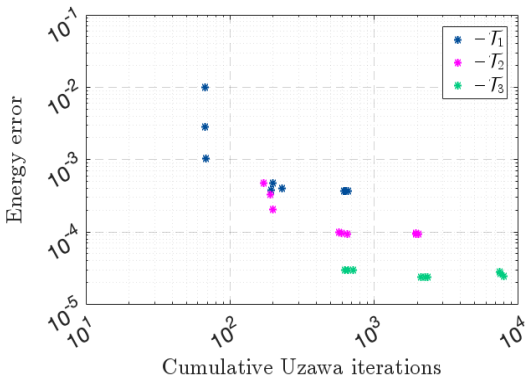
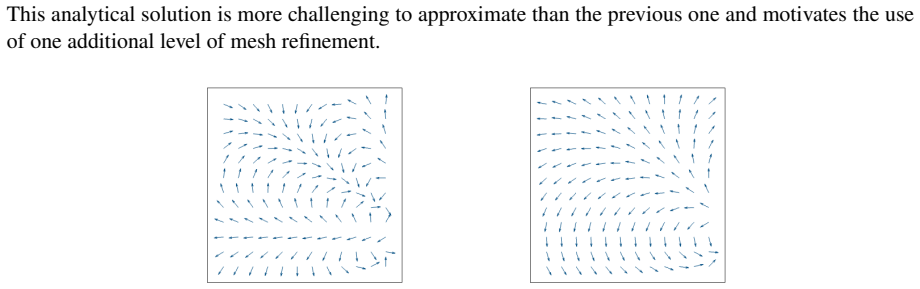
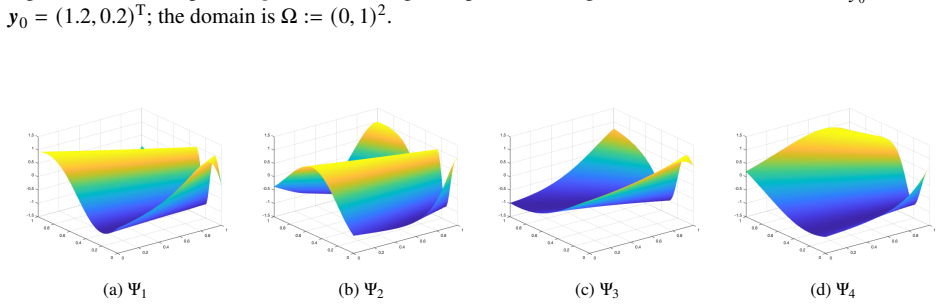
We develop an energy-decreasing algorithm for the finite element approximation of two-dimensional ferronematic equilibrium states. The problem is formulated as the minimization of the harmonic energy of two two-dimensional vector fields, both with prescribed length, together with an additional nonlinear relation on the orientation of the two vectors. The finite element setting is based on piecewise continuous finite elements on a weakly acute triangulation. The computational realization of the energy-decreasing algorithm employs a decomposition-coordination framework and a Uzawa-like iteration. Numerical experiments are presented to illustrate the computational performances of the algorithm.
Editorial analysis
A structured set of objections, weighed in public.
Referee Report
Summary. The manuscript develops an energy-decreasing algorithm for the finite element approximation of two-dimensional ferronematic equilibrium states. The problem is cast as minimization of the harmonic energy of two vector fields subject to unit-length constraints and a nonlinear orientation coupling. Discretization employs continuous piecewise linear finite elements on weakly acute triangulations. The algorithm is realized via a decomposition-coordination framework combined with a Uzawa-like iteration, and its performance is illustrated through numerical experiments.
Significance. If the algorithm indeed produces strictly energy-decreasing sequences that converge to discrete minimizers, the work would supply a stable computational tool for simulating ferronematic systems arising in liquid-crystal physics. The reliance on standard finite-element spaces and splitting techniques makes the method accessible and potentially extensible. However, the absence of any convergence analysis or error estimates restricts the result to an empirical demonstration rather than a fully justified numerical method.
major comments (2)
- [Abstract and algorithm section (likely §3–4)] The central assertion that the decomposition-coordination framework with Uzawa-like iteration yields a strictly energy-decreasing sequence converging to a discrete minimizer of the constrained harmonic energy is stated in the abstract and algorithm description but is never proved. No theorem, lemma, or reference establishes this property on weakly acute triangulations, which is load-bearing for the paper's contribution in numerical analysis.
- [Numerical experiments and conclusions] No a priori or a posteriori error estimates are derived relating the discrete solution to the continuous minimizer. Without such estimates, it is impossible to quantify how the observed energy decrease translates into approximation quality, undermining claims of reliable finite-element approximation.
minor comments (2)
- [Introduction and model section] The notation for the two vector fields and the nonlinear orientation constraint could be introduced more explicitly in the model formulation to improve readability.
- [Finite element setting] The description of the weakly acute triangulation assumption and its role in the algorithm would benefit from a brief recall or reference to the relevant property used in the iteration.
Simulated Author's Rebuttal
We thank the referee for the insightful comments on our manuscript. We address the major points raised below, clarifying the scope of our contribution which centers on the algorithmic development and numerical performance rather than a complete theoretical convergence analysis.
read point-by-point responses
-
Referee: [Abstract and algorithm section (likely §3–4)] The central assertion that the decomposition-coordination framework with Uzawa-like iteration yields a strictly energy-decreasing sequence converging to a discrete minimizer of the constrained harmonic energy is stated in the abstract and algorithm description but is never proved. No theorem, lemma, or reference establishes this property on weakly acute triangulations, which is load-bearing for the paper's contribution in numerical analysis.
Authors: We acknowledge that the manuscript does not include a formal proof or theorem establishing the strict energy-decreasing property or convergence of the sequence to a discrete minimizer. The algorithm is presented as energy-decreasing based on its construction via the decomposition-coordination framework and Uzawa-like iteration, which is designed to reduce the energy at each step on weakly acute meshes. However, a rigorous mathematical justification is indeed absent. In revision, we will modify the abstract and the algorithm description to state that the energy decrease is demonstrated through numerical experiments, without claiming a proved theoretical property. This will better align the presentation with the actual content of the paper. revision: partial
-
Referee: [Numerical experiments and conclusions] No a priori or a posteriori error estimates are derived relating the discrete solution to the continuous minimizer. Without such estimates, it is impossible to quantify how the observed energy decrease translates into approximation quality, undermining claims of reliable finite-element approximation.
Authors: The referee correctly notes the lack of error estimates. Our work does not derive a priori or a posteriori error bounds, as the primary aim is to introduce the energy-decreasing algorithm and showcase its computational behavior in numerical tests. Providing such estimates would require substantial additional theoretical work on the approximation properties of the finite element space for this specific nonlinear problem, which is not within the scope of the current manuscript. We maintain that the numerical results provide practical evidence of the method's utility, but we will not add error analysis in the revision. revision: no
Circularity Check
No significant circularity
full rationale
The paper constructs a numerical algorithm for constrained energy minimization using a decomposition-coordination framework and Uzawa-like iteration on a finite-element discretization over weakly acute triangulations. The central result—that the iteration produces a strictly energy-decreasing sequence converging to a discrete minimizer—is established directly from the algorithm's update rules and the properties of the chosen mesh and function spaces. No step reduces a claimed prediction or theorem to a fitted parameter, a self-referential definition, or a load-bearing self-citation; the derivation relies on standard convex-analysis and optimization arguments that remain independent of the target result itself.
Axiom & Free-Parameter Ledger
axioms (2)
- domain assumption The physical equilibrium is the minimizer of the sum of two harmonic energies subject to unit-length constraints and a nonlinear orientation coupling.
- standard math Piecewise-linear continuous finite elements on a weakly acute triangulation admit a stable discrete energy that can be decreased by the proposed iteration.
Lean theorems connected to this paper
-
IndisputableMonolith/Cost/FunctionalEquation.leanwashburn_uniqueness_aczel unclearenergy-decreasing algorithm ... decomposition-coordination framework and a Uzawa-like iteration ... weakly acute triangulation ... harmonic energy functional E(Ψ) = ½ ∫ ||∇Ψ||²
-
IndisputableMonolith/Foundation/RealityFromDistinction.leanreality_from_one_distinction unclearconstraint manifold N ... nonlinear map R: S → S ... G: S → N
Reference graph
Works this paper leans on
-
[1]
F. Alouges,A new algorithm for computing liquid crystal stable configurations: the harmonic mapping case, SIAM J. Numer. Anal.34(1997), no. 5, 1708–1726
work page 1997
-
[2]
K. J. Arrow, L. Hurwicz, and H. Uzawa,Studies in linear and non-linear programming, Stanford MathematicalStudiesintheSocialSciences,vol.II,StanfordUniversityPress,Stanford,CA,1958
work page 1958
-
[3]
Bartels,Stability and convergence of finite-element approximation schemes for harmonic maps, SIAM J
S. Bartels,Stability and convergence of finite-element approximation schemes for harmonic maps, SIAM J. Numer. Anal.43(2005), no. 1, 220–238
work page 2005
-
[4]
S. Bartels and A. Prohl,Constraint preserving implicit finite element discretization of harmonic map flow into spheres, Math. Comp.76(2007), no. 260, 1847–1859. 18
work page 2007
-
[5]
S.BartelsandA.Raisch,Simulationof𝑄-tensorfieldswithconstantorientationalorderparameter in the theory of uniaxial nematic liquid crystals, Singular phenomena and scaling in mathematical models, Springer, Cham, 2014, pp. 383–412. MR 3205050
work page 2014
-
[6]
D. P. Bertsekas,Constrained optimization and Lagrange multiplier methods, Computer Science and Applied Mathematics, Academic Press, Inc. [Harcourt Brace Jovanovich, Publishers], New York-London, 1982
work page 1982
-
[7]
,Nonlinear programming, second ed., Athena Scientific Optimization and Computation Series, Athena Scientific, Belmont, MA, 1999
work page 1999
-
[8]
F. Bethuel, H. Brezis, and F. Hélein,Asymptotics for the minimization of a Ginzburg-Landau functional, Calculus of Variations and Partial Differential Equations1(1993), no. 2, 123–148
work page 1993
- [9]
-
[10]
J. P. Borthagaray, R. H. Nochetto, and S. W. Walker,A structure-preserving FEM for the uniaxially constrained Q-tensor model of nematic liquid crystals, Numer. Math.145(2020), no. 4, 837–881
work page 2020
-
[11]
J. Brandts, S. Korotov, M. Křížek, and J. Šolc,On nonobtuse simplicial partitions, SIAM Rev.51 (2009), no. 2, 317–335
work page 2009
-
[12]
F.BrochardandP.G.deGennes,Theoryofmagneticsuspensionsinliquidcrystals,J.Phys.(Paris) 31(1970), no. 7, 691–708
work page 1970
- [13]
-
[14]
J.Dalby,P.E.Farrell,A.Majumdar,andJ.Xia,One-dimensionalferronematicsinachannel: order reconstruction, bifurcations, and multistability, SIAM J. Appl. Math.82(2022), no. 2, 694–719
work page 2022
-
[15]
P. G. de Gennes and J. Prost,The physics of liquid crystals, 2nd ed., vol. 83, Owford Science Publication, 1995
work page 1995
-
[16]
Q.Du, R.A.Nicolaides, andX.Wu,Analysisandconvergenceofacovolumeapproximationofthe Ginzburg-Landaumodelofsuperconductivity,SIAMJ.Numer.Anal.35(1998),no.3,1049–1072
work page 1998
-
[17]
M. Fortin and R. Glowinski,Augmented Lagrangian methods, Studies in Mathematics and its Applications, vol. 15, North-Holland Publishing Co., Amsterdam, 1983
work page 1983
-
[18]
A. J. Hess, Q. Liu, and I. I. Smalyukh,Optical patterning of magnetic domains and defects in ferromagnetic liquid crystal colloids, Appl. Phys. Letters107(2015), no. 7, 071906
work page 2015
-
[19]
S.Y.LinandM.Luskin,Relaxationmethodsforliquidcrystalproblems,SIAMJ.Numer.Anal.26 (1989), no. 6, 1310–1324
work page 1989
-
[20]
R.R.Maity,A.Majumdar,andN.Nataraj,Parameterdependentfiniteelementanalysisforferrone- matics solutions, Comput. Math. Appl.103(2021), 127–155
work page 2021
-
[21]
A. Mertelj, D. Lisjak, M. Drofenik, and M. Copič,Ferromagnetism in suspensions of magnetic platelets in liquid crystal, Nature504(2013), no. 7479, 237—241
work page 2013
-
[22]
R. H. Nochetto, S. W. Walker, and W. Zhang,A finite element method for nematic liquid crystals with variable degree of orientation, SIAM J. Numer. Anal.55(2017), no. 3, 1357–1386
work page 2017
-
[23]
M.Pierre,Newtonandconjugategradientforharmonicmapsfromthediscintothesphere,ESAIM Control Optim. Calc. Var.10(2004), no. 1, 142–167. 19
work page 2004
-
[24]
T. Tóth-Katona, P. Salamon, N. Éber, N. Tomašovičová, Z. Mitróová, and P. Kopčanský,High concentration ferronematics in low magnetic fields, J. Magn. Magn. Mater.372(2014), 117–121
work page 2014
-
[25]
J.XuandL.Zikatanov,Amonotonefiniteelementschemeforconvection-diffusionequations,Math. Comp.68(1999), no. 228, 1429–1446. 20
work page 1999
discussion (0)
Sign in with ORCID, Apple, or X to comment. Anyone can read and Pith papers without signing in.