Recognition: no theorem link
Hybrid Analytical--EMT Method for HVDC Protection System Component-Level Design
Pith reviewed 2026-05-13 01:53 UTC · model grok-4.3
The pith
A hybrid analytical-EMT method lets engineers design HVDC protection components by starting with analytical estimates and then refining them through targeted simulations.
A machine-rendered reading of the paper's core claim, the machinery that carries it, and where it could break.
Core claim
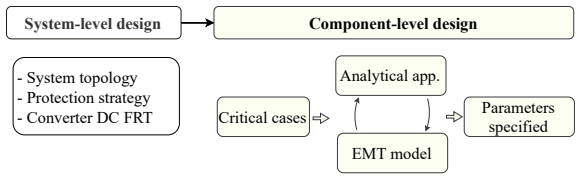
The paper claims that deriving a fundamental analytical solution to capture protection requirements, followed by a hybrid analytical--EMT methodology to accelerate convergence toward the required design parameters, and then applying detailed models for accuracy and validation, yields an efficient systematic procedure for component-level design of HVDC protection systems in both fully and partially selective strategies.
What carries the argument
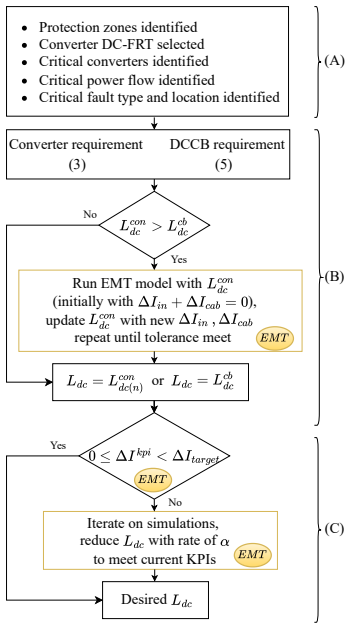
The hybrid analytical--EMT methodology, which uses an initial analytical solution as a starting point for protection requirements and interdependencies, then iteratively combines analytical calculations with EMT simulations to reach suitable component parameters before final detailed validation.
If this is right
- The method supports component-level design for both fully and partially selective protection strategies.
- It reduces computational time by using the analytical solution to guide EMT refinement instead of relying on exhaustive simulation.
- It manages interdependencies among protection components and between protection and converter control systems.
- Final use of detailed models ensures the design meets accuracy needs that pure analytical approximations cannot guarantee.
- The procedure applies directly to multi-terminal HVDC grids where conflicting requirements make isolated component sizing difficult.
Where Pith is reading between the lines
- Similar hybrid starting-point-plus-refinement logic could shorten design cycles for protection in other high-power converter systems.
- The acceleration step might be combined with automated optimization loops to further cut manual iteration.
- The separation of analytical initialization from EMT refinement offers a template for design tasks that must balance speed and fidelity in power-electronics engineering.
Load-bearing premise
That a fundamental analytical solution can be derived which sufficiently captures protection system requirements and interdependencies to serve as a reliable starting point for the hybrid refinement process.
What would settle it
Apply the hybrid method to a concrete multi-terminal HVDC test case, extract the resulting breaker and inductor values, and check whether those values satisfy all stated protection criteria when re-simulated in a full detailed EMT model; if the process takes as many or more iterations as a pure EMT search or fails to meet requirements, the efficiency and reliability claims do not hold.
Figures




read the original abstract
Protection system design for multi-terminal HVDC grids is challenging due to the complexity of the system and the often conflicting design requirements. Effective specification of protection component parameters (e.g., DC circuit breakers and series DC inductors) during component-level design is crucial due to interdependencies among components, the need for detailed modeling, and the complex interactions between the protection system and converter control systems. Both analytical and simulation-based approaches have been proposed as solutions for component-level design. However, analytical methods may not accurately represent system behavior given that approximation is necessary, and simulation-based approaches often require extensive computational effort and time. Therefore, this paper presents an efficient systematic design method, combining both approaches. First, a fundamental analytical solution is derived to consider the protection system requirements. Then, a hybrid analytical--EMT methodology is proposed to accelerate convergence toward the required design parameters, after which detailed models are applied to ensure accuracy in design and validation. The approach is applicable to component-level design for both fully and partially selective protection strategies in HVDC grids.
Editorial analysis
A structured set of objections, weighed in public.
Referee Report
Summary. The manuscript proposes a hybrid analytical-electromagnetic transient (EMT) method for component-level design of HVDC protection systems in multi-terminal grids. It first derives a fundamental analytical solution incorporating protection requirements (e.g., for DC breakers and series inductors), then applies a hybrid analytical-EMT iteration to accelerate convergence on design parameters, and finally uses detailed models for accuracy and validation. The method is positioned as applicable to both fully and partially selective protection strategies, addressing limitations of pure analytical approximations and computationally intensive simulations.
Significance. If the analytical starting point adequately encodes key interdependencies and the hybrid loop demonstrably converges with bounded error, the approach could reduce design time for HVDC protection while maintaining accuracy, offering a practical middle ground between the two existing paradigms. No machine-checked proofs, reproducible code, or falsifiable predictions are presented to strengthen this assessment.
major comments (2)
- [Abstract] Abstract: the claim that a 'fundamental analytical solution is derived to consider the protection system requirements' is load-bearing for the entire hybrid workflow, yet no derivation, retained/neglected dynamics, or error bounds are supplied; without these the hybrid refinement step cannot be shown to start from a reliable basin rather than diverging or converging incorrectly.
- [Abstract] The manuscript states that pure analytical methods 'may not accurately represent system behavior given that approximation is necessary' but provides no sensitivity analysis or explicit statement of which control-system interactions and inter-component dependencies are retained in the initial analytical model; this directly undermines the assertion that the hybrid method accelerates convergence to correct parameters.
minor comments (2)
- The abstract would benefit from a brief outline of the analytical equations or an example parameter set to illustrate the starting point.
- Clarify the convergence criterion and stopping condition for the hybrid analytical-EMT iteration.
Simulated Author's Rebuttal
We thank the referee for the constructive feedback on our manuscript. We appreciate the emphasis on strengthening the presentation of the analytical foundation and its limitations. We address each major comment below and are prepared to revise the abstract and related sections for greater clarity on derivations, retained dynamics, and interdependencies.
read point-by-point responses
-
Referee: [Abstract] Abstract: the claim that a 'fundamental analytical solution is derived to consider the protection system requirements' is load-bearing for the entire hybrid workflow, yet no derivation, retained/neglected dynamics, or error bounds are supplied; without these the hybrid refinement step cannot be shown to start from a reliable basin rather than diverging or converging incorrectly.
Authors: We agree that the abstract's brevity omits key details. The derivation appears in Section III, where the analytical model is obtained from a reduced-order DC-grid equivalent that retains the dominant fault-current rise time constants, breaker operating delays, and series-inductor voltage drops while neglecting AC-side harmonics and high-frequency control transients. Error bounds are quantified in Section V by direct comparison with EMT runs, showing that the initial analytical estimates lie within 8 % of the converged hybrid values for the test cases. We will revise the abstract to reference Section III and briefly state the principal approximations, thereby clarifying the starting basin for the hybrid iteration. revision: yes
-
Referee: [Abstract] The manuscript states that pure analytical methods 'may not accurately represent system behavior given that approximation is necessary' but provides no sensitivity analysis or explicit statement of which control-system interactions and inter-component dependencies are retained in the initial analytical model; this directly undermines the assertion that the hybrid method accelerates convergence to correct parameters.
Authors: The abstract statement is intentionally general. Section II.2 explicitly enumerates the retained elements: converter current-limiting dynamics modeled as a first-order lag, DC-breaker commutation time, and inductor-fault-current coupling; neglected elements include detailed inner-loop current control and AC-network resonances. A sensitivity study varying control gains and inductor values is presented in Section IV.3, confirming that the hybrid loop converges to the same final parameters regardless of moderate changes in the retained gains. We will augment the abstract with a short clause summarizing these retained interactions and will add a cross-reference to the sensitivity results. revision: yes
Circularity Check
No circularity: derivation starts from independent analytical solution and refines externally
full rationale
The described chain begins with an explicit first-principles analytical derivation of protection requirements, then applies an external EMT-based hybrid iteration for parameter convergence, and finally validates with detailed models. No equation or step is shown to reduce to its own fitted inputs by construction, no self-citation is invoked as the sole justification for a uniqueness claim, and no ansatz is smuggled via prior work. The process is presented as a standard sequential hybrid workflow whose validity rests on the independent accuracy of the initial analytical model rather than on any definitional loop. This is the normal non-circular case for such design papers.
Axiom & Free-Parameter Ledger
Reference graph
Works this paper leans on
-
[1]
Multi-terminal VSC HVDC for the European supergrid: Obstacles,
D. Van Hertem and M. Ghandhari, “Multi-terminal VSC HVDC for the European supergrid: Obstacles,” Renew. Sustain. Energy Rev., vol. 14, no. 9, pp. 3156–3163, 2010
work page 2010
-
[2]
ENTSO-E vision: A power system for a carbon neutral Europe,
ENTSO-E, “ENTSO-E vision: A power system for a carbon neutral Europe,” 2022, [Online]. Available: https://vision.entsoe.eu/
work page 2022
-
[3]
Systematic approach to HVDC circuit breaker sizing,
M. Abedrabbo, W. Leterme, and D. Van Hertem, “Systematic approach to HVDC circuit breaker sizing,” IEEE Trans. Power Del., vol. 35, no. 1, pp. 288–300, 2020
work page 2020
-
[4]
D4.2 broad comparison of fault clearing strategies for DC grids,
PROMOTioN WP4, “D4.2 broad comparison of fault clearing strategies for DC grids,” PROMOTioN Project, Deliverable D4.2, 2017
work page 2017
-
[5]
Review of (co-)design methods for HVDC protection systems,
M. Van Deyck, A. Mohammadi, G. Chaffey, and D. Van Hertem, “Review of (co-)design methods for HVDC protection systems,” inProc. CIGRE NRCC International Symposium, Trondheim, Norway, 2025
work page 2025
-
[6]
P. Torwelle, A. Bertinato, A. Zama, J. V. Doorn, and F. Kryezi, “North Sea Wind Power Hub pre-FEED study: DC protection functional requirements and parameter ranges for HVDC building blocks,” inProc. B4 International SC Meeting and Colloquium, ser. CIGRE B4 – 1147, Vienna, Austria, Sep. 2023. 19
work page 2023
-
[7]
Y. Wang, W. Wen, C. Zhang, Z. Chen, and C. Wang, “Reactor sizing criterion for the continuous operation of meshed HB-MMC-based MTDC system under DC faults,”IEEE Trans. Ind. Appl., vol. 54, no. 5, pp. 5408–5416, 2018
work page 2018
-
[8]
P. D¨ ullmann, C. Brantl, C. Klein, and A. Moser, “Interdependencies in HVDC grid protection: Impact of converter parameters and controls on DC fault-ride-through capabilities and protection system design,”IET Gener., Transm. Distrib., vol. 17, no. 10, pp. 2356–2375, 2023
work page 2023
-
[9]
Research on key technology and equipment for Zhangbei 500kv DC grid,
H. Pang and X. Wei, “Research on key technology and equipment for Zhangbei 500kv DC grid,” in2018 International Power Electronics Conference (IPEC-Niigata 2018 - ECCE Asia), 2018, pp. 2343–2351
work page 2018
-
[10]
Functional requirements for HVDC grid systems and subsystems,
InterOPERA Project Consortium, “Functional requirements for HVDC grid systems and subsystems,” In- terOPERA Project, Horizon Europe, Deliverable D2.1, April 2025
work page 2025
-
[11]
Reactor design for DC fault ride-through in MMC-based multi-terminal HVDC grids,
E. Kontos and P. Bauer, “Reactor design for DC fault ride-through in MMC-based multi-terminal HVDC grids,” in2016 IEEE 2nd Annual Southern Power Electronics Conference (SPEC). IEEE, 2016, pp. 1–6
work page 2016
-
[12]
On the damping and coupling impacts of DC fault-limiting reactors in multi-terminal DC grids,
M. Elsodany, K. Shinoda, J. Dai, and S. Bacha, “On the damping and coupling impacts of DC fault-limiting reactors in multi-terminal DC grids,”Int. J. Electr. Power Energy Syst., vol. 174, p. 111543, 2026
work page 2026
-
[13]
Impact of DC breaker systems on multiterminal VSC-HVDC stability,
W. Wang, M. Barnes, O. Marjanovic, and O. Cwikowski, “Impact of DC breaker systems on multiterminal VSC-HVDC stability,”IEEE Trans. Power Del., vol. 31, no. 2, pp. 769–779, 2016
work page 2016
-
[14]
S. Tang, M. Chen, Y. Ji, and C. Wang, “Efficient calculation of dc fault current considering inductor-based fault current limiter in hvdc grid,”IEEE Trans. Power Del., vol. 41, no. 1, pp. 166–178, 2026
work page 2026
-
[15]
W. Lv, T. Zheng, X. Liu, and P. Judge, “Modeling of the DC fault response of modular multilevel converters with fault control capability considering converter saturation,”IEEE Trans. Power Del., vol. 40, no. 1, pp. 62–74, 2025
work page 2025
-
[16]
Analytical calculation of transient short-circuit currents for mmc-based mtdc grids,
Y. Luo, J. He, M. Li, D. Zhang, Y. Zhang, Y. Song, and M. Nie, “Analytical calculation of transient short-circuit currents for mmc-based mtdc grids,”IEEE Trans. Ind. Electron., vol. 69, no. 7, pp. 7500–7511, 2022
work page 2022
-
[17]
DC-side fault current estimation approach for HVDC circuit breaker sizing,
M. Abedrabbo, W. Leterme, and D. Van Hertem, “DC-side fault current estimation approach for HVDC circuit breaker sizing,”Electr. Power Syst. Res., vol. 212, p. 108310, 2022
work page 2022
-
[18]
M. Abedrabbo, D. Van Hertem, and W. Leterme, “Continuous operation of meshed HVDC grids during DC faults: HVDC circuit breaker integration & design from a system perspective,” Ph.D. dissertation, KU Leuven, 2021
work page 2021
-
[19]
A vision of HVDC key role toward fault-tolerant and stable AC/DC grids,
B. Luscan, S. Bacha, A. Benchaib, A. Bertinato, L. Ch´ edot, J. C. Gonzalez-Torres, S. Poullain, M. Romero- Rodr´ ıguez, and K. Shinoda, “A vision of HVDC key role toward fault-tolerant and stable AC/DC grids,” IEEE J. Emerg. Sel. Topics Power Electron., vol. 9, no. 6, pp. 7471–7485, 2021
work page 2021
-
[20]
Method for DC reactor and DC circuit breaker design in HVDC grids,
F. Demichel, H. Bekkouri, A. Bertinato, C. Foote, S. Rangasamy, and B. Marshall, “Method for DC reactor and DC circuit breaker design in HVDC grids,” in22nd IET International Conference on AC and DC Power Transmission, Berlin, Germany, April 2026
work page 2026
-
[21]
Impact of MMC temporary blocking functionality on DC grid protection design,
D. Hart, A. Bertinato, P. Torwelle, and H. F. de Barros, “Impact of MMC temporary blocking functionality on DC grid protection design,” in22nd IET International Conference on AC and DC Power Transmission (ACDC Global 2025), vol. 2025. IET, 2025, pp. 97–102. 20
work page 2025
-
[22]
A holistic method for optimal design of HVDC grid protection,
I. Jahn, G. Chaffey, N. Svensson, and S. Norrga, “A holistic method for optimal design of HVDC grid protection,”Electr. Power Syst. Res., vol. 196, p. 107234, 2021
work page 2021
-
[23]
Designing for high-voltage dc grid protection: Fault clearing strategies and protection algorithms,
W. Leterme, I. Jahn, P. Ruffinget al., “Designing for high-voltage dc grid protection: Fault clearing strategies and protection algorithms,”IEEE Power and Energy Magazine, vol. 17, no. 3, pp. 73–81, May–Jun 2019
work page 2019
-
[24]
HVdc reactor reduction method based on virtual reactor fault current limiting control of MMC,
X. Li, Z. Li, B. Zhao, C. Lu, Q. Song, Y. Zhou, H. Rao, S. Xu, and Z. Zhu, “HVdc reactor reduction method based on virtual reactor fault current limiting control of MMC,”IEEE Trans. Ind. Electron., vol. 67, no. 12, pp. 9991–10 000, 2020
work page 2020
-
[25]
Modular multilevel converter DC fault protection,
O. Cwikowski, H. R. Wickramasinghe, G. Konstantinou, J. Pou, M. Barnes, and R. Shuttleworth, “Modular multilevel converter DC fault protection,”IEEE Trans. Power Del., vol. 33, no. 1, pp. 291–300, 2018
work page 2018
-
[26]
HVDC circuit breaker development and applica- tions in VSC-HVDC transmission project,
Y. Yang, M. Ren, J. Cao, W. Liu, X. Zhan, and C. Zhao, “HVDC circuit breaker development and applica- tions in VSC-HVDC transmission project,”IOP Conf. Ser.: Earth Environ. Sci., vol. 453, no. 1, p. 012048, 2020
work page 2020
-
[27]
SciBreak 80 kv modular HVDC breaker successfully tested at KEMA,
SCiBreak, “SciBreak 80 kv modular HVDC breaker successfully tested at KEMA,” https://www.scibreak. com, 2020, accessed: Mar. 5, 2026
work page 2020
-
[28]
IEC, “IEC TS 63291-1:2023 – high voltage direct current (HVDC) grid systems and connected converter stations – guideline and parameter lists for functional specifications – part 1: Guideline,” International Electrotechnical Commission, Tech. Rep., 2023
work page 2023
-
[29]
Remote MMC model selection method in HVDC grids for protection studies,
A. Mohammadi, G. Chaffey, and D. Van Hertem, “Remote MMC model selection method in HVDC grids for protection studies,” in22nd IET International Conference on AC and DC Power Transmission, Berlin, Germany, April 2026
work page 2026
-
[30]
Technical requirements and specifications of state-of-the-art HVDC switching equipment,
CIGRE JWG A3/B4.34, “Technical requirements and specifications of state-of-the-art HVDC switching equipment,” CIGRE, Paris, France, Tech. Brochure 683, 2017
work page 2017
-
[31]
Guide for the development of models for HVDC converters in a HVDC grid,
CIGRE WG B4.57, “Guide for the development of models for HVDC converters in a HVDC grid,” CIGRE, Paris, France, Tech. Brochure 604, 2014
work page 2014
-
[32]
Overview of grounding and configuration options for meshed hvdc grids,
W. Leterme, P. Tielens, S. De Boeck, and D. Van Hertem, “Overview of grounding and configuration options for meshed hvdc grids,”IEEE Transactions on Power Delivery, vol. 29, no. 6, pp. 2467–2475, 2014
work page 2014
-
[33]
Fault current testing envelopes for VSC HVDC circuit breakers,
O. Cwikowski, B. Chang, M. Barnes, R. Shuttleworth, and A. Beddard, “Fault current testing envelopes for VSC HVDC circuit breakers,”IET Gener., Transm. Distrib., vol. 10, no. 6, pp. 1393–1400, 2016
work page 2016
-
[34]
Guide for electromagnetic transient studies involving VSC converters,
CIGRE WG B4.70, “Guide for electromagnetic transient studies involving VSC converters,” CIGRE, Paris, France, Tech. Brochure 832, 2021
work page 2021
-
[35]
Design, test and application of HVDC circuit breakers,
CIGRE WG B4.80, “Design, test and application of HVDC circuit breakers,” CIGRE, Paris, France, Tech. Brochure 873, Sep. 2022
work page 2022
-
[36]
Comparison of fault currents in multiterminal HVDC grids with different grounding schemes,
M. K. Bucher and C. M. Franck, “Comparison of fault currents in multiterminal HVDC grids with different grounding schemes,” inProc. IEEE PES Gen. Meet., 2014, pp. 1–5
work page 2014
-
[37]
Shortlisting protection configurations for HVDC grids and electrical energy hubs,
M. Van Deyck, G. Chaffey, and D. Van Hertem, “Shortlisting protection configurations for HVDC grids and electrical energy hubs,”arXiv preprint arXiv:2505.05886, 2025. 21
discussion (0)
Sign in with ORCID, Apple, or X to comment. Anyone can read and Pith papers without signing in.