Recognition: 2 theorem links
· Lean TheoremThe mean-field theory of superfluid-superconducting vortex states in the outer core of neutron stars
Pith reviewed 2026-05-13 01:05 UTC · model grok-4.3
The pith
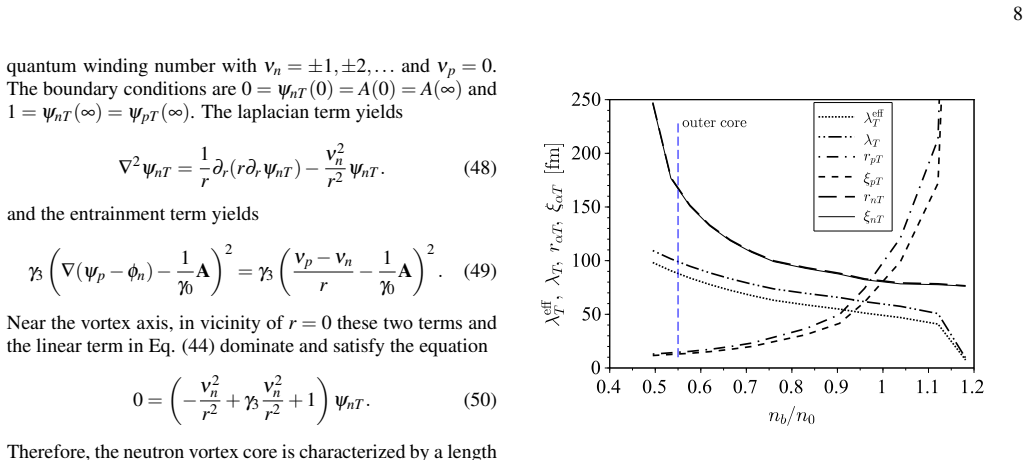
Neutron vortex cores exceed the magnetic penetration depth throughout the outer core of neutron stars.
A machine-rendered reading of the paper's core claim, the machinery that carries it, and where it could break.
Core claim
When the mean-field theory is extended to unequal critical temperatures T_cp and T_cn, the superfluid entrainment increases the neutron vortex core radius above the magnetic penetration depth at all pressures in the outer core, so that the London thin-line approximation for the neutron vortex fails everywhere in that region.
What carries the argument
Extended mean-field theory for coupled superfluid-superconducting vortices that incorporates entrainment, pressure-dependent gaps from chiral effective field theory, and an empirical temperature-dependent mean-field balancing condensation and magnetic energies.
If this is right
- The London approximation remains usable for proton vortices only near the crust-core transition density.
- The theory supplies the microscopic structure needed to compute angular momentum per vortex, magnetization, and vortex-fluxtube interaction energy.
- Entrainment reduces the effective penetration depth while enlarging the neutron core, altering the relative scales that govern vortex pinning and motion.
Where Pith is reading between the lines
- Models of pulsar glitches that rely on thin neutron vortices may need revision because the enlarged cores change the pinning volume and mutual friction coefficients.
- The pressure dependence of the gaps implies that the core-to-penetration-depth ratio varies with depth, potentially creating a layered vortex lattice structure inside the star.
- The same entrainment mechanism could affect the stability of fluxtube lattices against proton-neutron drag forces at higher densities.
Load-bearing premise
The thermodynamic magnetic field is assumed to vary quadratically with scaled temperature T over T_cp in analogy with pure superconductors.
What would settle it
A microscopic calculation or measurement showing whether the neutron vortex core radius is smaller than the London penetration depth at a representative outer-core density such as twice nuclear saturation density and a temperature below both critical temperatures.
Figures

read the original abstract
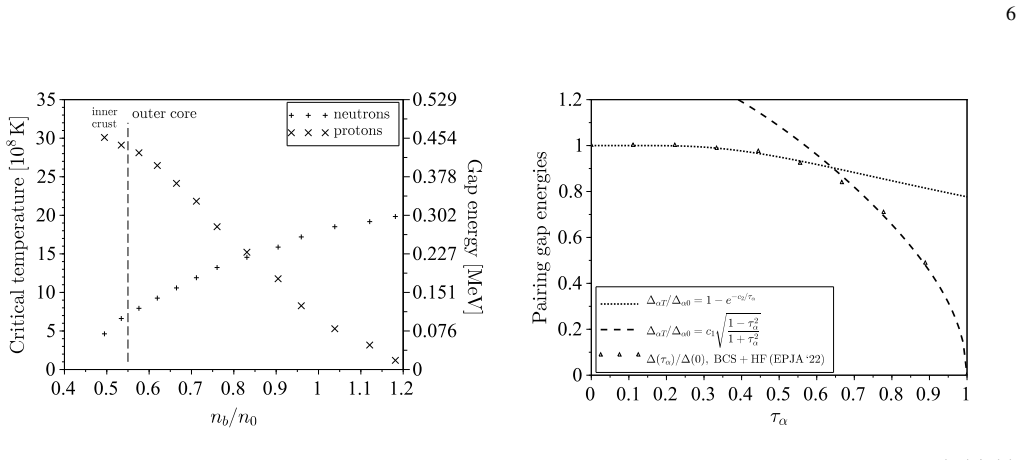
Purpose: Characterize superfluid-superconducting vortex states at arbitrary pressures with $T_{cp}\neq T_{cn}$, assuming both proton and neutron mean-fields are formed by spin-0 Cooper pairs. Method: The existing mean-field theory is extended to account for $T_{cp}\neq T_{cn}$. The pressure dependence of the pairing gap energy $\Delta_{\alpha0}$ is quantitatively established on the basis of the effective chiral field theory. To link $T_{c\alpha}$ with $\Delta_{\alpha0}$, I use the weak-coupling result $T_{c\alpha}\approx0.57\Delta_{\alpha0}$. A quadratic scaled-temperature ($T/T_{cp}$) dependence of the thermodynamic magnetic field is postulated in analogy with pure superconductors. The $T/T_{c\alpha}$-dependence of the gap $\Delta_{\alpha T}$ is inferred from the many-body approximations for the pure neutron matter. Results: An empirical $T/T_{c\alpha}$-dependence for the mean-field is constructed to account for the interplay between the condensation and the magnetic energies. The superfluid entrainment is found to increase the size of the vortex core and to decrease the effective magnetic penetration depth. The size of the neutron vortex core is found to be larger than the magnetic penetration depth in the outer core. Conclusions: The usual approximation of infinitely thin vortex line (the London's approximation) for the neutron vortex is found to be irrelevant in the entire outer core and for the proton vortex is found to be limited to vicinity of the crust-core transition. The developed mean-field theory paves the way to study the vortex microscopic structure, the angular momentum, the magnetization and the vortex-fluxtube interaction energy.
Editorial analysis
A structured set of objections, weighed in public.
Referee Report
Summary. The manuscript extends an existing mean-field theory for superfluid-superconducting vortex states in the outer core of neutron stars to handle unequal critical temperatures T_cp ≠ T_cn for protons and neutrons. It determines the pressure dependence of pairing gaps Δ_α0 via effective chiral field theory, links T_cα to Δ_α0 using the weak-coupling relation T_cα ≈ 0.57 Δ_α0, postulates a quadratic T/T_cp dependence for the thermodynamic magnetic field by analogy with pure superconductors, infers gap temperature dependences from pure-neutron many-body calculations, and constructs an empirical T/T_cα dependence for the mean field to balance condensation and magnetic energies. The central results are that entrainment enlarges the neutron vortex core while reducing the effective magnetic penetration depth, such that the neutron vortex core exceeds the penetration depth throughout the outer core (rendering the London approximation irrelevant for neutron vortices and limited for proton vortices near the crust-core transition).
Significance. If the temperature dependences can be placed on a self-consistent footing, the work supplies a useful framework for vortex structure, angular momentum, magnetization, and fluxtube interactions in neutron-star cores. The incorporation of chiral effective theory for gap pressure dependence and the explicit treatment of entrainment are constructive steps. However, the quantitative claims on core-size ratios rest on postulated and constructed temperature dependences rather than direct solution of the extended coupled equations, limiting the robustness of the reported findings.
major comments (3)
- [Methods (temperature dependences)] In the Methods section describing temperature dependences: the quadratic scaled-temperature (T/T_cp) dependence of the thermodynamic magnetic field is postulated by analogy with pure superconductors. Because the paper's central extension is precisely to the mixed case with T_cp ≠ T_cn and entrainment, this assumption must be derived from the coupled gap and vector-potential equations to support the core-size and penetration-depth ratios.
- [Results (mean-field construction)] In the Results section on mean-field construction: an empirical T/T_cα dependence for the mean field is assembled to incorporate condensation-magnetic energy interplay rather than obtained by solving the extended mean-field equations. This construction is load-bearing for the claim that the neutron vortex core exceeds the magnetic penetration depth throughout the outer core.
- [Conclusions] In the Conclusions: the statements that London's approximation is irrelevant for neutron vortices in the entire outer core and limited for proton vortices near the crust-core transition rest on the above temperature dependences. No direct validation against microscopic calculations, error estimates, or recovery of known limits (e.g., T → 0 or equal T_c) is provided.
minor comments (2)
- [Abstract] The abstract introduces the notation T_cα without immediate clarification of the index α; a brief parenthetical definition would improve readability.
- [Methods] The pressure dependence of Δ_α0 is stated to be 'quantitatively established' from chiral effective field theory; explicit functional forms or references to the specific parametrization used would aid reproducibility.
Simulated Author's Rebuttal
We thank the referee for the careful and constructive review. We respond point by point to the major comments, clarifying the methodological choices while acknowledging their approximate character. Revisions have been made to improve transparency and add caveats without altering the core framework.
read point-by-point responses
-
Referee: In the Methods section describing temperature dependences: the quadratic scaled-temperature (T/T_cp) dependence of the thermodynamic magnetic field is postulated by analogy with pure superconductors. Because the paper's central extension is precisely to the mixed case with T_cp ≠ T_cn and entrainment, this assumption must be derived from the coupled gap and vector-potential equations to support the core-size and penetration-depth ratios.
Authors: We agree that a direct derivation from the coupled equations in the mixed case would be preferable. However, obtaining such a dependence requires a full numerical solution of the extended mean-field equations with entrainment and unequal critical temperatures, which involves substantial computational complexity beyond the scope of this work. The quadratic form is adopted from established pure-superconductor results as a controlled approximation that recovers the correct T=0 and T=T_cp limits. We have revised the Methods section to state this explicitly, discuss the approximation's domain of validity, and note the desirability of future self-consistent calculations. revision: partial
-
Referee: In the Results section on mean-field construction: an empirical T/T_cα dependence for the mean field is assembled to incorporate condensation-magnetic energy interplay rather than obtained by solving the extended mean-field equations. This construction is load-bearing for the claim that the neutron vortex core exceeds the magnetic penetration depth throughout the outer core.
Authors: The empirical construction is introduced precisely to capture the energy balance between condensation and magnetic contributions in a manner consistent with known limiting behaviors. We recognize that it is not obtained from direct solution of the coupled equations. In the revised manuscript we have expanded the Results section with additional justification based on energy minimization arguments, included a sensitivity analysis to the functional form, and inserted explicit caveats that the quantitative core-size ratios rest on this approximation. revision: partial
-
Referee: In the Conclusions: the statements that London's approximation is irrelevant for neutron vortices in the entire outer core and limited for proton vortices near the crust-core transition rest on the above temperature dependences. No direct validation against microscopic calculations, error estimates, or recovery of known limits (e.g., T → 0 or equal T_c) is provided.
Authors: We have updated the Conclusions to acknowledge the dependence on the adopted temperature scalings, to demonstrate recovery of the T→0 limit (where gaps approach their zero-temperature values) and the equal-T_c consistency check, and to supply a brief parameter-sensitivity discussion as an error estimate. Direct comparison with microscopic calculations is not performed here, as the focus is on the mean-field framework; we have added this as an explicit direction for future work. revision: partial
- Full self-consistent numerical derivation of the temperature dependences directly from the coupled gap and vector-potential equations for the mixed T_cp ≠ T_cn case with entrainment.
Circularity Check
No significant circularity detected
full rationale
The paper explicitly states that a quadratic T/T_cp dependence of the thermodynamic magnetic field is postulated by analogy with pure superconductors, the gap T/T_cα dependence is inferred from many-body calculations on pure neutron matter, and an empirical T/T_cα dependence for the mean-field is constructed to incorporate condensation-magnetic energy balance. These are presented as inputs to the extended mean-field theory rather than outputs derived from its coupled gap and vector-potential equations. The reported findings on neutron vortex core size exceeding magnetic penetration depth, and the irrelevance of London's approximation, follow from applying the theory with these stated assumptions. No self-definitional loops, fitted parameters renamed as predictions, or load-bearing self-citations that reduce claims to tautologies are present in the provided text. The derivation chain is therefore self-contained with transparent external inputs.
Axiom & Free-Parameter Ledger
free parameters (2)
- quadratic coefficient for thermodynamic magnetic field
- empirical mean-field temperature dependence
axioms (2)
- domain assumption Both proton and neutron mean-fields are formed by spin-0 Cooper pairs
- domain assumption Weak-coupling result T_cα ≈ 0.57 Δ_α0 holds at all pressures
Lean theorems connected to this paper
-
IndisputableMonolith/Cost/FunctionalEquation.leanwashburn_uniqueness_aczel contradicts?
contradictsCONTRADICTS: the theorem conflicts with this paper passage, or marks a claim that would need revision before publication.
A quadratic scaled-temperature (T/T_cp) dependence of the thermodynamic magnetic field is postulated in analogy with pure superconductors... An empirical T/T_cα-dependence for the mean-field is constructed
-
IndisputableMonolith/Foundation/DimensionForcing.leanalexander_duality_circle_linking unclear?
unclearRelation between the paper passage and the cited Recognition theorem.
The size of the neutron vortex core is found to be larger than the magnetic penetration depth in the outer core
What do these tags mean?
- matches
- The paper's claim is directly supported by a theorem in the formal canon.
- supports
- The theorem supports part of the paper's argument, but the paper may add assumptions or extra steps.
- extends
- The paper goes beyond the formal theorem; the theorem is a base layer rather than the whole result.
- uses
- The paper appears to rely on the theorem as machinery.
- contradicts
- The paper's claim conflicts with a theorem or certificate in the canon.
- unclear
- Pith found a possible connection, but the passage is too broad, indirect, or ambiguous to say the theorem truly supports the claim.
Reference graph
Works this paper leans on
-
[1]
G. Baym, C. Pethick and D. Pines, Nature (Lon- don),224, 673 (1969). Superfluidity in Neutron Stars. https://doi.org/10.1038/224673a0
-
[2]
C. Drischler, T. Kr ¨uger, K. Hebeler, and A. Schwenk, Phys. Rev. C95, 024302 (2017). Pairing in neutron mat- ter: New uncertainty estimates and three-body forces. https://doi.org/10.1103/PhysRevC.95.024302
-
[3]
Y . Lim and J. W. Holt, Phys. Rev. C103, 025807 (2021). Proton Pairing in Neutron Stars from Chiral Effective Field Theory. https://doi.org/10.1103/physrevc.103.025807
-
[4]
P. W. Anderson, Rev. Mod. Phys.38, 298 (1966). Considerations on the Flow of Superfluid Helium. https://doi.org/10.1103/RevModPhys.38.298
-
[5]
E. Varoquaux, Rev. Mod. Phys.87, 803 (2015). Anderson’s considerations on the flow of superfluid helium: Some off- shoots. https://doi.org/10.1103/RevModPhys.87.803
-
[6]
M. A. Alpar, S. A. Langer, J. A. Sauls, Astrophys. J.282, 533 (1984). Rapid Postglitch Spin-up of the Superfluid Core in Pul- sars. https://doi.org/10.1086/162232
-
[7]
Tinkham,Introduction to superconductivity, (2ed., MGH, 10 1996)
M. Tinkham,Introduction to superconductivity, (2ed., MGH, 10 1996)
work page 1996
-
[8]
Ø. Elgarøy and F. V . De Blasio, A&A370, 939 (2001). Su- perfluid vortices in neutron stars. https://doi.org/10.1051/0004- 6361:20010160
-
[9]
D. N. Kobyakov, Phys. Rev. C98, 045803 (2018). Application of Superconducting-superfluid Magneto- hydrodynamics to Nuclear “Pasta” in Neutron Stars. https://doi.org/10.1103/physrevc.98.045803
-
[10]
D. N. Kobyakov and C. J. Pethick, Sov. Phys. JETP127, 851 (2018). Superfluid Liquid Crystals: Pasta Phases in Neutron Star Crusts. https://doi.org/10.1134/s1063776118110067
-
[11]
C. J. Pethick, Z.-W. Zhang, D. N. Kobyakov, Phys. Rev. C101, 055802 (2020). Elastic Properties of Phases with Nonspherical Nuclei in Dense Matter. https://doi.org/10.1103/physrevc.101.055802
-
[12]
Z.-W. Zhang and C. J. Pethick, Phys. Rev. C103, 055807 (2021). Proton Superconductivity in Pasta Phases in Neutron Star Crusts. https://doi.org/10.1103/physrevc.103.055807
-
[13]
D. N. Kobyakov, Phys. Rev. C102, 045803 (2020). Surface Energy of Magnetized Superconducting Matter in Neutron Star Cores. https://doi.org/10.1103/physrevc.102.045803
-
[14]
A. Haber and A. Schmitt, Phys. Rev. D95, 116016 (2017). Crit- ical magnetic fields in a superconductor coupled to a superfluid. https://doi.org/10.1103/PhysRevD.95.116016
-
[15]
B. Link, Phys. Rev. Lett.91, 101101 (2003). Constrain- ing Hadronic Superfluidity with Neutron Star Precession. https://doi.org/10.1103/physrevlett.91.101101
-
[16]
K. Glampedakis, N. Andersson and L. Samuelsson, MNRAS410, 805 (2011). Magnetohydrodynamics of superfluid and superconducting neutron star cores. https://doi.org/10.1111/j.1365-2966.2010.17484.x
-
[17]
T. S. Wood and V . Graber, Universe8, 228 (2022). Superconducting Phases in Neutron Star Cores. https://doi.org/10.3390/universe8040228
-
[18]
S. Shukla, M. E. Brachet and R. Pandit, Phys. Rev. D110, 083002 (2024) Neutron-superfluid vor- tices and proton-superconductor flux tubes: De- velopment of a minimal model for pulsar glitches. https://doi.org/10.1103/PhysRevD.110.083002
-
[19]
J. A. Gil Granados, A. Mu˜noz Mateo and X. Vi˜nas, Phys. Rev. C 111, 065802 (2025). Half-vortex states in the rotating outer core of neutron stars. https://doi.org/10.1103/PhysRevC.111.065802
-
[20]
G. Marmorini, S. Yasui and M. Nitta, Sci. Rep.14, 7857 (2024). Pulsar glitches from quantum vortex networks. https://doi.org/10.1038/s41598-024-56383-w
-
[21]
H. Tajima, H. Funaki, Y . Sekino, N. Yasutake, and M. Matsuo, Phys. Rev. C108, L052802 (2023). Explor- ing 3P2 superfluid in dilute spin-polarized neutron matter. https://doi.org/10.1103/PhysRevC.108.L052802
-
[22]
S. Yasui, C. Chatterjee, M. Kobayashi and M. Nitta, Phys. Rev. C100, 025204 (2019). Reexamining Ginzburg- Landau theory for neutron 3P2 superfluidity in neutron stars. https://doi.org/10.1103/PhysRevC.100.025204
-
[23]
T. Mizushima, S. Yasui, D. Inotani and M. Nitta, Phys. Rev. C 104, 045803 (2021) Spin-polarized phases of 3P2 superfluids in neutron stars. https://doi.org/10.1103/PhysRevC.104.045803
-
[24]
M. Kobayashi and M. Nitta, Phys. Rev. C105, 035807 (2022) Core structures of vortices in Ginzburg-Landau theory for neutron 3P2 superfluids. https://doi.org/10.1103/PhysRevC.105.035807
-
[25]
M. Kobayashi and M. Nitta, Phys. Rev. C107, 045801 (2023) Proximity effects of vortices in neutron 3P2 superfluids in neu- tron stars: V ortex core transitions and covalent bonding of vor- tex molecules. https://doi.org/10.1103/PhysRevC.107.045801
-
[26]
P. Adhikari et al., Progr. Part. Nucl. Phys.146, 104199 (2026). Strongly interacting matter in extreme magnetic fields. https://doi.org/10.1016/j.ppnp.2025.104199
-
[27]
T. Hattori and K. Sekizawa, arXiv:2512.22577v1 (2025). Ex- ploring Interplays Between 3P2 Neutron Superfluid V ortices and 1S0 Proton Fluxtubes in the Outer Core of Neutron Stars. https://doi.org/10.48550/arXiv.2512.22577
-
[28]
F. V . De Blasio and Ø. Elgarøy, Phys. Rev. Lett.82, 1815 (1999). Microscopic Structure of a V ortex Line in Superfluid Neutron Star Matter. https://doi.org/10.1103/PhysRevLett.82.1815
-
[29]
D. N. Kobyakov and C. J. Pethick, Astrophys. J.836, 203 (2017). Two-Component Superfluid Hydrodynamics of Neu- tron Star Cores. https://doi.org/10.3847/1538-4357/836/2/203
-
[30]
D. N. Kobyakov, C. J. Pethick, S. Reddy, A. Schwenk, Phys. Rev. C96, 025805 (2017). Dispersion and Decay of Collective Modes in Neutron Star Cores. https://doi.org/10.1103/physrevc.96.025805
-
[31]
Y . Yu and A. Bulgac, Phys. Rev. Lett. 90, 161101 (2003). Spatial Structure of a V ortex in Low Density Neutron Matter. https://doi.org/10.1103/PhysRevLett.90.161101
-
[32]
Y . Tang, W. Guo, H. Kobayashi, S. Yui, M. Tsubota and T. Kanai, Nat. Comm.14, 2941 (2023). Imaging quantized vor- tex rings in superfluid helium to evaluate quantum dissipation. https://doi.org/10.1038/s41467-023-38787-w
-
[33]
D. N. Kobyakov, Phys. Rev. C108, L062801 (2023). Screening condition in the core of neutron stars. https://doi.org/10.1103/PhysRevC.108.L062801
-
[34]
G. Mendell, ApJ380, 515 (1991). Superfluid hydrodynam- ics in rotating neutron stars. I - Nondissipative equations. https://doi.org/10.1086/170609
-
[35]
N. Andersson and G. L. Comer, Class. Quantum Grav.23, 5505 (2006). A flux-conservative formalism for convective and dissipative multi-fluid systems, with application to New- tonian superfluid neutron stars. https://doi.org/10.1088/0264- 9381/23/18/003
-
[36]
Andersson, Universe7, 17 (2021)
N. Andersson, Universe7, 17 (2021). A Su- perfluid Perspective on Neutron Star Dynamics. https://doi.org/10.3390/universe7010017
-
[37]
M. Drissi and A. Rios, Eur. Phys. J. A58, 90 (2022). Many-body approximations to the superfluid gap and critical temperature in pure neutron matter. https://doi.org/10.1140/epja/s10050-022-00738-2
discussion (0)
Sign in with ORCID, Apple, or X to comment. Anyone can read and Pith papers without signing in.