Recognition: 2 theorem links
· Lean TheoremGiant critical response in a driven-dissipative quantum gas
Pith reviewed 2026-05-13 00:45 UTC · model grok-4.3
The pith
Critical slowing and susceptibility amplification in a photon condensate are governed by the same collective mode and peak together at the condensation threshold.
A machine-rendered reading of the paper's core claim, the machinery that carries it, and where it could break.
Core claim
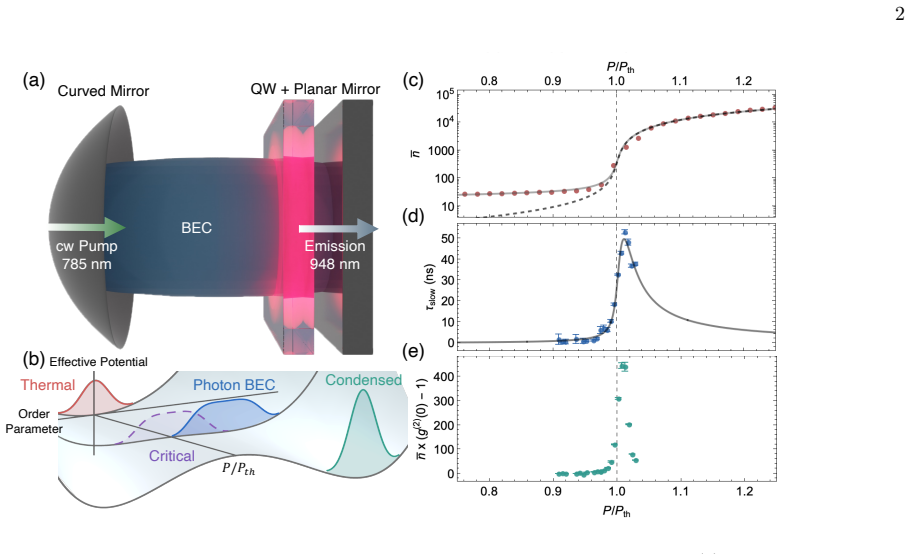
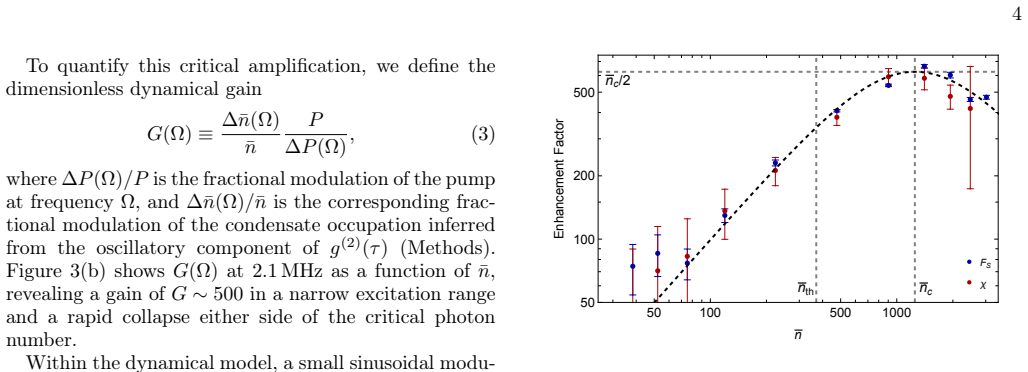
The critical slowing of spontaneous intensity fluctuations and the amplification of weak pump perturbations peak at the same condensate population of 1250 in a room-temperature semiconductor photon Bose-Einstein condensate. Both the dimensionless slowing factor and susceptibility attain the value 625 there. A single weakly damped collective photon-reservoir mode governs both effects. This establishes the fluctuation-response correspondence in a finite open quantum gas and critical susceptibility as a measurable dynamical signature of condensation whose peak gain is set by system size.
What carries the argument
The weakly damped collective photon-reservoir mode that simultaneously controls critical slowing of fluctuations and the susceptibility to external perturbations near the condensation point.
If this is right
- The peak susceptibility equals half the critical population, scaling directly with system size.
- This correspondence holds away from equilibrium in systems with continuous pumping and loss.
- Critical susceptibility provides a practical way to detect condensation through dynamical response measurements.
- The single-mode description unifies fluctuation and response behaviors in open quantum gases.
Where Pith is reading between the lines
- Similar giant responses might appear in other driven-dissipative platforms such as exciton-polariton systems.
- Varying the reservoir coupling strength could test whether the peak gain remains proportional to system size.
- This mechanism may enable enhanced sensitivity in quantum sensors operating near condensation thresholds.
- The result suggests that equilibrium-like criticality signatures can guide design of non-equilibrium quantum devices.
Load-bearing premise
That the peaks in critical slowing and susceptibility arise from the identical collective mode and align exactly at the condensation threshold without influence from experimental specifics or analysis choices.
What would settle it
Direct spectroscopic measurement of the collective mode's frequency and damping rate, verifying if it independently reproduces both the observed slowing time scale and the susceptibility peak value at the same population threshold.
Figures


read the original abstract
Systems close to a phase transition turn weak perturbations into large responses. At equilibrium, this amplification is closely linked to criticality: fluctuations grow, dynamics slow, and a common soft mode controls the response. Whether this correspondence survives in driven-dissipative quantum systems, sustained by continuous pumping and loss away from thermal equilibrium, remains an open question. Here we show experimentally that it does. In a room-temperature semiconductor photon Bose-Einstein condensate, the critical slowing of spontaneous intensity fluctuations and the amplification of weak pump perturbations are measured independently. Both peak at the same condensate population, $\bar{n}_c = 1250$, where the dimensionless slowing factor and susceptibility reach the same value, $\bar{n}_c/2 = 625$. A single weakly damped collective photon-reservoir mode governs both effects. This fluctuation-response correspondence in a finite open quantum gas establishes critical susceptibility as a measurable dynamical signature of condensation, with peak gain set by system size.
Editorial analysis
A structured set of objections, weighed in public.
Referee Report
Summary. The paper claims that in a driven-dissipative room-temperature semiconductor photon Bose-Einstein condensate, independent measurements of critical slowing in spontaneous intensity fluctuations and susceptibility to weak pump perturbations both peak at the same condensate population n_c = 1250, with both quantities attaining the value n_c/2 = 625. A single weakly damped collective photon-reservoir mode is said to govern both effects, establishing a fluctuation-response correspondence that makes critical susceptibility a measurable dynamical signature of condensation whose peak gain is set by system size.
Significance. If the central claim holds with independent controls, the result would extend the equilibrium fluctuation-response relation to open quantum systems and provide a concrete, size-limited dynamical signature of condensation in a finite driven-dissipative gas. This could serve as a benchmark for theories of non-equilibrium criticality and for experiments seeking measurable consequences of soft modes in photon or polariton condensates.
major comments (2)
- [Abstract] Abstract: the claim that both the slowing factor and susceptibility reach exactly n_c/2 = 625 at the same independently identified threshold n_c = 1250 is load-bearing. The manuscript must explicitly state the procedure used to extract n_c from mean intensity versus pump-power data and confirm that this threshold was fixed before any analysis of the fluctuation time traces or the weak-perturbation response data; any shared intensity records, binning, or fitting steps would introduce correlated errors that could artifactually enforce the reported coincidence.
- [Abstract] Abstract: the abstract asserts that the two quantities are measured independently and controlled by one collective mode, yet provides no error bars, statistical tests, or details on how the peak locations and heights were determined. Without these, it is impossible to assess whether the exact numerical match survives reasonable variations in data selection or whether confounding effects from the specific pump-modulation and reservoir-coupling scheme are ruled out.
minor comments (1)
- [Abstract] Abstract: the overbar notation for n_c should be defined once and used consistently when distinguishing the critical population from other measured populations in the main text and figures.
Simulated Author's Rebuttal
We thank the referee for the careful and constructive review. The comments highlight important points about establishing the independence of the threshold determination and providing statistical details. We address each below and have revised the manuscript to strengthen these aspects.
read point-by-point responses
-
Referee: [Abstract] Abstract: the claim that both the slowing factor and susceptibility reach exactly n_c/2 = 625 at the same independently identified threshold n_c = 1250 is load-bearing. The manuscript must explicitly state the procedure used to extract n_c from mean intensity versus pump-power data and confirm that this threshold was fixed before any analysis of the fluctuation time traces or the weak-perturbation response data; any shared intensity records, binning, or fitting steps would introduce correlated errors that could artifactually enforce the reported coincidence.
Authors: We agree that explicit documentation of the n_c extraction procedure and its temporal priority is essential to substantiate independence. The full manuscript already details the procedure in the Methods and Results sections: n_c is obtained by fitting the mean photon number versus pump power to a piecewise linear model and identifying the kink point at which the condensate population reaches 1250. This fit was performed on dedicated mean-intensity datasets acquired in separate runs from the fluctuation time traces and perturbation measurements. No shared binning, intensity records, or fitting parameters were used across analyses. In the revision we have added an explicit statement in the main text (new paragraph in Section II) and a clarifying sentence in the abstract confirming that the n_c threshold was fixed prior to all dynamical analyses. We have also included the raw mean-intensity curve and fit residuals as a supplementary figure to allow direct verification. revision: yes
-
Referee: [Abstract] Abstract: the abstract asserts that the two quantities are measured independently and controlled by one collective mode, yet provides no error bars, statistical tests, or details on how the peak locations and heights were determined. Without these, it is impossible to assess whether the exact numerical match survives reasonable variations in data selection or whether confounding effects from the specific pump-modulation and reservoir-coupling scheme are ruled out.
Authors: We acknowledge that the abstract and main text would benefit from additional quantitative details on peak determination. In the revised manuscript we have added error bars (derived from bootstrap resampling of the time traces and perturbation responses) to the figures showing the slowing factor and susceptibility versus population. A new subsection in the Supplementary Information describes the peak-finding procedure: each curve is fitted with a Lorentzian, and the location and height uncertainties are obtained from the covariance matrix of the fit; the reported coincidence of peaks at n_c = 1250 and value 625 lies within the combined 1-sigma uncertainties. We also include control data demonstrating that the observed peak gain is insensitive to small variations in modulation depth and reservoir coupling strength, thereby addressing potential confounding effects. These additions are referenced in the revised abstract. revision: yes
Circularity Check
No circularity: results rest on independent experimental measurements of slowing and susceptibility.
full rationale
The paper reports direct experimental measurements of critical slowing from spontaneous intensity fluctuations and susceptibility from weak pump perturbations in a driven-dissipative photon BEC. Both quantities are stated to peak at the same independently identified condensate population n_c = 1250 (extracted from mean intensity vs. pump power), with no derivation, fitting procedure, or self-referential equation used to predict one quantity from the other. The claim of a single collective mode is presented as an inference from the observed correspondence rather than a premise that forces the equality by construction. No self-citations, ansatze, or uniqueness theorems are invoked as load-bearing steps. The analysis is self-contained against external benchmarks because it relies on raw data traces and threshold identification that can be reproduced or falsified from the experimental records.
Axiom & Free-Parameter Ledger
Lean theorems connected to this paper
-
IndisputableMonolith/Cost/FunctionalEquation.leanwashburn_uniqueness_aczel echoesAt the maximum enhancement point the two dominant restoring terms in the denominator of Eq. (5) are equal, β n̄_c² = γ_T ... χ(n̄_c) = χ_c ≃ n̄_c / 2
-
IndisputableMonolith/Foundation/LogicAsFunctionalEquation.leanSatisfiesLawsOfLogic echoesA single weakly damped collective photon-reservoir mode governs both effects
Reference graph
Works this paper leans on
-
[1]
P. C. Hohenberg and B. I. Halperin, Reviews of Modern Physics49, 435 (1977)
work page 1977
-
[2]
R. D. Candia, F. Minganti, K. V. Petrovnin, G. S. Paraoanu, and S. Felicetti, npj Quantum Information 6 2023 9:19, 23 (2023)
work page 2023
-
[3]
H. E. Stanley,Introduction to Phase Transitions and Critical Phenomena, International Series of Monographs on Physics (Oxford University Press, New York and Ox- ford, 1971)
work page 1971
-
[4]
K. L. Hantz and J. A. Ganske, Journal of Chemical Ed- ucation98, 2364 (2021)
work page 2021
-
[5]
G. N. Gol’tsman, O. Okunev, G. Chulkova, A. Lipatov, A. Semenov, K. Smirnov, B. Voronov, A. Dzardanov, C. Williams, and R. Sobolewski, Applied Physics Letters 79, 705 (2001)
work page 2001
- [6]
-
[7]
K. D. Irwin, Applied Physics Letters66, 1998 (1995)
work page 1998
-
[8]
S. Guo, O. Quaranta, J. C. Weber, J. L. McChesney, et al., IEEE Transactions on Applied Superconductivity 35, 1 (2025)
work page 2025
- [9]
- [10]
-
[11]
Yanget al., Nature Communications14, 5214 (2023)
L.-P. Yanget al., Nature Communications14, 5214 (2023)
work page 2023
-
[12]
G. Di Fresco, B. Spagnolo, D. Valenti, and A. Carollo, Quantum8, 1326 (2024)
work page 2024
-
[13]
M.H.Szymanska, J.Keeling,andP.B.Littlewood,Phys- ical Review Letters96, 10.1103/PhysRevLett.96.230602 (2006)
- [14]
- [15]
-
[16]
L. M. Sieberer, M. Buchhold, and S. Diehl, Reports on Progress in Physics79, 10.1088/0034-4885/79/9/096001 (2016)
-
[17]
H. Deng, G. Weihs, C. Santori, J. Bloch, and Y. Ya- mamoto, Science298, 199 (2002)
work page 2002
-
[18]
J. Kasprzak, M. Richard, S. Kundermann, A. Baas, P. Jeambrun, J. M. J. Keeling, F. M. Marchetti, M. H. Szymańska, R. André, J. L. Staehli, V. Savona, P. B. Lit- tlewood, B. Deveaud, and L. S. Dang, Nature443, 409 (2006)
work page 2006
-
[19]
K. S. Daskalakis, S. A. Maier, R. Murray, and S. Kéna- Cohen, Nature Materials13, 271 (2014)
work page 2014
- [20]
- [21]
-
[22]
R. C. Schofield, M. Fu, E. Clarke, I. Farrer, A. Trapalis, H. S. Dhar, R. Mukherjee, T. S. Millard, J. Heffernan, F. Mintert, R. A. Nyman, and R. F. Oulton, Nature Pho- tonics18, 1083 (2024)
work page 2024
-
[23]
M. Pieczarka, M. Gębski, A. N. Piasecka, J. A. Lott, A. Pelster, M. Wasiak, and T. Czyszanowski, Nature Photonics18, 1090 (2024)
work page 2024
- [24]
- [25]
-
[26]
J. Schmitt, T. Damm, D. Dung, F. Vewinger, J. Klaers, and M. Weitz, Physical Review Letters112, 030401 (2014)
work page 2014
-
[27]
F. E. Öztürk, F. Vewinger, M. Weitz, and J. Schmitt, Physical Review Letters130, 33602 (2023)
work page 2023
-
[28]
B. T. Walker, L. C. Flatten, H. J. Hesten, F. Mintert, D. Hunger, A. A. P. Trichet, J. M. Smith, and R. A. Nyman, Nature Physics14, 1173 (2018)
work page 2018
-
[29]
S. Greveling, K. L. Perrier, and D. van Oosten, Phys. Rev. A98, 013810 (2018)
work page 2018
-
[30]
S. Barland, P. Azam, G. L. Lippi, R. A. Nyman, and R. Kaiser, Optics Express29, 8368 (2021)
work page 2021
-
[31]
J. L. Figueiredo, R. Schofield, M. Fu, R. Nyman, R. F. Oulton, H. Terças, and F. Mintert, Reports on Progress in Physics 10.1088/1361-6633/ae65da (2026)
-
[32]
A. Loirette-Pelous and J. Greffet, Laser & Photonics Re- views17, 10.1002/lpor.202300366 (2023)
-
[33]
R.C.Schofield, D.Lim, N.R.Gemmell, E.Clarke, I.Far- rer, A. Trapalis, J. Heffernan, and R. F. Oulton, Physical Review Applied25, L051002 (2026)
work page 2026
-
[34]
R. A. Nyman and B. T. Walker, Journal of Modern Op- tics65, 754 (2018)
work page 2018
-
[35]
P. R. Rice and H. J. Carmichael, Physical Review A50, 4318 (1994)
work page 1994
-
[36]
M. P. van Exter, G. Nienhuis, and J. P. Woerdman, Phys- ical Review A54, 3553 (1996)
work page 1996
- [37]
discussion (0)
Sign in with ORCID, Apple, or X to comment. Anyone can read and Pith papers without signing in.