Recognition: 2 theorem links
· Lean TheoremBreathing and Rotobreathing Cyclops States in Phase Oscillators with Inertia and Two-Harmonic Coupling
Pith reviewed 2026-05-13 00:51 UTC · model grok-4.3
The pith
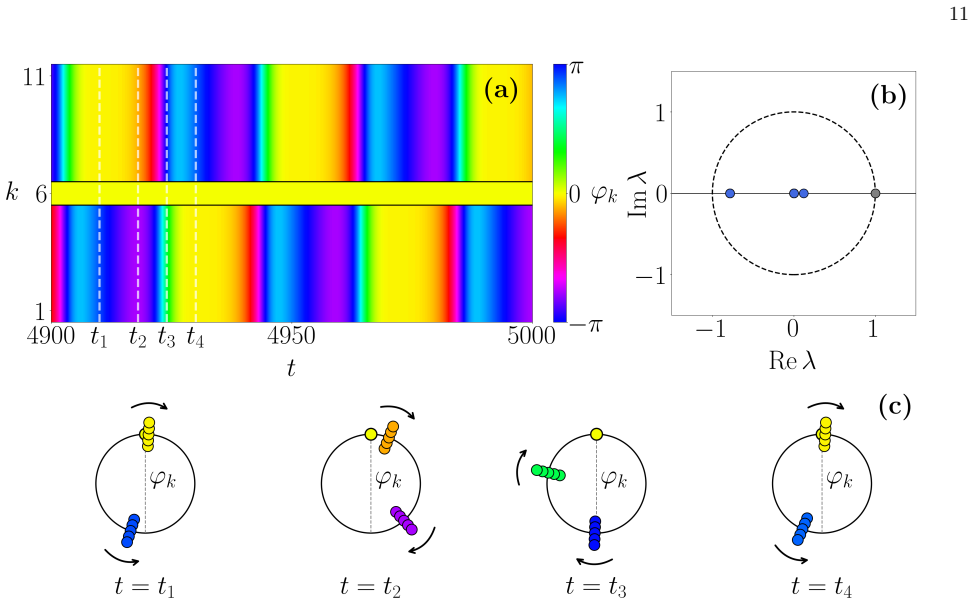
Breathing and rotobreathing cyclops states occupy vast parameter regions and serve as key elements in the dynamics of inertial phase oscillators with two-harmonic coupling.
A machine-rendered reading of the paper's core claim, the machinery that carries it, and where it could break.
Core claim
Breathing and rotobreathing cyclops states are nonstationary three-cluster configurations that preserve the structure of two synchronous groups plus a solitary oscillator. They occupy large portions of parameter space set by the second coupling harmonic and act as core organizing features in the collective dynamics. Destabilization occurs either by period doubling, which produces quasicyclops states while frequency synchronization inside clusters remains, or by loss of one or two clusters, which yields switching cyclops states or multicluster configurations.
What carries the argument
Breathing and rotobreathing cyclops states, nonstationary three-cluster configurations that maintain the overall cluster partition while the phase differences or frequencies within clusters vary periodically.
If this is right
- These states are expected to appear generically whenever inertia and a second coupling harmonic are both significant.
- Destabilization via period doubling keeps intra-cluster frequency locking, producing quasicyclops states as the next level of complexity.
- Cluster breakup routes lead directly to switching cyclops or multicluster states, providing a clear hierarchy of transitions.
- The prevalence of these states implies that control strategies for collective behavior must account for breathing and rotobreathing regimes rather than assuming stationary clusters.
Where Pith is reading between the lines
- If the second harmonic can be tuned externally, it may serve as a practical knob to induce or suppress breathing cyclops states in engineered oscillator arrays.
- Similar breathing cluster states could appear in other inertial oscillator models once a second harmonic term is added, even outside the exact three-cluster setting.
- The identified destabilization scenarios suggest that targeted perturbations to the solitary oscillator might steer the system between breathing and stationary cyclops regimes.
Load-bearing premise
The three-cluster structure stays identifiable over long times and numerical integration faithfully captures the nonstationary attractors without creating artifacts from time-stepping or parameter choices.
What would settle it
A high-resolution parameter sweep or long-time integration that finds breathing and rotobreathing states confined to narrow intervals or that shows the clusters rapidly lose coherence due to numerical drift would contradict the claim that they occupy vast regions and function as key dynamical elements.
Figures




read the original abstract
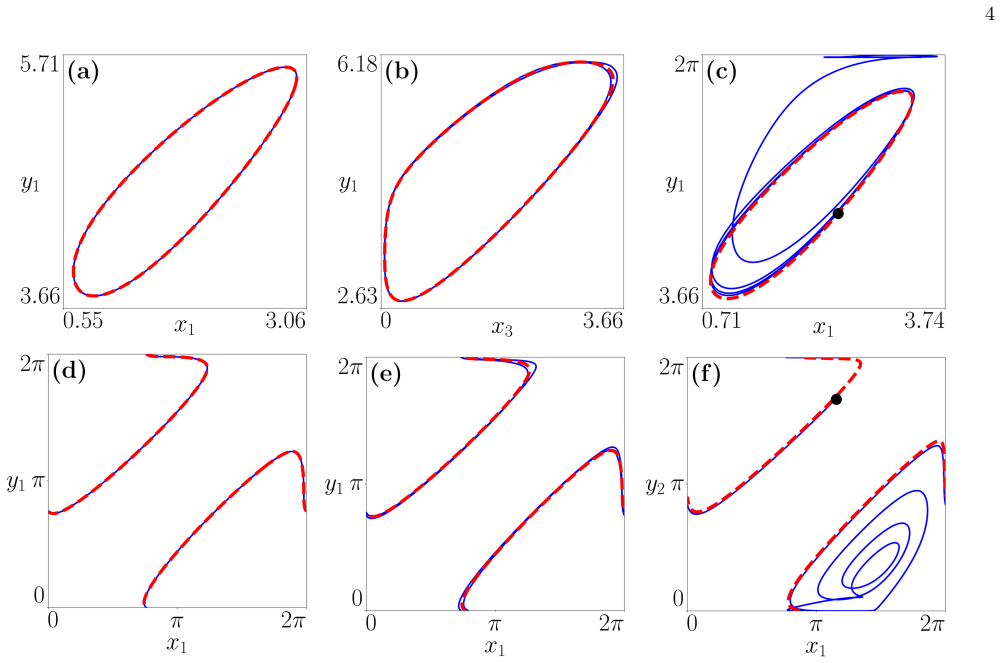
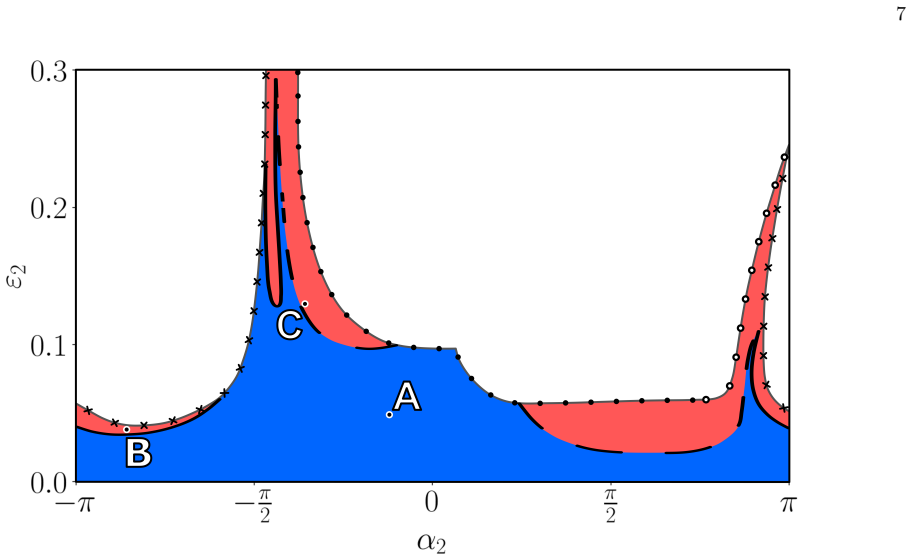
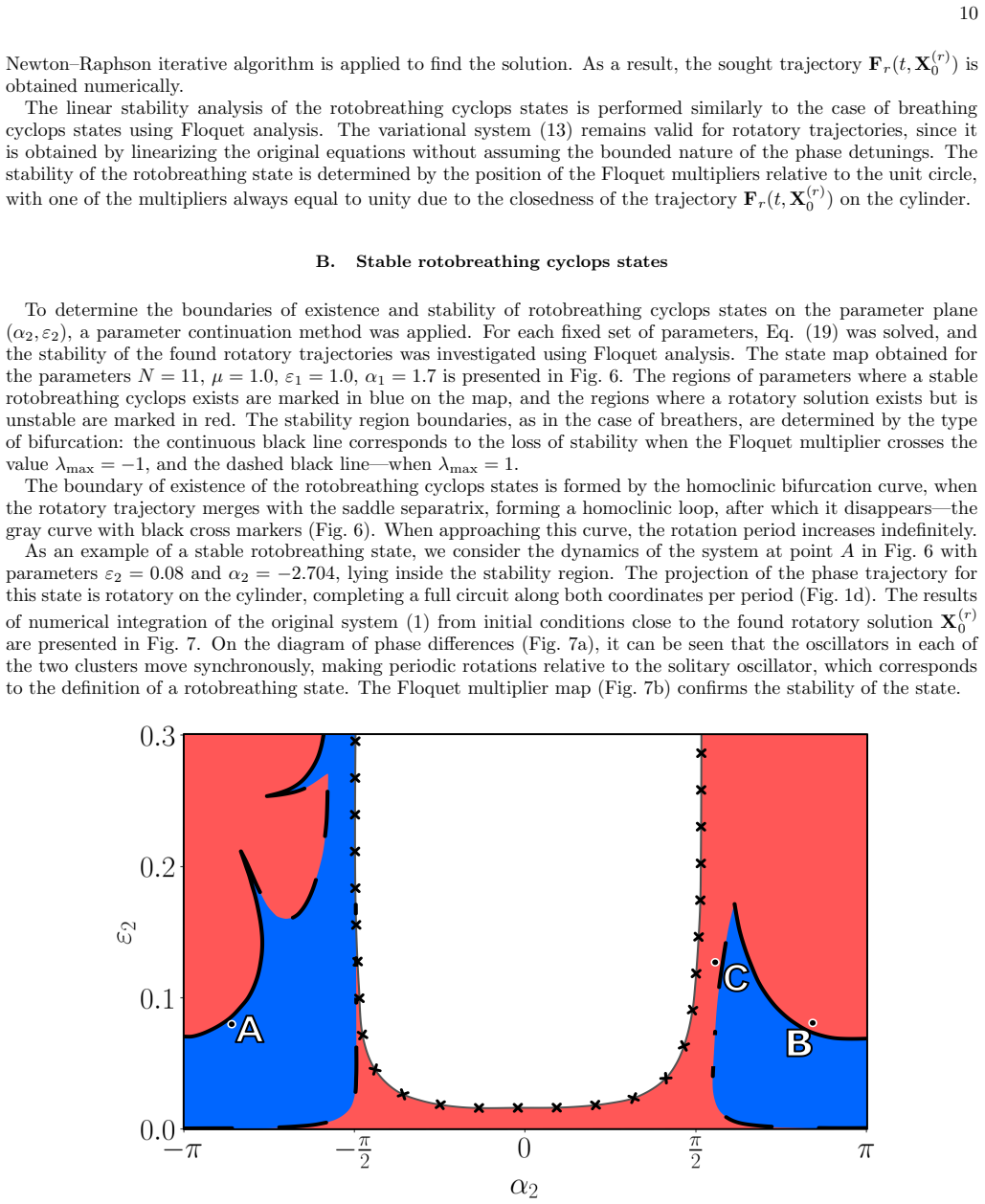
Cyclops states - three-cluster configurations consisting of two synchronous groups and a solitary oscillator - dominate in ensembles of phase oscillators with inertia and multiple coupling harmonics [Phys. Rev. E 109, 054202 (2024)]. In this work, for the first time, we systematically study nonstationary cyclops states that preserve the three-cluster structure: breathing and rotobreathing cyclops states. We identify two scenarios for their destabilization: period doubling, leading to quasicyclops states while preserving frequency synchronization within the clusters, and the destruction of one or two clusters, resulting in the emergence of switching cyclops or multicluster states. We show that breathing and rotobreathing cyclops states occupy vast parameter regions of the second coupling harmonic and are key elements of the dynamics. The results are important for predicting and controlling complex collective states in ensembles with higher-order interaction harmonics of various natures.
Editorial analysis
A structured set of objections, weighed in public.
Referee Report
Summary. The paper claims that breathing and rotobreathing cyclops states—nonstationary three-cluster configurations preserving the two synchronous groups plus solitary oscillator structure—occur in phase oscillators with inertia and two-harmonic coupling. These states are shown to occupy vast regions of the second-harmonic coupling parameter space, with two destabilization routes identified: period doubling (yielding quasicyclops states while preserving intra-cluster frequency synchronization) and cluster destruction (yielding switching cyclops or multicluster states). The states are presented as key elements of the overall dynamics.
Significance. If the numerical findings are robust, the work meaningfully extends the stationary cyclops states identified in prior literature to their nonstationary counterparts, underscoring the role of inertia and higher-order coupling harmonics in generating persistent periodic cluster dynamics. This has potential implications for control and prediction in systems such as Josephson-junction arrays or power-grid models where similar inertial and multi-harmonic interactions arise.
major comments (2)
- [Numerical Methods] Numerical Methods section: The identification of persistent breathing and rotobreathing states over long integration times and across broad parameter regions rests on direct numerical simulation of the second-order inertial equations. No information is supplied on the integrator (e.g., explicit RK4), fixed or adaptive step size, or any convergence tests with respect to discretization error. Because inertial terms can amplify truncation errors and introduce artificial frequencies, the reported stability of the three-cluster structure and the extent of the 'vast' regions cannot be fully assessed without such checks.
- [Results] Parameter-space exploration (results section): The central claim that breathing and rotobreathing cyclops states occupy 'vast' regions of the second coupling harmonic is supported only by qualitative statements and representative trajectories. No quantitative measure—such as the fraction of sampled points in the (second-harmonic strength, inertia) plane that exhibit the states, or area estimates from bifurcation diagrams—is provided, weakening the assertion that these states are dominant or key elements of the dynamics.
minor comments (2)
- [Abstract] Abstract: The phrasing 'vast parameter regions of the second coupling harmonic' is imprecise; it should explicitly indicate whether the regions are one-dimensional (second-harmonic strength at fixed inertia) or two-dimensional.
- [Figures] Figure captions and text: Ensure consistent terminology between 'breathing cyclops,' 'rotobreathing cyclops,' and 'quasicyclops' states when describing the period-doubling route.
Simulated Author's Rebuttal
We thank the referee for the careful review and insightful comments on our manuscript. We have addressed each of the major comments as detailed below, and revisions have been made to enhance the manuscript accordingly.
read point-by-point responses
-
Referee: [Numerical Methods] Numerical Methods section: The identification of persistent breathing and rotobreathing states over long integration times and across broad parameter regions rests on direct numerical simulation of the second-order inertial equations. No information is supplied on the integrator (e.g., explicit RK4), fixed or adaptive step size, or any convergence tests with respect to discretization error. Because inertial terms can amplify truncation errors and introduce artificial frequencies, the reported stability of the three-cluster structure and the extent of the 'vast' regions cannot be fully assessed without such checks.
Authors: We appreciate the referee highlighting the need for more details on the numerical methods. In the revised manuscript, we have expanded the Numerical Methods section to specify the integrator (explicit fourth-order Runge-Kutta method), the fixed step size employed, the long integration times used to verify persistence, and the results of convergence tests confirming that the reported states are robust to changes in discretization. revision: yes
-
Referee: [Results] Parameter-space exploration (results section): The central claim that breathing and rotobreathing cyclops states occupy 'vast' regions of the second coupling harmonic is supported only by qualitative statements and representative trajectories. No quantitative measure—such as the fraction of sampled points in the (second-harmonic strength, inertia) plane that exhibit the states, or area estimates from bifurcation diagrams—is provided, weakening the assertion that these states are dominant or key elements of the dynamics.
Authors: We agree that including a quantitative measure would provide stronger support for the claim. In the revised manuscript, we have added a quantitative assessment of the parameter space by including the fraction of sampled points exhibiting the states and estimates derived from the bifurcation diagrams, thereby better substantiating that these states occupy vast regions and are key elements of the dynamics. revision: yes
Circularity Check
No circularity: forward numerical exploration of nonstationary cluster states
full rationale
The paper performs a systematic numerical study of breathing and rotobreathing cyclops states in a standard second-order phase-oscillator model with two-harmonic coupling. It cites prior work only for the existence of stationary cyclops states and then proceeds to new simulations that identify destabilization routes (period doubling, cluster destruction) and parameter regions. No derivation reduces a claimed result to a fitted parameter, self-citation chain, or definitional tautology; the central claims rest on direct integration of the governing equations and visual/numerical identification of long-term behavior. This is a self-contained forward exploration with no load-bearing circular steps.
Axiom & Free-Parameter Ledger
free parameters (2)
- second harmonic coupling strength
- inertia coefficient
axioms (1)
- domain assumption The system is governed by the standard second-order phase oscillator equations with two-harmonic sinusoidal coupling
Lean theorems connected to this paper
-
IndisputableMonolith/Cost/FunctionalEquation.leanwashburn_uniqueness_aczel unclearWe obtain a system of two second-order equations: μẍ + ẋ = … (Eq. 7); breathing states satisfy |x(t)| < π, |y(t)| < π; Floquet analysis via monodromy matrix Φ(T) with multipliers λ_j
-
IndisputableMonolith/Foundation/DimensionForcing.leanalexander_duality_circle_linking unclearCyclops states … three-cluster configurations … breathing and rotobreathing … period doubling … homoclinic bifurcation
Reference graph
Works this paper leans on
-
[1]
F. C. Hoppensteadt and E. M. Izhikevich,Weakly Connected Neural Networks(Springer, 2012)
work page 2012
-
[2]
M. R. Tinsley, S. Nkomo, and K. Showalter, Nat. Phys.8, 662 (2012)
work page 2012
-
[3]
J. Ding, I. Belykh, A. Marandi, and M.-A. Miri, Phys. Rev. Appl.12, 054039 (2019)
work page 2019
-
[4]
F. D¨ orfler, M. Chertkov, and F. Bullo, Proc. Natl. Acad. Sci. USA110, 2005 (2013)
work page 2005
-
[5]
A. E. Motter, S. A. Myers, M. Anghel, and T. Nishikawa, Nat. Phys.9, 191 (2013)
work page 2013
-
[6]
Kuramoto, inInternational Symposium on Mathematical Problems in Theoretical Physics(1975), p
Y. Kuramoto, inInternational Symposium on Mathematical Problems in Theoretical Physics(1975), p. 420
work page 1975
-
[7]
S. H. Strogatz, Physica D143, 1 (2000)
work page 2000
- [8]
-
[9]
J. A. Acebr´ on et al., Rev. Mod. Phys.77, 137 (2005)
work page 2005
- [10]
-
[11]
Y. Kuramoto and D. Battogtokh, Nonlinear Phenom. Complex Syst.5, 380 (2002)
work page 2002
-
[12]
D. M. Abrams and S. H. Strogatz, Phys. Rev. Lett.93, 174102 (2004)
work page 2004
-
[13]
M. J. Panaggio and D. M. Abrams, Nonlinearity28, R67 (2015)
work page 2015
-
[14]
I. V. Belykh, B. N. Brister, and V. N. Belykh, Chaos26, 094822 (2016)
work page 2016
-
[15]
B. N. Brister, V. N. Belykh, and I. V. Belykh, Phys. Rev. E101, 062206 (2020)
work page 2020
- [16]
- [17]
-
[18]
V. O. Munyayev et al., Phys. Rev. E105, 024203 (2022)
work page 2022
- [19]
- [20]
-
[21]
P. S. Skardal, E. Ott, and J. G. Restrepo, Phys. Rev. E84, 036208 (2011)
work page 2011
- [22]
-
[23]
V. O. Munyayev et al., Phys. Rev. Lett.130, 107201 (2023)
work page 2023
-
[24]
M. I. Bolotov et al., Phys. Rev. E109, 054202 (2024)
work page 2024
-
[25]
M. I. Bolotov et al., Phys. Rev. E112, 052202, (2025)
work page 2025
- [26]
discussion (0)
Sign in with ORCID, Apple, or X to comment. Anyone can read and Pith papers without signing in.