Recognition: 2 theorem links
· Lean TheoremMetal Saturation and the Redistribution of Hydrogen in Earth's Mantle
Pith reviewed 2026-05-13 00:52 UTC · model grok-4.3
The pith
Metallic iron from disproportionation saturates the lower mantle and reduces subducted hydrogen, drying the deep layers while allowing water to rise and wet the shallow mantle.
A machine-rendered reading of the paper's core claim, the machinery that carries it, and where it could break.
Core claim
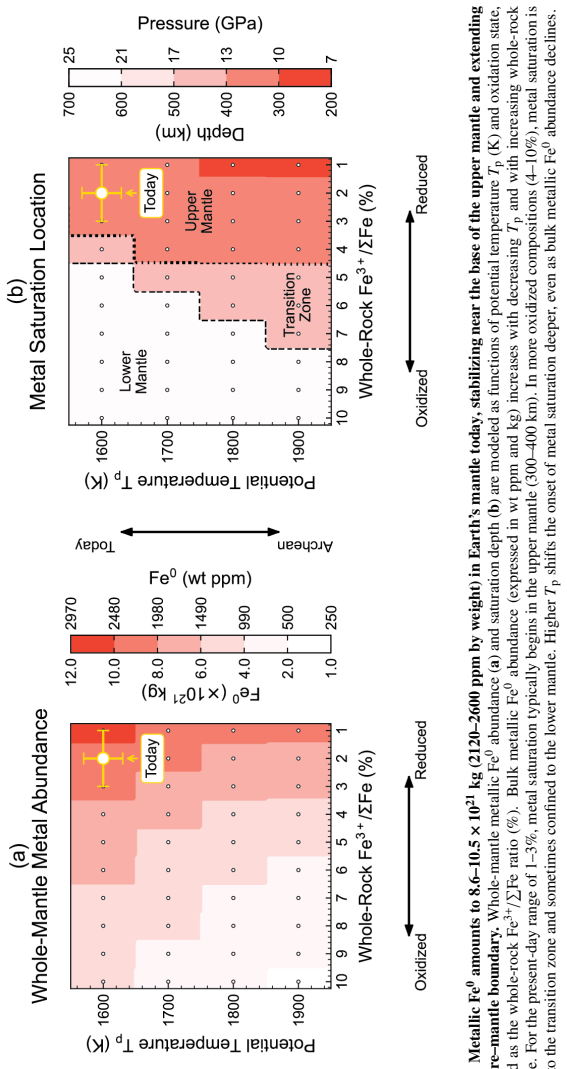
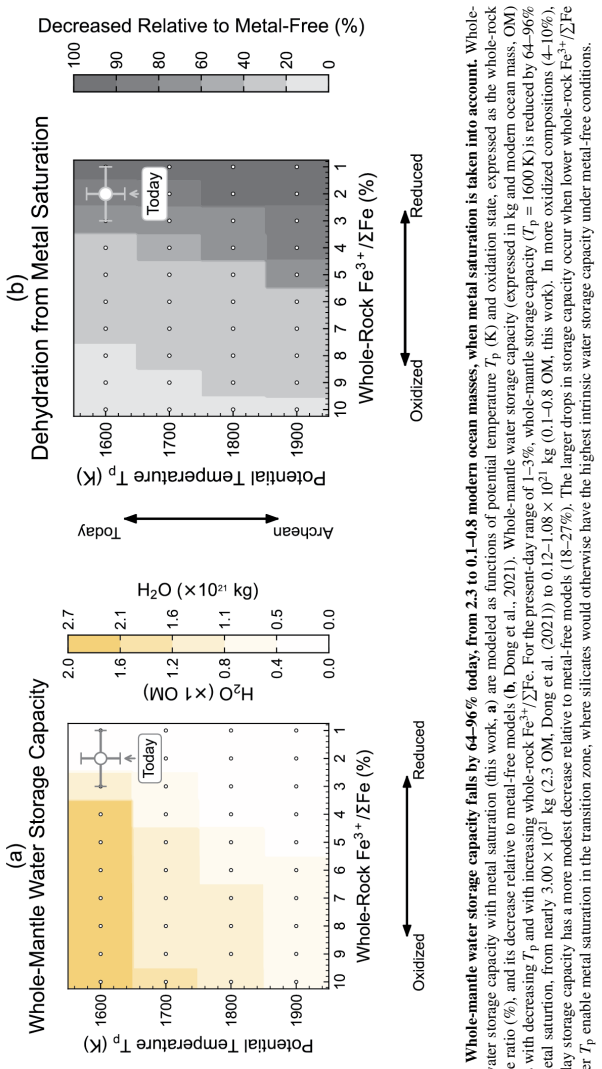
Iron disproportionation reactions in mantle silicates produce metallic iron that drives Earth's deep mantle toward metal saturation under reduced conditions. Subducting slabs transport hydrated silicates to these depths, where interactions with metallic iron reduce structurally bound hydrogen to reduced hydrogen-bearing phases such as molecular hydrogen or iron hydrides, leaving mantle rocks in effect dry. Metal saturation can thus redistribute hydrogen internally, creating a sharp contrast between a wet shallow mantle and a dry deep mantle, decreasing mantle silicate water storage capacity by 64-96% today to only 0.1-0.8 modern ocean masses.
What carries the argument
Iron disproportionation in silicates that generates metallic iron, followed by its redox reaction with hydrogen in subducted hydrated phases.
Load-bearing premise
Subducting slabs carry enough hydrated silicates into the metal-saturated lower mantle for significant reduction to occur, and thermodynamic models correctly predict metallic iron stability and hydrogen speciation at pressures above 50 GPa.
What would settle it
Direct sampling or remote sensing that shows substantial retained water in lower-mantle minerals or the absence of any viscosity jump at the upper-lower mantle boundary would falsify the predicted redistribution.
Figures


read the original abstract
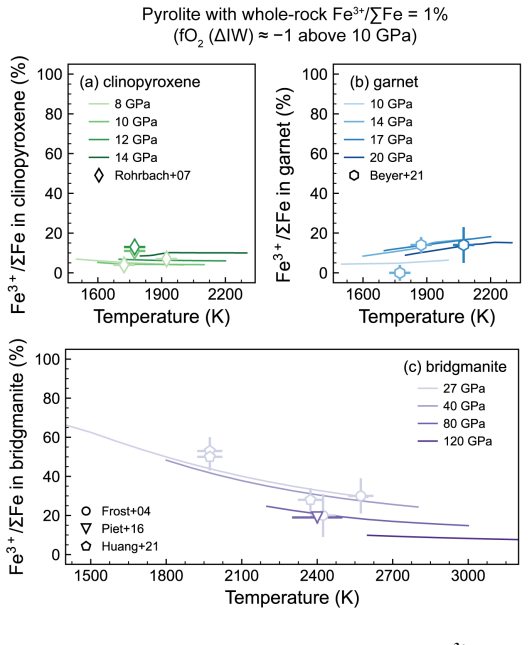
Iron disproportionation reactions in mantle silicates can produce metallic iron that drives Earth's deep mantle toward metal saturation under reduced conditions. Subducting slabs transport hydrated silicates to these depths, where interactions with metallic iron can reduce structurally bound hydrogen in silicates to reduced hydrogen-bearing phases, such as molecular hydrogen or iron hydrides, leaving mantle rocks in effect dry. Using the thermodynamic code HeFESTo with its latest self-consistent treatment of iron-bearing mantle phases, we investigate the stability and distribution of metallic iron in Earth's pyrolitic mantle across a broad range of oxidation states, represented by whole-rock Fe3+/$\Sigma$Fe ratio from 1% to 10%. We find that metallic iron is present through much of the lower mantle across this range and, under very reduced compositions of whole-rock Fe3+/$\Sigma$Fe = 1-3%, extends into the upper mantle. Where subducted water meets metal-saturated regions, hydrous melts may form and migrate upward, rehydrating the overlying mantle or pooling near the transition zone. Metal saturation can thus redistribute hydrogen internally, creating a sharp contrast between a wet shallow mantle and a dry deep mantle. This redox-driven redistribution can decrease mantle silicate water storage capacity by 64-96% today, to only 0.1-0.8 modern ocean masses, and may explain the viscosity contrast near the upper-lower mantle boundary. Although quantitative estimates of metal abundance and distribution depend on thermodynamic assumptions and remain uncertain above 50 GPa, our results reveal the role of redox reactions between disproportionated iron and subducted water in governing the speciation and redistribution of hydrogen in Earth's mantle.
Editorial analysis
A structured set of objections, weighed in public.
Referee Report
Summary. The paper claims that iron disproportionation produces metallic iron in mantle silicates, driving metal saturation under reduced conditions. Subducting hydrated silicates interact with this metal to reduce structurally bound hydrogen to H2 or FeH_x phases, leaving deep mantle rocks effectively dry. Using the HeFESTo thermodynamic code with self-consistent iron-phase treatment, the authors model metallic iron stability in pyrolitic mantle for whole-rock Fe3+/ΣFe ratios of 1-10%. They find metal present through much of the lower mantle (extending into the upper mantle at 1-3% ratios). This enables redox-driven internal hydrogen redistribution, producing a wet shallow mantle and dry deep mantle. The process is said to decrease silicate water storage capacity by 64-96% today (to 0.1-0.8 modern ocean masses) and may explain the viscosity contrast near the upper-lower mantle boundary. Quantitative estimates are noted to depend on thermodynamic assumptions and remain uncertain above 50 GPa.
Significance. If the modeled mechanism holds, it supplies a self-consistent redox pathway for generating sharp mantle hydration contrasts and viscosity changes driven by subduction and iron disproportionation, without external water sources. This could help reconcile geophysical observations of upper-mantle hydration with lower-mantle dryness. The use of HeFESTo's self-consistent thermodynamic database for iron-bearing phases across a range of oxidation states is a clear strength, allowing systematic exploration of metal stability as a function of Fe3+/ΣFe.
major comments (2)
- [Abstract] Abstract: The central quantitative result (64-96% reduction in silicate water storage capacity, yielding 0.1-0.8 ocean masses) is derived from HeFESTo outputs for metallic iron stability and H speciation. The abstract itself states that 'quantitative estimates of metal abundance and distribution depend on thermodynamic assumptions and remain uncertain above 50 GPa,' yet no sensitivity tests, alternative databases, or comparisons to high-pressure experiments (e.g., diamond-anvil cell data on Fe-bearing pyrolite at 25-100 GPa) are described. This directly limits in the reported percentages and the viscosity-contrast explanation.
- [Abstract] Abstract: The claim that subducting slabs deliver sufficient hydrated silicates to metal-saturated lower-mantle regions for significant reduction reactions is asserted without supporting flux calculations, slab transport models, or estimates of reaction efficiency. This assumption is load-bearing for the proposed redistribution mechanism but is not quantified or tested within the presented modeling framework.
minor comments (1)
- [Abstract] Abstract: The ratio 'whole-rock Fe3+/ΣFe' is introduced without a parenthetical definition on first use, although it is standard in the field; adding '(ferric iron to total iron)' would improve immediate clarity for a broad readership.
Simulated Author's Rebuttal
We thank the referee for their thoughtful comments on our manuscript. We provide point-by-point responses to the major comments below and outline revisions to address the concerns raised.
read point-by-point responses
-
Referee: [Abstract] Abstract: The central quantitative result (64-96% reduction in silicate water storage capacity, yielding 0.1-0.8 ocean masses) is derived from HeFESTo outputs for metallic iron stability and H speciation. The abstract itself states that 'quantitative estimates of metal abundance and distribution depend on thermodynamic assumptions and remain uncertain above 50 GPa,' yet no sensitivity tests, alternative databases, or comparisons to high-pressure experiments (e.g., diamond-anvil cell data on Fe-bearing pyrolite at 25-100 GPa) are described. This directly limits in the reported percentages and the viscosity-contrast explanation.
Authors: We agree that the quantitative results depend on the thermodynamic model employed, as already noted in the abstract. The HeFESTo database is self-consistent and incorporates the latest experimental constraints on iron-bearing phases. However, we recognize that explicit sensitivity tests to alternative databases or direct comparisons to diamond-anvil cell experiments at pressures above 50 GPa are not included. In the revised manuscript, we will expand the discussion to include a qualitative assessment of how variations in thermodynamic parameters might affect metal stability and add references to relevant high-pressure experimental studies on Fe-bearing pyrolite. Full quantitative sensitivity analyses would require substantial additional computational work and are beyond the current scope, but we will highlight this limitation more prominently. Thus, this will be addressed partially through enhanced discussion. revision: partial
-
Referee: [Abstract] Abstract: The claim that subducting slabs deliver sufficient hydrated silicates to metal-saturated lower-mantle regions for significant reduction reactions is asserted without supporting flux calculations, slab transport models, or estimates of reaction efficiency. This assumption is load-bearing for the proposed redistribution mechanism but is not quantified or tested within the presented modeling framework.
Authors: The primary focus of our study is the thermodynamic modeling of metal saturation in the mantle using HeFESTo and the implications for hydrogen speciation upon interaction with subducted water. We do not perform detailed slab transport or flux calculations, as these are typically addressed in geodynamic modeling studies. The assertion is based on the established fact that subducting slabs carry significant amounts of water into the mantle and that metal-saturated regions exist in the lower mantle according to our models. To address this, in revision we will include order-of-magnitude estimates of subducted water flux drawn from the literature and discuss the potential efficiency of redox reactions based on experimental studies of iron-water interactions. We will clarify that while the mechanism is thermodynamically feasible, quantitative global redistribution rates require integration with geodynamic models. This represents a partial revision focused on adding supporting context from existing literature. revision: partial
Circularity Check
No significant circularity; forward modeling via external thermodynamic code
full rationale
The derivation consists of running the external HeFESTo code (with its self-consistent iron-phase treatment) over a range of whole-rock Fe3+/ΣFe values to determine metallic iron stability, then using those results to infer possible redox-driven hydrogen redistribution and storage-capacity reduction. No equations or steps in the abstract reduce a claimed prediction back to a fitted parameter or self-citation by construction. The paper explicitly flags that quantitative estimates depend on thermodynamic assumptions and remain uncertain above 50 GPa, treating the output as model-dependent rather than a self-derived necessity. This is a standard forward-modeling workflow against external benchmarks and does not match any of the enumerated circularity patterns.
Axiom & Free-Parameter Ledger
free parameters (1)
- whole-rock Fe3+/ΣFe ratio =
1-10%
axioms (2)
- domain assumption Thermodynamic equilibrium governs phase stability and speciation in mantle silicates
- domain assumption Subducting slabs deliver hydrated silicates to metal-saturated lower-mantle depths
Reference graph
Works this paper leans on
-
[1]
Substantial water retained early in. Science , author =. 2025 , pages =. doi:10.1126/science.adx5883 , abstract =
-
[2]
Karato, Shun‐Ichiro and Wang, Duojun , editor =. Electrical. Physics and. 2013 , doi =
work page 2013
-
[3]
Surveys in Geophysics , author =
On. Surveys in Geophysics , author =. 2016 , pages =. doi:10.1007/s10712-015-9353-z , language =
- [4]
-
[5]
Physics and Chemistry of Minerals , author =
Structure and crystal chemistry of hydrous wadsleyite,. Physics and Chemistry of Minerals , author =. doi:10.1007/BF00202032 , language =
-
[6]
Earth and Planetary Science Letters , author =
Numerical modeling on global-scale mantle water cycle and its impact on the sea-level change , volume =. Earth and Planetary Science Letters , author =. 2023 , pages =. doi:10.1016/j.epsl.2023.118312 , language =
-
[7]
Earth and Planetary Science Letters , author =
Storage capacity of. Earth and Planetary Science Letters , author =. 2005 , pages =. doi:10.1016/j.epsl.2005.04.022 , language =
-
[8]
Geochemistry, Geophysics, Geosystems , author =
H _. Geochemistry, Geophysics, Geosystems , author =. 2008 , pages =. doi:10.1029/2007GC001707 , abstract =
-
[9]
Communications Earth & Environment , author =
Buffering of mantle conditions through water cycling and thermal feedbacks maintains magmatism over geologic time , volume =. Communications Earth & Environment , author =. 2022 , pages =. doi:10.1038/s43247-022-00617-0 , abstract =
-
[10]
Earth and Planetary Science Letters , author =
The coupled effects of mantle mixing and a water-dependent viscosity on the surface ocean , volume =. Earth and Planetary Science Letters , author =. 2020 , pages =. doi:10.1016/j.epsl.2019.115881 , language =
-
[11]
Contributions to Mineralogy and Petrology , author =
Solubility of water in the , and phases of (. Contributions to Mineralogy and Petrology , author =. 1996 , pages =. doi:10.1007/s004100050161 , number =
-
[12]
Reviews in Mineralogy and Geochemistry , author =
Remote. Reviews in Mineralogy and Geochemistry , author =. 2006 , pages =. doi:10.2138/rmg.2006.62.15 , language =
-
[13]
Proceedings of the National Academy of Sciences , author =
Metallic iron limits silicate hydration in. Proceedings of the National Academy of Sciences , author =. 2019 , pages =. doi:10.1073/pnas.1908716116 , abstract =
-
[14]
Constraining the. AGU Advances , author =. 2021 , pages =. doi:10.1029/2020AV000323 , abstract =
-
[15]
Geophysical Research Letters , author =
Chemical. Geophysical Research Letters , author =. 2018 , pages =. doi:10.1002/2017GL075720 , abstract =
-
[16]
Hydrogen. Science , author =. 1997 , pages =. doi:10.1126/science.278.5344.1781 , abstract =
-
[17]
Earth and Planetary Science Letters , author =
Bridgmanite is nearly dry at the top of the lower mantle , volume =. Earth and Planetary Science Letters , author =. 2021 , pages =. doi:10.1016/j.epsl.2021.117088 , language =
-
[18]
Geophysical Research Letters , author =
Water. Geophysical Research Letters , author =. 2019 , pages =. doi:10.1029/2019GL084630 , abstract =
-
[19]
Experimental evidence for the existence of iron-rich metal in the. Nature , author =. 2004 , pages =. doi:10.1038/nature02413 , number =
-
[20]
Metal saturation in the upper mantle , volume =. Nature , author =. 2007 , pages =. doi:10.1038/nature06183 , language =
-
[21]
Annual Review of Earth and Planetary Sciences , author =
Water,. Annual Review of Earth and Planetary Sciences , author =. 2006 , pages =. doi:10.1146/annurev.earth.34.031405.125211 , abstract =
-
[22]
Dauphas, N. and Morbidelli, A. , year =. Geochemical and. Treatise on. doi:10.1016/B978-0-08-095975-7.01301-2 , pages =
-
[23]
Earth and Planetary Science Letters , author =
Comparative deep. Earth and Planetary Science Letters , author =. 2018 , pages =. doi:10.1016/j.epsl.2018.08.023 , language =
-
[24]
Distribution and transport of hydrogen in the lithospheric mantle:. Lithos , author =. 2016 , pages =. doi:10.1016/j.lithos.2015.11.012 , language =
-
[25]
Hydrous mantle transition zone indicated by ringwoodite included within diamond , volume =. Nature , author =. 2014 , pages =. doi:10.1038/nature13080 , language =
-
[26]
Ice-. Science , author =. 2018 , pages =. doi:10.1126/science.aao3030 , abstract =
-
[27]
Dehydration melting at the top of the lower mantle , volume =. Science , author =. 2014 , pages =. doi:10.1126/science.1253358 , abstract =
-
[28]
Hydrous minerals and the storage of water in the deep mantle , volume =. Chemical Geology , author =. 2015 , pages =. doi:10.1016/j.chemgeo.2015.05.005 , language =
- [29]
-
[30]
Geochimica et Cosmochimica Acta , author =
The composition and redox state of bridgmanite in the lower mantle as a function of oxygen fugacity , volume =. Geochimica et Cosmochimica Acta , author =. 2021 , pages =. doi:10.1016/j.gca.2021.02.036 , language =
-
[31]
Bridgmanite’s ferric iron content determined. Nature Geoscience , author =. 2025 , file =. doi:10.1038/s41561-025-01725-0 , abstract =
-
[32]
Geophysical Research Letters , author =
Deep. Geophysical Research Letters , author =. 2025 , pages =
work page 2025
-
[33]
Science China Earth Sciences , author =
Iron hydride (. Science China Earth Sciences , author =. 2025 , pages =. doi:10.1007/s11430-024-1544-6 , language =
-
[34]
A hydrogen-enriched layer in the topmost outer core sourced from deeply subducted water , volume =. Nature Geoscience , author =. 2023 , pages =. doi:10.1038/s41561-023-01324-x , language =
-
[35]
Geochimica et Cosmochimica Acta , author =
Effect of oxygen fugacity on. Geochimica et Cosmochimica Acta , author =. 2016 , pages =. doi:10.1016/j.gca.2015.11.007 , language =
-
[36]
Nature Communications , author =
Molecular hydrogen in minerals as a clue to interpret. Nature Communications , author =. 2020 , pages =. doi:10.1038/s41467-020-17442-8 , abstract =
-
[37]
Earth and Planetary Science Letters , author =
Solubility of molecular hydrogen in silicate melts and consequences for volatile evolution of terrestrial planets , volume =. Earth and Planetary Science Letters , author =. 2012 , pages =. doi:10.1016/j.epsl.2012.06.031 , language =
-
[38]
Geochemical Perspectives Letters , author =
Molecular hydrogen in mantle minerals , issn =. Geochemical Perspectives Letters , author =. 2016 , pages =. doi:10.7185/geochemlet.1616 , urldate =
-
[39]
Geophysical Research Letters , author =
Iron hydride formed by the reaction of iron, silicate, and water:. Geophysical Research Letters , author =. 1995 , pages =. doi:10.1029/95GL01792 , abstract =
-
[40]
Geophysical Research Letters , author =
Chemical. Geophysical Research Letters , author =. 2020 , pages =. doi:10.1029/2020GL089616 , abstract =
-
[41]
Physics of the Earth and Planetary Interiors , author =
Stability of. Physics of the Earth and Planetary Interiors , author =. 2012 , pages =. doi:10.1016/j.pepi.2012.01.002 , language =
-
[42]
Nature Communications , author =
Extensive iron–water exchange at. Nature Communications , author =. 2024 , pages =. doi:10.1038/s41467-024-52677-9 , abstract =
-
[43]
Earth and Planetary Science Letters , author =
Hydrogen partitioning between iron and ringwoodite:. Earth and Planetary Science Letters , author =. 2009 , pages =. doi:10.1016/j.epsl.2009.08.034 , language =
-
[44]
Nature Communications , author =
Hydrogenation of iron in the early stage of. Nature Communications , author =. 2017 , pages =. doi:10.1038/ncomms14096 , abstract =
-
[45]
Physics of the Earth and Planetary Interiors , author =
The system iron-enstatite-water at high pressures and temperatures—formation of iron hydride and some geophysical implications , volume =. Physics of the Earth and Planetary Interiors , author =. 1984 , pages =. doi:10.1016/0031-9201(84)90014-1 , language =
-
[46]
Nature Communications , author =
Experimental evidence for hydrogen incorporation into. Nature Communications , author =. 2021 , pages =. doi:10.1038/s41467-021-22035-0 , abstract =
-
[47]
Behavior of light elements in iron-silicate-water-sulfur system during early. Scientific Reports , author =. 2021 , pages =. doi:10.1038/s41598-021-91801-3 , abstract =
- [48]
-
[49]
Global water cycle and the coevolution of the. Philosophical Transactions of the Royal Society A: Mathematical, Physical and Engineering Sciences , author =. 2017 , pages =. doi:10.1098/rsta.2015.0393 , abstract =
-
[50]
Journal of Geophysical Research , author =
Subduction factory: 4. Journal of Geophysical Research , author =. 2011 , pages =. doi:10.1029/2010JB007922 , language =
-
[51]
The. Oceanography , author =. 2010 , pages =. doi:10.5670/oceanog.2010.51 , language =
-
[52]
Stixrude, Lars and Lithgow-Bertelloni, Carolina , year =
-
[53]
Annual Review of Earth and Planetary Sciences , author =
The. Annual Review of Earth and Planetary Sciences , author =. 2008 , pages =. doi:10.1146/annurev.earth.36.031207.124322 , abstract =
-
[54]
Earth and Planetary Science Letters , author =
The deep. Earth and Planetary Science Letters , author =. 2023 , pages =. doi:10.1016/j.epsl.2023.118311 , language =
-
[55]
Geophysical Journal International , author =
Thermal expansivity, heat capacity and bulk modulus of the mantle , volume =. Geophysical Journal International , author =. 2021 , pages =. doi:10.1093/gji/ggab394 , abstract =
-
[56]
Geophysical Journal International , author =
Thermodynamics of mantle minerals -. Geophysical Journal International , author =. 2005 , pages =. doi:10.1111/j.1365-246X.2005.02642.x , language =
-
[57]
Geophysical Journal International , author =
Thermodynamics of mantle minerals -. Geophysical Journal International , author =. 2011 , pages =. doi:10.1111/j.1365-246X.2010.04890.x , language =
-
[58]
Geophysical Journal International , author =
Thermodynamics of mantle minerals –. Geophysical Journal International , author =. 2024 , pages =. doi:10.1093/gji/ggae126 , abstract =
-
[59]
McCammon, Catherine A. , editor =. Mantle oxidation state and oxygen fugacity:. Geophysical. 2005 , doi =
work page 2005
-
[60]
Earth and Planetary Science Letters , author =
Major and trace element composition of the depleted. Earth and Planetary Science Letters , author =. 2005 , pages =. doi:10.1016/j.epsl.2004.12.005 , language =
-
[61]
Earth and Planetary Science Letters , author =
Thermal history of the. Earth and Planetary Science Letters , author =. 2010 , pages =. doi:10.1016/j.epsl.2010.01.022 , language =
-
[62]
Water storage capacity of the martian mantle through time , volume =. Icarus , author =. 2022 , pages =. doi:10.1016/j.icarus.2022.115113 , abstract =
-
[63]
Earth and Planetary Science Letters , author =
Partitioning of water during melting of the. Earth and Planetary Science Letters , author =. 2006 , pages =. doi:10.1016/j.epsl.2006.06.014 , language =
-
[64]
Reviews in Mineralogy and Geochemistry , author =
Thermodynamics of. Reviews in Mineralogy and Geochemistry , author =. 2006 , pages =. doi:10.2138/rmg.2006.62.9 , language =
-
[65]
Aulbach, Sonja and Brounce, Maryjo , year =. Mantle redox , copyright =. Treatise on. doi:10.1016/B978-0-323-99762-1.00101-7 , pages =
-
[66]
Water. Science , author =. 2007 , pages =. doi:10.1126/science.1135422 , abstract =
-
[67]
American Mineralogist , author =
Hydrogen solubility and speciation in natural, gem-quality chromian diopside , volume =. American Mineralogist , author =. 2004 , pages =. doi:10.2138/am-2004-0703 , language =
-
[68]
Contributions to Mineralogy and Petrology , author =
Water solubility in pyrope to 100 kbar , volume =. Contributions to Mineralogy and Petrology , author =. 1997 , pages =. doi:10.1007/s004100050321 , number =
-
[69]
Earth and Planetary Science Letters , author =
Water partitioning between bridgmanite and postperovskite in the lowermost mantle , volume =. Earth and Planetary Science Letters , author =. 2016 , pages =. doi:10.1016/j.epsl.2016.08.009 , language =
-
[70]
Geophysical Journal International , author =
Effect of. Geophysical Journal International , author =. 2014 , pages =. doi:10.1093/gji/ggu045 , language =
-
[71]
Journal of Geophysical Research: Solid Earth , author =
Impact‐. Journal of Geophysical Research: Solid Earth , author =. 2025 , pages =. doi:10.1029/2024JB030817 , abstract =
-
[72]
Geophysical Research Letters , author =
Partitioning of. Geophysical Research Letters , author =. 2024 , pages =. doi:10.1029/2023GL107979 , abstract =
-
[73]
Deep penetration of molten iron into the mantle caused by a morphological instability , volume =. Nature , author =. 2012 , pages =. doi:10.1038/nature11663 , language =
-
[74]
Geophysical Research Letters , author =
Modeling core fluid motions and the drift of magnetic field patterns at the. Geophysical Research Letters , author =. 1990 , pages =. doi:10.1029/GL017i010p01473 , abstract =
-
[75]
Nature Communications , author =
Pressure stabilizes ferrous iron in bridgmanite under hydrous deep lower mantle conditions , volume =. Nature Communications , author =. 2024 , pages =. doi:10.1038/s41467-024-48665-8 , abstract =
-
[76]
Earth and Planetary Science Letters , author =
A reversed redox gradient in. Earth and Planetary Science Letters , author =. 2021 , pages =. doi:10.1016/j.epsl.2021.117181 , language =
-
[77]
Earth and Planetary Science Letters , author =
A decrease in the. Earth and Planetary Science Letters , author =. 2023 , pages =. doi:10.1016/j.epsl.2023.118440 , language =
-
[78]
Oxidized iron in garnets from the mantle transition zone , volume =. Nature Geoscience , author =. 2018 , pages =. doi:10.1038/s41561-017-0055-7 , language =
-
[79]
Geophysical Research Letters , author =
High‐. Geophysical Research Letters , author =. 2022 , pages =. doi:10.1029/2021GL096260 , abstract =
-
[80]
American Mineralogist , author =
Magnetism and equation of states of fcc. American Mineralogist , author =. 2023 , pages =. doi:10.2138/am-2022-8452 , abstract =
discussion (0)
Sign in with ORCID, Apple, or X to comment. Anyone can read and Pith papers without signing in.