Recognition: 2 theorem links
· Lean Theorem236 {μ}W Direct-RF PLL-Free Multi-PSK Transmitter Using Oscillator-Based Phase Synthesis
Pith reviewed 2026-05-13 01:29 UTC · model grok-4.3
The pith
Ring oscillator performs direct multi-PSK modulation at 2.4 GHz by synchronized charge extraction without PLL.
A machine-rendered reading of the paper's core claim, the machinery that carries it, and where it could break.
Core claim
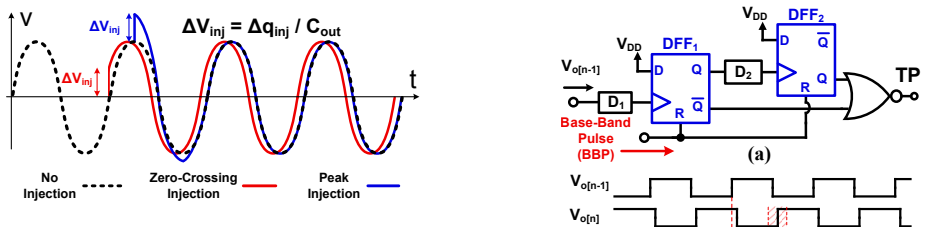
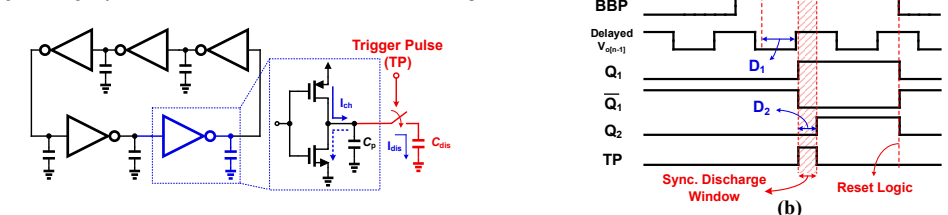
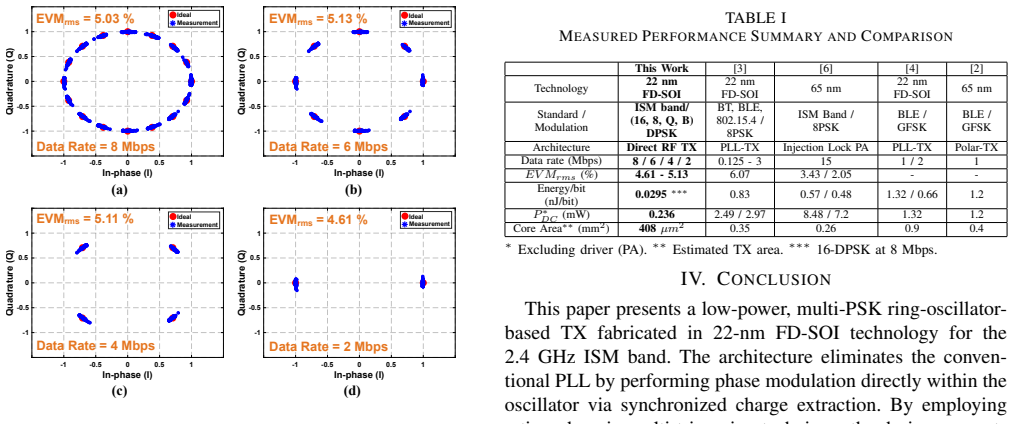
The proposed direct-RF multi-PSK transmitter eliminates the PLL by performing phase modulation within a ring oscillator using synchronized charge extraction at transition points to induce controlled phase shifts while maintaining constant amplitude and frequency. A time-domain multi-triggering technique enables reconfigurable support for 16-PSK, 8-PSK, QPSK, and BPSK in a unified structure, fabricated in 22-nm FD-SOI at 2.4 GHz with 2 MSps symbol rate and 5.13% rms EVM.
What carries the argument
Synchronized charge extraction at the oscillator transition points combined with time-domain multi-triggering, which induces precise phase shifts in the ring oscillator for multi-mode PSK modulation.
If this is right
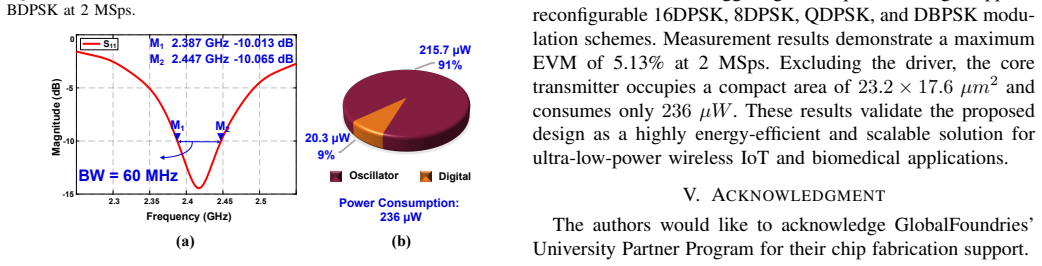
- The core transmitter consumes only 236 μW while delivering -10 dBm output over 60 MHz bandwidth.
- Multiple PSK modes are supported in a single hardware structure without additional circuits.
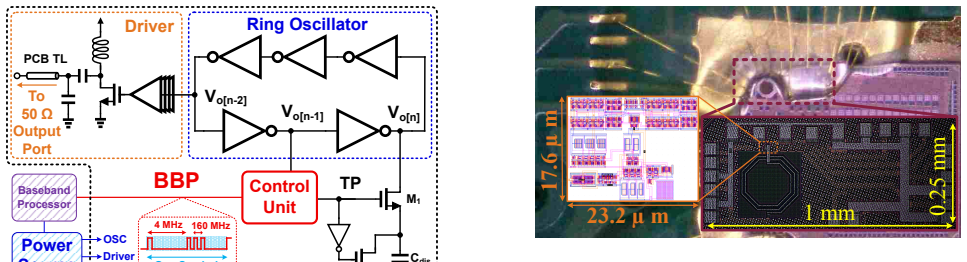
- The design occupies an extremely small area of 23 × 17.6 μm² in 22-nm process.
- Symbol rate of 2 MSps is achieved with maximum EVM of 5.13% rms in ISM band.
Where Pith is reading between the lines
- This method could simplify integration in highly scaled CMOS processes for IoT sensors.
- Extending the charge extraction technique might allow for higher-order modulations or different frequencies.
- Absence of PLL may reduce startup time and phase noise issues in some applications.
Load-bearing premise
That synchronized charge extraction at the oscillator transition points can produce precise, repeatable phase shifts for all supported PSK modes while keeping amplitude and frequency constant without post-fabrication calibration or additional compensation circuits.
What would settle it
If repeated measurements show that phase shifts vary beyond the tolerance needed for 5.13% EVM across different PSK modes or under varying supply voltages, the claim of reliable PLL-free operation would be disproven.
Figures

read the original abstract
This paper presents a compact, low-power, direct RF multi-phase-shift keying (PSK) transmitter (TX) that eliminates the need for a phase-locked loop (PLL) by performing phase modulation directly within a ring oscillator. The proposed architecture exploits synchronized charge extraction at the oscillator's transition points to induce controlled phase shifts while maintaining constant amplitude and frequency. A time-domain multi-triggering technique is introduced to enable reconfigurable multi-mode modulation, supporting 16-PSK, 8-PSK, QPSK, and BPSK within a unified hardware structure. The TX circuit is fabricated in a 22-nm FD-SOI process and operates in the ISM band at 2.4 GHz. Measurement results indicate a symbol rate of 2 MSps with a maximum error vector magnitude (EVM) of 5.13% rms. The core TX occupies 23 {\times} 17.6 {\mu}m2 and consumes 236 {\mu}W, excluding the output driver, which delivers -10 dBm output power over a 60 MHz bandwidth. The proposed design achieves a favorable trade-off between power consumption, circuit complexity, and modulation flexibility, making it well-suited for low-power wireless applications.
Editorial analysis
A structured set of objections, weighed in public.
Referee Report
Summary. The paper proposes a direct-RF multi-PSK transmitter that performs phase modulation directly in a ring oscillator using synchronized charge extraction at transition points, eliminating the need for a PLL. It introduces a time-domain multi-triggering technique for reconfigurable BPSK, QPSK, 8-PSK, and 16-PSK modulation. The design is fabricated in 22-nm FD-SOI process, operating at 2.4 GHz ISM band, with measured symbol rate of 2 MSps, maximum EVM of 5.13% rms, core area of 23 × 17.6 μm², and power consumption of 236 μW (excluding output driver delivering -10 dBm over 60 MHz bandwidth).
Significance. Should the measured performance prove robust and reproducible, this architecture offers a significant advancement in ultra-low-power wireless transmitters by achieving multi-level PSK modulation with minimal power and area overhead, bypassing traditional PLL-based frequency synthesis. This could enable more efficient designs for battery-constrained devices in the ISM band.
major comments (2)
- [Measurement Results] The EVM measurement of 5.13% rms is reported without accompanying error bars, statistical data from multiple samples, or a full description of the test setup and environmental conditions, which is critical to validate the claim that phase shifts are precise and repeatable without calibration.
- [Proposed Architecture] The assertion that synchronized charge extraction maintains constant amplitude and instantaneous frequency while inducing exact phase shifts for all PSK modes lacks supporting analysis or simulation results on the impact of supply noise, temperature drift, and device mismatch in the 22-nm FD-SOI process.
minor comments (2)
- [Abstract] The abstract mentions 'favorable trade-off' but does not quantify comparisons to prior art in terms of power or area.
- The manuscript would benefit from including detailed schematics of the oscillator and charge extraction circuit to allow better understanding of the phase synthesis mechanism.
Simulated Author's Rebuttal
We thank the referee for the thorough review and valuable comments on our manuscript. We address each major comment below with point-by-point responses and indicate the revisions we will make to strengthen the paper.
read point-by-point responses
-
Referee: [Measurement Results] The EVM measurement of 5.13% rms is reported without accompanying error bars, statistical data from multiple samples, or a full description of the test setup and environmental conditions, which is critical to validate the claim that phase shifts are precise and repeatable without calibration.
Authors: We agree that a more complete description of the measurement conditions is important for validating the results. In the revised manuscript, we will add a detailed subsection on the test setup, including the instrumentation (e.g., signal generator, spectrum analyzer, oscilloscope), cabling, power supply configuration, and environmental conditions (controlled room temperature and stable 1.0 V supply). The reported EVM value was obtained from a single fabricated die under these stable conditions, with repeated measurements showing consistent results across modulation modes; we will explicitly state this limitation and note that error bars were omitted because observed variations were negligible. This clarification supports the repeatability claim without calibration. revision: partial
-
Referee: [Proposed Architecture] The assertion that synchronized charge extraction maintains constant amplitude and instantaneous frequency while inducing exact phase shifts for all PSK modes lacks supporting analysis or simulation results on the impact of supply noise, temperature drift, and device mismatch in the 22-nm FD-SOI process.
Authors: The original manuscript presents nominal-condition simulations of the phase-shift mechanism. To address the concern, the revised version will include additional post-layout simulations that incorporate supply voltage noise (±10% variation), temperature sweeps from 0 °C to 80 °C, and Monte Carlo analysis for device mismatch and process corners specific to the 22-nm FD-SOI technology. These results will quantify the impact on amplitude stability, instantaneous frequency, and phase accuracy, confirming that the targeted EVM performance is maintained without calibration. revision: yes
Circularity Check
No circularity; central claims rest on fabricated-chip measurements, not looped derivations
full rationale
The paper describes a ring-oscillator-based phase-synthesis TX architecture that uses synchronized charge extraction and a time-domain multi-triggering technique to support multi-PSK modes. All reported performance numbers (2 MSps symbol rate, 5.13 % rms EVM, 236 μW core power, 23 × 17.6 μm² area, -10 dBm output) are obtained from direct silicon measurements on a 22 nm FD-SOI die. No equations, fitted parameters, or self-citations are invoked to derive these quantities; the architecture is presented as a circuit solution whose correctness is established empirically rather than by any self-referential mathematical chain. The derivation therefore remains self-contained against external hardware benchmarks.
Axiom & Free-Parameter Ledger
axioms (2)
- domain assumption Ring-oscillator frequency and amplitude remain constant when controlled charge is extracted at transition points.
- standard math Standard 22-nm FD-SOI CMOS device models accurately predict the fabricated circuit behavior.
Lean theorems connected to this paper
-
IndisputableMonolith/Cost/FunctionalEquation.leanwashburn_uniqueness_aczel unclearexploits synchronized charge extraction at the oscillator’s transition points to induce controlled phase shifts while maintaining constant amplitude and frequency... multi-triggering technique... 22.5° of phase adjustment
Reference graph
Works this paper leans on
-
[1]
Hajimiri, A. and Lee, T.H. , journal=. A general theory of phase noise in electrical oscillators , year=
-
[2]
Hajimiri, A. and Limotyrakis, S. and Lee, T.H. , journal=. Jitter and phase noise in ring oscillators , year=
-
[3]
Pour, Fariborz Lohrabi and Ha, Dong Sam , booktitle=. An. 2022 , volume=
work page 2022
-
[4]
Mohammadpour, Amin and Manstretta, Danilo and Castello, Rinaldo , journal=. A 140-μ. 2021 , volume=
work page 2021
-
[5]
Design Considerations for a Sub-
Kargaran, Ehsan and Manstretta, Danilo and Castello, Rinaldo , journal=. Design Considerations for a Sub-. 2021 , volume=
work page 2021
-
[6]
Oude and Prummel, Jan and Nauta, Bram , booktitle=
Dodangeh, Maryam and Alink, Mark S. Oude and Prummel, Jan and Nauta, Bram , booktitle=. A 50μ. 2023 , volume=
work page 2023
-
[7]
Thijssen, Bart J. and Klumperink, Eric A. M. and Quinlan, Philip and Nauta, Bram , booktitle=. 30.4 A. 2020 , volume=
work page 2020
-
[8]
Design of a Compact Low-Power Sub-2.4-
Huang, Heng and others , journal=. Design of a Compact Low-Power Sub-2.4-. 2025 , volume=
work page 2025
-
[9]
Wang, Bowen and Ding, Cong and Nie, Yunzhao and Rhee, Woogeun and Wang, Zhihua , journal=. A 0.14-nJ/b 200-Mb/s 2.7–3.5-GHz Quasi-Balanced FSK Transceiver With PLL-Based Modulation and Sideband Energy Detection , year=
-
[10]
Qian, Jing and Parks, Aaron N. and Smith, Joshua R. and Gao, Feifei and Jin, Shi , journal=. 2019 , volume=
work page 2019
-
[11]
23.2 A 1mm2 Software-Defined Dual-Mode Bluetooth Transceiver with
Scolari, Nicola and others , booktitle=. 23.2 A 1mm2 Software-Defined Dual-Mode Bluetooth Transceiver with. 2024 , volume=
work page 2024
-
[12]
Shibata, Kenichi and others , booktitle=. A 22nm 0.84mm2. 2022 , volume=
work page 2022
- [13]
-
[14]
Liu, Hanli and others , booktitle=. An. 2018 , volume=
work page 2018
- [15]
-
[16]
Zargham, Saba and Datta, Ameya and Liscidini, Antonio , booktitle=. A 2.4-. 2024 , volume=
work page 2024
discussion (0)
Sign in with ORCID, Apple, or X to comment. Anyone can read and Pith papers without signing in.