Recognition: no theorem link
Fluid Antenna-Enabled Hybrid NOMA and AirFL Networks Under Imperfect CSI and SIC
Pith reviewed 2026-05-13 02:03 UTC · model grok-4.3
The pith
Fluid antennas improve hybrid rates in NOMA-AirFL networks by adapting positions to handle imperfect channel estimates and interference cancellation.
A machine-rendered reading of the paper's core claim, the machinery that carries it, and where it could break.
Core claim
Dynamically reconfigurable fluid antennas in a hybrid NOMA-AirFL setup can jointly reduce AirFL aggregation error and sustain NOMA communication rates under uncertainties in channel state information and residual successive interference cancellation, with the resulting hybrid rate outperforming static-antenna baselines according to the LSTM-DDPG solution of the robust optimization problem.
What carries the argument
Fluid antenna position adaptation that responds to channel conditions, paired with a hybrid rate metric that trades off federated-learning aggregation accuracy against multi-user communication throughput.
If this is right
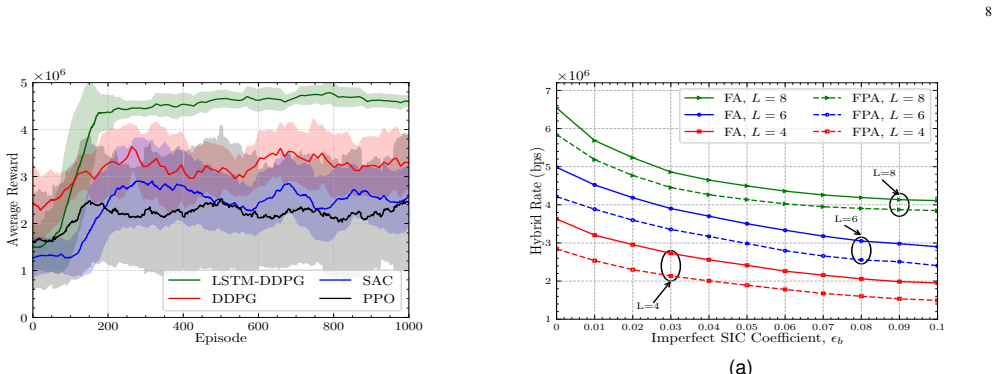
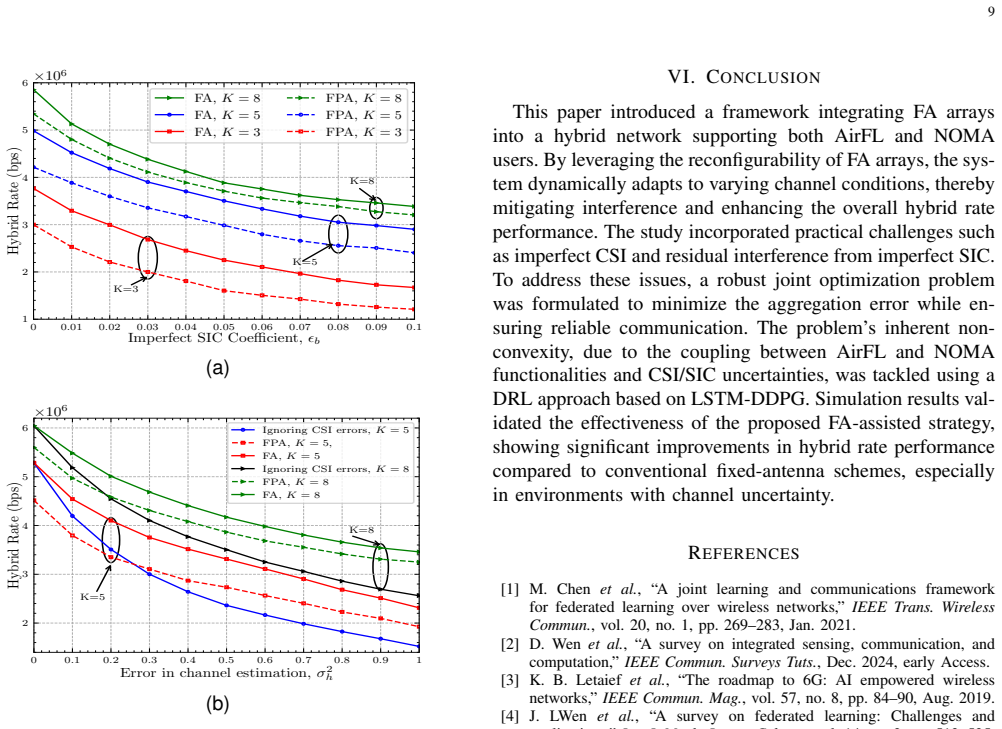
- The hybrid rate remains higher than fixed-antenna baselines across a range of imperfect CSI and SIC conditions.
- Joint optimization of learning error and communication reliability becomes feasible despite non-convex interactions between NOMA and AirFL users.
- Dynamic antenna repositioning mitigates interference more effectively than static placement in the presence of channel uncertainties.
- The Markov decision process formulation allows the reinforcement learning agent to adapt to time-varying channel and interference statistics.
Where Pith is reading between the lines
- The same position-adaptation mechanism could be applied to other mixed communication-computation tasks such as edge inference or distributed training beyond federated learning.
- Hardware implementations would need to verify that the mechanical or electronic reconfiguration speed of fluid antennas matches the channel coherence time assumed in the model.
- Scaling the approach to larger user populations would require checking whether the LSTM memory component continues to stabilize learning under higher-dimensional state spaces.
Load-bearing premise
The LSTM-DDPG reinforcement learning procedure can be trusted to find solutions that correctly account for the combined effects of imperfect CSI and residual SIC interference on the hybrid rate.
What would settle it
A set of Monte Carlo simulations or hardware measurements in which the proposed fluid-antenna configuration yields equal or lower hybrid rates than a comparable fixed-antenna system when the same levels of CSI error and SIC residual are present.
Figures


read the original abstract
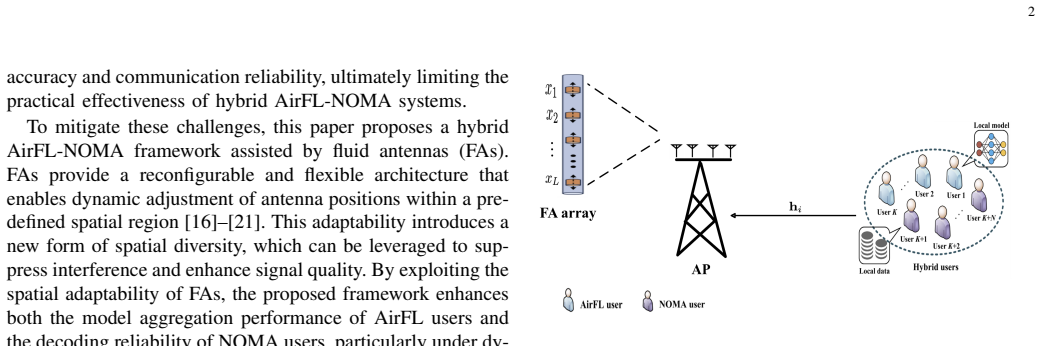
The integration of communication and computation is essential for next-generation wireless systems, especially in scenarios demanding massive connectivity and ultra-low latency. Over-the-air federated learning (AirFL), leveraging the superposition nature of wireless channels, enables fast data aggregation, while non-orthogonal multiple access (NOMA) offers spectrum-efficient connectivity. This paper investigates a fluid antenna (FA)-aided hybrid network, supporting hybrid users comprising both AirFL and NOMA participants. The dynamic reconfigurability of FAs offers significant potential for mitigating interference and enhancing network performance by adapting antenna positions in response to changing channel conditions. We consider practical challenges arising from imperfect channel state information (CSI) and residual interference due to imperfect successive interference cancellation (SIC). To jointly evaluate the learning and communication performance, a hybrid rate metric is introduced. Subsequently, we formulate a robust optimization problem that jointly minimizes the aggregation error while ensuring reliable user communication under CSI and SIC uncertainties. This joint optimization is formulated as a non-convex problem, complicated by the intricate interactions between NOMA and AirFL users and the impact of imperfect CSI and SIC. To solve this problem effectively, we reformulate the optimization as a Markov decision process and solve it using a long short-term memory deep deterministic policy gradient (LSTM-DDPG) algorithm, a memory-based approach within the realm of deep reinforcement learning. Simulation results demonstrate the superiority of the proposed FA-assisted approach over fixed-antenna baselines, particularly under imperfect CSI and SIC conditions, in terms of hybrid rate performance.
Editorial analysis
A structured set of objections, weighed in public.
Referee Report
Summary. The paper proposes a fluid antenna (FA)-enabled hybrid network integrating over-the-air federated learning (AirFL) and non-orthogonal multiple access (NOMA) users. It introduces a hybrid rate metric combining learning aggregation error and communication rates, formulates a robust non-convex optimization problem to minimize AirFL error while guaranteeing NOMA rates under bounded imperfect CSI and residual SIC interference, and solves the problem by reformulating it as a Markov decision process solved via an LSTM-DDPG deep reinforcement learning algorithm. Simulation results are presented to claim superiority of the FA-assisted scheme over fixed-antenna baselines, especially under imperfect CSI/SIC conditions.
Significance. If the simulation-based claims hold under the stated uncertainties, the work could contribute to integrated sensing-communication-computation systems by demonstrating how reconfigurable fluid antennas can dynamically mitigate interference and impairments in hybrid NOMA-AirFL setups. The hybrid rate metric and robust formulation address a relevant practical gap, though the reliance on DRL without closed-form insights limits analytical transferability.
major comments (3)
- [Optimization formulation and LSTM-DDPG algorithm] The MDP reformulation and LSTM-DDPG state/reward design (described in the optimization and algorithm sections) must explicitly encode the bounded CSI error sets and residual SIC interference terms to enforce worst-case robustness; if these appear only statistically or are omitted from the state, the learned policy cannot guarantee the claimed robust hybrid rate performance beyond training distributions.
- [Hybrid rate metric definition] The hybrid rate metric (introduced to jointly evaluate AirFL and NOMA performance) lacks an explicit closed-form expression or weighting parameter derivation; without this, it is impossible to verify that the optimization objective correctly trades off aggregation error against outage rates under the imperfect SIC model.
- [Simulation results] Simulation results claim superiority under imperfect CSI/SIC, but no ablation on the LSTM memory component versus standard DDPG, no comparison against other robust solvers (e.g., alternating optimization or SCA), and no sensitivity analysis to the CSI error bound radius are provided; this weakens the evidence that the performance gain is due to FA adaptation rather than algorithmic tuning.
minor comments (2)
- [System model] Notation for FA position variables and power allocation vectors should be introduced earlier and used consistently to improve readability.
- [Introduction] The abstract and introduction would benefit from citing recent works on fluid antennas in NOMA or AirFL to better position the novelty.
Simulated Author's Rebuttal
We thank the referee for the constructive feedback on our work regarding fluid antenna-enabled hybrid NOMA and AirFL networks. The comments highlight important aspects of robustness, metric clarity, and empirical validation. We address each major comment below, indicating planned revisions where appropriate.
read point-by-point responses
-
Referee: [Optimization formulation and LSTM-DDPG algorithm] The MDP reformulation and LSTM-DDPG state/reward design (described in the optimization and algorithm sections) must explicitly encode the bounded CSI error sets and residual SIC interference terms to enforce worst-case robustness; if these appear only statistically or are omitted from the state, the learned policy cannot guarantee the claimed robust hybrid rate performance beyond training distributions.
Authors: We agree that explicit incorporation of the uncertainty sets is essential to guarantee worst-case robustness in the learned policy. In the manuscript, the bounded CSI errors and residual SIC interference are already modeled in the robust optimization formulation and system model. To address the concern directly, we will revise the MDP section to explicitly include the CSI error bound radius and residual interference terms as components of the state vector, with the reward function penalizing worst-case violations. This ensures the LSTM-DDPG agent is trained to optimize under the full uncertainty sets rather than average cases. revision: yes
-
Referee: [Hybrid rate metric definition] The hybrid rate metric (introduced to jointly evaluate AirFL and NOMA performance) lacks an explicit closed-form expression or weighting parameter derivation; without this, it is impossible to verify that the optimization objective correctly trades off aggregation error against outage rates under the imperfect SIC model.
Authors: We appreciate this observation on the need for explicit definition. The hybrid rate is constructed as a convex combination of the negative logarithm of the AirFL aggregation error and the sum of NOMA achievable rates (accounting for residual SIC interference), with the weighting parameter derived from normalizing the scales of the two terms and balancing the dual objectives of learning convergence and communication reliability. In the revised manuscript, we will provide the full closed-form expression along with the derivation of the weighting parameter to enable verification of the trade-off under the imperfect SIC model. revision: yes
-
Referee: [Simulation results] Simulation results claim superiority under imperfect CSI/SIC, but no ablation on the LSTM memory component versus standard DDPG, no comparison against other robust solvers (e.g., alternating optimization or SCA), and no sensitivity analysis to the CSI error bound radius are provided; this weakens the evidence that the performance gain is due to FA adaptation rather than algorithmic tuning.
Authors: We acknowledge that additional empirical analyses would strengthen the claims. In the revision, we will add an ablation study isolating the LSTM memory component against standard DDPG and a sensitivity analysis sweeping the CSI error bound radius to confirm robustness of the FA gains. For comparisons against alternating optimization or SCA, we note that these approaches face scalability challenges with the continuous FA position variables and high-dimensional action space; we will discuss this limitation explicitly and include preliminary benchmarking where computationally feasible. These additions will better isolate the contribution of fluid antenna adaptation. revision: partial
Circularity Check
No circularity: optimization and DRL solution are independently formulated from system model
full rationale
The paper defines the hybrid rate metric and robust optimization problem directly from the AirFL/NOMA channel model incorporating bounded CSI errors and residual SIC interference. It then reformulates this as an MDP and applies the standard LSTM-DDPG algorithm to obtain policies, with superiority shown only via simulation comparisons to fixed-antenna baselines. No step reduces a claimed result to a fitted parameter, self-definition, or self-citation chain; the derivation chain remains self-contained against external benchmarks.
Axiom & Free-Parameter Ledger
Reference graph
Works this paper leans on
-
[1]
A joint learning and communications framework for federated learning over wireless networks,
M. Chenet al., “A joint learning and communications framework for federated learning over wireless networks,”IEEE Trans. Wireless Commun., vol. 20, no. 1, pp. 269–283, Jan. 2021
work page 2021
-
[2]
A survey on integrated sensing, communication, and computation,
D. Wenet al., “A survey on integrated sensing, communication, and computation,”IEEE Commun. Surveys Tuts., Dec. 2024, early Access
work page 2024
-
[3]
The roadmap to 6G: AI empowered wireless networks,
K. B. Letaiefet al., “The roadmap to 6G: AI empowered wireless networks,”IEEE Commun. Mag., vol. 57, no. 8, pp. 84–90, Aug. 2019
work page 2019
-
[4]
A survey on federated learning: Challenges and applications,
J. LWenet al., “A survey on federated learning: Challenges and applications,”Int. J. Mach. Learn. Cybern., vol. 14, no. 2, pp. 513–535, Feb. 2023
work page 2023
-
[5]
Federated learning for wireless communications: Mo- tivation, opportunities, and challenges,
S. Niknamet al., “Federated learning for wireless communications: Mo- tivation, opportunities, and challenges,”IEEE Commun. Mag., vol. 58, no. 6, pp. 46–51, Jun. 2020
work page 2020
-
[6]
Federated learning via over-the-air computation,
K. Yanget al., “Federated learning via over-the-air computation,”IEEE Trans. Wireless Commun., vol. 19, no. 3, pp. 2022–2035, Jan. 2020
work page 2022
-
[7]
Learning rate optimization for federated learning exploit- ing over-the-air computation,
C. Xuet al., “Learning rate optimization for federated learning exploit- ing over-the-air computation,”IEEE J. Sel. Areas Commun., vol. 39, no. 12, pp. 3742–3756, Oct. 2021
work page 2021
-
[8]
Scalable hierarchical over-the-air federated learning,
S. M. Azimi-Abarghouyiet al., “Scalable hierarchical over-the-air federated learning,”IEEE Trans. Wireless Commun., vol. 23, no. 8, pp. 8480–8496, Jan. 2024
work page 2024
-
[9]
Non-orthogonal multiple access: A unified perspective,
Q. Wanget al., “Non-orthogonal multiple access: A unified perspective,” IEEE Wireless Commun., vol. 25, no. 2, pp. 10–16, Apr. 2018
work page 2018
-
[10]
NOMA in 5G systems: Exciting possibilities for enhancing spectral efficiency,
S. M. Islamet al., “NOMA in 5G systems: Exciting possibilities for enhancing spectral efficiency,”arXiv preprint arXiv:1706.08215, Jan. 2017
-
[11]
Z. Linet al., “Wireless endogenous security for SAGINs: Achieving ubiquitous access and secure communication in symbiosis,”IEEE Net- work, Apr. 2025, early Access
work page 2025
-
[12]
Antenna activation for NOMA assisted pinching- antenna systems,
K. Wanget al., “Antenna activation for NOMA assisted pinching- antenna systems,”IEEE Wireless Commun. Lett., vol. 14, no. 5, pp. 1526–1530, May. 2025
work page 2025
-
[13]
Fluid antenna-assisted uplink NOMA networks under imperfect SIC,
S. Pakravanet al., “Fluid antenna-assisted uplink NOMA networks under imperfect SIC,”IEEE Trans. V eh. Technol., pp. 1–6, Aug. 2025, Early Access
work page 2025
-
[14]
Energy minimization for wireless-powered federated learning network with NOMA,
M. Alishahiet al., “Energy minimization for wireless-powered federated learning network with NOMA,”IEEE Wireless Commun. Lett., vol. 12, no. 5, pp. 833–837, May. 2023
work page 2023
-
[15]
Z. Linet al., “Joint beamforming and power allocation for satellite- terrestrial integrated networks with non-orthogonal multiple access,” IEEE J. Sel. Topics Signal Process., vol. 13, no. 3, pp. 657–670, Feb. 2019
work page 2019
-
[16]
AI-empowered fluid antenna systems: Opportunities, challenges, and future directions,
C. Wanget al., “AI-empowered fluid antenna systems: Opportunities, challenges, and future directions,”IEEE Wireless Commun., vol. 31, no. 5, pp. 34–41, Jul. 2024. 10 0 25 50 75 100 125 150 175 200 Number of outer iterations, T 0.4 0.5 0.6 0.7 0.8 0.9 1.0 Accuracy , (%) MNIST IID Ideal FL F A FP A (a) 0 25 50 75 100 125 150 175 200 Number of outer iteratio...
work page 2024
-
[17]
Fluid antenna for mobile edge computing,
Y . Zuoet al., “Fluid antenna for mobile edge computing,”IEEE Commun. Lett., vol. 28, no. 7, pp. 1728–1732, May. 2024
work page 2024
-
[18]
S. Pakravanet al., “Fluid antenna systems under channel uncertainty and hardware impairments: Trends, challenges, and future research directions,”arXiv preprint arXiv:2601.22989, Jan. 2026
-
[19]
AI-based fluid antenna design for client selection in over-the-air federated learning,
M. Ahmadzadeh.et al., “AI-based fluid antenna design for client selection in over-the-air federated learning,”IEEE Internet Things J., Aug. 2025, Early Access
work page 2025
-
[20]
K.-K. Wonget al., “Fluid antenna systems,”IEEE Trans. Wireless Commun., vol. 20, no. 3, pp. 1950–1962, Nov. 2021
work page 1950
-
[21]
Enhanced over-the-air federated learning using AI-based fluid antenna system,
M. Ahmadzadehet al., “Enhanced over-the-air federated learning using AI-based fluid antenna system,” inProc. IEEE Wireless Commun. Netw. Conf. (WCNC), Milan, Italy, Mar. 2025
work page 2025
-
[22]
Robust resource allocation for over-the-air computa- tion networks with fluid antenna array,
S. Pakravanet al., “Robust resource allocation for over-the-air computa- tion networks with fluid antenna array,” inProc. IEEE Global Commun. Conf. (GLOBECOM) Workshop, Cape Town, South Africa, Dec. 2024
work page 2024
-
[23]
Integrated communication and computation empowered by fluid antenna array,
S. Yeet al., “Integrated communication and computation empowered by fluid antenna array,” inProc. IEEE 25th Int. Workshop Signal Process. Adv. Wireless Commun. (SPA WC), Lucca, Italy, Sep. 2024, pp. 276–280
work page 2024
-
[24]
On performance of energy harvested cooperative NOMA under imperfect CSI and imperfect SIC,
S. Bisenet al., “On performance of energy harvested cooperative NOMA under imperfect CSI and imperfect SIC,”IEEE Trans. V eh. Technol., vol. 70, no. 9, pp. 8993–9005, Jul. 2021
work page 2021
-
[25]
Imperfect CSI: A key factor of uncertainty to over-the-air federated learning,
J. Yaoet al., “Imperfect CSI: A key factor of uncertainty to over-the-air federated learning,”IEEE Wireless Commun. Lett., vol. 12, no. 12, pp. 2273–2277, Sep. 2023
work page 2023
-
[26]
Fairness-aware energy-efficient power allocation for uplink NOMA systems with imperfect SIC,
K. Wanget al., “Fairness-aware energy-efficient power allocation for uplink NOMA systems with imperfect SIC,”IEEE Wireless Commun. Lett., vol. 12, no. 12, pp. 2018–2022, Aug. 2023
work page 2018
-
[27]
Full-duplex cooperative NOMA relaying systems with I/Q imbalance and imperfect SIC,
X. Liet al., “Full-duplex cooperative NOMA relaying systems with I/Q imbalance and imperfect SIC,”IEEE Wireless Commun. Lett., vol. 9, no. 1, pp. 17–20, Sep. 2020
work page 2020
-
[28]
Massive MIMO-NOMA networks with imperfect SIC: Design and fairness enhancement,
A. S. de Senaet al., “Massive MIMO-NOMA networks with imperfect SIC: Design and fairness enhancement,”IEEE Trans. Wireless Commun., vol. 19, no. 9, pp. 6100–6115, Jun. 2020
work page 2020
-
[29]
A survey on over-the-air computation,
A. S ¸ahinet al., “A survey on over-the-air computation,”IEEE Commun. Surveys Tuts., vol. 25, no. 3, pp. 1877–1908, Apr. 2023
work page 1908
-
[30]
W. Niet al., “Integrating over-the-air federated learning and non- orthogonal multiple access: What role can RIS play?”IEEE Trans. Wireless Commun., vol. 21, no. 12, pp. 10 083–10 099, Jun. 2022
work page 2022
-
[31]
Continuous control with deep reinforcement learning
T. P. Lillicrapet al., “Continuous control with deep reinforcement learning,”arXiv preprint arXiv:1509.02971, Sep. 2015
work page internal anchor Pith review Pith/arXiv arXiv 2015
-
[32]
S. Sheikhzadehet al., “AI-based secure NOMA and cognitive radio- enabled green communications: Channel state information and battery value uncertainties,”IEEE Trans. Green Commun. Netw., vol. 6, no. 2, pp. 1037–1054, Dec. 2021
work page 2021
-
[33]
Soft actor-critic: Off-policy maximum entropy deep reinforcement learning with a stochastic actor,
T. Haarnojaet al., “Soft actor-critic: Off-policy maximum entropy deep reinforcement learning with a stochastic actor,” inProc. IEEE 35th Int. Conf. Mach. Learn., Stockholm, Sweden, Jul. 2018, pp. 1861–1870
work page 2018
-
[34]
Proximal Policy Optimization Algorithms
J. Schulmanet al., “Proximal policy optimization algorithms,”arXiv preprint arXiv:1707.06347, Jul. 2017
work page internal anchor Pith review Pith/arXiv arXiv 2017
-
[35]
Movable-antenna enhanced multiuser communication via antenna position optimization,
L. Zhuet al., “Movable-antenna enhanced multiuser communication via antenna position optimization,”IEEE Trans. Wireless Commun., vol. 23, no. 7, pp. 7214–7229, Dec. 2024
work page 2024
-
[36]
S. Pakravanet al., “Robust resource allocation in RIS-assisted wireless networks integrating noma and over-the-air federated learning,”IEEE Trans. V eh. Technol., pp. 1–16, Apr. 2026
work page 2026
-
[37]
M. Ahmadzadehet al., “AI-enhanced RIS-aided cognitive radio network: Integrating communication and over-the-air federated learning users,” IEEE Trans. V eh. Technol., pp. 1–14, Jan. 2026
work page 2026
discussion (0)
Sign in with ORCID, Apple, or X to comment. Anyone can read and Pith papers without signing in.