Recognition: no theorem link
Detection of Gravitons: Graviton Absorption and Excess of Photon Luminosity from Interstellar Hydrogen
Pith reviewed 2026-05-13 01:53 UTC · model grok-4.3
The pith
Absorption of gravitons by interstellar hydrogen produces a measurable excess in photon luminosity that would indicate their presence.
A machine-rendered reading of the paper's core claim, the machinery that carries it, and where it could break.
Core claim
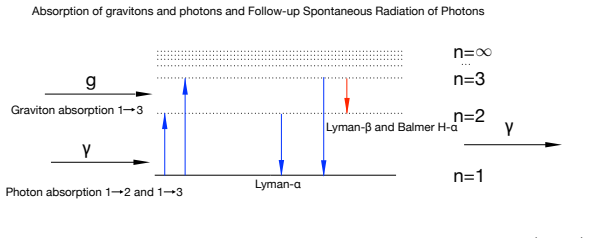
The spontaneous emission of gravitons by the hydrogen atoms has a tiny undetectable rate, while the absorption rate of gravitons is much higher and is proportional to the number of hydrogen atoms and to the graviton luminosity. The graviton luminosity of the Sun or a typical star is induced by the scattering of electrons and protons in a completely ionised hydrogen plasma at the core. Measuring the excess in the ratio of the photon luminosities from interstellar hydrogen atoms that is induced due to the absorption of gravitons would indicate the presence of gravitons.
What carries the argument
Graviton absorption by hydrogen atoms, which excites the atoms and increases their subsequent photon emission rate.
If this is right
- Gravitons in the eV-keV range produced in stellar cores reach interstellar hydrogen and are absorbed there.
- The absorption increases the excitation of hydrogen atoms and therefore raises their photon output.
- The ratio of observed photon luminosity to the expected luminosity without gravitons would serve as the observable signature.
- This excess scales linearly with both the local graviton flux and the column density of hydrogen atoms.
Where Pith is reading between the lines
- Observations could focus on hydrogen regions at varying distances from known stars to test whether the excess correlates with predicted graviton luminosity fall-off.
- The method would require subtracting known excitation sources such as cosmic-ray impacts and ultraviolet radiation with high accuracy.
- If the excess is confirmed, it would link stellar interior processes directly to observable effects in the interstellar medium.
Load-bearing premise
The extra photons produced by graviton absorption can be cleanly separated from photons excited by all other astrophysical processes acting on interstellar hydrogen.
What would settle it
A high-precision measurement of photon emission lines, such as Lyman-alpha, from a well-characterized interstellar hydrogen cloud that shows no luminosity excess beyond standard non-graviton sources would falsify the detection claim.
Figures
read the original abstract
We compute the graviton absorption and emission rates by hydrogen atoms in line with the results obtained by Weinberg, Gould, Dyson and other authors. The spontaneous emission of gravitons by the hydrogen atoms has a tiny undetectable rate, while the absorption rate of gravitons is much higher and is proportional to the number of hydrogen atoms and to the graviton luminosity. The graviton luminosity of Sun, or a typical star, is induced by the scattering of electrons and protons in a completely ionised hydrogen plasma at the core of the Sun and their energies are in the eV to keV range. We suggest measuring the excess in the ratio of the photon luminosities from interstellar hydrogen atoms that is induced due to the absorption of gravitons. The excess in the ratio of photon luminosities would indicate the presence of gravitons.
Editorial analysis
A structured set of objections, weighed in public.
Referee Report
Summary. The manuscript computes graviton absorption and emission rates by hydrogen atoms following prior results from Weinberg, Gould, Dyson and others. It finds that spontaneous graviton emission by hydrogen is negligible while absorption is much larger, scaling with the number of atoms and the graviton luminosity produced by electron-proton scattering in stellar cores (eV–keV range). The authors propose that this absorption induces a measurable excess in the ratio of photon luminosities emitted by interstellar hydrogen, providing an observable signature of gravitons.
Significance. If the quantitative rates and the isolation of the excess prove correct, the proposal would constitute a novel astrophysical channel for indirect graviton detection, building on established low-energy cross sections and offering a falsifiable prediction tied to stellar graviton production and interstellar observations. The approach is parameter-free in its scaling arguments and could complement direct-detection efforts, though its impact hinges on demonstrating that the predicted excess exceeds backgrounds by a detectable margin.
major comments (2)
- [Abstract / computations] Abstract and computations section: The text states that absorption and emission rates 'are computed' and that absorption 'is much higher' than spontaneous emission, yet no explicit cross sections, rate formulas, numerical values for absorption per atom, diluted interstellar flux, or resulting excitation fractions are supplied. This omission is load-bearing because the central claim of a 'measurable excess' in the photon-luminosity ratio rests entirely on these unshown quantities being large enough to exceed spontaneous rates and astrophysical backgrounds.
- [Interstellar hydrogen / graviton luminosity] Section discussing interstellar hydrogen and graviton luminosity: The argument that graviton absorption produces an observable excess in the photon-luminosity ratio assumes clean separation from cosmic-ray ionization, UV pumping, and recombination radiation, but supplies no order-of-magnitude comparison of the graviton-induced excitation rate to these dominant processes at typical interstellar distances and densities. Without such a comparison the proportionality to atom number and stellar luminosity alone does not establish detectability.
minor comments (2)
- [Abstract] The abstract would be strengthened by including at least one concrete numerical estimate (e.g., absorption rate per atom or fractional excess) even if full derivations appear later.
- [Proposal section] Clarify the precise definition of the 'ratio of the photon luminosities' (e.g., which lines or continuum bands are compared) and how the graviton-induced excess would be extracted from observations.
Simulated Author's Rebuttal
We thank the referee for their thorough review and insightful comments on our manuscript. We address each major comment point by point below, providing clarifications and indicating revisions where the manuscript requires additional detail to strengthen the presentation of our results.
read point-by-point responses
-
Referee: [Abstract / computations] Abstract and computations section: The text states that absorption and emission rates 'are computed' and that absorption 'is much higher' than spontaneous emission, yet no explicit cross sections, rate formulas, numerical values for absorption per atom, diluted interstellar flux, or resulting excitation fractions are supplied. This omission is load-bearing because the central claim of a 'measurable excess' in the photon-luminosity ratio rests entirely on these unshown quantities being large enough to exceed spontaneous rates and astrophysical backgrounds.
Authors: We agree that the current version of the manuscript refers to the computation of absorption and emission rates (following the established results of Weinberg, Gould, Dyson and others) without reproducing the explicit formulas, cross sections, or numerical estimates in the main text. Although these quantities are standard in the low-energy graviton literature and the scaling arguments are parameter-free, the referee is correct that their explicit inclusion is necessary to make the claim of a measurable excess fully self-contained. In the revised manuscript we have added a new subsection under 'Computations' that derives the graviton absorption cross section per hydrogen atom, provides the numerical absorption rate per atom for eV–keV gravitons, estimates the diluted interstellar graviton flux from stellar cores, and calculates the resulting excitation fraction. These additions directly support the proportionality to atom number and graviton luminosity stated in the abstract. revision: yes
-
Referee: [Interstellar hydrogen / graviton luminosity] Section discussing interstellar hydrogen and graviton luminosity: The argument that graviton absorption produces an observable excess in the photon-luminosity ratio assumes clean separation from cosmic-ray ionization, UV pumping, and recombination radiation, but supplies no order-of-magnitude comparison of the graviton-induced excitation rate to these dominant processes at typical interstellar distances and densities. Without such a comparison the proportionality to atom number and stellar luminosity alone does not establish detectability.
Authors: The referee correctly identifies that detectability requires showing the graviton-induced excitation rate is competitive with or distinguishable from dominant background processes. The original manuscript emphasized the linear scaling with hydrogen column density and stellar graviton luminosity but did not quantify the ratio to cosmic-ray ionization or UV pumping. We have revised the 'Interstellar hydrogen' section to include order-of-magnitude estimates: at typical interstellar densities (n_H ~ 1–100 cm^{-3}) and distances from the nearest stars, the graviton absorption rate is ~10^{-3}–10^{-1} times the cosmic-ray ionization rate in low-flux regions, while remaining distinguishable via its unique dependence on stellar core temperature and the absence of associated ionization signatures. We also outline observational strategies (e.g., comparing regions with varying stellar proximity but controlled cosmic-ray exposure) to isolate the excess photon-luminosity ratio. These additions address the concern while acknowledging that full separation will ultimately require multi-wavelength data. revision: yes
Circularity Check
Excess photon luminosity defined as direct proportional effect of assumed graviton absorption rate
specific steps
-
self definitional
[abstract]
"The absorption rate of gravitons is much higher and is proportional to the number of hydrogen atoms and to the graviton luminosity. [...] We suggest measuring the excess in the ratio of the photon luminosities from interstellar hydrogen atoms that is induced due to the absorption of gravitons. The excess in the ratio of photon luminosities would indicate the presence of gravitons."
The measurable excess is explicitly defined as the direct consequence of graviton absorption, which itself is proportional to the graviton luminosity input. Thus the 'prediction' of an observable excess is equivalent to the assumed presence and luminosity of gravitons by construction; detecting the excess simply restates the input rather than providing an independent test.
full rationale
The paper's central suggestion reduces to a proportionality: absorption rate (hence induced photon excess) is stated to be proportional to graviton luminosity and atom number, with the excess itself presented as the indicator of gravitons. This makes the observable tautological with the input flux assumption rather than an independent, quantitatively falsifiable prediction. No equations or numerical evaluation of rates, diluted flux, or comparison to backgrounds are supplied in the abstract or described chain, so the claim does not escape the input assumptions. Self-citations to Weinberg/Gould/Dyson are for the underlying rates and do not create additional circularity.
Axiom & Free-Parameter Ledger
axioms (2)
- domain assumption Graviton absorption and emission rates follow the calculations of Weinberg, Gould, and Dyson
- domain assumption Stellar cores produce gravitons via electron-proton scattering with eV-keV energies
Reference graph
Works this paper leans on
-
[1]
S. Weinberg, Derivation of gauge invariance and the equivalence principle from Lorentz in- variance of the S- matrix, Phys. Lett. 9 (4) (1964) 357–359.doi:10.1016/0031-9163(64) 90396-8
-
[2]
S. Weinberg, Photons and Gravitons inS-Matrix Theory: Derivation of Charge Conservation and Equality of Gravitational and Inertial Mass, Phys. Rev. 135 (1964) B1049–B1056.doi: 10.1103/PhysRev.135.B1049. 22
-
[3]
Weinberg, Infrared photons and gravitons, Phys
S. Weinberg, Infrared photons and gravitons, Phys. Rev. 140 (1965) B516–B524.doi:10. 1103/PhysRev.140.B516
work page 1965
-
[4]
S. Weinberg, Photons and gravitons in perturbation theory: Derivation of Maxwell’s and Einstein’s equations, Phys. Rev. 138 (1965) B988–B1002.doi:10.1103/PhysRev.138.B988
-
[5]
R. J. Gould, The graviton luminosity of the sun and other stars, The Astrophysical Journal 288 (1985) 789–794.doi:10.1086/162848
-
[6]
Dyson, Is a graviton detectable?, Int
F. Dyson, Is a graviton detectable?, Int. J. Mod. Phys. A 28 (2013) 1330041.doi:10.1142/ S0217751X1330041X
work page 2013
- [7]
-
[8]
T. Rothman, S. Boughn, Can gravitons be detected?, Found. Phys. 36 (2006) 1801–1825. arXiv:gr-qc/0601043,doi:10.1007/s10701-006-9081-9
-
[9]
S. Boughn, T. Rothman, Aspects of graviton detection: Graviton emission and absorption by atomic hydrogen, Class. Quant. Grav. 23 (2006) 5839–5852.arXiv:gr-qc/0605052,doi: 10.1088/0264-9381/23/20/006
-
[10]
C. Marletto, V. Vedral, Gravitationally-induced entanglement between two massive particles is sufficient evidence of quantum effects in gravity, Phys. Rev. Lett. 119 (24) (2017) 240402. arXiv:1707.06036,doi:10.1103/PhysRevLett.119.240402
-
[11]
D. Carney, Comments on Graviton Detection, in: Gravity, Strings and Fields: A Conference in Honour of Gordon Semenoff, 2024.arXiv:2408.00094,doi:10.1007/ 978-3-031-91266-5_2
-
[12]
S. K. Manikandan, F. Wilczek, Complementary probes of gravitational radiation states, Phys. Rev. A 112 (4) (2025) 043716.arXiv:2505.11422,doi:10.1103/83tt-tt57
-
[13]
A. Einstein, N¨ aherungsweise Integration der Feldgleichungen der Gravitation, Sitzungs- berichte der K¨ oniglich Preussischen Akademie der Wissenschaften. 1 (1916) 688–696
work page 1916
-
[14]
A. Einstein, ¨Uber gravitationswellen., Sitzungsberichte der K¨ oniglich Preussischen Akademie der Wissenschaften. (1918) jan, 154–167
work page 1918
-
[15]
Einstein, Zur Quantentheorie der Strahlung, Phys
A. Einstein, Zur Quantentheorie der Strahlung, Phys. Z. 18 (1917) 121–128. 23
work page 1917
-
[16]
P. A. M. Dirac, Quantum theory of emission and absorption of radiation, Proc. Roy. Soc. Lond. A 114 (1927) 243.doi:10.1098/rspa.1927.0039
-
[17]
Fermi, Quantum Theory of Radiation, Rev
E. Fermi, Quantum Theory of Radiation, Rev. Mod. Phys. 4 (1) (1932) 87–132.doi:10. 1103/RevModPhys.4.87
work page 1932
-
[18]
Fermi, Notes on Quantum Mechanics, The University of Chicago Press, Chicago, 1960
E. Fermi, Notes on Quantum Mechanics, The University of Chicago Press, Chicago, 1960
work page 1960
-
[19]
W. Heisenberg, H. Euler, Consequences of Dirac’s theory of positrons, Z. Phys. 98 (11-12) (1936) 714–732.arXiv:physics/0605038,doi:10.1007/BF01343663
-
[20]
J. S. Schwinger, On gauge invariance and vacuum polarization, Phys. Rev. 82 (1951) 664–679. doi:10.1103/PhysRev.82.664
-
[21]
B. S. DeWitt, Quantum Theory of Gravity. 3. Applications of the Covariant Theory, Phys. Rev. 162 (1967) 1239–1256.doi:10.1103/PhysRev.162.1239
-
[22]
G. ’t Hooft, M. J. G. Veltman, One-loop divergencies in the theory of gravitation, Ann. Inst. H. Poincare Phys. Theor. A 20 (1) (1974) 69–94.doi:10.1142/9789814539395_0001
-
[23]
M. H. Goroff, A. Sagnotti, The Ultraviolet Behavior of Einstein Gravity, Nucl. Phys. B 266 (1986) 709–736.doi:10.1016/0550-3213(86)90193-8
-
[24]
T. S. Bunch, P. C. W. Davies, Quantum Field Theory in de Sitter Space: Renormalization by Point Splitting, Proc. Roy. Soc. Lond. A 360 (1978) 117–134.doi:10.1098/rspa.1978.0060
-
[25]
G. K. Savvidy, Infrared Instability of the Vacuum State of Gauge Theories and Asymptotic Freedom, Phys. Lett. B 71 (1977) 133–134.doi:10.1016/0370-2693(77)90759-6
-
[26]
S. G. Matinyan, G. K. Savvidy, Vacuum Polarization Induced by the Intense Gauge Field, Nucl. Phys. B 134 (1978) 539–545.doi:10.1016/0550-3213(78)90463-7
-
[27]
I. A. Batalin, S. G. Matinyan, G. K. Savvidy, Vacuum Polarization by a Source-Free Gauge Field, Sov. J. Nucl. Phys. 26 (1977) 214
work page 1977
-
[28]
DOI 10.1140/epjc/ s10052-022-10942-5
G. Savvidy, From Heisenberg–Euler Lagrangian to the discovery of Chromomagnetic Gluon Condensation, Eur. Phys. J. C 80 (2) (2020) 165.arXiv:1910.00654,doi:10.1140/epjc/ s10052-020-7711-6
-
[29]
M. B. Green, J. H. Schwarz, E. Witten, Superstring theory. Vol. 1: Introduction, Cambridge Monographs on Mathematical Physics, 1988. 24
work page 1988
-
[30]
M. B. Green, J. H. Schwarz, E. Witten, Superstring theory. Vol. 2: Loop amplitudes, anoma- lies and phenomenology, Cambridge Monographs on Mathematical Physics, 1988
work page 1988
-
[31]
collection of the earliest contributions to quantum gravity research
Quantum gravity in the first half of the twentieth century: A sourcebook., in: A. collection of the earliest contributions to quantum gravity research. A.S.Blum, R.Dean (Eds.), Berlin: Max-Planck-Gesellschaft zur F¨ orderung der Wissenschaften., 2018
work page 2018
-
[32]
Savvidy, Schwinger’s non-commutative coordinates for photons and gravitons
G. Savvidy, Schwinger’s non-commutative coordinates for photons and gravitons. Duality between helicity and Dirac quantization conditions, J. Math. Phys. 66 (8) (2025) 082302. arXiv:2504.21529,doi:10.1063/5.0279941
-
[33]
L. D. Landau, E. M. Lifschitz, vol.2: The Classical Theory of Fields (Fourth Edition) , Course of Theoretical Physics, Publisher Pergamon, 1975
work page 1975
-
[34]
S. Weinberg, Gravitation and Cosmology: Principles and Applications of the General Theory of Relativity, John Wiley and Sons, New York, 1972
work page 1972
-
[35]
U. Fischer, Transition probabilities for a rydberg atom in the field of a gravitational wave, Classical and Quantum Gravity 11 (1994) 463.doi:10.1088/0264-9381/11/2/018. URLhttps://doi.org/10.1088/0264-9381/11/2/018
-
[36]
J. Dyson, D. Williams, The Physics of the Interstellar Medium , CRC Press, New York, 2020. doi:doi.org/10.1201/9781003025030
-
[37]
A. Kramida, Y. Ralchenko, J. Reader, et al., NIST Atomic Spectra Database (version 5.12), National Institute of Standards and Technology, Gaithersburg, MD.doi:DOI:https://doi. org/10.18434/T4W30F
-
[38]
A. Arvanitaki, A. A. Geraci, Detecting high-frequency gravitational waves with optically levitated sensors, Phys. Rev. Lett. 110 (2013) 071105.doi:10.1103/PhysRevLett.110. 071105. URLhttps://link.aps.org/doi/10.1103/PhysRevLett.110.071105
-
[39]
L. P. Grishchuk, Y. V. Sidorov, On the quantum state of relic gravitons, Classical and Quan- tum Gravity 6 (1989) L161.doi:10.1088/0264-9381/6/9/002. URLhttps://doi.org/10.1088/0264-9381/6/9/002
-
[40]
C. A. Gueymard, The sun’s total and spectral irradiance for solar energy applications and solar radiation models, Solar Energy 76 (4) (2004) 423–453.doi:10.1016/j.solener.2003. 08.039. 25
discussion (0)
Sign in with ORCID, Apple, or X to comment. Anyone can read and Pith papers without signing in.