Recognition: 3 theorem links
· Lean TheoremFlocking with Multiple Types: Competition, Fluid Limits and Traveling Waves
Pith reviewed 2026-05-13 01:42 UTC · model grok-4.3
The pith
Two-type particles with order-based switching converge to a McKean-Vlasov process whose exponential-jump case admits traveling waves as heteroclinic orbits.
A machine-rendered reading of the paper's core claim, the machinery that carries it, and where it could break.
Core claim
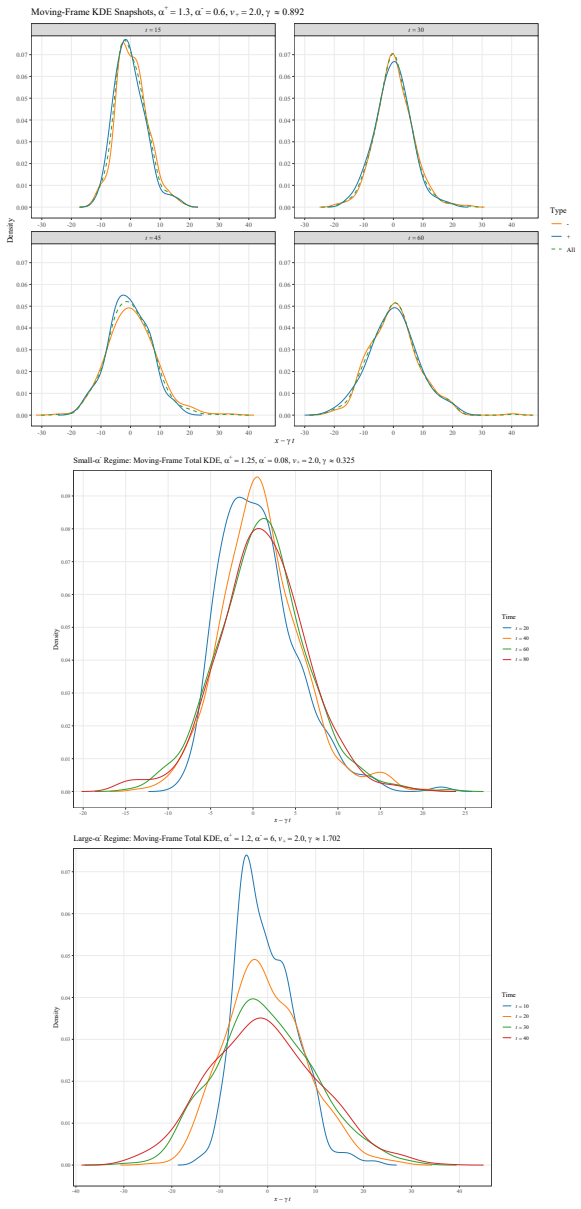
We prove convergence, along subsequences, to a deterministic measure-valued process characterized by a McKean-Vlasov equation. A Kolmogorov-Smirnov-type distance adapted to the ordering structure yields uniqueness and therefore full-sequence convergence together with propagation of chaos on finite intervals. For exponential jump distributions the limit dynamics reduce to a coupled system of nonlinear ODEs whose phase portrait contains a heteroclinic orbit connecting two equilibria; this orbit is identified as a traveling wave whose speed and asymptotic mass partition between types are computed explicitly, and whose tail asymptotics follow from spectral analysis of the linearized system.
What carries the argument
The McKean-Vlasov equation for the two-type empirical measure, whose non-local, order-dependent switching term drives the fluid limit and, under exponential jumps, reduces the system to a planar ODE whose heteroclinic orbit encodes the traveling wave.
If this is right
- The full sequence of empirical measures converges, not merely subsequences, because of the adapted uniqueness argument.
- Propagation of chaos holds for the finite-particle system on any finite time interval.
- Traveling waves exist with explicitly computable speed and asymptotic mass partition between the two types.
- Exponential tails of the wave profile are governed by the eigenvalues of the linearized operator around the equilibria.
Where Pith is reading between the lines
- The ordering structure on the line is crucial to the uniqueness proof and would need replacement by a different metric if the model were placed on the circle or in higher dimensions.
- The same reduction to ODEs might be possible for other jump distributions whose nonlocal terms admit a local description.
- The traveling-wave profile may describe macroscopic segregation or pursuit patterns that persist in competitive multi-type systems even without invariant measures.
Load-bearing premise
Uniqueness of the McKean-Vlasov limit points follows from a Kolmogorov-Smirnov distance that exploits the linear ordering of particles on the line.
What would settle it
Numerical simulation of the finite-particle system for large N in which the empirical measure trajectory deviates persistently from the predicted McKean-Vlasov solution, or failure to observe the computed wave speed and mass partition in the long-time profile for exponential jumps.
Figures
read the original abstract
We study a class of interacting particle systems on $\mathbb{R}$ with two types. Particles evolve by independent jumps sampled from a fixed distribution, with type-dependent jump rates $v_+$, $v_-$ and stochastic type switching driven by non-local order-based interactions. The switching rates depend on the empirical distribution through the proportion of opposite-type particles located ahead, leading to a nonlinear and discontinuous dependence on the empirical measure outside the standard Lipschitz McKean-Vlasov framework. Our first main result is a law of large numbers for the empirical measure process: we prove convergence, along subsequences, to a deterministic measure-valued process characterized by a McKean-Vlasov equation. The proof combines tightness in Wasserstein space with a martingale characterization of limit points. A uniqueness argument based on a Kolmogorov-Smirnov-type distance adapted to the ordering structure yields convergence of the full empirical measure sequence and, in turn, propagation of chaos on finite time intervals. We then study the long-time behavior of the limiting dynamics. Because the system has persistent drift, invariant distributions do not arise; instead, we analyze traveling waves, corresponding to stationary profiles in a moving frame. For exponential jump distributions, the associated non-local integro-differential system admits a local description. In the regime $v_+>v_-=0$, this further reduces to a coupled system of non-linear ODEs, allowing a phase-plane analysis that yields a traveling wave as a heteroclinic orbit connecting two equilibria. We also identify the wave speed and mass partition, and derive tail asymptotics by spectral analysis of the linearized system.
Editorial analysis
A structured set of objections, weighed in public.
Referee Report
Summary. The paper studies a two-type interacting particle system on the real line with independent jumps from a fixed distribution and type switching rates depending non-locally on the proportion of opposite-type particles ahead. It proves a law of large numbers: subsequential convergence of the empirical measure to a deterministic McKean-Vlasov process via tightness in Wasserstein space and martingale characterization, upgraded to full convergence and propagation of chaos by uniqueness via an adapted Kolmogorov-Smirnov distance. For exponential jump distributions in the regime v_+ > v_- = 0, the long-time dynamics reduce to a coupled nonlinear ODE system whose traveling-wave profiles are obtained as heteroclinic orbits via phase-plane analysis; the wave speed, mass partition, and tail asymptotics (via spectral linearization) are identified.
Significance. If the central claims hold, the work is significant as a technical extension of mean-field limits to discontinuous non-local McKean-Vlasov equations outside the Lipschitz regime, with the adapted KS metric providing a tool for uniqueness in ordered systems. The explicit reduction to ODEs and phase-plane construction for traveling waves yields concrete predictions (speed, partition, tails) for competition-driven flocking models, which are falsifiable and potentially useful for applications.
major comments (2)
- [LLN / uniqueness argument] Uniqueness argument (LLN section, following the martingale characterization): the adapted Kolmogorov-Smirnov distance is load-bearing for upgrading subsequential convergence to full sequence convergence. Because the switching rates are discontinuous and depend on the non-local proportion of opposite-type mass ahead, it must be shown explicitly that this metric yields a Gronwall bound or contraction that absorbs the jumps at crossing times; without a detailed estimate controlling the discontinuity, multiple limit points could satisfy the same integral equation, leaving the LLN only subsequential.
- [Traveling waves / spectral analysis] Traveling waves and tail asymptotics (long-time behavior section): the phase-plane analysis identifies the heteroclinic orbit and wave speed for the reduced ODE system, but the spectral analysis of the linearized system around the equilibria (used for tail asymptotics) requires explicit computation of the principal eigenvalue and eigenfunction to confirm the claimed decay rates; the current sketch leaves open whether the non-local terms affect the spectrum in a way that alters the asymptotics.
minor comments (2)
- [Model definition] Notation for the proportion of opposite-type particles ahead should be accompanied by a diagram illustrating the ordering and the non-local functional to aid readability.
- [Tightness argument] The abstract states convergence along subsequences followed by uniqueness; the main text should include a clear statement of the precise Wasserstein topology used for tightness.
Simulated Author's Rebuttal
We thank the referee for the careful reading and constructive feedback on our manuscript. We address each major comment below and will revise the paper accordingly to strengthen the arguments.
read point-by-point responses
-
Referee: [LLN / uniqueness argument] Uniqueness argument (LLN section, following the martingale characterization): the adapted Kolmogorov-Smirnov distance is load-bearing for upgrading subsequential convergence to full sequence convergence. Because the switching rates are discontinuous and depend on the non-local proportion of opposite-type mass ahead, it must be shown explicitly that this metric yields a Gronwall bound or contraction that absorbs the jumps at crossing times; without a detailed estimate controlling the discontinuity, multiple limit points could satisfy the same integral equation, leaving the LLN only subsequential.
Authors: We thank the referee for this observation. The adapted Kolmogorov-Smirnov distance is designed to exploit the ordering structure and monotonicity of the switching rates, ensuring that the distance between any two candidate limit points satisfies a differential inequality. The jumps at crossing times are controlled because the non-local proportion is monotone in the ordering, so the integral form of the McKean-Vlasov equation yields a Gronwall bound that is insensitive to the discontinuity set (which has measure zero). Nevertheless, to make this fully explicit and address the concern about multiple limit points, we will add a dedicated lemma in the revised LLN section deriving the contraction estimate step by step, including the handling of crossing times. revision: yes
-
Referee: [Traveling waves / spectral analysis] Traveling waves and tail asymptotics (long-time behavior section): the phase-plane analysis identifies the heteroclinic orbit and wave speed for the reduced ODE system, but the spectral analysis of the linearized system around the equilibria (used for tail asymptotics) requires explicit computation of the principal eigenvalue and eigenfunction to confirm the claimed decay rates; the current sketch leaves open whether the non-local terms affect the spectrum in a way that alters the asymptotics.
Authors: We appreciate the referee pointing this out. In the regime v_+ > v_- = 0 with exponential jumps, the non-local integro-differential system reduces to a local ODE system, so the linearization around the equilibria is a standard linear ODE whose characteristic equation determines the principal eigenvalue and eigenfunction explicitly. The non-local terms do not alter the leading spectrum because they become local constants in this reduction. To remove any ambiguity in the sketch, we will include the full explicit computation of the eigenvalue, eigenfunction, and resulting decay rates in the revised long-time behavior section. revision: yes
Circularity Check
No significant circularity; derivations use standard tightness, martingales, and independent uniqueness argument
full rationale
The paper establishes subsequential convergence via tightness in Wasserstein space combined with martingale problem characterization of limit points satisfying the McKean-Vlasov equation. The upgrade to full-sequence convergence relies on a uniqueness proof using a Kolmogorov-Smirnov-type distance adapted to particle ordering; this is presented as an original argument within the manuscript rather than a self-citation or self-definitional reduction. For exponential jumps the system reduces to ODEs whose traveling-wave solutions are obtained via phase-plane analysis of heteroclinic orbits, with wave speed and mass partition identified directly from the equilibria without fitting to the target result. No load-bearing step reduces by construction to its own inputs, fitted parameters, or prior self-citations whose validity depends on the present claims. The chain remains self-contained against external benchmarks.
Axiom & Free-Parameter Ledger
axioms (2)
- standard math Existence of a unique solution to the martingale problem for the McKean-Vlasov equation
- domain assumption The jump distribution admits a density allowing reduction to local integro-differential equations for exponential case
Lean theorems connected to this paper
-
IndisputableMonolith/Cost/FunctionalEquation.leanwashburn_uniqueness_aczel unclearA uniqueness argument based on a Kolmogorov-Smirnov-type distance adapted to the ordering structure yields convergence of the full empirical measure sequence
-
IndisputableMonolith/Foundation/AlphaCoordinateFixation.leanalpha_pin_under_high_calibration unclearphase-plane analysis that yields a traveling wave as a heteroclinic orbit connecting two equilibria
-
IndisputableMonolith/Foundation/AbsoluteFloorClosure.leanabsolute_floor_iff_bare_distinguishability unclearnonlinear and discontinuous dependence on the empirical measure outside the standard Lipschitz McKean-Vlasov framework
discussion (0)
Sign in with ORCID, Apple, or X to comment. Anyone can read and Pith papers without signing in.