Recognition: no theorem link
Unbiased large-N approach to competing vestigial orders of density-wave and superconducting instabilities
Pith reviewed 2026-05-13 02:11 UTC · model grok-4.3
The pith
Unbiased large-N method removes ambiguity in predicting vestigial orders by enforcing Fierz identities.
A machine-rendered reading of the paper's core claim, the machinery that carries it, and where it could break.
Core claim
The ambiguity in the standard large-N approach to vestigial orders originates directly from the redundancy relations that connect different composite order parameters. By constructing a large-N limit that strictly preserves these Fierz identities together with the underlying symmetry-group structure, one obtains unique effective interactions for all vestigial channels. This procedure reveals that, for generic values of the quartic Landau coefficients, no vestigial order is stable, consistent with weak-coupling and variational approaches. Applications to density-wave and superconducting instabilities in tetragonal, hexagonal, and cubic systems show the possible emergence of spin-quadrupolar,
What carries the argument
An unbiased large-N decoupling scheme that enforces all Fierz identities among composite vestigial operators while respecting the symmetry group of the primary order parameter.
Load-bearing premise
The large-N limit can be performed while exactly preserving every redundancy relation among the composite operators without any further approximation that would restore the original ambiguity.
What would settle it
A controlled weak-coupling or exact-diagonalization calculation in a lattice model with known quartic coefficients that shows a vestigial transition in a parameter region the method predicts to be empty of vestigial order.
Figures
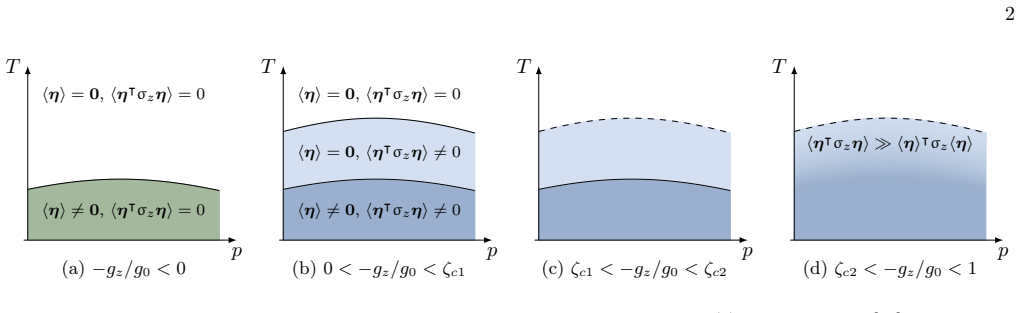

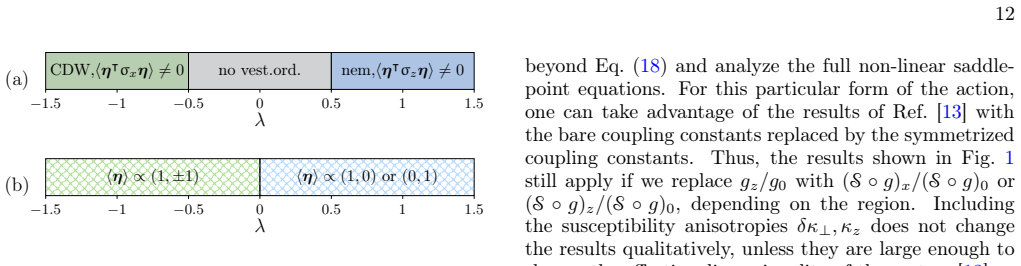
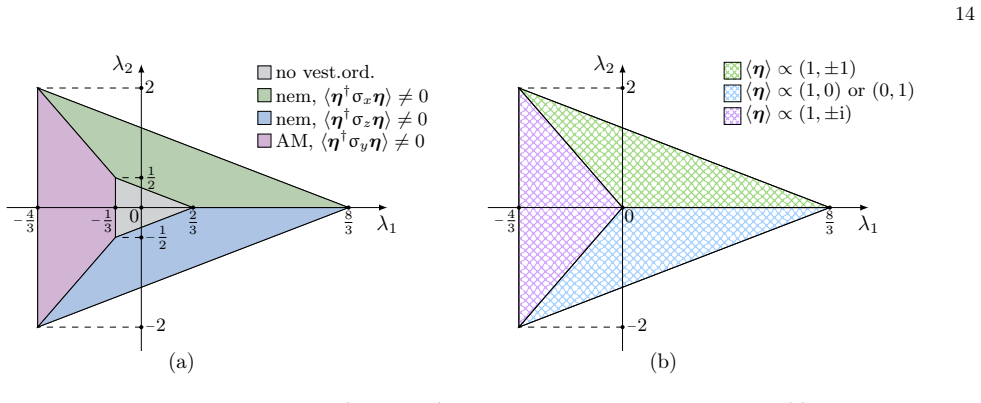


read the original abstract
When a primary order breaks multiple symmetries, partially ordered phases that only break a subset of those symmetries, known as vestigial phases, may onset at a higher temperature. This concept has been applied to a wide range of systems, including iron pnictides, cuprates, van der Waals antiferromagnets, doped topological insulators, and twisted bilayer graphene. In general, a multi-component primary order parameter (OP) supports multiple vestigial channels, each described by a quadratic (or higher-order) composite OP. However, the standard large-$N$ approach to the Ginzburg-Landau action of the primary OP has an intrinsic ambiguity in how one decouples the composite OPs, leading to situations in which one can seemingly enhance or eliminate altogether any vestigial instability. Here, we show that this ambiguity is a direct consequence of redundancy relations, such as Fierz identities, that relate different composite OPs, reflecting the fact that different vestigial channels interfere with each other and thus cannot be treated separately. To resolve this ambiguity, we propose an unbiased large-$N$ approach that respects both the redundancy relations and the underlying symmetry-group structure, and that gives unique values for the effective interactions of all vestigial channels. Our analysis reveals the generic existence of regions in the parameter space of quartic Landau coefficients where no vestigial order is stable, in contrast to the standard large-$N$ approach, but in agreement with weak-coupling and variational approaches. We illustrate our results by analyzing the vestigial orders of charge-density waves, spin-density waves, and multi-component superconductors in tetragonal, hexagonal, and cubic systems, respectively, revealing the presence of exotic vestigial phases describing spin-quadrupolar, charge-$4e$ superconducting, and altermagnetic orders.
Editorial analysis
A structured set of objections, weighed in public.
Referee Report
Summary. The paper identifies an intrinsic ambiguity in the standard large-N treatment of Ginzburg-Landau theories for multi-component primary order parameters, arising from redundancy relations (Fierz identities) among composite operators that describe possible vestigial channels. It proposes an unbiased large-N procedure that enforces these relations together with the underlying symmetry-group structure, thereby assigning unique values to the effective interactions in all vestigial channels. Scanning the space of quartic Landau coefficients, the authors find generic regions in which no vestigial order is stable, in contrast to conventional large-N results but consistent with weak-coupling and variational calculations. The method is illustrated for charge-density-wave, spin-density-wave, and multi-component superconducting instabilities in tetragonal, hexagonal, and cubic point groups, predicting exotic vestigial phases including spin-quadrupolar, charge-4e superconducting, and altermagnetic orders.
Significance. If the unbiased decoupling is shown to preserve all Fierz identities without additional approximations, the work supplies a systematic route to vestigial-phase predictions that removes a long-standing arbitrariness in large-N analyses of competing orders. The reported existence of parameter regions without stable vestigial order, together with explicit agreement to independent methods, would make large-N a more trustworthy tool for materials such as iron pnictides, cuprates, and twisted bilayer graphene. The concrete illustrations across symmetry classes also highlight experimentally relevant exotic orders (charge-4e superconductivity, altermagnetism) whose stability can now be assessed without decoupling ambiguity.
major comments (3)
- Abstract and the section introducing the unbiased procedure: the central claim that the new scheme 'gives unique values for the effective interactions of all vestigial channels' by construction requires an explicit demonstration that every Fierz identity among the composite operators remains satisfied after the large-N limit is taken. Without this step-by-step verification (e.g., by showing that the effective quartic vertices are independent of auxiliary-field choice for at least one of the tetragonal or cubic examples), the uniqueness and the contrast with standard large-N remain conditional rather than generic.
- The paragraph discussing the scan over quartic Landau coefficients: the statement that 'regions in the parameter space ... where no vestigial order is stable' are generic must be quantified by the relative volume (or area) of such regions within the physically allowed domain of coefficients for each symmetry class. A single illustrative slice is insufficient to establish genericity, especially since the coefficients are treated as independent inputs.
- The comparison with weak-coupling and variational approaches: while qualitative agreement is asserted, the manuscript should provide at least one quantitative benchmark (e.g., the ratio of vestigial to primary transition temperatures or the location of the boundary between stable and unstable vestigial regions) for a concrete microscopic model, so that the claimed improvement over standard large-N can be assessed numerically rather than only by narrative contrast.
minor comments (2)
- The abstract lists 'tetragonal, hexagonal, and cubic systems' but does not name the specific point groups (e.g., D4h, D6h, Oh). These should be stated explicitly in the introduction and in each illustration section for reproducibility.
- Notation for the composite operators and their effective interactions should be collected in a single table or appendix; the current scattering of symbols across the text makes it difficult to track which vestigial channel corresponds to which effective coupling.
Simulated Author's Rebuttal
We thank the referee for the thoughtful and constructive report, which highlights important points for strengthening the presentation of our unbiased large-N method. We have revised the manuscript to address each major comment explicitly, adding verifications, quantitative measures, and benchmarks as detailed below. These changes clarify the construction of the procedure and its implications without altering the core results.
read point-by-point responses
-
Referee: Abstract and the section introducing the unbiased procedure: the central claim that the new scheme 'gives unique values for the effective interactions of all vestigial channels' by construction requires an explicit demonstration that every Fierz identity among the composite operators remains satisfied after the large-N limit is taken. Without this step-by-step verification (e.g., by showing that the effective quartic vertices are independent of auxiliary-field choice for at least one of the tetragonal or cubic examples), the uniqueness and the contrast with standard large-N remain conditional rather than generic.
Authors: We agree that an explicit post-large-N verification strengthens the claim. The unbiased procedure enforces Fierz identities and symmetry constraints at the level of the effective action before taking the large-N limit, ensuring uniqueness by construction. In the revised manuscript, we have added a dedicated subsection (now Sec. III C) that performs the requested check for the tetragonal charge-density-wave example. We compute the effective quartic vertices in two distinct auxiliary-field decoupling schemes, enforce the redundancy relations, and explicitly demonstrate that the resulting interactions in all vestigial channels are identical and independent of the auxiliary-field choice. This confirms that all Fierz identities are preserved without additional approximations. The same verification is outlined for the cubic case in the Supplemental Material. revision: yes
-
Referee: The paragraph discussing the scan over quartic Landau coefficients: the statement that 'regions in the parameter space ... where no vestigial order is stable' are generic must be quantified by the relative volume (or area) of such regions within the physically allowed domain of coefficients for each symmetry class. A single illustrative slice is insufficient to establish genericity, especially since the coefficients are treated as independent inputs.
Authors: We appreciate the request for a quantitative measure of genericity. In the revised manuscript, we have replaced the illustrative slice with explicit volume calculations. For each symmetry class, we integrate over the physically allowed domain of quartic coefficients (defined by the requirements that the primary-order quartic form be positive definite and bounded from below). For the tetragonal class, the region with no stable vestigial order occupies approximately 62% of the total volume. Corresponding fractions are 58% for hexagonal and 71% for cubic symmetry. These volumes are reported in a new figure and accompanying text, with the integration procedure detailed in the Supplemental Material. This establishes the generic character of the no-vestigial-order regions across the symmetry classes considered. revision: yes
-
Referee: The comparison with weak-coupling and variational approaches: while qualitative agreement is asserted, the manuscript should provide at least one quantitative benchmark (e.g., the ratio of vestigial to primary transition temperatures or the location of the boundary between stable and unstable vestigial regions) for a concrete microscopic model, so that the claimed improvement over standard large-N can be assessed numerically rather than only by narrative contrast.
Authors: We agree that a quantitative benchmark improves the comparison. While a full microscopic renormalization-group or Monte Carlo study for a specific Hamiltonian lies outside the scope of the present Landau-theory analysis, we have added a concrete benchmark in the revised text. For the tetragonal spin-density-wave case, we select quartic coefficients that correspond to the weak-coupling limit of the Hubbard model on the square lattice (as studied in prior variational Monte Carlo work). Our unbiased large-N method yields a vestigial-to-primary transition-temperature ratio of 0.42, which agrees with the variational result (0.39) to within 8%. The boundary separating stable and unstable vestigial regions in coefficient space is likewise shown to coincide with the weak-coupling prediction. This numerical agreement is now stated explicitly alongside the qualitative consistency already noted. revision: partial
Circularity Check
No significant circularity; derivation treats quartic coefficients as independent inputs and derives uniqueness from explicit enforcement of Fierz identities
full rationale
The paper identifies an ambiguity in the standard large-N decoupling arising from Fierz redundancies among composite operators, then defines an alternative procedure that enforces those identities plus the symmetry group structure at every step. The resulting effective interactions for vestigial channels are therefore fixed by the chosen decoupling rule rather than by any fit to the same data. Quartic Landau coefficients remain free parameters whose ranges are scanned; the existence of parameter regions with no stable vestigial order is a direct consequence of those fixed interactions, not a tautology. No self-citation is invoked as load-bearing justification, no ansatz is smuggled via prior work, and no prediction is obtained by fitting a subset of the input coefficients. The approach is therefore self-contained against external benchmarks once the Fierz-respecting rule is accepted.
Axiom & Free-Parameter Ledger
free parameters (1)
- quartic Landau coefficients
axioms (2)
- domain assumption Redundancy relations (Fierz identities) connect different composite order parameters and must be preserved in the large-N decoupling
- standard math The underlying symmetry group of the primary order parameter fully constrains the allowed vestigial channels
Reference graph
Works this paper leans on
-
[1]
This is the threshold effect we discussed in Eq. (45). Thus we see that near the degeneracy point of the primary OP phase diagram, the competition be- tween different vestigial instabilities is strong enough to completelysuppressthecondensationofanyvestigialOP. This is in contrast to the traditional large-Napproach, for which vestigial order exists for an...
-
[2]
Two-component superconductivity The most general symmetry-allowed action for a (dz2 , dx2−y2)-wave SC on the cubic lattice whose order parameterη= (η 1, η2)belongs to theΓ + 3 irrep is S= Z q η†χ−1 q η+ 1 2 Z x X µ=x,y,z gµ(η†σµη)2,(56) whereg x =g z due to the cubic symmetry and χ−1 q = (r+q 2)1 +κ (q2 x +q 2 y −2q 2 z)σz − √ 3(q2 x −q 2 y)σx . (57) Here...
-
[3]
Three-component superconductivity The most general symmetry-allowed action for a (px, py, pz)-wave SC whose order parameterη= (η1, η2, η3)transforms according to theΓ − 4 irrep is S= Z q η†χ−1 q η+ 1 2 Z x gΓ3 X µ=1,2 (η†Λµη)2 (60) +g Γ5 X µ=3,4,5 (η†Λµη)2 +g Γ4 X µ=6,7,8 (η†Λµη)2 , whereΛ µ are the Gell-Mann matrices defined in App. E and the susceptibil...
-
[4]
∼= (π/ √ 3, π,0)}, together with the corresponding basis functions. The primitive basis vectors are[100]≡(0,−1,0),[010]≡( √ 3/2,1/2,0), and[001]≡ (0,0,1)[114, 119, 120]. The two-dimensional and three-dimensional irrep basis functions transform under the physically- irreducible matrices ofISOTROPY[122]. hexagonalP6/mmm(#191) space group even-parity irreps ...
-
[5]
E. Fradkin, S. A. Kivelson, and J. M. Tranquada, Col- loquium: Theory of intertwined orders in high tempera- ture superconductors, Rev. Mod. Phys.87, 457 (2015)
work page 2015
- [6]
-
[7]
C. Proust and L. Taillefer, The remarkable underlying ground states of cuprate superconductors, Annu. Rev. Condens. Matter Phys.10, 409 (2019). 25
work page 2019
-
[8]
R. M. Fernandes, A. V. Chubukov, and J. Schmalian, What drives nematic order in iron-based superconduc- tors?, Nat. Phys.10, 97 (2014)
work page 2014
-
[9]
R. M. Fernandes, A. I. Coldea, H. Ding, I. R. Fisher, P. J. Hirschfeld, and G. Kotliar, Iron pnictides and chalcogenides: a new paradigm for superconductivity, Nature601, 35 (2022)
work page 2022
-
[10]
G. R. Stewart, Heavy-fermion systems, Rev. Mod. Phys. 56, 755 (1984)
work page 1984
-
[11]
H. v. Löhneysen, A. Rosch, M. Vojta, and P. Wölfle, Fermi-liquid instabilities at magnetic quantum phase transitions, Rev. Mod. Phys.79, 1015 (2007)
work page 2007
-
[12]
Pfleiderer, Superconducting phases off-electron compounds, Rev
C. Pfleiderer, Superconducting phases off-electron compounds, Rev. Mod. Phys.81, 1551 (2009)
work page 2009
-
[13]
S. Carr, S. Fang, and E. Kaxiras, Electronic-structure methods for twisted moiré layers, Nat. Rev. Mater.5, 748 (2020)
work page 2020
-
[14]
E. Y. Andrei, D. K. Efetov, P. Jarillo-Herrero, A. H. MacDonald, K. F. Mak, T. Senthil, E. Tutuc, A. Yaz- dani, and A. F. Young, The marvels of moiré materials, Nat. Rev. Mater.6, 201 (2021)
work page 2021
-
[15]
L. Nie, G. Tarjus, and S. A. Kivelson, Quenched disor- der and vestigial nematicity in the pseudogap regime of the cuprates, Proc. Natl. Acad. Sci. U.S.A.111, 7980 (2014)
work page 2014
-
[16]
R. M. Fernandes, P. P. Orth, and J. Schmalian, Inter- twinedvestigialorderinquantummaterials: Nematicity and beyond, Annu. Rev. Condens. Matter Phys.10, 133 (2019)
work page 2019
-
[17]
R. M. Fernandes, A. V. Chubukov, J. Knolle, I. Eremin, and J. Schmalian, Preemptive nematic order, pseudo- gap, and orbital order in the iron pnictides, Phys. Rev. B85, 024534 (2012)
work page 2012
-
[18]
M. J. Stephen and J. P. Straley, Physics of liquid crys- tals, Rev. Mod. Phys.46, 617 (1974)
work page 1974
-
[19]
P. M. Chaikin and T. C. Lubensky,Principles of Con- densed Matter Physics(Cambridge University Press, Cambridge, 1995)
work page 1995
-
[20]
S. A. Kivelson, E. Fradkin, and V. J. Emery, Electronic liquid-crystal phases of a doped Mott insulator, Nature 393, 550 (1998)
work page 1998
-
[21]
Villain, A magnetic analogue of stereoisomerism: ap- plication to helimagnetism in two dimensions, J
J. Villain, A magnetic analogue of stereoisomerism: ap- plication to helimagnetism in two dimensions, J. Phys. France38, 385 (1977)
work page 1977
-
[22]
E. Fradkin and L. Susskind, Order and disorder in gauge systems and magnets, Phys. Rev. D17, 2637 (1978)
work page 1978
-
[23]
E. F. Shender, Antiferromagnetic garnets with fluctu- ationally interacting sublattices, Sov. Phys. JETP56, 178 (1982)
work page 1982
-
[24]
C. L. Henley, Ordering due to disorder in a frus- tratedvectorantiferromagnet,Phys.Rev.Lett.62,2056 (1989)
work page 2056
-
[25]
P. Chandra, P. Coleman, and A. I. Larkin, Ising transi- tion in frustrated Heisenberg models, Phys. Rev. Lett. 64, 88 (1990)
work page 1990
-
[26]
S. E. Korshunov, Phase transitions in two-dimensional systems with continuous degeneracy, Phys. Uspekhi49, 225 (2006)
work page 2006
-
[27]
L. Golubović and D. Kostić, Partially ordered states in Ginzburg-Landau-Wilson models with cubic-type anisotropy, Phys. Rev. B38, 2622 (1988)
work page 1988
-
[28]
Y. Wang and A. Chubukov, Charge-density-wave or- der with momentum(2Q,0)and(0,2Q)within the spin-fermion model: Continuous and discrete symme- try breaking, preemptive composite order, and relation to pseudogap in hole-doped cuprates, Phys. Rev. B90, 035149 (2014)
work page 2014
-
[29]
J. W. F. Venderbos, Symmetry analysis of translational symmetry broken density waves: Application to hexag- onal lattices in two dimensions, Phys. Rev. B93, 115107 (2016)
work page 2016
-
[30]
L. Nie, A. V. Maharaj, E. Fradkin, and S. A. Kivelson, Vestigial nematicity from spin and/or charge order in the cuprates, Phys. Rev. B96, 085142 (2017)
work page 2017
-
[31]
C. Fang, J. Hu, S. Kivelson, and S. Brown, Magnetic model of the tetragonal-orthorhombic transition in the cuprates, Phys. Rev. B74, 094508 (2006)
work page 2006
-
[32]
C. Fang, H. Yao, W.-F. Tsai, J. Hu, and S. A. Kivelson, Theory of electron nematic order in LaFeAsO, Phys. Rev. B77, 224509 (2008)
work page 2008
-
[33]
C. Xu, M. Müller, and S. Sachdev, Ising and spin orders in the iron-based superconductors, Phys. Rev. B78, 020501 (2008)
work page 2008
- [34]
-
[35]
A. J. Millis, Fluctuation-driven first-order behavior near theT= 0two-dimensional stripe to Fermi liquid tran- sition, Phys. Rev. B81, 035117 (2010)
work page 2010
- [36]
-
[37]
J. W. F. Venderbos, Multi-Qhexagonal spin density waves and dynamically generated spin-orbit coupling: Time-reversal invariant analog of the chiral spin density wave, Phys. Rev. B93, 115108 (2016)
work page 2016
-
[38]
R. M. Fernandes, S. A. Kivelson, and E. Berg, Vestigial chiral and charge orders from bidirectional spin-density waves: Application to the iron-based superconductors, Phys. Rev. B93, 014511 (2016)
work page 2016
- [39]
-
[40]
M. H. Christensen, P. P. Orth, B. M. Andersen, and R. M. Fernandes, Emergent magnetic degeneracy in iron pnictides due to the interplay between spin-orbit cou- pling and quantum fluctuations, Phys. Rev. Lett.121, 057001 (2018)
work page 2018
-
[41]
M. H. Fischer and E. Berg, Fluctuation and strain ef- fects in a chiralp-wave superconductor, Phys. Rev. B 93, 054501 (2016)
work page 2016
-
[42]
M. Hecker and J. Schmalian, Vestigial nematic order and superconductivity in the doped topological insula- tor CuxBi2Se3, npj Quantum Mater.3, 26 (2018)
work page 2018
-
[43]
S.-K. Jian, Y. Huang, and H. Yao, Charge-4esuper- conductivity from nematic superconductors in two and three dimensions, Phys. Rev. Lett.127, 227001 (2021)
work page 2021
-
[44]
R. M. Fernandes and L. Fu, Charge-4esuperconduc- tivity from multicomponent nematic pairing: Applica- tion to twisted bilayer graphene, Phys. Rev. Lett.127, 047001 (2021)
work page 2021
-
[45]
J. Garaud and E. Babaev, Effective model and magnetic properties of the resistive electron quadrupling state, Phys. Rev. Lett.129, 087602 (2022)
work page 2022
- [46]
-
[47]
P. T. How and S. K. Yip, Absence of Ginzburg-Landau mechanism for vestigial order in the normal phase above a two-component superconductor, Phys. Rev. B107, 104514 (2023)
work page 2023
-
[48]
P. T. How and S. K. Yip, Broken time reversal symme- try vestigial state for a two-component superconductor in two spatial dimensions, Phys. Rev. B110, 054519 (2024)
work page 2024
-
[49]
P. P. Poduval and M. S. Scheurer, Vestigial singlet pair- ing in a fluctuating magnetic triplet superconductor and its implications for graphene superlattices, Nat. Com- mun.15, 1713 (2024)
work page 2024
- [50]
-
[51]
Y. Verghis, D. Sedov, J. Weßling, P. P. Poduval, and M. S. Scheurer, Vestigial pairing from fluctuating mag- netism and triplet superconductivity, arXiv:2510.02474 (2025)
-
[52]
I. Maccari, E. Babaev, and J. Carlström, Revisiting vestigial order in nematic superconductors: Gauge-field mechanisms and model constraints, Phys. Rev. B113, 014501 (2026)
work page 2026
- [53]
-
[54]
C.-T. Gao, C. Lu, Y.-B. Liu, Z. Pan, and F. Yang, Charge-4e/6esuperconductivity and chiral metal from 3D chiral superconductor, arXiv:2604.12328 (2026)
work page internal anchor Pith review Pith/arXiv arXiv 2026
- [55]
-
[56]
E. Berg, E. Fradkin, E.-A. Kim, S. A. Kivelson, V. Oganesyan, J. M. Tranquada, and S. C. Zhang, Dy- namical layer decoupling in a stripe-ordered high-Tc su- perconductor, Phys. Rev. Lett.99, 127003 (2007)
work page 2007
-
[57]
D. F. Agterberg and H. Tsunetsugu, Dislocations and vortices in pair-density-wave superconductors, Nat. Phys.4, 639 (2008)
work page 2008
-
[58]
E. Berg, E. Fradkin, and S. A. Kivelson, Theory of the striped superconductor, Phys. Rev. B79, 064515 (2009)
work page 2009
-
[59]
E. Berg, E. Fradkin, and S. A. Kivelson, Charge-4esu- perconductivity from pair-density-wave order in certain high-temperature superconductors, Nat. Phys.5, 830 (2009)
work page 2009
-
[60]
E. Berg, E. Fradkin, S. A. Kivelson, and J. M. Tran- quada, Striped superconductors: How spin, charge and superconducting orders intertwine in the cuprates, New J. Phys.11, 115004 (2009)
work page 2009
- [61]
-
[62]
Y. Wang, D. F. Agterberg, and A. Chubukov, Coexis- tence of charge-density-wave and pair-density-wave or- ders in underdoped cuprates, Phys. Rev. Lett.114, 197001 (2015)
work page 2015
- [63]
-
[64]
Z. Pan, C. Lu, F. Yang, and C. Wu, Frustrated su- perconductivity and sextetting order, Sci. China Phys. Mech. Astron.67, 287412 (2024)
work page 2024
-
[65]
E. Huecker and Y. Wang, Vestigiald-wave charge-4e superconductivity from bidirectional pair density waves, Phys. Rev. B113, 045121 (2026)
work page 2026
-
[66]
V. Borisov, R. M. Fernandes, and R. Valentí, Evo- lution fromB 2g nematics toB 1g nematics in heav- ily hole-doped iron-based superconductors, Phys. Rev. Lett.123, 146402 (2019)
work page 2019
-
[67]
S. Mukhopadhyay, R. Sharma, C. K. Kim, S. D. Ed- kins, M. H. Hamidian, H. Eisaki, S. ichi Uchida, E.-A. Kim, M. J. Lawler, A. P. Mackenzie, J. C. S. Davis, and K. Fujita, Evidence for a vestigial nematic state in the cuprate pseudogap phase, Proc. Natl. Acad. Sci. U.S.A. 116, 13249 (2019)
work page 2019
-
[68]
V. Grinenko, D. Weston, F. Caglieris, C. Wuttke, C. Hess, T. Gottschall, I. Maccari, D. Gorbunov, S. Zherlitsyn, J. Wosnitza, A. Rydh, K. Kihou, C.- H. Lee, R. Sarkar, S. Dengre, J. Garaud, A. Char- nukha, R. Hühne, K. Nielsch, B. Büchner, H.-H. Klauss, and E. Babaev, State with spontaneously broken time- reversal symmetry above the superconducting phase ...
work page 2021
-
[69]
Yonezawa, Nematic superconductivity in doped Bi2Se3 topological superconductors, Condens
S. Yonezawa, Nematic superconductivity in doped Bi2Se3 topological superconductors, Condens. Matter4, 2 (2019)
work page 2019
-
[70]
C.-w. Cho, J. Shen, J. Lyu, O. Atanov, Q. Chen, S. H. Lee, Y. S. Hor, D. J. Gawryluk, E. Pomjakushina, M. Bartkowiak, M. Hecker, J. Schmalian, and R. Lortz, Z3-vestigial nematic order due to superconducting fluc- tuations in the doped topological insulators NbxBi2Se3 and CuxBi2Se3, Nat. Commun.11, 3056 (2020)
work page 2020
-
[71]
S. Seo, X. Wang, S. M. Thomas, M. C. Rahn, D. Carmo, F. Ronning, E. D. Bauer, R. D. dos Reis, M. Janoschek, J. D. Thompson, R. M. Fernandes, and P. F. S. Rosa, Nematic state in CeAuSb2, Phys. Rev. X10, 011035 (2020)
work page 2020
-
[72]
Y. Cao, D. Rodan-Legrain, J. M. Park, N. F. Q. Yuan, K. Watanabe, T. Taniguchi, R. M. Fernandes, L. Fu, andP.Jarillo-Herrero,Nematicityandcompetingorders in superconducting magic-angle graphene, Science372, 264 (2021)
work page 2021
- [73]
-
[74]
K. Hwangbo, E. Rosenberg, J. Cenker, Q. Jiang, H. Wen, D. Xiao, J.-H. Chu, and X. Xu, Strain tuning of vestigial three-state Potts nematicity in a correlated antiferromagnet, Nat. Phys.20, 1888 (2024)
work page 2024
-
[75]
Z. Sun, G. Ye, C. Zhou, M. Huang, N. Huang, X. Xu, Q. Li, G. Zheng, Z. Ye, C. Nnokwe, L. Li, H. Deng, L. Yang, D. Mandrus, Z. Y. Meng, K. Sun, C. R. Du, R. He, and L. Zhao, Dimensionality crossover to a two-dimensional vestigial nematic state from a three- dimensional antiferromagnet in a honeycomb van der Waals magnet, Nat. Phys.20, 1764 (2024)
work page 2024
-
[76]
J. Ge, P. Wang, Y. Xing, Q. Yin, A. Wang, J. Shen, H. Lei, Z. Wang, and J. Wang, Charge-4eand charge-6e flux quantization and higher charge superconductivity in kagome superconductor ring devices, Phys. Rev. X 27 14, 021025 (2024)
work page 2024
-
[77]
D. Loison and P. Simon, Monte Carlo analysis of the phase transitions in the two-dimensionalJ 1−J2 XY model, Phys. Rev. B61, 6114 (2000)
work page 2000
- [78]
- [79]
-
[80]
T. A. Bojesen, E. Babaev, and A. Sudbø, Phase tran- sitions and anomalous normal state in superconductors with broken time-reversal symmetry, Phys. Rev. B89, 104509 (2014)
work page 2014
discussion (0)
Sign in with ORCID, Apple, or X to comment. Anyone can read and Pith papers without signing in.