Recognition: 2 theorem links
· Lean TheoremDynamic Alignment: A Fragile Survival Effect
Pith reviewed 2026-05-13 00:51 UTC · model grok-4.3
The pith
Dynamic alignment in magnetohydrodynamic turbulence is primarily a selective survival effect favoring intense small-angle events.
A machine-rendered reading of the paper's core claim, the machinery that carries it, and where it could break.
Core claim
These results indicate that dynamic alignment, as measured by conventional weighted diagnostics, is best understood as selective sampling of longer-lived intense small-angle events, not as a cascade-wide alignment of typical MHD fluctuations.
What carries the argument
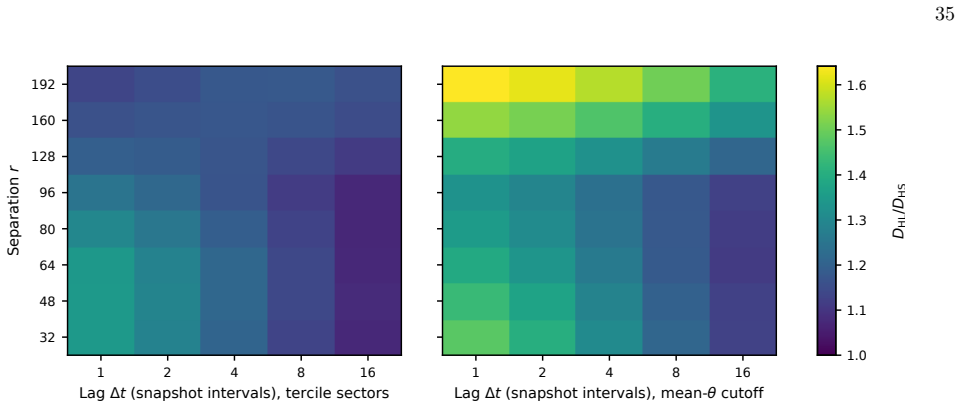
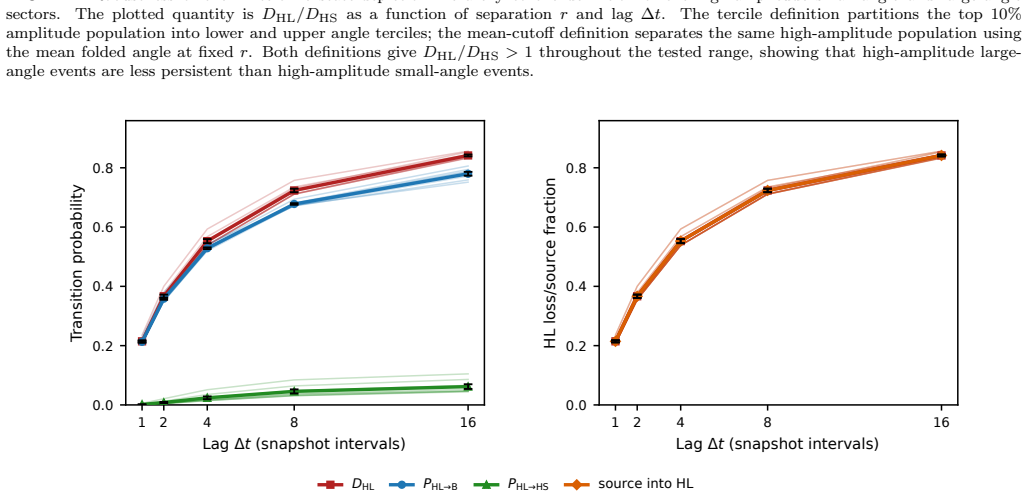
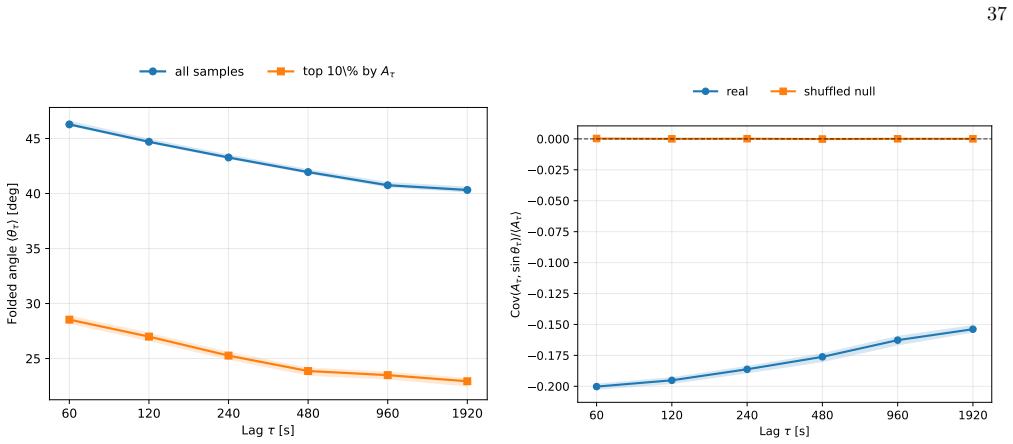
A finite-time state-retention analysis showing that high-amplitude large-angle events depart their sector faster than high-amplitude small-angle events, supported by shuffled-null tests that isolate the negative covariance between amplitude and angular misalignment.
Load-bearing premise
The shuffled-null tests and finite-time state-retention analysis isolate a genuine survival mechanism without confounding effects from other unmeasured properties of the turbulence or sampling.
What would settle it
A simulation in which high-amplitude events with large angles persist in their amplitude-angle sector at the same rate as those with small angles would falsify the proposed survival mechanism.
Figures






read the original abstract
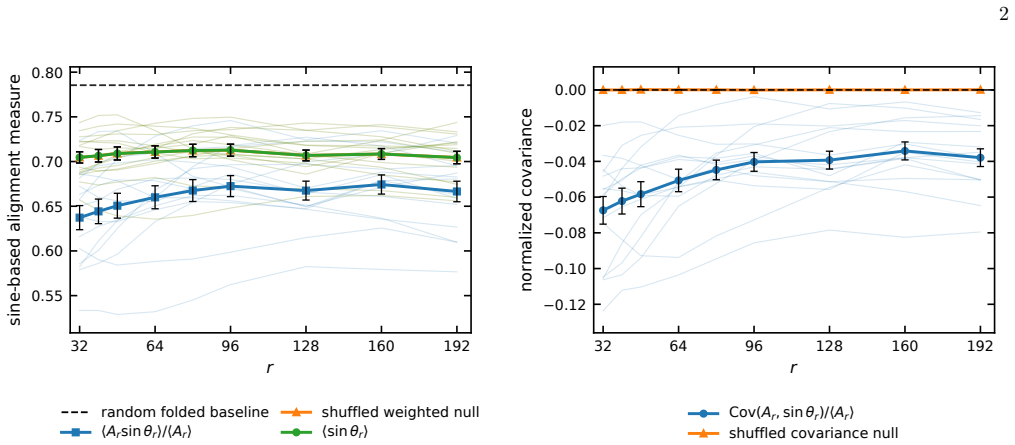
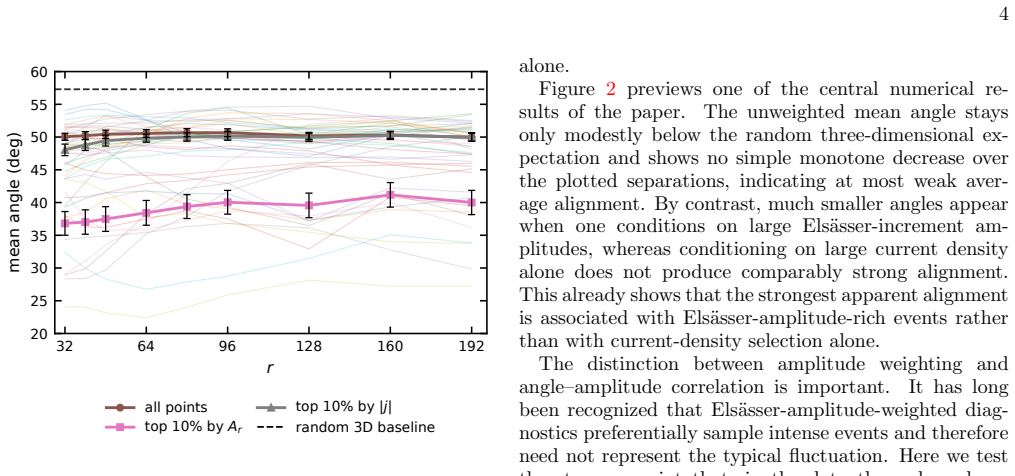
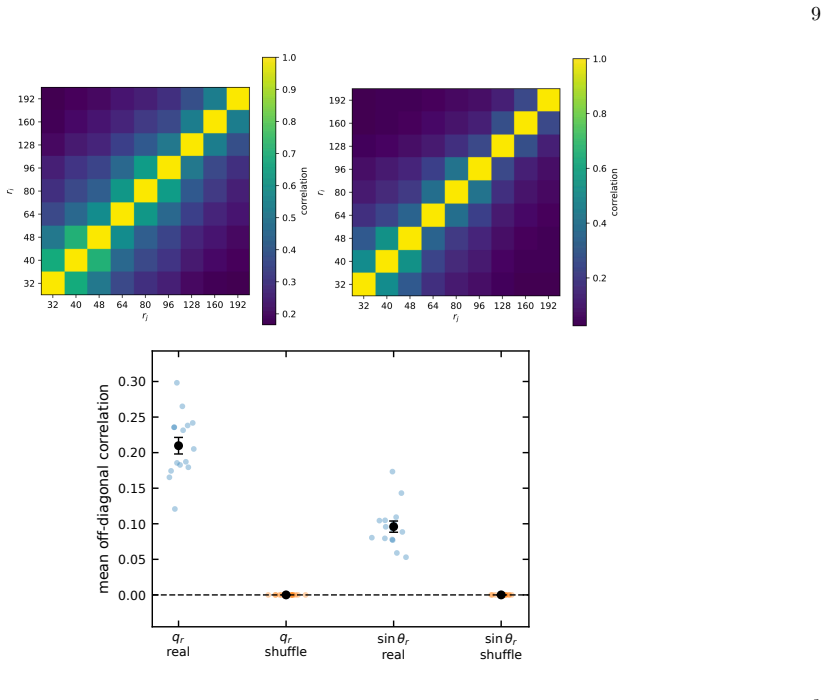
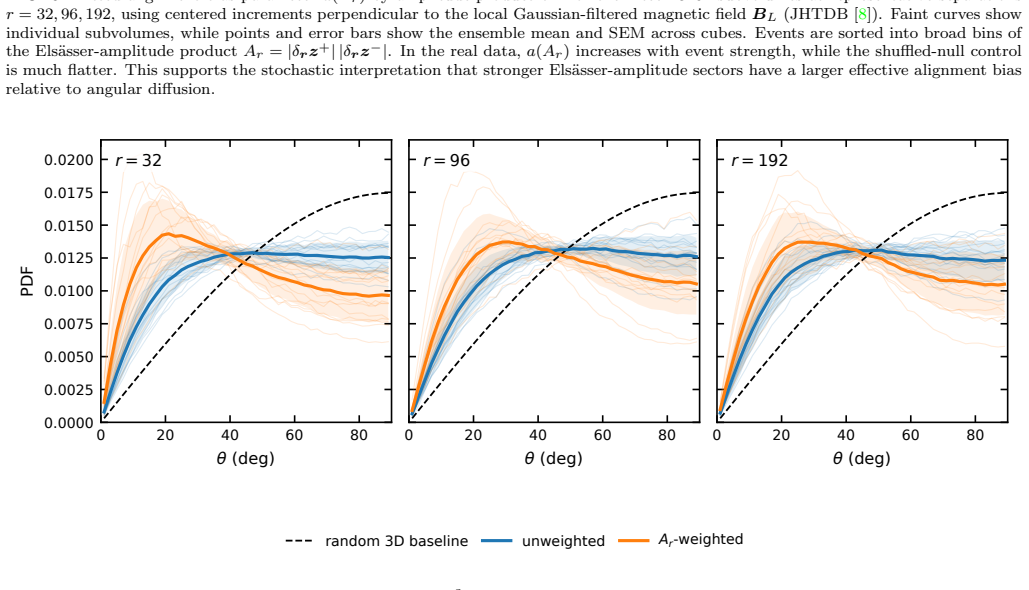
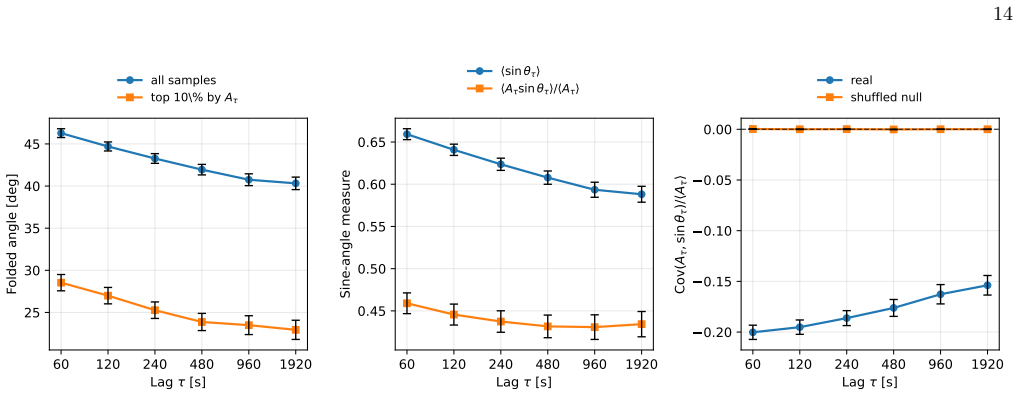
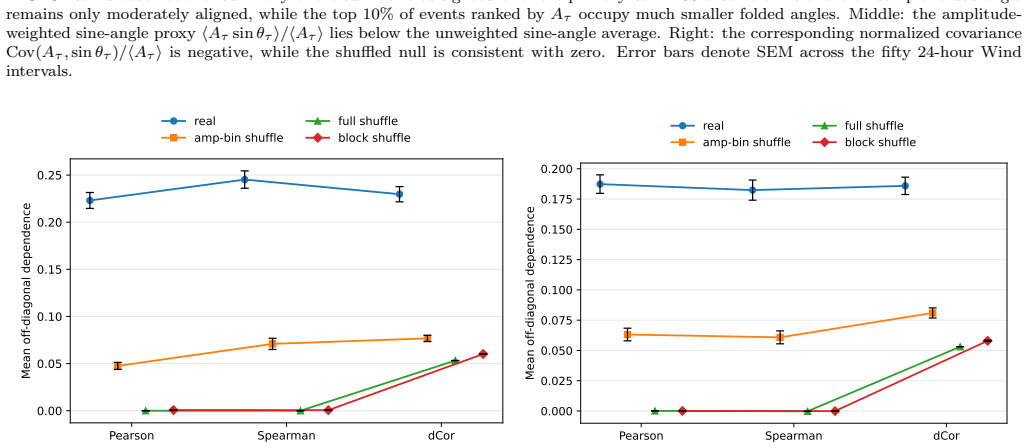
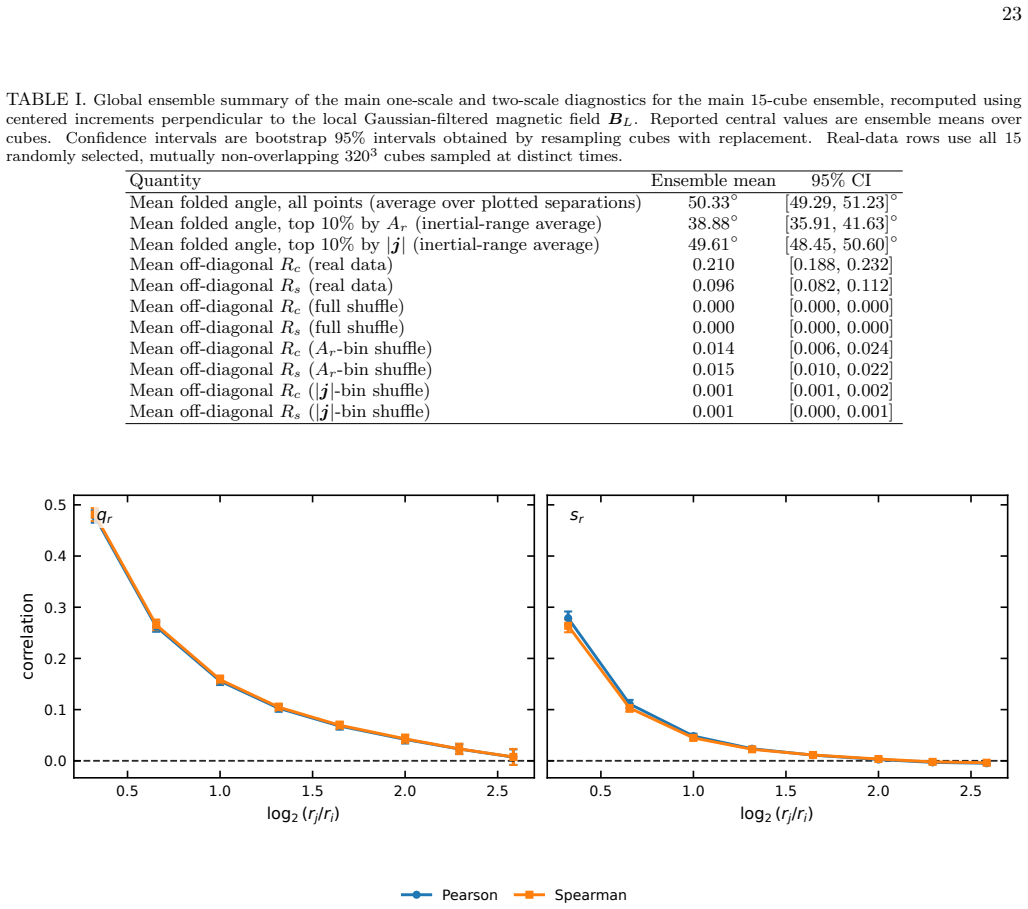
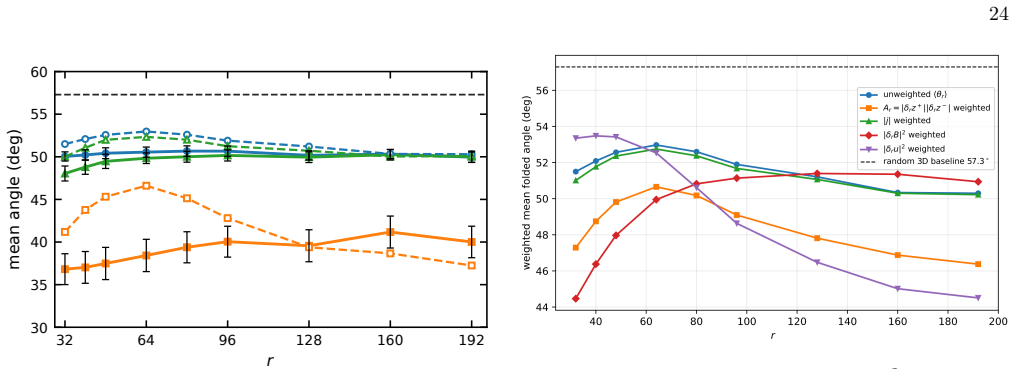
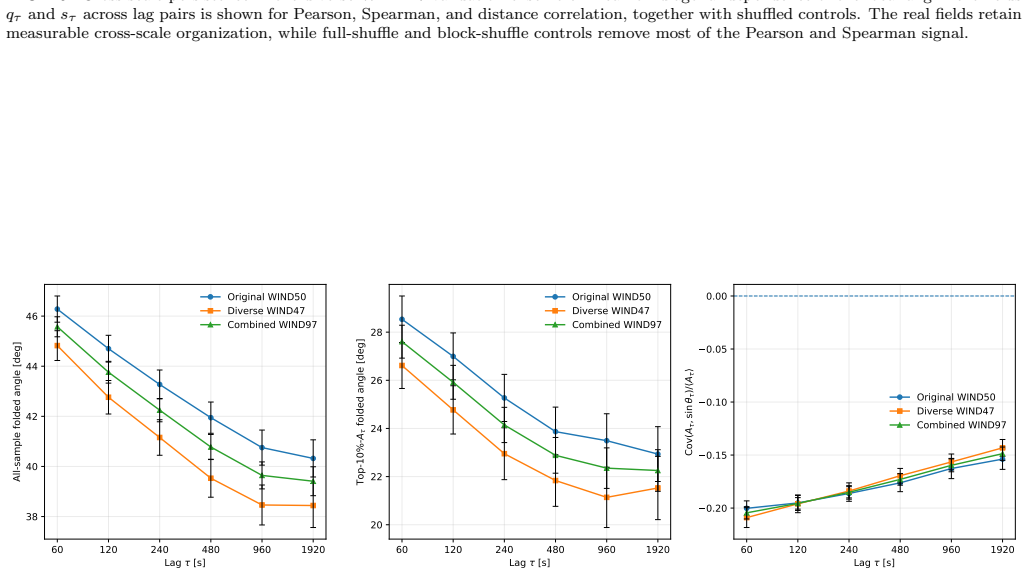
Dynamic alignment in magnetohydrodynamic (MHD) turbulence is usually interpreted as a cascade-wide tendency of Elsasser increments to become increasingly collinear at smaller scales. We argue instead that the standard measurements mainly detect a conditional survival effect of intense events. In high-resolution Johns Hopkins MHD simulations, the typical folded Elsasser-increment angle remains only modestly below the random-orientation baseline and shows no evidence for a rigid, monotone, volume-filling ordering of the cascade. Much smaller angles appear primarily in the strongest Elsasser-amplitude events, while conditioning on current density leaves the angle close to its unweighted behavior. Shuffled-null tests show that this reduction is caused by a genuine negative covariance between event amplitude and angular misalignment, not by weighting alone. Cross-scale angular correlations are measurable but decaying, indicating partial and non-rigid persistence of the local alignment field. A finite-time state-retention test directly supports the proposed mechanism: high-amplitude large-angle events leave their amplitude--angle sector faster than high-amplitude small-angle events, while incoming transitions continually replenish the large-angle sector. NASA Wind solar-wind observations show the same angle--amplitude hierarchy and negative covariance in Taylor-sampled Elsasser increments. These results indicate that dynamic alignment, as measured by conventional weighted diagnostics, is best understood as selective sampling of longer-lived intense small-angle events, not as a cascade-wide alignment of typical MHD fluctuations.
Editorial analysis
A structured set of objections, weighed in public.
Referee Report
Summary. The paper claims that dynamic alignment in MHD turbulence, as conventionally measured by weighted diagnostics on Elsasser increments, is not evidence of a cascade-wide, volume-filling tendency toward collinearity at small scales. Instead, it primarily reflects a selective survival effect in which intense, small-angle events persist longer than large-angle ones of comparable amplitude. This is supported by Johns Hopkins high-resolution simulations showing only modest deviations of typical angles from random baselines, a negative amplitude-angle covariance confirmed by shuffled-null tests, decaying cross-scale correlations, a finite-time state-retention analysis demonstrating differential exit rates from amplitude-angle sectors, and consistent patterns in NASA Wind solar-wind data. Conditioning on current density is reported to leave the angle distribution nearly unchanged.
Significance. If the central interpretation holds, the result would substantially revise the understanding of dynamic alignment away from a fundamental cascade property toward a fragile, conditional sampling bias affecting only the strongest events. This carries implications for theories of MHD energy transfer and dissipation. The manuscript earns credit for its use of high-resolution simulations, independent observational confirmation, multiple null tests (shuffled, cross-scale, retention), and direct comparison to external datasets without reliance on fitted parameters or circular definitions.
major comments (2)
- [finite-time state-retention test] Finite-time state-retention analysis: the test establishes faster departure of high-amplitude large-angle events and replenishment of the large-angle sector, but does not condition on local current density |j|, vorticity, or dissipation rate. Although the abstract states that conditioning on |j| leaves the angle distribution nearly unchanged, this does not demonstrate that |j| (or correlated quantities) is independent of retention time; the survival effect could still be driven by these confounders rather than angle itself.
- [results and discussion of retention and covariance tests] Interpretation of the mechanism: the negative covariance and differential retention are presented as evidence that alignment drives selective survival, yet the tests do not isolate angle from other properties known to correlate with both amplitude and geometry in MHD turbulence. A direct test conditioning the retention analysis on |j| (or dissipation) would be required to support the causal claim that alignment itself produces the observed lifetime difference.
minor comments (2)
- Clarify the precise definition and folding procedure for the 'Elsasser-increment angle' used in the weighted and unweighted diagnostics, especially how it differs from the standard angle between increments.
- The abstract refers to 'folded' angles and 'state-retention'; ensure these terms are defined at first use in the main text with explicit formulas or pseudocode for reproducibility.
Simulated Author's Rebuttal
We thank the referee for the constructive report and positive assessment of the manuscript's methodology and implications. We address the two major comments on the finite-time state-retention analysis below, focusing on the potential role of current density |j| as a confounder.
read point-by-point responses
-
Referee: [finite-time state-retention test] Finite-time state-retention analysis: the test establishes faster departure of high-amplitude large-angle events and replenishment of the large-angle sector, but does not condition on local current density |j|, vorticity, or dissipation rate. Although the abstract states that conditioning on |j| leaves the angle distribution nearly unchanged, this does not demonstrate that |j| (or correlated quantities) is independent of retention time; the survival effect could still be driven by these confounders rather than angle itself.
Authors: We agree that the retention test does not explicitly condition on |j|. However, the analysis is already restricted to high-amplitude events, which are strongly correlated with elevated |j|. Within this population, the angle distribution remains nearly unchanged upon conditioning on |j|, indicating that |j| does not preferentially select for small angles. The differential retention rates are therefore observed as a function of angle at comparable amplitudes (and thus comparable |j| levels). We will add a clarifying paragraph in the revised manuscript explaining this reasoning and why |j| is unlikely to be the dominant driver. revision: partial
-
Referee: [results and discussion of retention and covariance tests] Interpretation of the mechanism: the negative covariance and differential retention are presented as evidence that alignment drives selective survival, yet the tests do not isolate angle from other properties known to correlate with both amplitude and geometry in MHD turbulence. A direct test conditioning the retention analysis on |j| (or dissipation) would be required to support the causal claim that alignment itself produces the observed lifetime difference.
Authors: The shuffled-null tests already isolate the amplitude-angle covariance from weighting artifacts. The retention test then demonstrates longer persistence of small-angle events at fixed high amplitude. Given the demonstrated insensitivity of the angle distribution to |j| conditioning, we maintain that the survival effect is attributable to angle rather than |j| or dissipation. A full re-analysis conditioning retention times on |j| would be computationally intensive and, in our view, unlikely to change the conclusions. We will expand the discussion to explicitly address potential confounders and the limits of the current isolation. revision: partial
Circularity Check
No significant circularity detected
full rationale
The paper's claims rest on direct empirical measurements from external Johns Hopkins MHD simulations and NASA Wind observations, including shuffled-null tests for covariance and finite-time state-retention analysis for differential survival rates. These steps compare observed angle-amplitude hierarchies and transition rates against baselines without reducing to self-defined quantities, fitted parameters renamed as predictions, or load-bearing self-citations. The reinterpretation of dynamic alignment as selective sampling follows from the data patterns rather than by construction, and conditioning statements (e.g., on current density) are presented as independent checks.
Axiom & Free-Parameter Ledger
axioms (2)
- domain assumption Turbulence obeys the MHD equations and Elsasser increments are well-defined
- standard math Shuffling data preserves amplitude distributions while destroying correlations
Lean theorems connected to this paper
-
IndisputableMonolith/Cost/FunctionalEquation.leanwashburn_uniqueness_aczel unclearhigh-amplitude large-angle events leave their amplitude–angle sector faster than high-amplitude small-angle events... D_HL > D_HS
Reference graph
Works this paper leans on
-
[1]
Larger-cube and component-weighting checks As an additional consistency check, we repeated the one-scale angle diagnostics on a substantially larger cutout from the same MHD dataset, using a single 448 3 cube att= 57 with spatial rangex, y, z= 289–736. We do not include this run in the main 15-cube ensemble averages, since it is a separate larger-volume r...
-
[2]
These diagnostics use only the velocity and magnetic fields; pressure is not required
Numerical implementation of angle and cross-scale correlation diagnostics This appendix describes the numerical implementation of the local alignment-angle and cross-scale correlation diagnostics. These diagnostics use only the velocity and magnetic fields; pressure is not required. 25 For each subvolume we form the Els¨ asser fields z± =u±B. For each sep...
-
[3]
Chapman–Kolmogorov consistency check As a consistency check on the Markov-in-scale reduc- tion, we tested the Chapman–Kolmogorov relation for the signed cosine field cr(x) =q r(x). Here “transition” is meant in an empirical scale-space sense, not as a physical-time trajectory of a material ob- ject. At each sampled base point and separation direc- tion, w...
-
[4]
Compact-support filtering for the geometric diagnostic The geometric diagnostic requires coarse-grained Els¨ asser fields and their effective accelerations. For this part of the calculation we use a smooth compact-support separable kernel, not a Gaussian filter. In one dimension the unnormalised kernel is ϕ(s) = exp − 1 1−s 2 ,|s|<1, 0,|s| ≥1. For a...
-
[5]
Discrete Els¨ asser acceleration and control coefficient For each scaleℓ, we compute filtered fieldsz ± ℓ and Πℓ. The subscale stress tensor is computed componentwise as τ ± ℓ,ij = z± i z∓ j ℓ −z ± i,ℓz∓ j,ℓ, where the overbar denotes compact-support filtering. The resolved nonideal contribution is N ± ℓ =−∇ ·τ ± ℓ +ν∇ 2z± ℓ +F ℓ, with ν=η= 1.1×10 −4. The...
-
[6]
This part uses the resolved Els¨ asser increments and does not require pressure
Local-perpendicular angle and amplitude diagnostics The stochastic angle–amplitude diagnostic tests whether amplitude-weighted alignment is caused by a genuine coupling between local angle and event strength. This part uses the resolved Els¨ asser increments and does not require pressure. Unlike the compact-support geo- metric diagnostic above, the local ...
-
[7]
Cross-scale correlation and surrogate calculations The cross-scale calculations use the same local-B L- perpendicular centered increments as the one-scale angle diagnostics. Full definitions of thec r,s r, Pearson, Spear- man, and surrogate diagnostics are given in Appendix B; here we summarize only the implementation. For each pair of separations (r i, r...
-
[8]
At a given separationr, each valid sampled point is assigned to an amplitude–angle state
Finite-time state-retention diagnostic The finite-time state-retention diagnostic tests the residence-time interpretation of the amplitude–angle statistics. At a given separationr, each valid sampled point is assigned to an amplitude–angle state. We then ask whether a sample that is initially in one state remains in that same state after a finite simulati...
-
[9]
The fifteen 320 3 subvolumes provide the main statistical ensemble
Robustness ensemble and reproducibility The 448 3 cube provides the larger-volume reference calculation used in several geometric and stochastic di- agnostic figures. The fifteen 320 3 subvolumes provide the main statistical ensemble. The geometric calcula- tion uses the compact-support filter and theℓ-ranges de- scribed above. The angle, stochastic, and ...
work page 1998
-
[10]
To check that the result is not tied to this particular threshold, Fig
Amplitude-threshold hierarchy The main comparison uses the top 10% of events ranked by Aτ =|δ τz+| |δτz−|. To check that the result is not tied to this particular threshold, Fig. 16 compares the full sample with the top 20%, top 10%, and top 5% amplitude populations. The folded angle decreases monotonically as the amplitude threshold is made more selectiv...
-
[11]
Leave-one-out stability We test whether any single 24-hour interval controls the WIND50 ensemble by recomputing the ensemble means after removing each interval in turn. Figure 17 shows the leave-one-out stability of both the folded-angle hierarchy and the normalized angle–amplitude covari- ance. The high-amplitude population remains substan- tially more a...
-
[12]
Solar-wind speed and Alfv´ enicity splits We next test whether the angle–amplitude hierarchy is confined to a particular broad solar-wind regime. For each 24-hour interval we compute the mean solar-wind speed Vsw =|⟨v(t)⟩ t| and an interval-level normalized cross helicity, σc = E+ −E − E+ +E − , E ± = D z±(t)− ⟨z ±⟩t 2E t . Herez ± =v±b A, and⟨·⟩ t denote...
-
[13]
Diverse-interval validation ensemble The primary WIND50 ensemble is a clean contigu- ous 1998 sequence. To test whether the result is spe- cific to that stream sequence, we also analyze a sepa- rate diverse validation ensemble. Fifty additional 24- hour Wind intervals were selected independently of the 1998 sequence and distributed across multiple years a...
work page 1998
-
[14]
Boldyrev, Spectrum of magnetohydrodynamic turbu- lence, Phys
S. Boldyrev, Spectrum of magnetohydrodynamic turbu- lence, Phys. Rev. Lett.96, 115002 (2006)
work page 2006
- [15]
-
[16]
Biskamp,Magnetohydrodynamic Turbulence(Cam- bridge University Press, 2003)
D. Biskamp,Magnetohydrodynamic Turbulence(Cam- bridge University Press, 2003)
work page 2003
-
[17]
A. A. Schekochihin, S. C. Cowley, W. Dorland, G. W. Hammett, G. G. Howes, E. Quataert, and T. Tatsuno, Astrophysical gyrokinetics: Kinetic and fluid turbu- lent cascades in magnetized weakly collisional plasmas, The Astrophysical Journal Supplement Series182, 310 (2009)
work page 2009
-
[18]
A. A. Schekochihin, Mhd turbulence: A biased review, Journal of Plasma Physics88, 905880501 (2022)
work page 2022
-
[19]
Beresnyak, Spectral slope and kolmogorov constant of mhd turbulence, Phys
A. Beresnyak, Spectral slope and kolmogorov constant of mhd turbulence, Phys. Rev. Lett.106, 075001 (2011)
work page 2011
-
[20]
A. Lazarian, G. L. Eyink, A. Jafari, G. Kowal, H. Li, S. Xu, and E. T. Vishniac, 3d turbulent reconnection: Theory, tests, and astrophysical im- plications, Physics of Plasmas27, 012305 (2020), https://doi.org/10.1063/1.5110603
-
[21]
Y. Li, E. Perlman, M. Wan, Y. Yang, C. Meneveau, R. Burns, S. Chen, A. Szalay, and G. Eyink, A public turbulence database cluster and applications to study La- grangian evolution of velocity increments in turbulence, Journal of Turbulence9, N31 (2008), arXiv:0804.1703 [physics.flu-dyn]
-
[22]
nasa.gov/, accessed 2026-05-10
NASA Space Physics Data Facility Coordinated Data Analysis Web (CDAWeb),https://cdaweb.gsfc. nasa.gov/, accessed 2026-05-10
work page 2026
-
[23]
R. P. Lepping, M. H. Acu˜ na, L. F. Burlaga, W. M. Far- rell, J. A. Slavin, K. H. Schatten, F. Mariani, N. F. Ness, F. M. Neubauer, Y. C. Whang, J. B. Byrnes, R. S. Ken- non, P. V. Panetta, J. Scheifele, and E. M. Worley, The Wind Magnetic Field Investigation, Space Science Re- views71, 207 (1995)
work page 1995
-
[24]
R. P. Lin, K. A. Anderson, S. Ashford, C. Carlson, D. Curtis, R. Ergun, D. Larson, J. McFadden, M. Mc- Carthy, G. K. Parks, H. R` eme, J. M. Bosqued, J. Coute- lier, F. Cotin, C. D’Uston, K.-P. Wenzel, T. R. Sander- son, J. Henrion, J. C. Ronnet, and G. Paschmann, A Three-Dimensional Plasma and Energetic Particle Inves- tigation for the Wind Spacecraft, S...
work page 1995
-
[25]
Jafari, Lagrangian approach to reconnection and topology change, Phys
A. Jafari, Lagrangian approach to reconnection and topology change, Phys. Rev. E111, 065212 (2025)
work page 2025
- [26]
-
[27]
R. Friedrich and J. Peinke, Description of a turbulent cascade by a fokker-planck equation, Phys. Rev. Lett. 78, 863 (1997)
work page 1997
- [28]
-
[29]
Zwanzig, Memory effects in irreversible thermodynam- ics, Phys
R. Zwanzig, Memory effects in irreversible thermodynam- ics, Phys. Rev.124, 983 (1961)
work page 1961
-
[30]
H. Mori, Transport, collective motion, and brown- ian motion*), Progress of Theoretical Physics33, 423 (1965), https://academic.oup.com/ptp/article- pdf/33/3/423/5428510/33-3-423.pdf
work page 1965
discussion (0)
Sign in with ORCID, Apple, or X to comment. Anyone can read and Pith papers without signing in.