Recognition: 1 theorem link
· Lean TheoremPositive probability of explosion for stochastic heat equation with superlinear accretive reaction term and polynomially growing multiplicative noise
Pith reviewed 2026-05-13 01:34 UTC · model grok-4.3
The pith
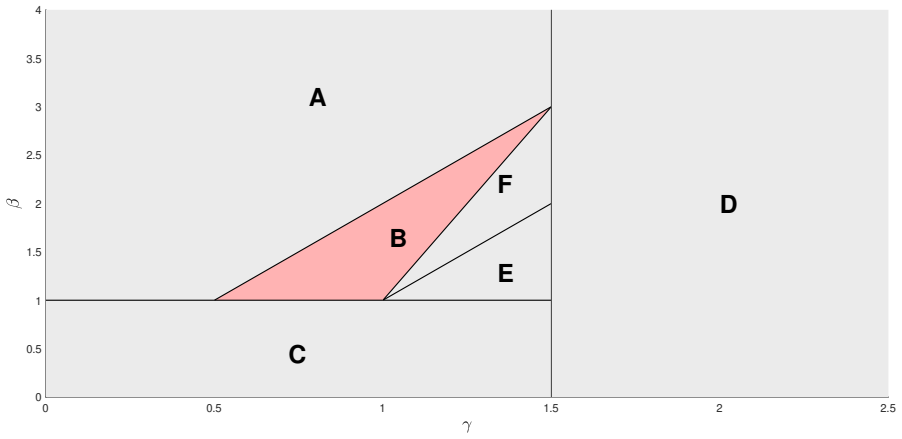
Mild solutions to the stochastic heat equation explode with positive probability for beta in (1,3) with gamma in (beta/2, (beta+3)/4) or beta greater than 1 with gamma up to beta/2.
A machine-rendered reading of the paper's core claim, the machinery that carries it, and where it could break.
Core claim
The central claim is that for the equation partial u over partial t equals partial squared u over partial x squared plus u to the beta plus sigma(u) dot W, with sigma(u) approximately u to the gamma near infinity, mild solutions explode with positive probability if beta is in (1,3) and gamma in (beta/2, (beta+3)/4), or if beta exceeds 1 and gamma is in (0, beta/2]. The result is obtained on the periodic domain with space-time white noise and provides a partial characterization of explosion behavior in the intermediate regime.
What carries the argument
Mild solutions defined up to the potential explosion time, whose existence allows direct analysis of the probability that the solution reaches infinity in finite time when the reaction and noise exponents satisfy the stated inequalities.
Load-bearing premise
The noise coefficient behaves like a power of the solution near infinity, together with the existence of mild solutions up to the potential explosion time on the periodic interval.
What would settle it
A numerical simulation of a spatial discretization of the equation for parameters inside the claimed range, such as beta equal to 2 and gamma equal to 1.1, showing that the solution remains finite for all time with probability one would falsify the positive probability of explosion.
Figures


read the original abstract
This paper studies the finite time explosion of the stochastic heat equation $\frac{\partial u}{\partial t}(t,x)=\frac{\partial^2}{\partial x^2} u(t,x)+(u(t,x))^{\beta}+\sigma(u(t,x))\dot{W}(t,x)$. We consider an interval $D=[-\pi,\pi]$ under periodic boundary condition where $\dot{W}(t,x)$ is a space-time white noise and $\sigma(u)\approx u^{\gamma}$ near $\infty$. Our results refine existing results by identifying behavior in a previously less understood regime, where we show that if $\beta\in(1,3),\gamma\in(\frac{\beta}{2},\frac{\beta+3}{4})$ or $\beta>1,\gamma\in(0,\frac{\beta}{2}]$ then mild solutions can explode with positive probability. This paper provides a partial characterization of the explosion behavior in an intermediate parameter regime, and contribute to the understanding of the interplay between the drift and diffusion terms.
Editorial analysis
A structured set of objections, weighed in public.
Referee Report
Summary. The paper proves that mild solutions to the stochastic heat equation ∂_t u = ∂_{xx} u + u^β + σ(u) Ẇ on the torus [-π,π] with space-time white noise explode in finite time with positive probability, provided β ∈ (1,3) and γ ∈ (β/2, (β+3)/4), or β > 1 and γ ∈ (0, β/2], where σ(u) ∼ u^γ near infinity. The result refines earlier explosion criteria by covering an intermediate regime in which the noise growth competes with the superlinear drift.
Significance. If the local existence and stopping-time arguments hold, the work supplies a more complete picture of the parameter region separating global existence from finite-time blow-up for SPDEs with locally Lipschitz coefficients. It clarifies the balance between the accretive reaction term and the multiplicative noise in the presence of space-time white noise.
major comments (1)
- [§3] §3 (local existence and stopping time): the mild solution is constructed on [0,τ) with τ = inf{t : ||u(t)||_∞ = ∞} via truncation and fixed-point in a ball of the mild integral equation. For γ > β/2 the stochastic convolution term must map into a space where u ↦ u^γ remains locally Lipschitz; given the Hölder regularity <1/4 of the space-time white noise, the a priori estimates used to close the contraction (or to obtain a positive lower bound on τ) are not shown to hold uniformly up to the boundary of the claimed regime γ = (β+3)/4. This is load-bearing for the positive-probability explosion statement.
minor comments (1)
- [Theorem 1.1] The notation for the explosion time τ and the precise function space in which the mild solution lives should be stated explicitly in the statement of the main theorem (currently only in the abstract).
Simulated Author's Rebuttal
We thank the referee for the careful reading and the detailed comment on the local existence construction. We address the concern point by point below and clarify that the estimates hold uniformly inside the open interval for γ.
read point-by-point responses
-
Referee: [§3] §3 (local existence and stopping time): the mild solution is constructed on [0,τ) with τ = inf{t : ||u(t)||_∞ = ∞} via truncation and fixed-point in a ball of the mild integral equation. For γ > β/2 the stochastic convolution term must map into a space where u ↦ u^γ remains locally Lipschitz; given the Hölder regularity <1/4 of the space-time white noise, the a priori estimates used to close the contraction (or to obtain a positive lower bound on τ) are not shown to hold uniformly up to the boundary of the claimed regime γ = (β+3)/4. This is load-bearing for the positive-probability explosion statement.
Authors: We appreciate the referee highlighting the need for explicit uniformity. In the proof of local existence (Theorem 3.1), we work in the Hölder space C^α([0,T]×𝕋) with α<1/4 chosen small enough depending on γ. The stochastic convolution is estimated via the heat kernel and BDG inequality, producing the key bound (3.12) whose contraction factor contains the term T^θ with θ=(β+3)/4−γ>0. Because the claimed regime is the open interval γ<(β+3)/4, θ remains strictly positive and we may choose T>0 small enough, uniformly in the truncation level N, to close the contraction mapping and guarantee inf τ_N>0 with positive probability. The boundary γ=(β+3)/4 is deliberately excluded precisely because θ=0 would prevent this uniform control. We will add a short remark after the proof of Theorem 3.1 making the dependence on the gap θ explicit. revision: partial
Circularity Check
No circularity: standard SPDE local existence and explosion probability proof
full rationale
The derivation proceeds via the standard mild formulation of the stochastic heat equation on the torus, local existence of mild solutions up to a stopping time via truncation or fixed-point arguments in appropriate Hölder spaces, and then separate probabilistic estimates showing that the explosion time is finite with positive probability under the given parameter ranges for β and γ. These steps rely on classical semigroup theory for the heat kernel, Burkholder-Davis-Gundy inequalities for the stochastic convolution, and comparison or test-function arguments for explosion; none reduce by construction to fitted parameters, self-definitions, or load-bearing self-citations. The paper refines prior results in the literature without invoking uniqueness theorems or ansatzes from the authors' own prior work as the sole justification.
Axiom & Free-Parameter Ledger
axioms (2)
- domain assumption Existence of mild solutions to the SPDE up to explosion time
- standard math Standard properties of space-time white noise on the periodic domain
Lean theorems connected to this paper
-
IndisputableMonolith/Cost/FunctionalEquation.leanwashburn_uniqueness_aczel unclearV(In(t)) = V(In(0)) + ∫ [ε u^β / I^{ε+1} - ε(ε+1) σ(u)^2 / (2 I^{ε+2})] dx ds + N(t∧τ_n^∞) with Hölder comparison ∫ u^β ≥ C (∫ σ(u)^2)^{β/(2γ)} when 2γ ≤ β
Reference graph
Works this paper leans on
-
[1]
Antonio Agresti and Mark Veraar. Reaction-diffusion equations with transport noise and critical superlinear diffusion: Local well-posedness and positivity. Journal of Differential Equations, 368:247–300, 2023
work page 2023
-
[2]
Blowup for the heat equation with a no ise term
Sower Richard Carl Mueller. Blowup for the heat equation with a no ise term. Probab. Th. Rel. Fields , 97:287–320, 1993
work page 1993
-
[3]
Superlinear stochastic heat equat ion on Rd
Chen, Le and Huang, Jingyu. Superlinear stochastic heat equat ion on Rd. Proc. Amer. Math. Soc. , 151(9):4063–4078, 2023
work page 2023
-
[4]
Stochastic Equations in Infinite Dimensions
Giuseppe Da Prato and Jerzy Zabczyk. Stochastic Equations in Infinite Dimensions . Encyclopedia of Mathematics and its Applications. Cambridge Univers ity Press, 2 edi- tion, 2014
work page 2014
-
[5]
Robert Dalang. Extending the Martingale Measure Stochastic In tegral With Applica- tions to Spatially Homogeneous S.P.D.E.’s. Electronic Journal of Probability , 4(none):1 – 29, 1999
work page 1999
-
[6]
de Bouard A. and Debussche A. On the effect of a noise on the solu tions of the focusing supercritical nonlinear schr¨ odinger equation. Probab. Th. Rel. Fields , 123:76–96, 2002
work page 2002
-
[7]
Time-space white noise eliminates global solutions in reaction-diffusion equations
Julian Fern´ andez Bonder and Pablo Groisman. Time-space white noise eliminates global solutions in reaction-diffusion equations. Phys. D , 238(2):209–215, 2009
work page 2009
-
[8]
In stantaneous everywhere-blowup of parabolic SPDEs
Mohammud Foondun, Davar Khoshnevisan, and Eulalia Nualart. In stantaneous everywhere-blowup of parabolic SPDEs. Probab. Theory Related Fields , 190(1-2):601– 624, 2024
work page 2024
- [9]
-
[10]
Long Time Existence for the Heat Equation with a Spatially Co rrelated Noise Term
Nora Franzova. Long Time Existence for the Heat Equation with a Spatially Co rrelated Noise Term. Phd thesis, University of Rochester, 1996
work page 1996
-
[11]
Blowup for the multiplicative s tochastic heat equation with superlinear drift, 2026
Mathew Joseph and Shubham Ovhal. Blowup for the multiplicative s tochastic heat equation with superlinear drift, 2026
work page 2026
-
[12]
On the growth of solutions of quasi-linear parab olic equations
Stanley Kaplan. On the growth of solutions of quasi-linear parab olic equations. Comm. Pure Appl. Math. , 16:305–330, 1963. 24
work page 1963
-
[13]
Rafail Khasminskii. Stochastic stability of differential equations , volume 66 of Stochastic Modelling and Applied Probability . Springer, Heidelberg, second edition, 2012. With contributions by G. N. Milstein and M. B. Nevelson
work page 2012
-
[14]
Comparison methods for a class of function value d stochastic partial differential equations
Kotelenez, P. Comparison methods for a class of function value d stochastic partial differential equations. Probab. Th. Rel. Fields , 93:1–19, 1992
work page 1992
-
[15]
Krylov, N. V. On lp-theory of stochastic partial differential equations in the whole sp ace. SIAM Journal on Mathematical Analysis , 27(2):313–340, 1996
work page 1996
-
[16]
Global existence and finit e time blow-up for a stochastic non-local reaction-diffusion equation
Liang, Fei and Zhao, Shuangshuang. Global existence and finit e time blow-up for a stochastic non-local reaction-diffusion equation. J. Geom. Phys. , 178:Paper No. 104577, 21, 2022
work page 2022
-
[17]
Global solutions to stochast ic wave equations with superlinear coefficients
Annie Millet and Marta Sanz-Sol´ e. Global solutions to stochast ic wave equations with superlinear coefficients. Stochastic Process. Appl., 139:175–211, 2021
work page 2021
-
[18]
Some non-existen ce results for a class of stochastic partial differential equations
Foondun Mohammud, Liu Wei, and Nane Erkan. Some non-existen ce results for a class of stochastic partial differential equations. J. Differential Equations , 266(5):2575–2596, 2019
work page 2019
-
[19]
The Osgood condition for stochastic partial differential equations
Mohammud Foondun and Eulalia Nualart. The Osgood condition for stochastic partial differential equations. Bernoulli, 27(1):295 – 311, 2021
work page 2021
-
[20]
Long time existence for the heat equation with a no ise term
Carl Mueller. Long time existence for the heat equation with a no ise term. Probab. Th. Rel. Fields , 90:505–517, 1991
work page 1991
-
[21]
On the support of solutions to the heat equation w ith noise
Carl Mueller. On the support of solutions to the heat equation w ith noise. Stochastics Stochastics Rep., 37(4):225–245, 1991
work page 1991
-
[22]
Long time existence for the wave equation with a no ise term
Carl Mueller. Long time existence for the wave equation with a no ise term. The Annals of Probability, 25(1):133 – 151, 1997
work page 1997
-
[23]
Long-time existence for signed solutions of the he at equation with a noise term
Carl Mueller. Long-time existence for signed solutions of the he at equation with a noise term. Probab Theory Relat Fields , 110:51–68, 1998
work page 1998
-
[24]
The critical parameter for the heat equation with a noise term to blow up in finite time
Carl Mueller. The critical parameter for the heat equation with a noise term to blow up in finite time. The Annals of Probability , 28(4):1735 – 1746, 2000
work page 2000
-
[25]
W. F. Osgood. Beweis der Existenz einer L¨ osung der Differentia lgleichung dy dx =f (x,y ) ohne Hinzunahme der Cauchy-Lipschitz’schen Bedingung. Monatsh. Math. Phys. , 9(1):331–345, 1898. 25
-
[26]
Existence and blow-up of solutions to the fractio nal stochastic heat equations
Bezdek Pavel. Existence and blow-up of solutions to the fractio nal stochastic heat equations. Stoch. Partial Differ. Equ. Anal. Comput. , 6(1):73–108, 2018
work page 2018
-
[27]
Dalang and Davar Khoshnevisan and Tusheng Zhang
Robert C. Dalang and Davar Khoshnevisan and Tusheng Zhang. Global solutions to stochastic reaction–diffusion equations with super-linear drift and multiplicative noise. The Annals of Probability , 47(1):519 – 559, 2019
work page 2019
-
[28]
Michael Salins. Global solutions to the stochastic reaction-diffu sion equation with su- perlinear accretive reaction term and superlinear multiplicative noise term on a bounded spatial domain. Trans. Amer. Math. Soc. , 375:8083–8099, 2023
work page 2023
-
[29]
Michael Salins. Global solutions to the stochastic heat equation with superlinear ac- cretive reaction term and polynomially growing multiplicative white noise coefficient. Stoch PDE: Anal Comp , 2025. https://doi.org/10.1007/s40072-025-00351-6
-
[30]
Michael Salins. Solutions to the stochastic heat equation with po lynomially growing multiplicative noise do not explode in the critical regime. The Annals of Probability , 53(1):223 – 238, 2025
work page 2025
-
[31]
Michael Salins and Yuyang Zhang. Nonexplosion for a large class o f superlinear stochas- tic parabolic equations, in arbitrary spatial dimension. Stoch PDE: Anal Comp , 2025. https://doi.org/10.1007/s40072-025-00400-0. 26
discussion (0)
Sign in with ORCID, Apple, or X to comment. Anyone can read and Pith papers without signing in.