Recognition: 2 theorem links
· Lean TheoremMeVPrtl: An Event Generator for Dark Sector Particles in the Short-Baseline Neutrino Program
Pith reviewed 2026-05-13 01:44 UTC · model grok-4.3
The pith
MeVPrtl supplies a modular event generator that connects dark sector models to the SBN neutrino detectors at Fermilab.
A machine-rendered reading of the paper's core claim, the machinery that carries it, and where it could break.
Core claim
MeVPrtl provides an interface to implement the overlapping phenomenology of BSM models in which new particles are produced in the BNB and NuMI beams, travel to the SBN detectors, and decay into Standard Model particles. The interface links meson flux inputs directly to object outputs used by the LArSoft-based detector simulation. Concrete implementations exist for the Higgs portal, heavy neutral lepton, and heavy QCD axion models, each accompanied by validation checks that confirm the generated events reproduce the expected production and decay kinematics.
What carries the argument
The modular interface that accepts meson flux inputs from the beams and delivers compatible object outputs for LArSoft simulation, enabling specific BSM models to be slotted in without rewriting the detector chain.
If this is right
- SBN analyses can now simulate signals from these three BSM models inside the same detector simulation framework already used for neutrino interactions.
- New models sharing the same production or decay topology can be added by extending the interface without altering the downstream LArSoft chain.
- Consistent event samples become available for direct comparison of expected rates across the Higgs portal, heavy neutral lepton, and heavy QCD axion scenarios.
- Validation results establish that the generator reproduces the kinematics needed for detector response studies in ICARUS and SBND.
Where Pith is reading between the lines
- The same interface structure could be reused by other neutrino experiments that employ similar beam and liquid-argon detector setups.
- Future additions of models with more complex decay chains would test how well the current output format handles additional final-state particles.
- If data from SBN show excesses, the generator supplies a ready-made way to translate those excesses into limits on the shared parameter space of the three models.
Load-bearing premise
The chosen modular interface accurately captures the relevant production and decay kinematics for the implemented models without significant omissions or model-specific corrections beyond what is described.
What would settle it
A direct comparison in which independent analytic calculations of particle production rates or decay angles in the BNB or NuMI beams produce distributions that differ from those output by MeVPrtl for the same input fluxes.
Figures




read the original abstract
MeVPrtl is a modular event generator of beyond the Standard Model (BSM) physics particles developed for use in the Short-Baseline Neutrino (SBN) Program. A large class of BSM physics models predict that new particles could be produced in the intense Booster Neutrino Beam (BNB) and Neutrinos at the Main Injector (NuMI) beams at Fermilab, travel to the SBN Program detectors, and decay into Standard Model (SM) particles. These new physics models are motivated by dark matter, the neutrino mass scale, and a solution to the strong CP problem. MeVPrtl provides an interface to implement the overlapping phenomenology of these models, and to connect them with meson flux inputs and object outputs used by the SBN Program's LArSoft-based detector simulation. Implementations for the Higgs portal, heavy neutral lepton, and heavy QCD axion models exist within MeVPrtl. In this paper these implementations and their validation, as well as details of the MeVPrtl interface, are specified.
Editorial analysis
A structured set of objections, weighed in public.
Referee Report
Summary. The manuscript describes MeVPrtl, a modular event generator developed for the Short-Baseline Neutrino Program to simulate beyond-Standard-Model particles produced in the BNB and NuMI beams. It provides an interface connecting meson flux inputs to LArSoft-compatible outputs and includes specific implementations for the Higgs-portal, heavy neutral lepton, and heavy QCD axion models, along with details of those implementations and their validations.
Significance. If the modular interface and validations accurately reproduce the relevant production and decay kinematics, this tool would enable consistent, reproducible studies of dark-sector phenomenology across SBN detectors. The modular design for overlapping model phenomenology and direct connection to existing simulation frameworks is a practical strength for the neutrino physics community.
major comments (2)
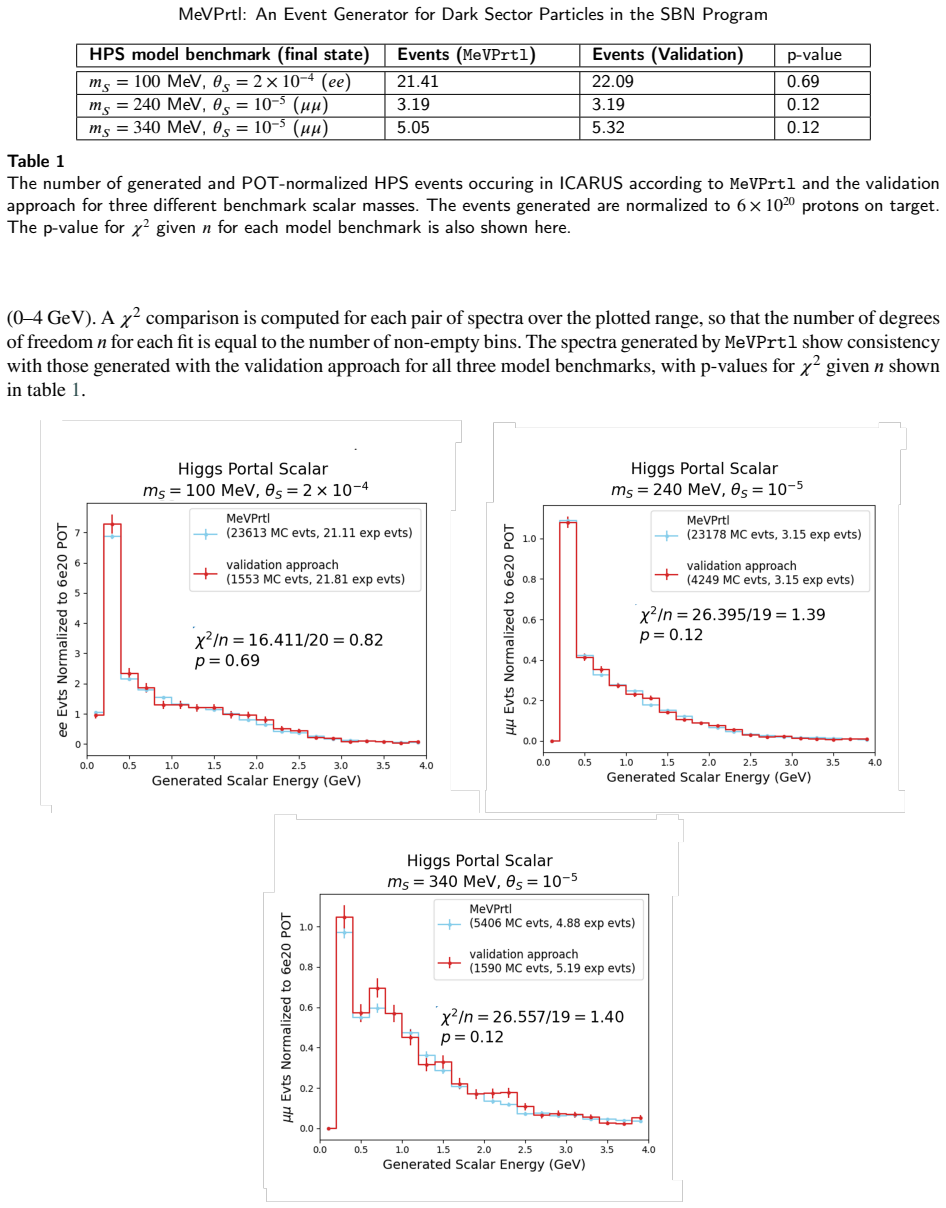
- [Abstract and validation sections] The abstract states that 'implementations and their validation' are specified, yet no quantitative validation details (e.g., comparison plots, error budgets, or metrics for 2-body/3-body kinematics, angular distributions, or beam boosts) are described. This leaves the central claim of a working, complete interface unverified for the three models.
- [Implementation and interface description] The modular structure is presented as capturing the overlapping phenomenology, but it is unclear whether model-specific corrections (form factors, interference, or off-shell effects) known to appear in the literature for MeV-scale masses and BNB/NuMI energies have been included or explicitly tested.
minor comments (1)
- [Abstract] The abstract and introduction could more explicitly list the validation methods (e.g., internal consistency checks versus external benchmarks) to allow readers to assess completeness without reading the full implementation sections.
Simulated Author's Rebuttal
We thank the referee for their careful and constructive review of our manuscript describing MeVPrtl. We address each major comment point by point below and have revised the manuscript to strengthen the presentation of validations and implementation details.
read point-by-point responses
-
Referee: [Abstract and validation sections] The abstract states that 'implementations and their validation' are specified, yet no quantitative validation details (e.g., comparison plots, error budgets, or metrics for 2-body/3-body kinematics, angular distributions, or beam boosts) are described. This leaves the central claim of a working, complete interface unverified for the three models.
Authors: We acknowledge that the manuscript text describes the validation approach for the Higgs portal, heavy neutral lepton, and heavy QCD axion implementations through comparisons to analytic expectations and reference calculations, but does not present quantitative figures, error budgets, or specific metrics for kinematics, angular distributions, or boosted frames. To address this, we have added a new subsection with comparison plots and tabulated metrics demonstrating agreement for 2-body and 3-body decays, angular distributions, and beam-boost effects across the three models. These additions directly support the abstract claim. revision: yes
-
Referee: [Implementation and interface description] The modular structure is presented as capturing the overlapping phenomenology, but it is unclear whether model-specific corrections (form factors, interference, or off-shell effects) known to appear in the literature for MeV-scale masses and BNB/NuMI energies have been included or explicitly tested.
Authors: The modular interface is intentionally designed to permit inclusion of such corrections on a model-by-model basis. In the current implementations, we employ the leading-order matrix elements and on-shell approximations standard in the cited literature for MeV-scale production and decay; form-factor corrections for meson decays, interference terms, and off-shell contributions are not yet incorporated beyond the basic models. We have revised the implementation section to explicitly list which corrections are included, which are omitted, and the rationale, with references to the relevant papers on MeV-scale effects at BNB/NuMI energies. revision: partial
Circularity Check
Software interface description with no derivations or self-referential results
full rationale
The paper presents MeVPrtl as a modular event generator providing an interface between meson flux inputs and LArSoft detector outputs for three BSM models (Higgs portal, heavy neutral lepton, heavy QCD axion). No equations, fitted parameters, or predictions are derived; the work consists of software design, implementation details, and validation descriptions. The central claim reduces to a statement of interface functionality rather than any quantity obtained by construction from its own inputs. No self-citations are load-bearing for any result, and the text contains no ansatzes, uniqueness theorems, or renamings of known patterns that would trigger the enumerated circularity patterns.
Axiom & Free-Parameter Ledger
axioms (1)
- domain assumption Meson production fluxes in the BNB and NuMI beams are taken as external inputs from prior measurements or simulations.
Lean theorems connected to this paper
-
IndisputableMonolith/Foundation/RealityFromDistinction.leanreality_from_one_distinction unclear?
unclearRelation between the paper passage and the cited Recognition theorem.
MeVPrtl provides an interface to implement the overlapping phenomenology of these models, and to connect them with meson flux inputs and object outputs used by the SBN Program's LArSoft-based detector simulation.
-
IndisputableMonolith/Cost/FunctionalEquation.leanwashburn_uniqueness_aczel unclear?
unclearRelation between the paper passage and the cited Recognition theorem.
The total weight ... w_total = w_flux × w_ray × w_decay × POT_expected / POT_generated
What do these tags mean?
- matches
- The paper's claim is directly supported by a theorem in the formal canon.
- supports
- The theorem supports part of the paper's argument, but the paper may add assumptions or extra steps.
- extends
- The paper goes beyond the formal theorem; the theorem is a base layer rather than the whole result.
- uses
- The paper appears to rely on the theorem as machinery.
- contradicts
- The paper's claim conflicts with a theorem or certificate in the canon.
- unclear
- Pith found a possible connection, but the passage is too broad, indirect, or ambiguous to say the theorem truly supports the claim.
Reference graph
Works this paper leans on
-
[1]
Batell, et al., Dark Sector Studies with Neutrino Beams, in: Snowmass 2021, 2022.arXiv:2207.06898
B. Batell, et al., Dark Sector Studies with Neutrino Beams, in: Snowmass 2021, 2022.arXiv:2207.06898
-
[2]
arXiv:hep-ph/0401195, doi:10.1103/PhysRevLett.93.201803
C.Bird,P.Jackson,R.V.Kowalewski,M.Pospelov,Searchfordarkmatterinb →stransitionswithmissingenergy,Phys.Rev.Lett.93(2004) 201803. arXiv:hep-ph/0401195, doi:10.1103/PhysRevLett.93.201803
-
[3]
F. Bezrukov, D. Gorbunov, Light inflaton Hunter’s Guide, JHEP 05 (2010) 010.arXiv:0912.0390, doi:10.1007/JHEP05(2010)010
-
[4]
arXiv:2011.05995, doi:10.1103/PhysRevD.103.095002
K.J.Kelly,S.Kumar,Z.Liu,HeavyaxionopportunitiesattheDUNEneardetector,Phys.Rev.D103(9)(2021)095002. arXiv:2011.05995, doi:10.1103/PhysRevD.103.095002
-
[5]
R. Acciarri, et al., A Proposal for a Three Detector Short-Baseline Neutrino Oscillation Program in the Fermilab Booster Neutrino Beam (3 2015). arXiv:1503.01520
-
[6]
E. Bertuzzo, A. L. Foguel, G. M. Salla, R. Z. Funchal, New Limits on Leptophilic Axionlike Particles and Majorons from ArgoNeuT, Phys. Rev. Lett. 130 (17) (2023) 171801.arXiv:2202.12317, doi:10.1103/PhysRevLett.130.171801
-
[7]
V. De Romeri, K. J. Kelly, P. A. N. Machado, DUNE-PRISM Sensitivity to Light Dark Matter, Phys. Rev. D 100 (9) (2019) 095010. arXiv:1903.10505, doi:10.1103/PhysRevD.100.095010
-
[8]
Amerio, et al., Design, construction and tests of the ICARUS T600 detector, Nucl
S. Amerio, et al., Design, construction and tests of the ICARUS T600 detector, Nucl. Instrum. Meth. A 527 (2004) 329–410.doi: 10.1016/j.nima.2004.02.044
-
[9]
Abratenko, et al., ICARUS at the Fermilab Short-Baseline Neutrino program: initial operation, Eur
P. Abratenko, et al., ICARUS at the Fermilab Short-Baseline Neutrino program: initial operation, Eur. Phys. J. C 83 (6) (2023) 467. arXiv:2301.08634, doi:10.1140/epjc/s10052-023-11610-y
-
[10]
E. L. Snider, G. Petrillo, LArSoft: Toolkit for Simulation, Reconstruction and Analysis of Liquid Argon TPC Neutrino Detectors, J. Phys. Conf. Ser. 898 (4) (2017) 042057.doi:10.1088/1742-6596/898/4/042057. URL https://larsoft.org/
-
[11]
R. Brun, F. Rademakers, ROOT — An object oriented data analysis framework, Nucl. Instrum. Meth. A 389 (1-2) (1997) 81–86.doi: 10.1016/s0168-9002(97)00048-x
-
[12]
C. Green, J. Kowalkowski, M. Paterno, M. Fischler, L. Garren, Q. Lu, The Art Framework, J. Phys. Conf. Ser. 396 (2012) 022020. doi:10.1088/1742-6596/396/2/022020
-
[13]
Asai, Geant4-a simulation toolkit, Trans
M. Asai, Geant4-a simulation toolkit, Trans. Amer. Nucl. Soc. 95 (2006) 757
work page 2006
-
[14]
Allison, et al., Geant4 developments and applications, IEEE Trans
J. Allison, et al., Geant4 developments and applications, IEEE Trans. Nucl. Sci. 53 (2006) 270.doi:10.1109/TNS.2006.869826
-
[15]
M. Asai, A. Dotti, M. Verderi, D. H. Wright, Recent developments in Geant4, Annals Nucl. Energy 82 (2015) 19–28.doi:10.1016/j. anucene.2014.08.021
work page doi:10.1016/j 2015
-
[16]
URL https://github.com/SBNSoftware/sbncode/tree/develop/sbncode/EventGenerator/MeVPrtl
MeVPrtl GitHub Repository. URL https://github.com/SBNSoftware/sbncode/tree/develop/sbncode/EventGenerator/MeVPrtl
- [17]
- [18]
-
[19]
P. Adamson, et al., The NuMI Neutrino Beam, Nucl. Instrum. Meth. A 806 (2016) 279–306.arXiv:1507.06690, doi:10.1016/j.nima. 2015.08.063. ICARUS and SBND Collaborations for the SBN Program:Preprint submitted to Elsevier Page 24 of 30 MeVPrtl: An Event Generator for Dark Sector Particles in the SBN Program
-
[20]
Stancu, et al., Technical Design Report for the 8 GeV Beam (5 2001).doi:10.2172/1212167
I. Stancu, et al., Technical Design Report for the 8 GeV Beam (5 2001).doi:10.2172/1212167
- [21]
-
[22]
A. A. Aguilar-Arevalo, et al., The Neutrino Flux Prediction at MiniBooNE, Phys. Rev. D 79 (2009) 072002.arXiv:0806.1449, doi: 10.1103/PhysRevD.79.072002
-
[23]
Booster Neutrino Flux Prediction at MicroBooNE (7 2018).doi:10.2172/1573216
-
[24]
J.L.Paton,TowardsAnUpdatedSimulationoftheBoosterNeutrinoBeam,in:25thInternationalWorkshoponNeutrinosfromAccelerators,
-
[25]
Hatcher, Proposal for a unified “flux” n-tuple format, Tech
R. Hatcher, Proposal for a unified “flux” n-tuple format, Tech. Rep. MINOS-doc-9070-v4 (2012)
work page 2012
-
[26]
A comprehensive guide to the physics and usage of PYTHIA 8.3
C.Bierlich,etal.,AcomprehensiveguidetothephysicsandusageofPYTHIA8.3,SciPostPhys.Codeb.2022(2022)8. arXiv:2203.11601, doi:10.21468/SciPostPhysCodeb.8
work page internal anchor Pith review Pith/arXiv arXiv doi:10.21468/scipostphyscodeb.8 2022
-
[27]
R. T. Co, S. Kumar, Z. Liu, Enhancing searches for heavy QCD axions via dimuon final states, JHEP 02 (2023) 111.arXiv:2210.02462, doi:10.1007/JHEP02(2023)111
-
[28]
R. H. Milburn, Neutrino Beam Simulation using PAW with Weighted Monte Carlo, Fermilab Internal Documents (1995)
work page 1995
-
[29]
M. Pospelov, A. Ritz, M. B. Voloshin, Secluded WIMP Dark Matter, Phys. Lett. B 662 (2008) 53–61.arXiv:0711.4866, doi:10.1016/ j.physletb.2008.02.052
work page Pith review arXiv 2008
-
[30]
C.Andreopoulos,C.Barry,S.Dytman,H.Gallagher,T.Golan,R.Hatcher,G.Perdue,J.Yarba,TheGENIENeutrinoMonteCarloGenerator: Physics and User Manual (10 2015).arXiv:1510.05494
work page Pith review arXiv 2015
-
[31]
B. Batell, J. Berger, A. Ismail, Probing the higgs portal at the fermilab short-baseline neutrino experiments, Phys. Rev. D 100 (2019) 115039. doi:10.1103/PhysRevD.100.115039. URL https://link.aps.org/doi/10.1103/PhysRevD.100.115039
-
[33]
URL https://doi.org/10.1016%2Fj.nima.2015.08.063
P.Adamson,etal.,TheNuMIneutrinobeam,NuclearInstrumentsandMethodsinPhysicsResearchSectionA:Accelerators,Spectrometers, Detectors and Associated Equipment 806 (2016) 279–306.doi:10.1016/j.nima.2015.08.063. URL https://doi.org/10.1016%2Fj.nima.2015.08.063
-
[34]
S. Glashow, The future of elementary particle physics, in: Quarks and Leptons: Cargèse 1979, Springer, 1980, pp. 687–713
work page 1979
-
[35]
Langacker, Grand unified theories and proton decay, Physics Reports 72 (4) (1981) 185–385
P. Langacker, Grand unified theories and proton decay, Physics Reports 72 (4) (1981) 185–385
work page 1981
-
[36]
M.Gell-Mann,P.Ramond,R.Slansky,Complexspinorsandunifiedtheories,in:MurrayGell-Mann:SelectedPapers,WorldScientific,2010, pp. 266–272
work page 2010
-
[37]
T. Yanagida, Proc. workshop on unified theory and the baryon number in the universe, KEK Report No. 79-18 95 (1979)
work page 1979
-
[38]
R. N. Mohapatra, G. Senjanović, Neutrino mass and spontaneous parity nonconservation, Physical Review Letters 44 (14) (1980) 912
work page 1980
-
[39]
P. Abratenko, et al., Search for Heavy Neutral Leptons in Electron-Positron and Neutral-Pion Final States with the MicroBooNE Detector, Phys. Rev. Lett. 132 (4) (2024) 041801.arXiv:2310.07660, doi:10.1103/PhysRevLett.132.041801
-
[40]
P. Abratenko, et al., Search for long-lived heavy neutral leptons and Higgs portal scalars decaying in the MicroBooNE detector, Phys. Rev. D 106 (9) (2022) 092006.arXiv:2207.03840, doi:10.1103/PhysRevD.106.092006
-
[41]
P. Ballett, S. Pascoli, M. Ross-Lonergan, Mev-scale sterile neutrino decays at the fermilab short-baseline neutrino program, Journal of High Energy Physics 2017 (4) (2017) 1–38
work page 2017
-
[42]
A. Chatterjee, J. Hernandez-Garcia, A. De Roeck, Heavy Neutral Lepton Searches at an ICARUS-like detector using NuMI Beam, The European Physical Journal C 85 (2025) 195.doi:10.1140/epjc/s10052-025-13846-2
-
[43]
J. M. Berryman, A. de Gouvea, P. J. Fox, B. J. Kayser, K. J. Kelly, J. L. Raaf, Searches for decays of new particles in the dune multi-purpose near detector, Journal of High Energy Physics 2020 (2) (2020) 1–68
work page 2020
-
[44]
arXiv:2109.10358, doi:10.1103/PhysRevD.105.015019
A.deGouvêa,P.J.Fox,B.J.Kayser,K.J.Kelly,Characterizingheavyneutralfermionsviatheirdecays,Phys.Rev.D105(1)(2022)015019. arXiv:2109.10358, doi:10.1103/PhysRevD.105.015019
-
[45]
A. Atre, T. Han, S. Pascoli, B. Zhang, The search for heavy majorana neutrinos, Journal of High Energy Physics 2009 (05) (2009) 030
work page 2009
-
[46]
P. Ballett, T. Boschi, S. Pascoli, Heavy Neutral Leptons from low-scale seesaws at the DUNE Near Detector, JHEP 03 (2020) 111.arXiv: 1905.00284, doi:10.1007/JHEP03(2020)111
-
[47]
A. de Gouvêa, P. J. Fox, B. J. Kayser, K. J. Kelly, Three-body decays of heavy Dirac and Majorana fermions, Phys. Rev. D 104 (1) (2021) 015038. arXiv:2104.05719, doi:10.1103/PhysRevD.104.015038
-
[48]
Dimopoulos, A Solution of the Strong CP Problem in Models With Scalars, Phys
S. Dimopoulos, A Solution of the Strong CP Problem in Models With Scalars, Phys. Lett. B 84 (1979) 435–439.doi:10.1016/ 0370-2693(79)91233-4
work page 1979
-
[49]
S. H. H. Tye, A Superstrong Force With a Heavy Axion, Phys. Rev. Lett. 47 (1981) 1035.doi:10.1103/PhysRevLett.47.1035
-
[50]
B. Holdom, M. E. Peskin, Raising the Axion Mass, Nucl. Phys. B 208 (1982) 397–412.doi:10.1016/0550-3213(82)90228-0
-
[51]
V. A. Rubakov, Grand unification and heavy axion, JETP Lett. 65 (1997) 621–624.arXiv:hep-ph/9703409, doi:10.1134/1.567390
-
[52]
Z. Berezhiani, L. Gianfagna, M. Giannotti, Strong CP problem and mirror world: The Weinberg-Wilczek axion revisited, Phys. Lett. B 500 (2001) 286–296.arXiv:hep-ph/0009290, doi:10.1016/S0370-2693(00)01392-7
-
[53]
T. Gherghetta, N. Nagata, M. Shifman, A Visible QCD Axion from an Enlarged Color Group, Phys. Rev. D 93 (11) (2016) 115010. arXiv:1604.01127, doi:10.1103/PhysRevD.93.115010
-
[54]
S. Dimopoulos, A. Hook, J. Huang, G. Marques-Tavares, A collider observable QCD axion, JHEP 11 (2016) 052.arXiv:1606.03097, doi:10.1007/JHEP11(2016)052
-
[55]
H. Fukuda, M. Ibe, T. T. Yanagida, Dark Matter Candidates in a Visible Heavy QCD Axion Model, Phys. Rev. D 95 (9) (2017) 095017. arXiv:1702.00227, doi:10.1103/PhysRevD.95.095017
-
[56]
P. Agrawal, K. Howe, Factoring the Strong CP Problem, JHEP 12 (2018) 029.arXiv:1710.04213, doi:10.1007/JHEP12(2018)029
-
[57]
B. Lillard, T. M. P. Tait, A High Quality Composite Axion, JHEP 11 (2018) 199.arXiv:1811.03089, doi:10.1007/JHEP11(2018)199. ICARUS and SBND Collaborations for the SBN Program:Preprint submitted to Elsevier Page 25 of 30 MeVPrtl: An Event Generator for Dark Sector Particles in the SBN Program
-
[58]
M. K. Gaillard, M. B. Gavela, R. Houtz, P. Quilez, R. Del Rey, Color unified dynamical axion, Eur. Phys. J. C 78 (11) (2018) 972. arXiv:1805.06465, doi:10.1140/epjc/s10052-018-6396-6
-
[59]
A. Hook, S. Kumar, Z. Liu, R. Sundrum, High Quality QCD Axion and the LHC, Phys. Rev. Lett. 124 (22) (2020) 221801.arXiv: 1911.12364, doi:10.1103/PhysRevLett.124.221801
-
[60]
arXiv:2001.05610, doi:10.1007/JHEP03(2020)063
T.Gherghetta,V.V.Khoze,A.Pomarol,Y.Shirman,TheAxionMassfrom5DSmallInstantons,JHEP03(2020)063. arXiv:2001.05610, doi:10.1007/JHEP03(2020)063
-
[61]
T. Gherghetta, M. D. Nguyen, A Composite Higgs with a Heavy Composite Axion, JHEP 12 (2020) 094.arXiv:2007.10875, doi: 10.1007/JHEP12(2020)094
- [62]
-
[63]
D. I. Dunsky, L. J. Hall, K. Harigaya, A heavy QCD axion and the mirror world, JHEP 02 (2024) 212.arXiv:2302.04274, doi: 10.1007/JHEP02(2024)212
-
[64]
A.A.Belavin,A.M.Polyakov,A.S.Schwartz,Y.S.Tyupkin,PseudoparticleSolutionsoftheYang-MillsEquations,Phys.Lett.B59(1975) 85–87.doi:10.1016/0370-2693(75)90163-X
-
[65]
’t Hooft, Symmetry Breaking Through Bell-Jackiw Anomalies, Phys
G. ’t Hooft, Symmetry Breaking Through Bell-Jackiw Anomalies, Phys. Rev. Lett. 37 (1976) 8–11.doi:10.1103/PhysRevLett.37.8
- [66]
-
[67]
C. G. Callan, Jr., R. F. Dashen, D. J. Gross, The Structure of the Gauge Theory Vacuum, Phys. Lett. B 63 (1976) 334–340.doi: 10.1016/0370-2693(76)90277-X
-
[68]
R. J. Crewther, P. Di Vecchia, G. Veneziano, E. Witten, Chiral Estimate of the Electric Dipole Moment of the Neutron in Quantum Chromodynamics, Phys. Lett. B 88 (1979) 123, [Erratum: Phys.Lett.B 91, 487 (1980)].doi:10.1016/0370-2693(79)90128-X
-
[69]
M. Kamionkowski, J. March-Russell, Planck scale physics and the Peccei-Quinn mechanism, Phys. Lett. B 282 (1992) 137–141.arXiv: hep-th/9202003, doi:10.1016/0370-2693(92)90492-M
-
[70]
S. M. Barr, D. Seckel, Planck scale corrections to axion models, Phys. Rev. D 46 (1992) 539–549.doi:10.1103/PhysRevD.46.539
-
[71]
doi:10.1016/0370-2693(92) 90019-Z
S.Ghigna,M.Lusignoli,M.Roncadelli,Instabilityoftheinvisibleaxion,Phys.Lett.B283(1992)278–281. doi:10.1016/0370-2693(92) 90019-Z
-
[72]
R. Holman, S. D. H. Hsu, T. W. Kephart, E. W. Kolb, R. Watkins, L. M. Widrow, Solutions to the strong CP problem in a world with gravity, Phys. Lett. B 282 (1992) 132–136.arXiv:hep-ph/9203206, doi:10.1016/0370-2693(92)90491-L
-
[73]
R. Essig, R. Harnik, J. Kaplan, N. Toro, Discovering New Light States at Neutrino Experiments, Phys. Rev. D 82 (2010) 113008.arXiv: 1008.0636, doi:10.1103/PhysRevD.82.113008
-
[74]
M. J. Dolan, T. Ferber, C. Hearty, F. Kahlhoefer, K. Schmidt-Hoberg, Revised constraints and Belle II sensitivity for visible and invisible axion-like particles, JHEP 12 (2017) 094, [Erratum: JHEP 03, 190 (2021)].arXiv:1709.00009, doi:10.1007/JHEP12(2017)094
-
[75]
L. Harland-Lang, J. Jaeckel, M. Spannowsky, A fresh look at ALP searches in fixed target experiments, Phys. Lett. B 793 (2019) 281–289. arXiv:1902.04878, doi:10.1016/j.physletb.2019.04.045
-
[76]
B. Döbrich, J. Jaeckel, T. Spadaro, Light in the beam dump - ALP production from decay photons in proton beam-dumps, JHEP 05 (2019) 213, [Erratum: JHEP 10, 046 (2020)].arXiv:1904.02091, doi:10.1007/JHEP05(2019)213
-
[77]
J. B. Dent, B. Dutta, D. Kim, S. Liao, R. Mahapatra, K. Sinha, A. Thompson, New Directions for Axion Searches via Scattering at Reactor Neutrino Experiments, Phys. Rev. Lett. 124 (21) (2020) 211804.arXiv:1912.05733, doi:10.1103/PhysRevLett.124.211804
-
[78]
V. Brdar, B. Dutta, W. Jang, D. Kim, I. M. Shoemaker, Z. Tabrizi, A. Thompson, J. Yu, Axionlike Particles at Future Neutrino Experiments: Closing the Cosmological Triangle, Phys. Rev. Lett. 126 (20) (2021) 201801.arXiv:2011.07054, doi:10.1103/PhysRevLett.126. 201801
-
[79]
R. Acciarri, et al., First Constraints on Heavy QCD Axions with a Liquid Argon Time Projection Chamber using the ArgoNeuT Experiment (7 2022). arXiv:2207.08448
- [81]
-
[82]
J. Berger, G. Putnam, Sensitivity to kaon decays to alps at fixed target experiments, Physical Review D 110 (5) (Sep. 2024).doi: 10.1103/physrevd.110.055035. URL http://dx.doi.org/10.1103/PhysRevD.110.055035
discussion (0)
Sign in with ORCID, Apple, or X to comment. Anyone can read and Pith papers without signing in.