Recognition: 2 theorem links
· Lean TheoremCharacterizing quantum correlations and quantum teleportation in gg to tbar{t} and qbar{q} to tbar{t} processes under noisy channels
Pith reviewed 2026-05-13 01:24 UTC · model grok-4.3
The pith
Quantum correlations in top-antitop pairs allow teleportation to remain above the classical threshold of 2/3 even under decoherence.
A machine-rendered reading of the paper's core claim, the machinery that carries it, and where it could break.
Core claim
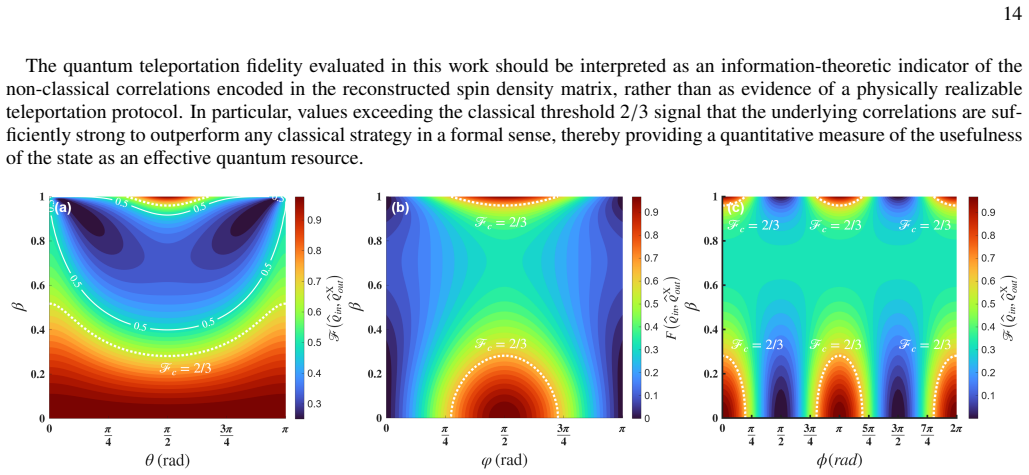
In both gg to ttbar and q qbar to ttbar processes, the spin correlations depend on kinematic variables and converge in the ultra-relativistic limit. Application of amplitude damping and phase damping channels causes steady loss of correlation strength as the parameter p grows, while the phase flip channel shows symmetric degradation around p equals one half. Quantum teleportation fidelity calculated from the noisy states nevertheless exceeds the classical limit of two thirds for all values of the decoherence parameter.
What carries the argument
The spin density matrix of the produced ttbar pair, evolved under the amplitude damping, phase damping, and phase flip channels to compute Bell nonlocality, steering, concurrence, geometric discord, and teleportation fidelity.
If this is right
- Correlations degrade monotonically with increasing decoherence strength in amplitude and phase damping.
- Phase flip noise produces symmetric loss of correlations around the midpoint parameter value.
- Teleportation fidelity stays strictly above two thirds regardless of noise level.
- Kinematic dependence shows approach to gluon fusion dominance at high beta.
Where Pith is reading between the lines
- This framework could be extended to test whether real collider data matches the predicted noise resilience.
- Similar analyses might apply to other short-lived particles with measurable spin correlations.
- Persistent quantum resources suggest collider events as testbeds for noisy quantum information protocols.
Load-bearing premise
The three effective decoherence channels capture the dominant noise affecting the top quark spin states prior to decay.
What would settle it
A direct measurement in collider experiments showing teleportation fidelity dropping below two thirds in ttbar events would disprove the persistence claim.
Figures





read the original abstract
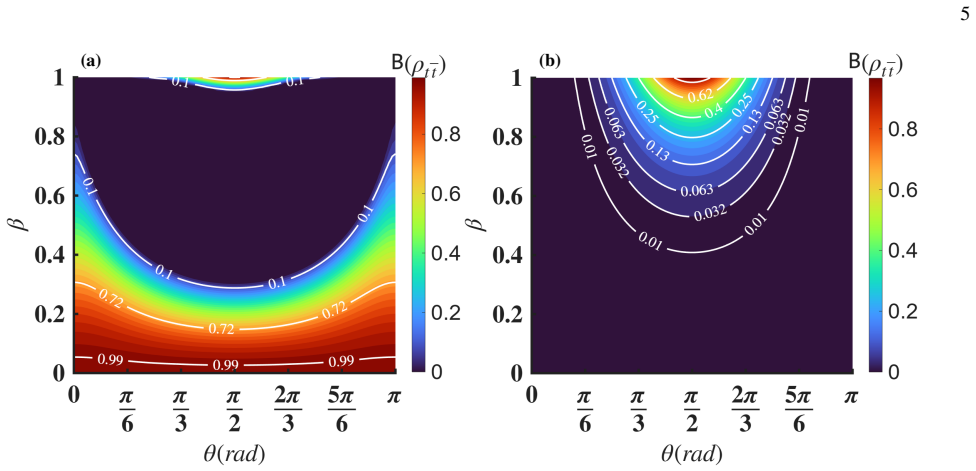
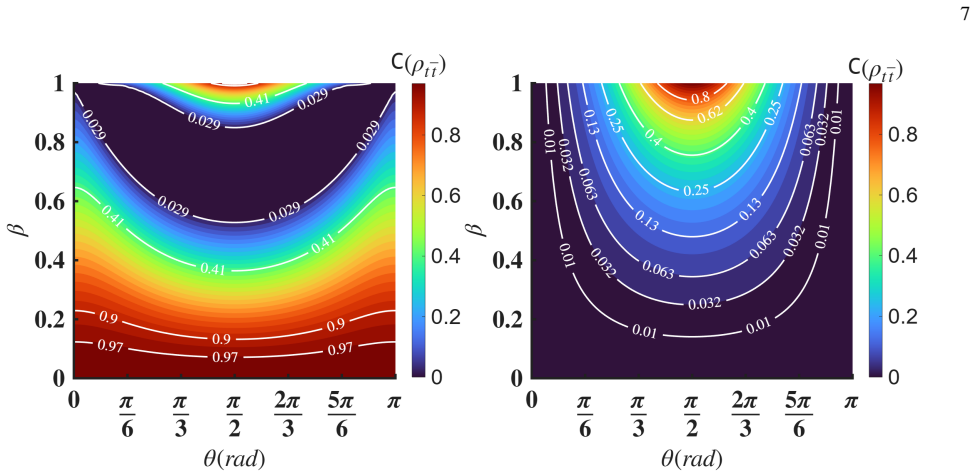
The measurement of top-quark spin correlations provides a key tool for probing its interactions with high precision. Owing to its extremely short lifetime ($\tau \sim 10^{-25}$ s), the top quark preserves its spin polarization information, making the $t\bar{t}$ system an ideal framework for investigating quantum correlations in high-energy physics. In this work, we analyze quantum correlations in $t\bar{t}$ pairs produced in QCD using several quantum information-theoretic measures, including Bell nonlocality, quantum steering, concurrence, and geometric quantum discord. Their dependence on kinematic variables is examined in both the $gg \to t\bar{t}$ and $q\bar{q} \to t\bar{t}$ channels, with convergence toward the $gg \to t\bar{t}$ dominated regime in the ultra-relativistic limit ($\beta = 1$). We also investigate the effect of three effective decoherence channels (AD, PD, and PF). The AD and PD channels lead to a monotonic degradation of correlations as the decoherence parameter $p$ increases, while the PF channel exhibits a symmetric behavior around $p=1/2$. The impact of these channels on quantum teleportation is analyzed, showing that it remains above the classical threshold of $2/3$ even in the presence of noise. These results indicate that certain quantum resources can persist despite decoherence, opening new perspectives at the interface of quantum information and particle physics.
Editorial analysis
A structured set of objections, weighed in public.
Referee Report
Summary. The paper claims to characterize quantum correlations in ttbar pairs from gg and qqbar production using Bell nonlocality, quantum steering, concurrence, and geometric quantum discord, examining their dependence on kinematic variables and convergence in the ultra-relativistic limit. It further studies the effects of amplitude damping (AD), phase damping (PD), and phase flip (PF) decoherence channels on these correlations, noting monotonic degradation for AD and PD, symmetry for PF around p=1/2, and that quantum teleportation fidelity remains above the classical threshold of 2/3 under these noisy channels.
Significance. If the effective decoherence model is valid for the ttbar system, this work highlights the persistence of quantum resources in high-energy processes, potentially bridging quantum information theory and particle physics. The kinematic analysis and channel-specific behaviors provide concrete predictions that could guide experimental searches for quantum effects at colliders like the LHC. The robustness of teleportation fidelity is a notable result that could inspire further studies on quantum protocols in noisy collider environments.
major comments (2)
- [Decoherence and teleportation analysis] The application of the AD, PD, and PF channels to the spin density matrix of the ttbar system is presented without a derivation connecting these phenomenological qubit channels to the underlying Standard Model dynamics, parton shower, or decay processes. This makes it unclear whether the reported monotonic degradation and fidelity above 2/3 correspond to any physical observable in collider experiments.
- [Results on correlations] The abstract states clear trends in the measures but the manuscript appears to lack explicit formulas, error bars, or step-by-step derivations for how the kinematic variables affect the quantum measures, hindering verification of the convergence claim in the ultra-relativistic limit.
minor comments (2)
- [Abstract] The abstract mentions 'several quantum information-theoretic measures' but does not specify the exact definitions or references used for Bell nonlocality, steering, etc., in the context of spin correlations.
- [Notation] The decoherence parameter p is used without initial clarification of its range and physical meaning in the collider context.
Simulated Author's Rebuttal
We thank the referee for the constructive and detailed report. We address the major comments point by point below, clarifying the scope of our effective models and improving the explicitness of our derivations and results. Revisions have been made to enhance clarity without altering the core findings.
read point-by-point responses
-
Referee: [Decoherence and teleportation analysis] The application of the AD, PD, and PF channels to the spin density matrix of the ttbar system is presented without a derivation connecting these phenomenological qubit channels to the underlying Standard Model dynamics, parton shower, or decay processes. This makes it unclear whether the reported monotonic degradation and fidelity above 2/3 correspond to any physical observable in collider experiments.
Authors: We acknowledge that the AD, PD, and PF channels are applied as effective phenomenological models to the spin density matrix, without a first-principles derivation from Standard Model dynamics, parton showers, or decay processes. Such a microscopic connection would require detailed modeling of the top quark's interaction with its environment during production and decay, which lies outside the present scope and is not established in the existing literature for this system. These channels are standard in quantum information studies of spin decoherence and are chosen to illustrate generic noise effects. We have added a new subsection in the manuscript explicitly discussing the effective nature of the models, their motivation from general decoherence considerations in high-energy processes, relevant citations, and the limitations on direct correspondence to collider observables. The reported behaviors (monotonic degradation for AD/PD, symmetry for PF, and fidelity remaining above 2/3) are therefore presented as theoretical indications of robustness rather than immediate experimental predictions. revision: partial
-
Referee: [Results on correlations] The abstract states clear trends in the measures but the manuscript appears to lack explicit formulas, error bars, or step-by-step derivations for how the kinematic variables affect the quantum measures, hindering verification of the convergence claim in the ultra-relativistic limit.
Authors: The explicit analytic expressions for Bell nonlocality (CHSH correlator), quantum steering, concurrence, and geometric quantum discord are given in the main text as functions of the spin density matrix elements, which are themselves derived from the production amplitudes in the gg and q qbar channels and depend on the kinematic variables (scattering angle and velocity beta). The ultra-relativistic convergence is shown by taking the beta to 1 limit, where the gg channel dominates. To improve verifiability, we have expanded the main text with additional intermediate steps in the derivations, added a dedicated appendix containing the full step-by-step calculations, and included error bands on the relevant plots that incorporate uncertainties from parton distribution functions. These changes make the kinematic dependence and convergence explicit and easier to check. revision: yes
Circularity Check
No circularity: standard measures applied to external production amplitudes and phenomenological channels.
full rationale
The derivation begins from standard QCD production amplitudes for gg and q qbar to ttbar, extracts the spin density matrix, applies the three textbook decoherence channels (AD, PD, PF) whose Lindblad forms are independent of the present work, and computes standard QI quantifiers (concurrence, discord, steering, Bell violation) plus teleportation fidelity. None of these steps reduces a reported output to a parameter fitted inside the paper or to a self-citation whose content is itself unverified. The persistence of fidelity above 2/3 is a direct numerical consequence of the channel action on the external density matrix, not a tautology. The modeling choice of AD/PD/PF is an assumption whose validity is external to the calculation and therefore does not constitute circularity.
Axiom & Free-Parameter Ledger
axioms (2)
- domain assumption Standard quantum mechanics and quantum information theory apply to the spin correlations of top quarks produced in high-energy collisions
- domain assumption The three effective decoherence channels (AD, PD, PF) provide a realistic description of noise in the ttbar system
Lean theorems connected to this paper
-
IndisputableMonolith/Cost/FunctionalEquation.lean (Jcost uniqueness, washburn_uniqueness_aczel)reality_from_one_distinction unclear?
unclearRelation between the paper passage and the cited Recognition theorem.
We also investigate the effect of three effective decoherence channels (AD, PD, and PF). The AD and PD channels lead to a monotonic degradation... fidelity remains above the classical threshold of 2/3
-
IndisputableMonolith/Foundation/ArithmeticFromLogic.lean (LogicNat, embed, J-cost orbit)J_uniquely_calibrated_via_higher_derivative unclear?
unclearRelation between the paper passage and the cited Recognition theorem.
ρX = 1/4 (I⊗I + Σ Ci σi ⊗ σi); Kraus operators for AD/PD/PF given in Table I
What do these tags mean?
- matches
- The paper's claim is directly supported by a theorem in the formal canon.
- supports
- The theorem supports part of the paper's argument, but the paper may add assumptions or extra steps.
- extends
- The paper goes beyond the formal theorem; the theorem is a base layer rather than the whole result.
- uses
- The paper appears to rely on the theorem as machinery.
- contradicts
- The paper's claim conflicts with a theorem or certificate in the canon.
- unclear
- Pith found a possible connection, but the passage is too broad, indirect, or ambiguous to say the theorem truly supports the claim.
Reference graph
Works this paper leans on
-
[1]
is a fundamental phenomenon in quantum physics and quantum technologies [11]. It occurs when two or more particles are correlated such that the quantum state of each cannot be described independently of the others, even at large distances. A change in one particle’s state thus instantly affects its partner. This correlation is a key resource for building ...
work page internal anchor Pith review Pith/arXiv arXiv 2026
-
[2]
Here,C i correspond to the spin-correlation parameters along the principal axes. 6 FIG. 2: Quantum steering as a function of the top-quark velocityβand the production angleθ. (a) Gluon-fusion channelgg→t ¯t; (b) top- antitop annihilation channelq¯q→t ¯t. Since a state is considered steerable only ifF 3 >1, and given that the theoretical maximum for a sing...
-
[3]
J. I. Cirac, M. Lewenstein, K. Mølmer, and P. Zoller, Phys. Rev. A57, 1208 (1998), URLhttps://link.aps.org/doi/10.1103/ PhysRevA.57.1208
work page 1998
-
[4]
C. C. Gerry and P. L. Knight, American Journal of Physics65, 964 (1997), ISSN 0002-9505, URLhttps://doi.org/10.1119/1. 18698
work page doi:10.1119/1 1997
-
[6]
K. ˙Zyczkowski, P. Horodecki, M. Horodecki, and R. Horodecki, Phys. Rev. A65, 012101 (2001), URLhttps://link.aps.org/doi/ 10.1103/PhysRevA.65.012101
-
[7]
S. G. A. Brito, B. Amaral, and R. Chaves, Phys. Rev. A97, 022111 (2018), URLhttps://link.aps.org/doi/10.1103/PhysRevA. 97.022111
-
[8]
H. M. Wiseman, S. J. Jones, and A. C. Doherty, Phys. Rev. Lett.98, 140402 (2007), URLhttps://link.aps.org/doi/10.1103/ PhysRevLett.98.140402
work page 2007
-
[9]
R. Uola, A. C. S. Costa, H. C. Nguyen, and O. G ¨uhne, Rev. Mod. Phys.92, 015001 (2020), URLhttps://link.aps.org/doi/10. 1103/RevModPhys.92.015001
work page 2020
-
[10]
H. Ollivier and W. H. Zurek, Phys. Rev. Lett.88, 017901 (2001), URLhttps://link.aps.org/doi/10.1103/PhysRevLett.88. 017901
-
[11]
S. Luo and S. Fu, Phys. Rev. A82, 034302 (2010), URLhttps://link.aps.org/doi/10.1103/PhysRevA.82.034302
-
[12]
N. Laflorencie, Phys. Rep.646, 1 (2016), ISSN 0370-1573, URLhttps://www.sciencedirect.com/science/article/pii/ S0370157316301582
work page 2016
-
[13]
J. L. O’Brien, A. Furusawa, and J. Vu ˇckovi´c, Nature Photon.3, 687 (2009), ISSN 1749-4893, URLhttps://doi.org/10.1038/ nphoton.2009.229
work page 2009
-
[14]
T. D. Ladd, F. Jelezko, R. Laflamme, Y . Nakamura, C. Monroe, and J. L. O’Brien, Nature464, 45 (2010), URLhttps://doi.org/ 10.1038/nature08812
-
[15]
J. A. Jones and M. Mosca, J. Chem. Phys.109, 1648 (1998), ISSN 0021-9606, URLhttps://doi.org/10.1063/1.476739. 20
-
[16]
J. Wang, F. Sciarrino, A. Laing, and M. G. Thompson, Nature Photon.14, 273 (2020), ISSN 1749-4893, URLhttps://doi.org/10. 1038/s41566-019-0532-1
work page 2020
-
[17]
Auff`eves, PRX Quantum3, 020101 (2022), URLhttps://link.aps.org/doi/10.1103/PRXQuantum.3.020101
A. Auff`eves, PRX Quantum3, 020101 (2022), URLhttps://link.aps.org/doi/10.1103/PRXQuantum.3.020101
-
[18]
S. Weinberg, Ann. Phys.194, 336 (1989), ISSN 0003-4916, URLhttps://www.sciencedirect.com/science/article/pii/ 0003491689902765
work page 1989
-
[19]
Y . Omar, N. Paunkovi´c, L. Sheridan, and S. Bose, Phys. Rev. A74, 042304 (2006), URLhttps://link.aps.org/doi/10.1103/ PhysRevA.74.042304
work page 2006
-
[20]
X.-s. Ma, A. Qarry, J. Kofler, T. Jennewein, and A. Zeilinger, Phys. Rev. A79, 042101 (2009), URLhttps://link.aps.org/doi/ 10.1103/PhysRevA.79.042101
-
[21]
D. Das, S. Sasmal, and S. Roy, Phys. Rev. A99, 052109 (2019), URLhttps://link.aps.org/doi/10.1103/PhysRevA.99. 052109
-
[22]
Schr¨odinger, Mathematical Proceedings of the Cambridge Philosophical Society31, 555–563 (1935)
E. Schr¨odinger, Mathematical Proceedings of the Cambridge Philosophical Society31, 555–563 (1935)
work page 1935
-
[23]
N. Brunner, D. Cavalcanti, S. Pironio, V . Scarani, and S. Wehner, Rev. Mod. Phys.86, 419 (2014), URLhttps://link.aps.org/ doi/10.1103/RevModPhys.86.419
-
[24]
M. L. Hu, X. Hu, J. Wang, Y . Peng, Y . R. Zhang, and H. Fan, Phys. Rep.762–764, 1 (2018), URLhttps://www.sciencedirect. com/science/article/abs/pii/S0370157318301893
work page 2018
-
[25]
C. Cruz, Int. J. Quantum Inf.15, 1750031 (2017), URLhttps://doi.org/10.1142/S0219749917500319
-
[26]
F.-G. Deng, B.-C. Ren, and X.-H. Li, Sci. Bull.62, 46 (2017), ISSN 2095-9273, URLhttps://www.sciencedirect.com/science/ article/pii/S2095927316305692
work page 2017
-
[27]
H.-K. Lo, Phys. Rev. A62, 012313 (2000), URLhttps://link.aps.org/doi/10.1103/PhysRevA.62.012313
-
[28]
M. Beneke, Nuclear Physics B - Proceedings Supplements86, 547 (2000), ISSN 0920-5632, proceedings of the QCD 99 Euroconference, URLhttps://www.sciencedirect.com/science/article/pii/S0920563200006216
work page 2000
-
[29]
L. Massa, Nuclear and Particle Physics Proceedings294-296, 42 (2018), ISSN 2405-6014, the 20th High-Energy Physics Interna- tional Conference in Quantum Chromodynamics (QCD 17), URLhttps://www.sciencedirect.com/science/article/pii/ S2405601418300191
work page 2018
-
[30]
S. Chatrchyan, V . Khachatryan, A. Sirunyan, A. Tumasyan, W. Adam, E. Aguilo, T. Bergauer, M. Dragicevic, J. Er ¨o, C. Fabjan, et al., Physics Letters B720, 83 (2013), ISSN 0370-2693, URLhttps://www.sciencedirect.com/science/article/pii/ S0370269313001500
work page 2013
-
[31]
R. Hawkings, Comptes Rendus Physique16, 424 (2015), ISSN 1631-0705, highlights of the LHC run 1/R ´esultats marquants de la premi`ere p´eriode d’exploitation du GCH, URLhttps://www.sciencedirect.com/science/article/pii/S1631070515000766
work page 2015
-
[32]
V . Khachatryan, A. M. Sirunyan, A. Tumasyan, W. Adam, E. Asilar, T. Bergauer, J. Brandstetter, E. Brondolin, M. Dragicevic, J. Er¨o, et al. (CMS Collaboration), Phys. Rev. D93, 052007 (2016), URLhttps://link.aps.org/doi/10.1103/PhysRevD.93.052007
-
[33]
G. Mahlon and S. J. Parke, Phys. Rev. D81, 074024 (2010), URLhttps://link.aps.org/doi/10.1103/PhysRevD.81.074024
-
[34]
R. Frederix, Phys. Rev. Lett.112, 082002 (2014), URLhttps://link.aps.org/doi/10.1103/PhysRevLett.112.082002
-
[35]
G. Mahlon and S. Parke, Phys. Rev. D53, 4886 (1996), URLhttps://link.aps.org/doi/10.1103/PhysRevD.53.4886
-
[36]
W. Bernreuther and Z.-G. Si, Physics Letters B725, 115 (2013), ISSN 0370-2693, URLhttps://www.sciencedirect.com/ science/article/pii/S0370269313005261
work page 2013
- [37]
-
[38]
G. L. Kane, G. A. Ladinsky, and C. P. Yuan, Phys. Rev. D45, 124 (1992), URLhttps://link.aps.org/doi/10.1103/PhysRevD. 45.124
-
[39]
A. Brandenburg, Z. Si, and P. Uwer, Physics Letters B539, 235 (2002), ISSN 0370-2693, URLhttps://www.sciencedirect.com/ science/article/pii/S0370269302020981
work page 2002
-
[40]
W. Bernreuther, A. Brandenburg, Z. G. Si, and P. Uwer, Phys. Rev. Lett.87, 242002 (2001), URLhttps://link.aps.org/doi/10. 1103/PhysRevLett.87.242002
work page 2001
-
[41]
W. Bernreuther, A. Brandenburg, and P. Uwer, Nuclear Physics B - Proceedings Supplements65, 39 (1998), ISSN 0920-5632, the Irresistable Rise of the Standard Model, URLhttps://www.sciencedirect.com/science/article/pii/S0920563297009730
work page 1998
-
[42]
W. Bernreuther and A. Brandenburg, Phys. Rev. D49, 4481 (1994), URLhttps://link.aps.org/doi/10.1103/PhysRevD.49. 4481
-
[43]
P. Uwer, Physics Letters B609, 271 (2005), ISSN 0370-2693, URLhttps://www.sciencedirect.com/science/article/pii/ S0370269305000109
work page 2005
-
[44]
R. Horodecki, P. Horodecki, and M. Horodecki, Physics Letters A200, 340 (1995), ISSN 0375-9601, URLhttps://www. sciencedirect.com/science/article/pii/037596019500214N
-
[45]
R. Horodecki, P. Horodecki, M. Horodecki, and K. Horodecki, Rev. Mod. Phys.81, 865 (2009), URLhttps://link.aps.org/doi/ 10.1103/RevModPhys.81.865
-
[46]
P. Shadbolt, T. V ´ertesi, Y .-C. Liang, C. Branciard, N. Brunner, and J. L. O’Brien, Scientific reports2, 470 (2012), URLhttps: //doi.org/10.1038/srep00470
- [47]
-
[48]
K. Bartkiewicz, B. Horst, K. Lemr, and A. Miranowicz, Phys. Rev. A88, 052105 (2013), URLhttps://link.aps.org/doi/10. 1103/PhysRevA.88.052105
work page 2013
-
[49]
E. G. Cavalcanti, S. J. Jones, H. M. Wiseman, and M. D. Reid, Phys. Rev. A80, 032112 (2009), URLhttps://link.aps.org/doi/ 10.1103/PhysRevA.80.032112
-
[50]
A. C. S. Costa and R. M. Angelo, Phys. Rev. A93, 020103 (2016), URLhttps://link.aps.org/doi/10.1103/PhysRevA.93. 020103
-
[51]
M.-M. Du and D. M. Tong, Phys. Rev. A103, 032407 (2021), URLhttps://link.aps.org/doi/10.1103/PhysRevA.103.032407
-
[52]
W. K. Wootters, Phys. Rev. Lett.80, 2245 (1998), URLhttps://link.aps.org/doi/10.1103/PhysRevLett.80.2245
-
[53]
V . Coffman, J. Kundu, and W. K. Wootters, Phys. Rev. A61, 052306 (2000), URLhttps://link.aps.org/doi/10.1103/ PhysRevA.61.052306
work page 2000
-
[54]
S. M. Hashemi Rafsanjani, M. Huber, C. J. Broadbent, and J. H. Eberly, Phys. Rev. A86, 062303 (2012), URLhttps://link.aps. org/doi/10.1103/PhysRevA.86.062303
- [55]
- [56]
- [57]
-
[58]
Z. Ma, Z. Chen, F. F. Fanchini, and S.-M. Fei, Scientific reports5, 10262 (2015)
work page 2015
-
[59]
Luo, Physical Review A—Atomic, Molecular, and Optical Physics77, 042303 (2008)
S. Luo, Physical Review A—Atomic, Molecular, and Optical Physics77, 042303 (2008)
work page 2008
-
[60]
F. Ciccarello and T. Tufarelli, New Journal of Physics16, 013038 (2014)
work page 2014
-
[61]
M. V ogel, Contemporary Physics52, 604 (2011), https://doi.org/10.1080/00107514.2011.587535, URLhttps://doi.org/10.1080/ 00107514.2011.587535
-
[62]
G. Bowen and S. Bose, Phys. Rev. Lett.87, 267901 (2001), URLhttps://link.aps.org/doi/10.1103/PhysRevLett.87.267901
-
[63]
Y . Yeo, Phys. Rev. A66, 062312 (2002), URLhttps://link.aps.org/doi/10.1103/PhysRevA.66.062312
-
[64]
E. Jaloum and M. Amazioug, Nuclear Physics B1022, 117255 (2026), ISSN 0550-3213, URLhttps://www.sciencedirect.com/ science/article/pii/S0550321325004614
work page 2026
-
[65]
X. Wang, C.-S. Yu, and X. Yi, Physics Letters A373, 58 (2008), ISSN 0375-9601, URLhttps://www.sciencedirect.com/ science/article/pii/S0375960108015946
work page 2008
-
[66]
E. Jaloum and M. Amazioug, Phys. Rev. D113, 016024 (2026), URLhttps://link.aps.org/doi/10.1103/kxw9-wdth
-
[67]
E. Jaloum and M. Amazioug, Physica Scripta100, 055120 (2025), URLhttps://doi.org/10.1088/1402-4896/add0f2
-
[68]
S. Wu, C. Qian, Q. Wang, and Y .-G. Yang, Phys. Rev. D113, 056030 (2026), URLhttps://link.aps.org/doi/10.1103/ x43x-3wgy
work page 2026
-
[69]
O. Bachain, M. Amazioug, R. A. Laamara, K. S. Nisar, M. Zakarya, G. M. Ismail, and A.-H. Abdel-Aty, The European Physical Journal C86, 271 (2026)
work page 2026
discussion (0)
Sign in with ORCID, Apple, or X to comment. Anyone can read and Pith papers without signing in.