Recognition: 2 theorem links
· Lean TheoremDoubly topological harmonic generation
Pith reviewed 2026-05-13 02:38 UTC · model grok-4.3
The pith
Two topological states interact through frequency doubling at a shared protected interface.
A machine-rendered reading of the paper's core claim, the machinery that carries it, and where it could break.
Core claim
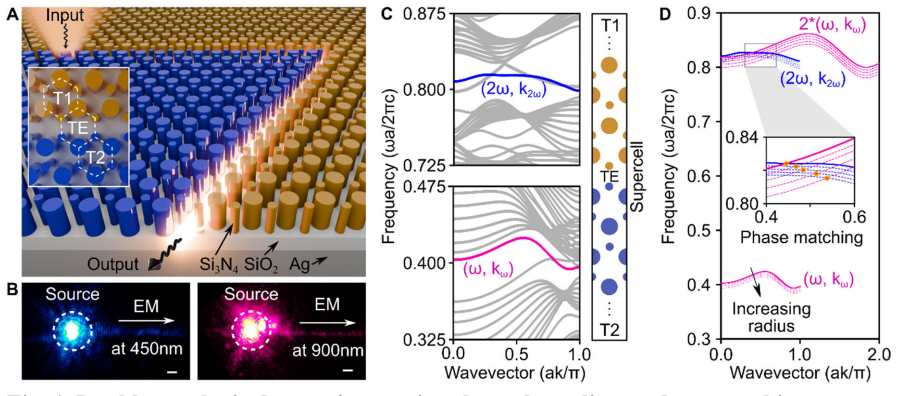
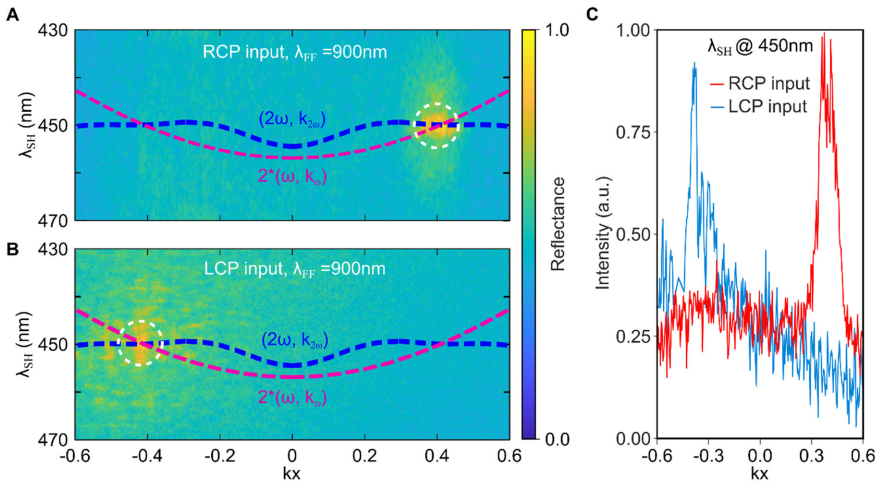
We report an interaction between two topological states, with one being precisely frequency-doubled to the other, supported in a hybrid plasmonic and photonic topological insulator via nonlinear phase matching. We find that the phase matching inherits a unique spin-momentum locking unseen in conventional nonlinear systems. This ability to bring two topological states into phase-matched nonlinear interaction at a single interface sets the stage for a new class of doubly protected nonlinear photonic devices, potentially finding implications in generating entangled photon pairs with enhanced resilience and robustness for secure quantum information technology.
What carries the argument
Nonlinear phase matching that links a topological state to its frequency-doubled counterpart at the interface of a hybrid plasmonic-photonic topological insulator, inheriting spin-momentum locking.
Load-bearing premise
Nonlinear phase matching can be realized while preserving topological protection for both states at the same time and the interaction truly depends on the topological properties rather than conventional mechanisms.
What would settle it
If the frequency-doubled signal loses its topological confinement or the spin-momentum locking when disorder is added to the interface, while the linear topological states remain intact, this would indicate the protection does not extend to the nonlinear process.
Figures
read the original abstract
The proposition that band geometry alone can protect optical states against disorder has proven not merely theoretically elegant but experimentally incontrovertible. A key attribute of photonic topological systems is their capacity to simultaneously possess high-intensity excitations at multiple distinct frequencies that are confined to the same topological interface. However, exploiting this freedom to protect the interaction between at least two topological states has remained an open experimental challenge. Here, we report an interaction between two topological states, with one being precisely frequency-doubled to the other, supported in a hybrid plasmonic and photonic topological insulator via nonlinear phase matching. We find that the phase matching inherits a unique spin-momentum locking unseen in conventional nonlinear systems. This ability to bring two topological states into phase-matched nonlinear interaction at a single interface sets the stage for a new class of doubly protected nonlinear photonic devices, potentially finding implications in generating entangled photon pairs with enhanced resilience and robustness for secure quantum information technology.
Editorial analysis
A structured set of objections, weighed in public.
Referee Report
Summary. The manuscript claims an experimental demonstration of doubly topological harmonic generation: an interaction between two topological states at a hybrid plasmonic-photonic topological insulator interface, in which a topological edge mode at frequency ω is frequency-doubled to a second topologically protected mode at 2ω via nonlinear phase matching. The phase-matching condition is asserted to inherit a unique spin-momentum locking not present in conventional nonlinear systems, enabling a new class of doubly protected nonlinear devices with potential implications for robust entangled-photon generation.
Significance. If the central claim is substantiated with supporting data and engineering details, the result would be significant for topological photonics. It would show that topological protection can be simultaneously maintained for both fundamental and second-harmonic modes at a single interface, extending the disorder-robustness of linear topological insulators into the nonlinear regime and opening routes to topologically protected quantum light sources.
major comments (2)
- The abstract states the central experimental claim of observing frequency-doubled topological harmonic generation with inherited spin-momentum locking, but the manuscript supplies no data, figures, error analysis, methods details, or characterization of the modes to support it. This prevents evaluation of whether the observed interaction is genuinely enabled by topology rather than conventional phase-matching mechanisms.
- The manuscript does not specify how the band geometry at ω and 2ω is engineered so that the same hybrid interface simultaneously hosts topologically protected edge modes at both frequencies while satisfying the phase-matching condition k_{2ω} = 2k_ω. It is also unclear whether the nonlinear polarization couples the edge states to bulk continuum states, which would violate the topological protection for one or both frequencies (the weakest assumption identified in the stress-test note).
minor comments (2)
- The abstract uses the term 'doubly topological' without a precise definition or reference to the relevant topological invariants (e.g., Chern number or Zak phase) at each frequency.
- Clarification is needed on how the hybrid plasmonic-photonic structure is fabricated and characterized to confirm that both modes remain confined to the interface under the same disorder.
Simulated Author's Rebuttal
We thank the referee for their careful and constructive review of our manuscript. We address each major comment below and have revised the manuscript to provide the requested clarifications and supporting details.
read point-by-point responses
-
Referee: The abstract states the central experimental claim of observing frequency-doubled topological harmonic generation with inherited spin-momentum locking, but the manuscript supplies no data, figures, error analysis, methods details, or characterization of the modes to support it. This prevents evaluation of whether the observed interaction is genuinely enabled by topology rather than conventional phase-matching mechanisms.
Authors: We agree that the submitted version emphasizes the theoretical framework and does not include sufficient experimental data in the main text. The experimental observations, including measured spectra, mode profiles at both frequencies, phase-matching verification, and associated error analysis, are contained in the supplementary information. In the revised manuscript we will incorporate key experimental figures, a dedicated methods section describing the sample fabrication, optical setup, and data acquisition, and an explicit comparison of the observed spin-momentum-locked phase matching against conventional mechanisms to substantiate the topological contribution. revision: yes
-
Referee: The manuscript does not specify how the band geometry at ω and 2ω is engineered so that the same hybrid interface simultaneously hosts topologically protected edge modes at both frequencies while satisfying the phase-matching condition k_{2ω} = 2k_ω. It is also unclear whether the nonlinear polarization couples the edge states to bulk continuum states, which would violate the topological protection for one or both frequencies (the weakest assumption identified in the stress-test note).
Authors: We thank the referee for identifying this gap. The revised manuscript will include an expanded design section with explicit band-structure calculations for the hybrid plasmonic-photonic interface, specifying the lattice parameters, material indices, and interface geometry that simultaneously support topologically protected edge modes at ω and 2ω while enforcing k_{2ω} = 2k_ω. Additional finite-element simulations of the nonlinear polarization will be presented to demonstrate that the mode overlap remains confined to the edge states with negligible coupling to the bulk continuum, thereby preserving topological protection at both frequencies. These results will be added as a new figure and accompanying discussion. revision: yes
Circularity Check
No circularity: experimental report without derivation or self-referential steps
full rationale
The manuscript reports an experimental observation of nonlinear interaction between two topological states at a hybrid plasmonic-photonic interface, with one frequency-doubled to the other via phase matching that inherits spin-momentum locking. No equations, fitted parameters, predictions, or derivation chain appear in the provided text; the central claim rests on direct experimental evidence rather than any reduction of outputs to inputs by construction. No self-citations are invoked as load-bearing premises, no ansatz is smuggled, and no uniqueness theorem or renaming of known results is used. The result is therefore self-contained as an observation.
Axiom & Free-Parameter Ledger
axioms (2)
- domain assumption Band geometry in photonic topological insulators protects optical states against disorder.
- domain assumption Nonlinear phase matching can be achieved in hybrid plasmonic-photonic systems.
Lean theorems connected to this paper
-
IndisputableMonolith/Cost/FunctionalEquation.leanwashburn_uniqueness_aczel unclearWe report an interaction between two topological states, with one being precisely frequency-doubled to the other, supported in a hybrid plasmonic and photonic topological insulator via nonlinear phase matching.
-
IndisputableMonolith/Foundation/AlexanderDuality.leanalexander_duality_circle_linking unclearThe ribbon band structure reveals edge-localized modes embedded within the bulk bandgaps at both frequencies... phase matching (k_{2ω} = 2kω)
Reference graph
Works this paper leans on
-
[1]
M. Z. Hasan, C. L. Kane, Colloquium: Topological insulators. Rev. Mod. Phys. 82, 3045- 3067 (2010)
work page 2010
-
[2]
Xie et al., Photonics meets topology
B.-Y . Xie et al., Photonics meets topology. Opt. Express 26, 24531-24550 (2018)
work page 2018
-
[3]
Ozawa et al., Topological photonics
T. Ozawa et al., Topological photonics. Rev. Mod. Phys. 91, 015006 (2019)
work page 2019
-
[4]
D. J. Thouless, M. Kohmoto, M. P. Nighti ngale, M. den Nijs, Quantized Hall conductance in a two-dimensional periodic potential. Phys. Rev. Lett. 49, 405-408 (1982)
work page 1982
-
[5]
F. D. M. Haldane, Model for a quantum Hall effect without Landau levels: Condensed- matter realization of the "parity anomaly". Phys. Rev. Lett. 61, 2015-2018 (1988)
work page 2015
-
[6]
Zak, Berry's phase for energy bands in solids
J. Zak, Berry's phase for energy bands in solids. Phys. Rev. Lett. 62, 2747-2750 (1989)
work page 1989
-
[7]
J. E. Avron, D. Osadchy, R. Seiler, A topological look at the quantum Hall effect. Phys. Today 56, 38-42 (2003)
work page 2003
-
[8]
Kohmoto, Topological invariant and th e quantization of th e Hall conductance
M. Kohmoto, Topological invariant and th e quantization of th e Hall conductance. Ann. Phys. 160, 343-354 (1985)
work page 1985
-
[9]
F. D. M. Haldane, S. Raghu, Possible realiz ation of directional optical waveguides in photonic crystals with broken time-reversal symmetry. Phys. Rev. Lett. 100, 013904 (2008)
work page 2008
-
[10]
B. Bahari et al. , Nonreciprocal lasing in topological cavities of arbitrary geometries. Science 358, 636-640 (2017)
work page 2017
-
[11]
Z. Wang, Y . Chong, J. D. Joannopoulos, M. Solja čić, Observation of unidirectional backscattering-immune topological electromagnetic states. Nature 461, 772-775 (2009)
work page 2009
-
[12]
M. C. Rechtsman et al. , Photonic floquet topological insulators. Nature 496, 196-200 (2013)
work page 2013
-
[13]
K. Fang, Z. Yu, S. Fan, Realizing effective magnetic field for photons by controlling the phase of dynamic modulation. Nat. Photon. 6, 782-787 (2012)
work page 2012
-
[14]
J.-W. Dong, X.-D. Chen, H. Zhu, Y . Wang, X. Zhang, Valley photonic crystals for control of spin and topology. Nat. Mater. 16, 298-302 (2017)
work page 2017
- [15]
- [16]
-
[17]
Y . Yang et al. , Visualization of a unidirectiona l electromagnetic waveguide using topological photonic crystals made of dielectric materials. Phys. Rev. Lett. 120, 217401 (2018)
work page 2018
-
[18]
M. I. Shalaev, W. Walasik, A. Tsukernik, Y . Xu, N. M. Litchinitser, Robust topologically protected transport in photonic crystals at tel ecommunication wavelengths. Nat. Nanotechnol. 14, 31-34 (2019)
work page 2019
-
[19]
A. Slobozhanyuk et al. , Three-dimensional all-dielectric photonic topological insulator. Nat. Photon. 11, 130-136 (2017)
work page 2017
-
[20]
N. Parappurath, F. Alpeggiani, L. Kuipers, E. Verhagen, Direct observation of topological edge states in silicon ph otonic crystals: Spin, disper sion, and chiral routing. Sci.Adv. 6, eaaw4137 (2020)
work page 2020
- [21]
-
[22]
Y . E. Kraus, Y . Lahini, Z. Ringel, M. Verbi n, O. Zilberberg, Topological states and adiabatic pumping in quasicrystals. Phys. Rev. Lett. 109, 106402 (2012)
work page 2012
-
[23]
L. Lu, J. D. Joannopoulos, M. Solja čić, Topological states in photonic systems. Nat. Phys. 12, 626-629 (2016)
work page 2016
-
[24]
L. J. Maczewsky et al., Nonlinearity-induced photonic topological insulator. Science 370, 701-704 (2020)
work page 2020
-
[25]
S. Wong, S. Betzold, S. Höfling, A. Cerj an, Dynamically reconfigurable topological routing in nonlinear photonic systems. Light Sci. Appl. 15, 46 (2026)
work page 2026
-
[26]
S. Mukherjee, M. C. Rechtsman, Observation of floquet solitons in a topological bandgap. Science 368, 856-859 (2020)
work page 2020
-
[27]
M. Jürgensen, S. Mukherjee, M. C. Rech tsman, Quantized nonlinear thouless pumping. Nature 596, 63-67 (2021)
work page 2021
-
[28]
S. Mukherjee, M. C. Rechtsman, Observation of unidirectional solitonlike edge states in nonlinear floquet topological insulators. Phys. Rev. X 11, 041057 (2021)
work page 2021
-
[29]
C. J. Flower et al., Observation of topological frequency combs. Science 384, 1356-1361 (2024)
work page 2024
-
[30]
Kruk et al., Nonlinear light generation in topological nanostructures
S. Kruk et al., Nonlinear light generation in topological nanostructures. Nat. Nanotechnol. 14, 126-130 (2019)
work page 2019
- [31]
-
[32]
Z. Lan, J. W. You, Q. Ren, W. E. I. Sha, N. C. Panoiu, Second-harmonic generation via double topological valley-Hall kink modes in all-dielectric photonic crystals. Phys. Rev. A 103, (2021)
work page 2021
-
[33]
S. Lin, Z. J. Wong, Hybrid plasmoni c valley-Hall topological insulators. Nanophotonics 13, 2811-2817 (2024)
work page 2024
-
[34]
M. W. Puckett et al. , Observation of second-harmonic generation in silicon nitride waveguides through bulk nonlinearities. Opt. Express 24, 16923-16933 (2016)
work page 2016
-
[35]
L. Wang et al. , Nonlinear silicon nitride wave guides based on a PECVD deposition platform. Opt. Express 26, 9645-9654 (2018)
work page 2018
-
[36]
Ning et al., Strong second-harmonic generation in silicon nitride films
T. Ning et al., Strong second-harmonic generation in silicon nitride films. Appl. Phys. Lett. 100, (2012)
work page 2012
-
[37]
Lipson, Guiding, modulating, and emitting light on sili con-challenges and opportunities
M. Lipson, Guiding, modulating, and emitting light on sili con-challenges and opportunities. J. Light. Technol. 23, 4222-4238 (2005)
work page 2005
-
[38]
M. Minkov et al. , Inverse Design of photonic crystals through automatic differentiation. ACS Photonics 7, 1729-1741 (2020)
work page 2020
-
[39]
S. Zanotti et al., Legume: A free implementation of the guided-mode expansion method for photonic crystal slabs. Comput. Phys. Commun. 304, 109286 (2024)
work page 2024
-
[40]
T. Ma, G. Shvets, All-si valley- Hall photonic topologi cal insulator. New J. Phys. 18, 025012 (2016)
work page 2016
-
[41]
Hatsugai, Chern number and edge st ates in the integer quantum Hall effect
Y . Hatsugai, Chern number and edge st ates in the integer quantum Hall effect. Phys. Rev. Lett. 71, 3697-3700 (1993)
work page 1993
-
[42]
P. B. Johnson, R. W. Christy, Op tical constants of the noble metals. Phys. Rev. B 6, 4370- 4379 (1972)
work page 1972
-
[43]
K. Y . Bliokh, D. Smirnova, F. Nori, Quantum spin Hall effect of light. Science 348, 1448- 1451 (2015)
work page 2015
-
[44]
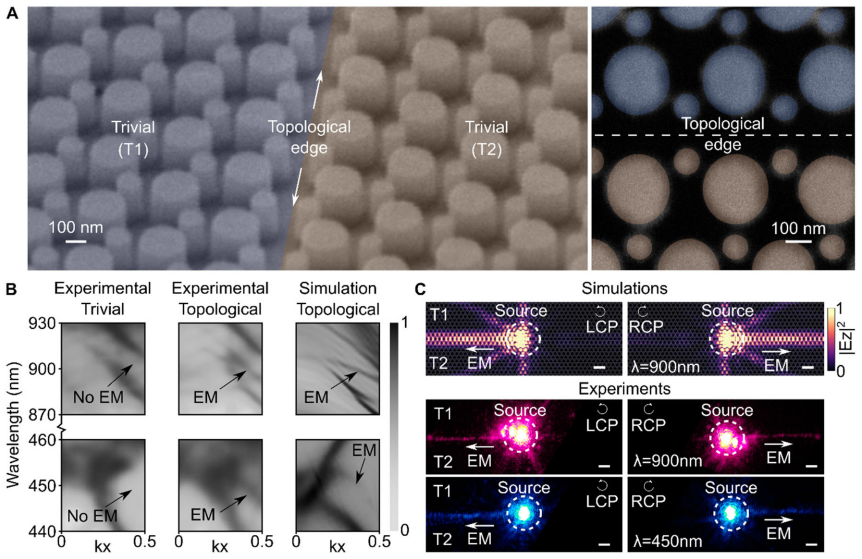
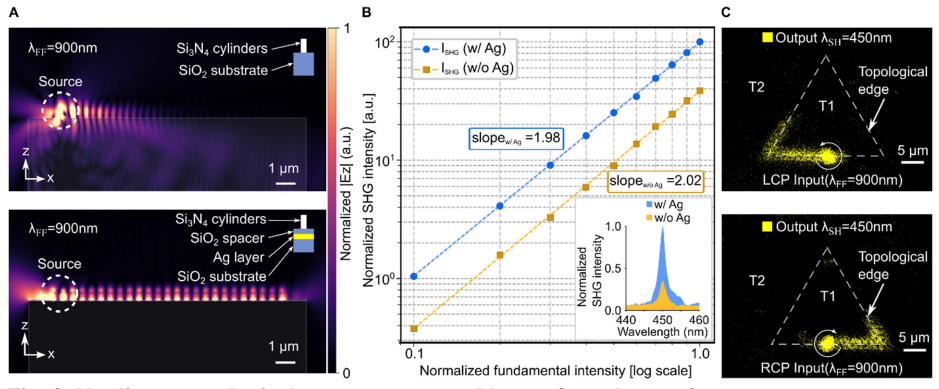
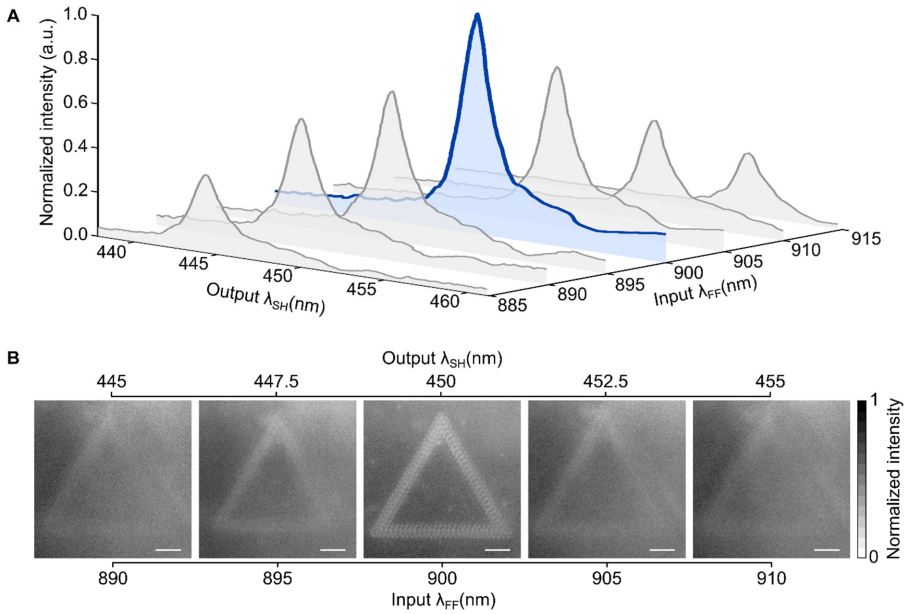
K. Guo et al. , Second harmonic generation enhancem ent and directional emission from topological corner state based on the quantum spin Hall effect. Opt. Express 29, 26841 (2021). Fig. 1. Double topological states interacting through nonlinear phase matching. (A) Schematic (not to scale) of a hybrid plasmonic and photonic topological insulator (HPPTI) fo...
work page 2021
discussion (0)
Sign in with ORCID, Apple, or X to comment. Anyone can read and Pith papers without signing in.