Recognition: no theorem link
Parameter Estimation of Mutual Information Maximized Channels
Pith reviewed 2026-05-13 02:29 UTC · model grok-4.3
The pith
When the transmitter selects inputs to maximize mutual information, output observations alone suffice to recover both the true channel parameters and the optimal input distribution.
A machine-rendered reading of the paper's core claim, the machinery that carries it, and where it could break.
Core claim
By enforcing the Blahut-Arimoto fixed-point conditions during estimation, the true channel parameter vector and the capacity-achieving input distribution can be recovered jointly from output samples alone.
What carries the argument
Bilevel fixed-point iteration and augmented Lagrangian optimization that incorporate the Blahut-Arimoto optimality conditions for the capacity-achieving input distribution.
If this is right
- Joint recovery of channel parameters and capacity-achieving inputs becomes possible without observing any inputs.
- A naive maximum-likelihood estimator fails because it treats the input distribution as free rather than constrained to optimality.
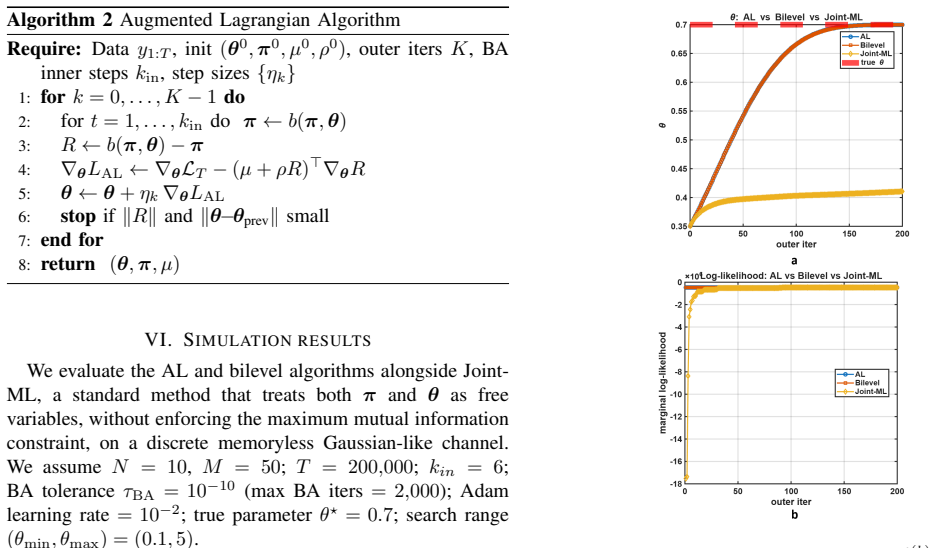
- The two proposed algorithms converge to the ground-truth values on synthetic data drawn from parametric discrete memoryless channels.
- The approach applies whenever the only data are output observations and the input distribution satisfies the mutual-information maximization condition.
Where Pith is reading between the lines
- The same optimality-constrained estimation idea could be tested on channels with memory or with continuous alphabets.
- In practice the method might allow channel tracking in systems that already operate near capacity without inserting training symbols.
- If the recovered parameters are used to recompute the output distribution under the estimated input distribution, any mismatch with the empirical output frequencies would flag an inconsistency.
Load-bearing premise
The transmitter is using exactly the input distribution that maximizes mutual information for the unknown true channel parameters.
What would settle it
Generate synthetic output samples from a known parametric channel and its exact capacity-achieving input distribution, then apply either algorithm; if the returned estimates differ from the known values, the recovery claim does not hold.
Figures

read the original abstract
We study the problem of estimating a parametric discrete memoryless channel \( p(y \mid x; \boldsymbol{\theta}) \) when the transmitter selects its input distribution \( \pi \) to maximize mutual information under the true parameter \( \boldsymbol{\theta}^* \). Using only i.i.d.\ observations of the channel output, we aim to jointly estimate the capacity-achieving input distribution \( \boldsymbol{\pi}^* \) and the true channel parameter \( \boldsymbol{\theta}^* \). In general, recovery of \( \boldsymbol{\pi}^* \) and \( \boldsymbol{\theta}^* \) can be challenging. To that end, we propose two efficient algorithms based on the Blahut--Arimoto (BA) optimality conditions: (i) a bilevel fixed-point method and (ii) an augmented Lagrangian method. Empirical results demonstrate that both proposed algorithms successfully recover the true \( \boldsymbol{\theta}^* \) and \( \boldsymbol{\pi}^* \), whereas a naive maximum-likelihood approach that ignores the mutual-information maximization constraint fails to do so.
Editorial analysis
A structured set of objections, weighed in public.
Referee Report
Summary. The paper studies joint estimation of the true parameter θ* of a parametric DMC p(y|x;θ) and the capacity-achieving input distribution π* from i.i.d. output samples alone, under the assumption that the transmitter uses the MI-maximizing π for the unknown θ*. It proposes two algorithms derived from Blahut-Arimoto optimality conditions—a bilevel fixed-point iteration and an augmented-Lagrangian method—and reports that both recover the ground-truth (θ*,π*) on synthetic instances while a naïve maximum-likelihood estimator that ignores the MI constraint does not.
Significance. If the identifiability, convergence, and consistency claims can be established, the work would supply a principled route to channel-parameter recovery when the input distribution is itself capacity-achieving, with potential relevance to adaptive communication systems and inverse problems in information theory.
major comments (3)
- [Abstract and algorithmic sections] The manuscript provides no identifiability analysis establishing that the map (θ,π)↦p(y) is injective when π satisfies the Blahut-Arimoto fixed-point condition for that θ. Without such a result, the empirical recovery on the reported synthetic cases does not rule out the existence of multiple (θ,π) pairs that induce statistically indistinguishable output marginals.
- [Algorithm descriptions and empirical evaluation] No convergence guarantees (global or local) are given for either the bilevel fixed-point iteration or the augmented-Lagrangian procedure, nor is consistency of the resulting estimator proved as the number of output samples tends to infinity. These omissions make the central empirical claim unverifiable from the given information.
- [Empirical results] The experimental section supplies neither the number of Monte-Carlo trials, quantitative error metrics (e.g., MSE or total-variation distance on θ̂ and π̂), sample-size regimes, nor convergence tolerances. Consequently the reported “successful recovery” cannot be assessed for statistical reliability or robustness.
minor comments (2)
- [Notation] Notation for vectors (θ, π) should be uniformly boldface or otherwise distinguished from scalars throughout the text and equations.
- [Algorithm comparison] A brief comparison table contrasting the two proposed methods (iteration count, per-iteration complexity, hyper-parameter sensitivity) would improve readability.
Simulated Author's Rebuttal
We thank the referee for the constructive and detailed feedback. We address each major comment point by point below, indicating planned revisions to the manuscript.
read point-by-point responses
-
Referee: [Abstract and algorithmic sections] The manuscript provides no identifiability analysis establishing that the map (θ,π)↦p(y) is injective when π satisfies the Blahut-Arimoto fixed-point condition for that θ. Without such a result, the empirical recovery on the reported synthetic cases does not rule out the existence of multiple (θ,π) pairs that induce statistically indistinguishable output marginals.
Authors: We agree that a formal identifiability analysis is absent. The algorithms rely on the assumption that π satisfies the BA fixed-point condition for θ*, which empirically yields unique recovery in the tested parametric families, but we provide no proof that the induced output marginal is injective. In revision we will add a dedicated discussion subsection on identifiability, including analytic verification for simple cases (e.g., BSC) and explicit acknowledgment that general uniqueness remains open. Additional synthetic experiments checking for multiple solutions will also be reported. revision: partial
-
Referee: [Algorithm descriptions and empirical evaluation] No convergence guarantees (global or local) are given for either the bilevel fixed-point iteration or the augmented-Lagrangian procedure, nor is consistency of the resulting estimator proved as the number of output samples tends to infinity. These omissions make the central empirical claim unverifiable from the given information.
Authors: We acknowledge the lack of convergence and consistency theory. The methods are obtained by enforcing the BA optimality conditions; they exhibit reliable practical convergence on the reported instances, yet no contraction mapping or statistical consistency argument is supplied. We will expand the manuscript with a limitations section that outlines the obstacles to such proofs and reports empirical convergence diagnostics (iteration counts, sensitivity to initialization). A full theoretical treatment is beyond the present scope and will be noted as future work. revision: partial
-
Referee: [Empirical results] The experimental section supplies neither the number of Monte-Carlo trials, quantitative error metrics (e.g., MSE or total-variation distance on θ̂ and π̂), sample-size regimes, nor convergence tolerances. Consequently the reported “successful recovery” cannot be assessed for statistical reliability or robustness.
Authors: This observation is correct. The revised experimental section will report: 100 Monte-Carlo trials per setting, MSE for θ̂ and total-variation distance for π̂ (with standard deviations), results across sample sizes 10²–10⁵, and the convergence tolerance (‖Δ‖ < 10^{-6}). Error bars and robustness checks under varied initializations will be added so that statistical reliability can be evaluated directly. revision: yes
Circularity Check
No circularity; estimation relies on external BA conditions and numerical optimization
full rationale
The paper formulates joint estimation of θ* and π* as a constrained optimization problem whose constraint is the standard Blahut-Arimoto optimality condition (external, not self-derived). The two proposed algorithms (bilevel fixed-point iteration and augmented Lagrangian) are constructed directly from those classical fixed-point equations and standard constrained-optimization techniques. Empirical recovery is demonstrated on synthetic instances by comparing recovered values to ground-truth θ* and π*; no quantity is defined in terms of itself, no fitted parameter is relabeled as a prediction, and no load-bearing step reduces to a self-citation. The derivation chain is therefore self-contained against independently established information-theoretic primitives.
Axiom & Free-Parameter Ledger
axioms (2)
- domain assumption The channel is a parametric discrete memoryless channel p(y|x; θ).
- domain assumption The transmitter chooses the input distribution to maximize mutual information for the true θ*.
Reference graph
Works this paper leans on
-
[1]
Computation of channel capacity and rate-distortion functions,
R. E. Blahut, “Computation of channel capacity and rate-distortion functions,”IEEE Transactions on Information Theory, vol. 18, no. 4, pp. 460–473, 1972
work page 1972
-
[2]
An algorithm for computing the capacity of arbitrary dis- crete memoryless channels,
S. Arimoto, “An algorithm for computing the capacity of arbitrary dis- crete memoryless channels,”IEEE Transactions on Information Theory, vol. 18, no. 1, pp. 14–20, 1972
work page 1972
-
[4]
G. J. McLachlan and T. Krishnan,The EM Algorithm and Extensions, 2nd ed. John Wiley & Sons, 2007, vol. 382
work page 2007
-
[5]
Optnet: Differentiable optimization as a layer in neural networks,
B. Amos and J. Z. Kolter, “Optnet: Differentiable optimization as a layer in neural networks,” inProceedings of the 34th International Conference on Machine Learning (ICML), ser. Proceedings of Machine Learning Research, vol. 70, 2017, pp. 136–145
work page 2017
-
[6]
Dif- ferentiating through a cone program,
A. Agrawal, S. Barratt, S. Boyd, E. Busseti, and W. M. Moursi, “Dif- ferentiating through a cone program,”arXiv preprint arXiv:1904.09043, 2019
-
[7]
Bilevel programming for hyperparameter optimization and meta-learning,
L. Franceschi, P. Frasconi, S. Salzo, R. Grazzi, and M. Pontil, “Bilevel programming for hyperparameter optimization and meta-learning,” in Proceedings of the 35th International Conference on Machine Learning (ICML), ser. Proceedings of Machine Learning Research, vol. 80. PMLR, 2018, pp. 1568–1577
work page 2018
-
[8]
D. P. Bertsekas,Nonlinear Programming, 2nd ed. Belmont, MA: Athena Scientific, 1999
work page 1999
-
[9]
Information theoretic threshold tuning in parallel stochastic quantizer architectures,
H. Tavakoli, T. Nguyen, and B. Bose, “Information theoretic threshold tuning in parallel stochastic quantizer architectures,” inProceedings of the IEEE International Conference on Machine Learning and Applica- tions (ICMLA), 2025
work page 2025
-
[10]
Multiplier and gradient methods,
M. R. Hestenes, “Multiplier and gradient methods,”Journal of Opti- mization Theory and Applications, vol. 4, no. 5, pp. 303–320, 1969
work page 1969
-
[11]
Capacity of a simple intercellular signal transduction channel,
P. J. Thomas and A. W. Eckford, “Capacity of a simple intercellular signal transduction channel,”IEEE Transactions on Information Theory, vol. 62, no. 12, pp. 7358–7382, 2016
work page 2016
-
[12]
Maximum likelihood from incomplete data via the em algorithm,
A. P. Dempster, N. M. Laird, and D. B. Rubin, “Maximum likelihood from incomplete data via the em algorithm,”Journal of the Royal Statistical Society. Series B (Methodological), vol. 39, no. 1, pp. 1–38, 1977
work page 1977
-
[13]
G. J. McLachlan and T. Krishnan,The EM Algorithm and Extensions, 2nd ed. John Wiley & Sons, 2008
work page 2008
-
[14]
S. M. Kay,Fundamentals of Statistical Signal Processing, Volume I: Estimation Theory. Prentice Hall, 1993
work page 1993
-
[15]
T. M. Cover and J. A. Thomas,Elements of Information Theory, 2nd ed. Hoboken, NJ: Wiley-Interscience, 2006
work page 2006
discussion (0)
Sign in with ORCID, Apple, or X to comment. Anyone can read and Pith papers without signing in.