Recognition: 1 theorem link
Sensitive biodetection in flow using metasurface hosting quasi-bound state in the continuum resonances
Pith reviewed 2026-05-13 02:32 UTC · model grok-4.3
The pith
A metasurface with quasi-bound states in the continuum resonances detects streptavidin-biotin binding at 18 nanomolar in microfluidic flow.
A machine-rendered reading of the paper's core claim, the machinery that carries it, and where it could break.
Core claim
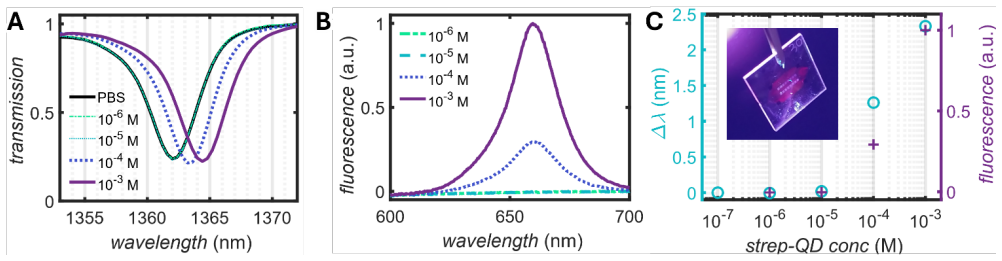
Optical metasurfaces hosting q-BIC resonances, created by introducing an asymmetry factor through variation of the gap width between two rectangular bars in each unit cell, confine a high-quality-factor resonance to the air gap between neighboring nanoresonators. This location makes the resonance highly sensitive to changes in the local refractive index, yielding experimental bulk sensitivities exceeding 315 nm/RIU with a figure of merit of 66. Real-time monitoring of transmission through the metasurface in a microfluidic flow cell demonstrates successful observation of streptavidin-biotin binding across various analyte concentrations, with a limit of detection of 1.8 times 10 to the minus 8
What carries the argument
The quasi-bound state in the continuum resonance confined to the air gap between asymmetrically gapped rectangular nanoresonators, which is excited by the gap asymmetry and shifts wavelength with local refractive index changes from surface-bound molecules.
If this is right
- The demonstrated sensitivity allows reliable detection of low-concentration biomolecules in real time during flow.
- Integration with commercial microfluidic cells supports kinetic studies of binding events without stopping the flow.
- Transmission-only readout enables simple optical setups that avoid fluorescence or complex instrumentation.
- The reported figure of merit supports use in applications where both sensitivity and resolution matter.
- The platform extends to other affinity-based assays by changing the surface functionalization chemistry.
Where Pith is reading between the lines
- Changing the surface chemistry could allow detection of different molecular pairs while keeping the same metasurface geometry.
- Arrays of unit cells with varied asymmetries might support simultaneous readout of multiple analytes on one chip.
- Further tuning of the gap asymmetry could raise the quality factor and push the limit of detection lower.
- Embedding these metasurfaces in portable microfluidic cartridges could lead to field-deployable optical diagnostics.
Load-bearing premise
The measured transmission shifts arise from specific binding of the analyte to the functionalized surface rather than from non-specific adsorption, flow dynamics, or unrelated environmental changes, and the resonance is excited and localized as intended by the gap asymmetry.
What would settle it
A control run with the same analyte concentration but without the specific binding pair on the surface, or with symmetric gaps that suppress the q-BIC, showing no resonance shift would indicate the observed effect is not due to the designed sensing mechanism.
Figures
read the original abstract
We have designed optical metasurfaces hosting high-quality factor quasi-bound state in the continuum (q-BIC) resonances for optical biosensing in flow. The unit cell of the metasurface contains two rectangular bars. An asymmetry factor is introduced by varying the gap width between the bars, to enable optical coupling to a q-BIC resonance confined to the air gap between neighboring nanoresonators. The location of the resonances makes them highly sensitive to changes in the local refractive index, leading to experimental bulk refractive index sensitivities exceeding 315 +/- 22 nm/RIU and a figure-of-merit of 66 +/- 5 RIU-1. Successful streptavidin-biotin binding was observed by measuring the metasurface transmission in real-time by exposing the metasurface to various concentrations of analytes via a commercial microfluidic flow cell apparatus. The experimental limit of detection, defined as 3{\sigma} above noise, was found to be 1.8x10⁻⁸ M. This platform represents a compact optical approach for point-of-care diagnostics with fast read-out.
Editorial analysis
A structured set of objections, weighed in public.
Referee Report
Summary. The manuscript reports the design of a metasurface unit cell with two rectangular bars and controlled gap-width asymmetry to support quasi-bound states in the continuum (q-BIC) resonances. Experimental bulk refractive-index sensitivities exceeding 315 ± 22 nm/RIU and a figure-of-merit of 66 ± 5 RIU^{-1} are claimed, together with real-time transmission measurements in a commercial microfluidic flow cell that detect streptavidin-biotin binding down to a limit of detection of 1.8 × 10^{-8} M (3σ above noise). The work positions the platform as a compact optical approach for point-of-care diagnostics.
Significance. If the reported sensitivities, FOM, and specific-binding interpretation hold after verification, the result would demonstrate a practical, flow-compatible metasurface biosensor that exploits high-Q q-BIC modes for enhanced local-index sensitivity. This could be of interest for compact photonic sensing platforms, provided the resonance confinement and binding specificity are rigorously established.
major comments (3)
- [Experimental biodetection results] The central experimental claim of specific streptavidin-biotin binding and the derived LOD of 1.8 × 10^{-8} M requires that observed transmission shifts arise from refractive-index changes localized to the functionalized q-BIC mode rather than non-specific adsorption or flow artifacts. The manuscript does not describe control experiments (non-functionalized surfaces, blocked binding sites, or scrambled ligand) performed under identical flow conditions; without these data the attribution of shifts and the LOD value remain unsupported.
- [Resonance characterization and design validation] The design relies on gap-width asymmetry to excite and confine the q-BIC resonance within the air gap. No experimental verification is provided (e.g., polarization-resolved spectra showing the expected coupling behavior or comparison with the symmetric case) that the observed resonance matches the simulated q-BIC mode; this confirmation is load-bearing for interpreting the measured sensitivity as arising from the designed resonance.
- [Bulk refractive-index sensitivity measurements] The bulk sensitivity (>315 ± 22 nm/RIU) and FOM (66 ± 5 RIU^{-1}) are reported with uncertainties, yet the manuscript supplies neither the specific refractive-index standards used, the fitting procedure for resonance tracking, nor the statistical basis for the quoted errors. These details are necessary to assess reproducibility of the quoted performance metrics.
minor comments (2)
- [Abstract] In the abstract the notation “3{σ}” should be rendered as 3σ for typographical clarity.
- [Experimental methods] The manuscript would benefit from explicit statements of the number of independent devices or flow runs used to obtain the reported uncertainties and LOD.
Simulated Author's Rebuttal
We thank the referee for their careful reading of our manuscript and for providing constructive feedback. We have prepared point-by-point responses to the major comments and will revise the manuscript to address the concerns raised.
read point-by-point responses
-
Referee: The central experimental claim of specific streptavidin-biotin binding and the derived LOD of 1.8 × 10^{-8} M requires that observed transmission shifts arise from refractive-index changes localized to the functionalized q-BIC mode rather than non-specific adsorption or flow artifacts. The manuscript does not describe control experiments (non-functionalized surfaces, blocked binding sites, or scrambled ligand) performed under identical flow conditions; without these data the attribution of shifts and the LOD value remain unsupported.
Authors: We agree that rigorous control experiments are necessary to substantiate the specificity of the binding and the validity of the LOD. Although the original manuscript focused on the primary binding results, we will include in the revised version additional control data obtained under identical flow conditions using non-functionalized metasurfaces and surfaces with blocked binding sites. These controls will confirm that the observed transmission shifts are attributable to specific streptavidin-biotin interactions rather than artifacts. revision: yes
-
Referee: The design relies on gap-width asymmetry to excite and confine the q-BIC resonance within the air gap. No experimental verification is provided (e.g., polarization-resolved spectra showing the expected coupling behavior or comparison with the symmetric case) that the observed resonance matches the simulated q-BIC mode; this confirmation is load-bearing for interpreting the measured sensitivity as arising from the designed resonance.
Authors: We acknowledge the importance of experimentally validating that the observed resonance corresponds to the designed q-BIC mode. In the revised manuscript, we will add polarization-resolved spectra for both the asymmetric and symmetric configurations. This will demonstrate the expected coupling behavior and confirm that the resonance is indeed the q-BIC mode supported by the gap asymmetry, as predicted by simulations. revision: yes
-
Referee: The bulk sensitivity (>315 ± 22 nm/RIU) and FOM (66 ± 5 RIU^{-1}) are reported with uncertainties, yet the manuscript supplies neither the specific refractive-index standards used, the fitting procedure for resonance tracking, nor the statistical basis for the quoted errors. These details are necessary to assess reproducibility of the quoted performance metrics.
Authors: We appreciate this comment and agree that these methodological details are important for reproducibility. In the revision, we will specify the refractive index standards employed (such as calibrated glycerol solutions), describe the Lorentzian fitting procedure used to track the resonance wavelength, and explain the statistical analysis (including the number of measurements and how the standard deviations were calculated) that underpin the reported uncertainties of ±22 nm/RIU and ±5 RIU^{-1}. revision: yes
Circularity Check
No circularity: purely experimental report of measured sensitivities and binding
full rationale
The manuscript is an experimental study reporting direct measurements of transmission shifts in a microfluidic flow cell for bulk RI sensitivity (>315 nm/RIU) and streptavidin-biotin binding (LOD 1.8e-8 M). No mathematical derivations, fitted parameters presented as predictions, or self-referential equations appear in the abstract or described content. Design choices (gap asymmetry for q-BIC) are stated as enabling the observed resonances, but results rest on empirical data rather than any chain that reduces to inputs by construction. No load-bearing self-citations or ansatzes are invoked.
Axiom & Free-Parameter Ledger
axioms (1)
- standard math Electromagnetic wave propagation and resonance conditions in dielectric nanostructures follow Maxwell's equations.
Reference graph
Works this paper leans on
-
[1]
(1) Shimoboji, T.; Ding, Z. L.; Stayton, P. S.; Hoffman, A. S. Photoswitching of Ligand Association with a Photoresponsive Polymer−Protein Conjugate. Bioconjugate Chem. 2002, 13 (5), 915–919. https://doi.org/10.1021/bc010057q. (2) Grimm, O.; Schacher, F. H. Dual Stimuli- Responsive P(NIPAAm-Co-SPA) Copolymers: Synthesis and Response in Solution and in Fil...
-
[2]
(3) Zou, C.; Poudel, P.; Walden, S
https://doi.org/10.3390/polym10060645. (3) Zou, C.; Poudel, P.; Walden, S. L.; Tanaka, K.; Minovich, A.; Pertsch, T.; Schacher, F. H.; Staude, I. Multiresponsive Dielectric Metasurfaces Based on Dual Light - and Temperature - Responsive Copolymers. Advanced Optical Materials 2023, 11, 2202187. https://doi.org/10.1002/adom.202202187
discussion (0)
Sign in with ORCID, Apple, or X to comment. Anyone can read and Pith papers without signing in.