Recognition: no theorem link
Intrinsic chirality of dielectric metasurfaces unlocked by resonant chiral modes
Pith reviewed 2026-05-13 02:26 UTC · model grok-4.3
The pith
A nominally achiral bilayer dielectric metasurface produces strong circular dichroism when a thin polymer layer breaks out-of-plane symmetry and activates resonant chiral modes.
A machine-rendered reading of the paper's core claim, the machinery that carries it, and where it could break.
Core claim
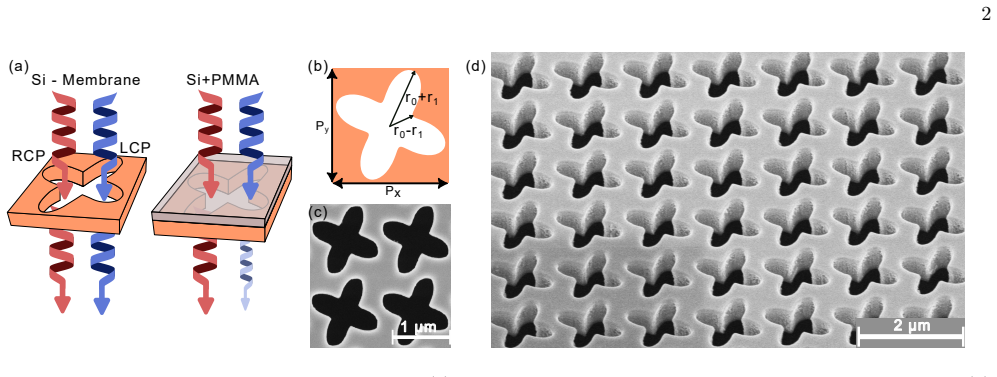
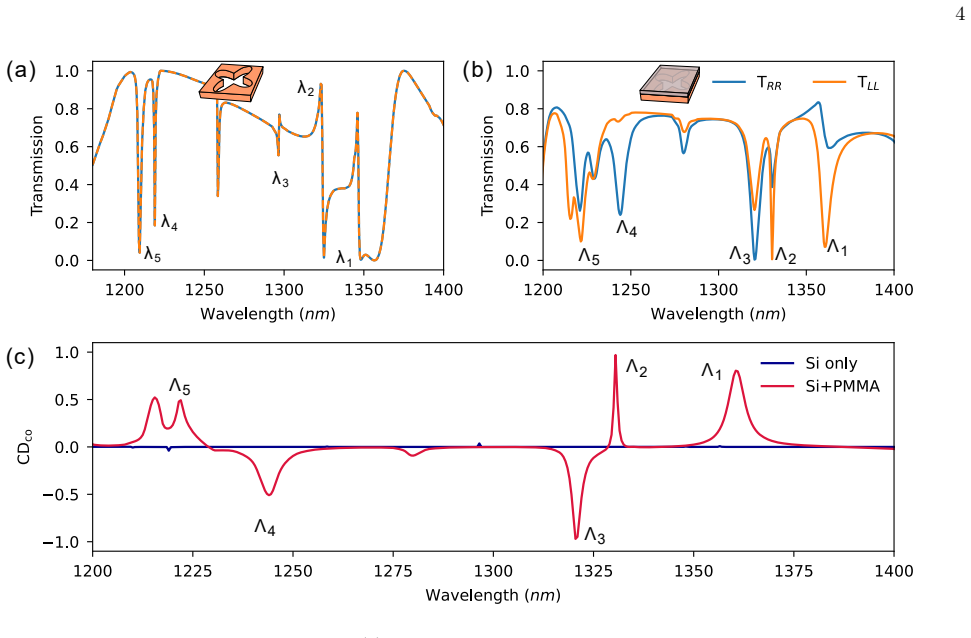
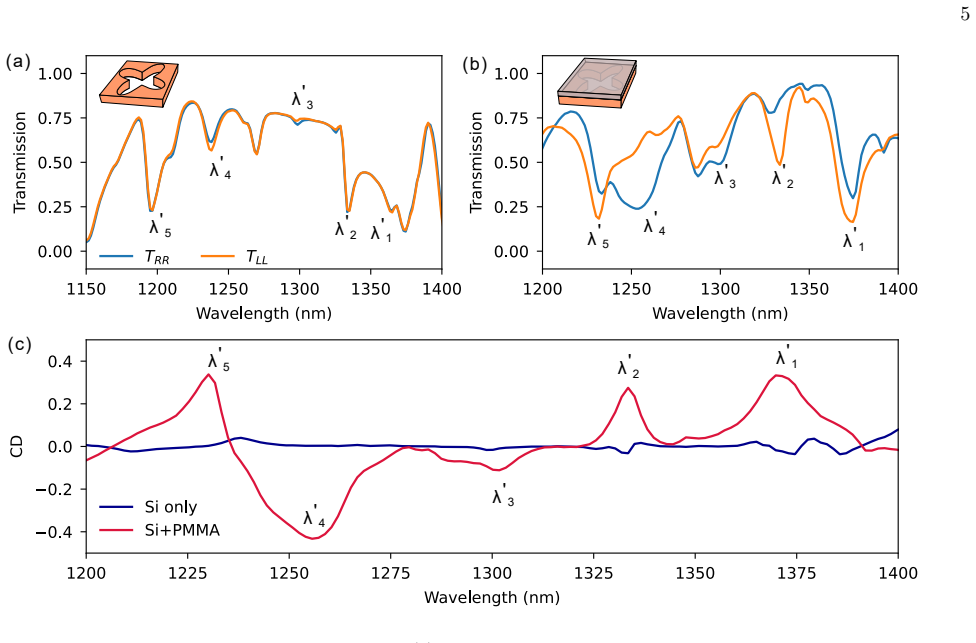
Bilayer metasurfaces with rotated C4-symmetric apertures exhibit pronounced chiral response originating from resonant chiral photonic modes realizing maximum chirality under the mode strong coupling. When out-of-plane symmetry is broken by a thin PMMA layer on a free-standing silicon membrane, it unlocks and activates a strong chiral response. The observed circular dichroism is explained by the properties of chiral photonic modes, and it is governed by interlayer coupling and symmetry breaking, in agreement with theoretical predictions.
What carries the argument
Resonant chiral photonic modes in a bilayer metasurface with rotated C4-symmetric apertures, activated by out-of-plane symmetry breaking and strong interlayer coupling.
Load-bearing premise
The measured chiral response is produced by activation of resonant chiral photonic modes under strong coupling rather than by fabrication imperfections or scattering from the PMMA layer or release process.
What would settle it
Fabricate the identical membrane metasurface without the PMMA layer and measure whether circular dichroism disappears while transmission and scattering spectra remain otherwise unchanged; persistence of chirality would falsify the mode-activation claim.
Figures

read the original abstract
Controlling optical chirality at the subwavelength scales is essential for many applications of nanophotonic structures in polarization optics, sensing, and nonlinear photonics. Achieving a strong chiroptical response in planar dielectric metasurfaces without intrinsically chiral building blocks (or "meta-atoms") remains challenging. The recent theoretical study [ACS Photonics 12, 6717 (2025)] predicted that bilayer metasurfaces with rotated C$_4$-symmetric apertures can exhibit pronounced chiral response originating from resonant chiral photonic modes realizing maximum chirality under the mode strong coupling. That observation uncovers a novel mechanism of metasurface chirality. Here, we confirm experimentally this novel concept and demonstrate resonantly enhanced circular dichroism in the near-infrared frequency range. We fabricate a free-standing silicon membrane metasurface that is nominally achiral. When out-of-plane symmetry is broken by a thin PMMA layer, it unlocks and activates a strong chiral response. The observed circular dichroism is explained by the properties of chiral photonic modes, and it is governed by interlayer coupling and symmetry breaking, in agreement with theoretical predictions. These results establish bilayer metasurfaces as a simple and versatile platform for engineering strong mode-induced chirality in compact planar photonic metadevices.
Editorial analysis
A structured set of objections, weighed in public.
Referee Report
Summary. The paper experimentally demonstrates that a nominally achiral bilayer silicon metasurface with rotated C4-symmetric apertures exhibits strong circular dichroism in the near-infrared once out-of-plane symmetry is broken by a thin PMMA layer. This response is attributed to the activation of resonant chiral photonic modes under strong interlayer coupling, in agreement with prior theoretical predictions from ACS Photonics 12, 6717 (2025). The work fabricates free-standing silicon membrane structures and shows that the observed chiroptical effect is governed by mode properties and symmetry breaking rather than extrinsic factors.
Significance. If the quantitative spectra and controls hold, this establishes a simple, planar platform for engineering intrinsic chirality in dielectric metasurfaces without chiral meta-atoms, relying instead on resonant mode strong coupling. It validates a novel mechanism that could enable compact devices for polarization optics, sensing, and nonlinear photonics, moving beyond conventional approaches that require complex chiral building blocks.
major comments (1)
- Experimental Results section: The central claim that the measured CD arises specifically from resonant chiral modes (rather than fabrication imperfections or the PMMA/membrane release process) requires explicit comparison to control samples without the symmetry-breaking layer and quantitative error bars on the spectra; without these, the attribution to mode-induced chirality remains under-supported despite the abstract's statement of agreement with theory.
minor comments (2)
- Figure captions and axis labels should explicitly state the polarization handedness convention and the exact PMMA thickness used for symmetry breaking to aid reproducibility.
- The manuscript would benefit from a brief table summarizing the measured CD peak values, resonance wavelengths, and Q-factors alongside the corresponding theoretical predictions for direct comparison.
Simulated Author's Rebuttal
We thank the referee for their positive assessment of our manuscript and for the constructive comment aimed at strengthening the experimental support for our claims. We have revised the Experimental Results section accordingly.
read point-by-point responses
-
Referee: Experimental Results section: The central claim that the measured CD arises specifically from resonant chiral modes (rather than fabrication imperfections or the PMMA/membrane release process) requires explicit comparison to control samples without the symmetry-breaking layer and quantitative error bars on the spectra; without these, the attribution to mode-induced chirality remains under-supported despite the abstract's statement of agreement with theory.
Authors: We agree that explicit controls and error analysis are essential to rule out alternative explanations such as fabrication imperfections or artifacts from the PMMA deposition and membrane release process. In the revised manuscript, we have added measurements on control samples without the PMMA symmetry-breaking layer; these exhibit negligible circular dichroism across the spectral range of interest, confirming that the observed chiroptical response is activated specifically by the out-of-plane symmetry breaking. We have also included quantitative error bars on all reported spectra, obtained from repeated measurements on multiple devices and different sample locations to quantify fabrication variability. These additions directly support the attribution of the measured CD to the resonant chiral photonic modes under strong interlayer coupling, consistent with the theoretical predictions cited in the manuscript. revision: yes
Circularity Check
No significant circularity; experimental confirmation of external theory
full rationale
The paper reports fabrication of a nominally achiral bilayer silicon metasurface, symmetry breaking via a thin PMMA layer, and direct measurement of resonantly enhanced circular dichroism in the near-IR. The observed CD is attributed to activation of resonant chiral photonic modes governed by interlayer coupling. This is presented as experimental validation of predictions from a cited prior theoretical study (ACS Photonics 12, 6717 (2025)). No derivation, ansatz, or equation chain within the present manuscript reduces the central result to fitted inputs, self-definitions, or self-citations by construction. The measurement itself is independently falsifiable, and agreement with theory is external rather than load-bearing within this work.
Axiom & Free-Parameter Ledger
Reference graph
Works this paper leans on
-
[1]
L. D. Barron, From Cosmic Chirality to Protein Struc- ture: Lord Kelvin’s Legacy, Chirality24, 879 (2012)
work page 2012
-
[2]
Prelog, Chirality in chemistry, Science193, 17 (1976)
V. Prelog, Chirality in chemistry, Science193, 17 (1976)
work page 1976
-
[3]
Vukusic, Evolutionary photonics with a twist, Science 325, 398 (2009)
P. Vukusic, Evolutionary photonics with a twist, Science 325, 398 (2009)
work page 2009
-
[4]
Q.-M. Deng, X. Li, M.-X. Hu, F.-J. Li, X. Li, and Z.- L. Deng, Advances on broadband and resonant chiral metasurfaces, npj Nanophotonics1, 10.1038/s44310-024- 00018-5 (2024)
-
[5]
H. Eyring, H.-C. Liu, and D. Caldwell, Optical rotatory dispersion and circular dichroism, Chemical Reviews68, 525 (1968)
work page 1968
-
[6]
E. Castiglioni, S. Abbate, and G. Longhi, Experimental methods for measuring optical rotatory dispersion: sur- vey and outlook, Chirality23, 711 (2011)
work page 2011
-
[7]
A. Rodger and B. Nord´ en,Circular dichroism and linear dichroism, Vol. 1 (Oxford university press, 1997)
work page 1997
- [8]
-
[9]
C.-W. Qiu, T. Zhang, G. Hu, and Y. Kivshar, Quo vadis, metasurfaces?, Nano Letters21, 5461 (2021)
work page 2021
-
[10]
P. Tonkaev and Y. Kivshar, All-dielectric resonant metaphotonics: opinion, Optical Materials Express12, 7 2879 (2022)
work page 2022
-
[11]
A. I. Kuznetsov, M. L. Brongersma, J. Yao, M. K. Chen, U. Levy, D. P. Tsai, N. I. Zheludev, A. Faraon, A. Arbabi, N. Yu,et al., Roadmap for optical metasurfaces, ACS Photonics11, 816 (2024)
work page 2024
-
[12]
P. Yu, J. Li, C. Tang, H. Cheng, Z. Liu, Z. Li, Z. Liu, C. Gu, J. Li, S. Chen, and J. Tian, Controllable optical activity with non-chiral plasmonic metasurfaces, Light: Science & Applications5, 10.1038/lsa.2016.96 (2016)
- [13]
-
[14]
Z. Wang, Y. Wang, G. Adamo, J. Teng, and H. Sun, In- duced Optical Chirality and Circularly Polarized Emis- sion from Achiral CdSe/ZnS Quantum Dots via Res- onantly Coupling with Plasmonic Chiral Metasurfaces, Laser Photonics Rev.13, 1800276 (2019)
work page 2019
-
[15]
H. S. Khaliq, A. Nauman, J. Lee, and H. Kim, Recent progress on plasmonic and dielectric chi- ral metasurfaces: Fundamentals, design strategies, and implementation, Advanced Optical Materials11, 10.1002/adom.202300644 (2023)
-
[16]
M. L. Solomon, J. Hu, M. Lawrence, A. Garc´ ıa-Etxarri, and J. A. Dionne, Enantiospecific optical enhancement of chiral sensing and separation with dielectric metasur- faces, ACS Photonics6, 43 (2019)
work page 2019
- [17]
-
[18]
D. Beutel, P. Scott, M. Wegener, C. Rockstuhl, and I. Fernandez-Corbaton, Enhancing the optical rota- tion of chiral molecules using helicity preserving all- dielectric metasurfaces, Applied Physics Letters118, 10.1063/5.0050411 (2021)
-
[19]
J. Wu, H. Jiang, Z. Guo, Y. Sun, Y. Li, and H. Chen, Giant optical chirality in dielectric metasurfaces induced by toroidal dipole resonances, Opt. Lett.48, 916 (2023)
work page 2023
-
[20]
M. V. Gorkunov, A. A. Antonov, and Y. S. Kivshar, Metasurfaces with Maximum Chirality Empowered by Bound States in the Continuum, Phys. Rev. Lett.125, 093903 (2020)
work page 2020
- [21]
-
[22]
M. V. Gorkunov, A. A. Antonov, V. R. Tuz, A. S. Kupriianov, and Y. S. Kivshar, Bound states in the continuum underpin near-lossless maximum chirality in dielectric metasurfaces, Advanced Optical Materials9, 10.1002/adom.202100797 (2021)
-
[23]
A. Overvig, N. Yu, and A. Al` u, Chiral quasi-bound states in the continuum, Physical Review Letters126, 073001 (2021)
work page 2021
-
[24]
Y. Chen, H. Deng, X. Sha, W. Chen, R. Wang, Y.-H. Chen, D. Wu, J. Chu, Y. S. Kivshar, S. Xiao,et al., Observation of intrinsic chiral bound states in the con- tinuum, Nature613, 474 (2023)
work page 2023
-
[25]
M. V. Gorkunov, A. A. Antonov, A. V. Mamonova, E. A. Muljarov, and Y. Kivshar, Substrate-Induced Maximum Optical Chirality of Planar Dielectric Structures, Adv. Opt. Mater.13, 2402133 (2025)
work page 2025
- [26]
-
[27]
K. Hallman, S. Stengel, W. Jaffray, F. Belli, M. Ferrera, M. A. Vincenti, D. de Ceglia, Y. Kivshar, N. Akozbek, S. Mukhopadhyay, J. Trull, C. Cojocaru, and M. Scalora, High-harmonic generation from subwavelength silicon films, Nanophotonics 10.1515/nanoph-2024-0468 (2025)
-
[28]
P. Tonkaev, F. Richter, I. Toftul, M. A. Vincenti, I. Sinev, M. Scalora, H. Altug, and Y. Kivshar, Unconventional high-harmonic generation in resonant membrane meta- surfaces, Nature Communications16, 11571 (2025)
work page 2025
-
[29]
P. Tonkaev, Y. Zhuang, D. Kim, I. Toftul, T. Yamaguchi, K. Li, J. Huang, H. Wang, T. Tanaka, H.-G. Park,et al., Nonlinear chiral response from linearly achiral membrane metasurfaces, Nano Letters25, 16643 (2025)
work page 2025
-
[30]
W. Adi, S. Rosas, A. Beisenova, S. K. Biswas, H. Mei, D. A. Czaplewski, and F. Yesilkoy, Trapping light in air with membrane metasurfaces for vibrational strong cou- pling, Nat. Commun.15, 1 (2024)
work page 2024
- [31]
- [32]
-
[33]
C.-Z. Deng, C.-H. Chiang, S. Shi, J.-H. Fu, Y.-J. Wu, K. Konishi, V. Tung, C.-W. Chen, and Y.-L. Ho, Atomic- scale light coupling control in ultrathin photonic mem- branes, Advanced Functional Materials , e24286 (2026)
work page 2026
-
[34]
K. Koshelev, I. Toftul, Y. Hwang, and Y. Kivshar, Scat- tering matrix for chiral harmonic generation and fre- quency mixing in nonlinear metasurfaces, J. Opt.26, 055003 (2024)
work page 2024
- [35]
-
[36]
I. Sinev, F. U. Richter, I. Toftul, N. Glebov, K. Koshelev, Y. Hwang, D. G. Lancaster, Y. Kivshar, and H. Al- tug, Chirality encoding in resonant metasurfaces gov- erned by lattice symmetries, Nature Communications16, 10.1038/s41467-025-61221-2 (2025)
- [37]
- [38]
-
[39]
K. K. Mandal, Y. Gupta, B. Kumar, M. Sohoni, A. Venu Gopal, and A. Kumar, A photonic integrated chip platform for interlayer exciton valley routing, Jour- nal of Applied Physics133, 10.1063/5.0139880 (2023)
-
[40]
K. K. Mandal, A. K. Singh, B. Kumar, A. P. Shah, R. Vij, A. Majumder, J. J. Khunte, V. G. Achanta, and A. Ku- mar, Emission engineering in monolithically integrated silicon nitride microring resonators, ACS Materials Let- ters6, 1831–1840 (2024)
work page 2024
discussion (0)
Sign in with ORCID, Apple, or X to comment. Anyone can read and Pith papers without signing in.