Recognition: 1 theorem link
· Lean TheoremAn investigation of magnetic energy and helicity thresholds at the onset of solar eruptions based on numerical simulations
Pith reviewed 2026-05-13 01:40 UTC · model grok-4.3
The pith
The ratio of current-carrying helicity to total relative helicity reaches a consistent threshold of 0.38 at the onset of solar eruptions across diverse magnetic configurations.
A machine-rendered reading of the paper's core claim, the machinery that carries it, and where it could break.
Core claim
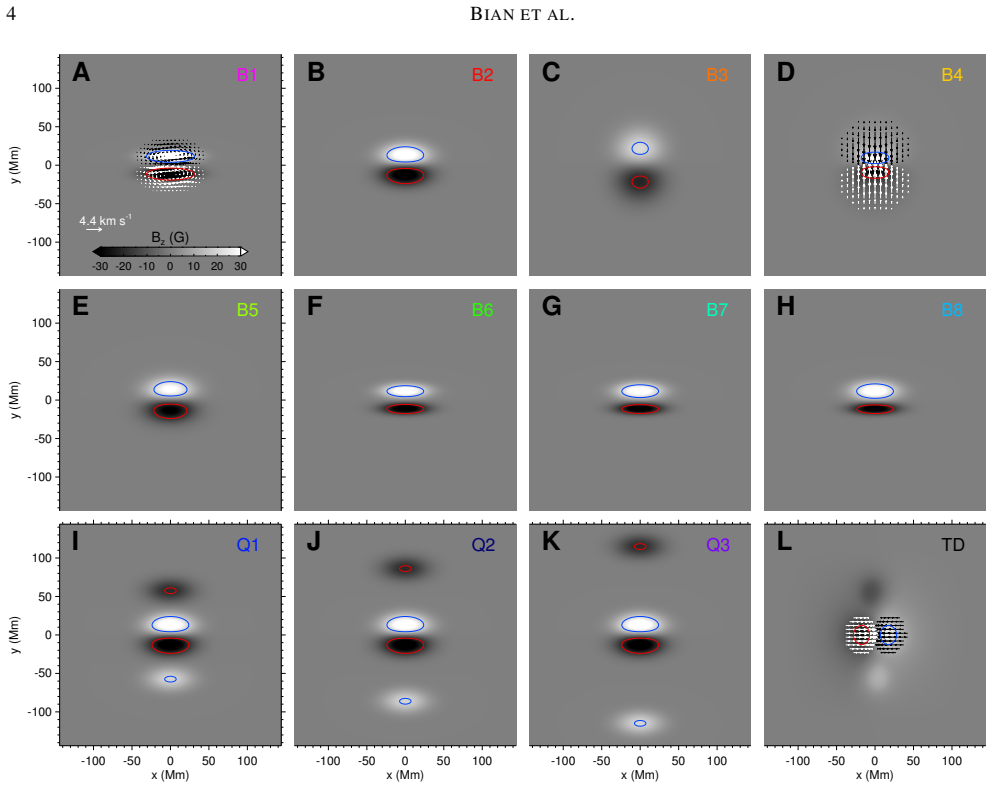
In twelve high-fidelity 3D MHD simulations covering bipolar and quadrupolar configurations, sheared arcades and pre-existing flux ropes, and varied photospheric driving motions, the ratio of current-carrying helicity to total relative helicity (H_j/H_r) reaches a threshold of 0.38 ± 0.04 at eruption onset. This value shows a coefficient of variation of only about 10 percent across all cases and better marks the critical conditions at onset than other normalized helicity and energy metrics. The ratio does not necessarily peak at onset; afterward it continues to rise in bipolar setups due to tether-cutting reconnection but falls in quadrupolar setups due to breakout reconnection.
What carries the argument
The ratio of current-carrying helicity to total relative helicity (H_j/H_r), which quantifies the fraction of relative helicity tied to the current-carrying field component and functions as a threshold marker for the start of eruptions.
If this is right
- Other normalized helicity and energy metrics display greater scatter at eruption onset than H_j/H_r.
- The 0.38 threshold specifically identifies critical conditions at onset and stays largely independent of later evolution.
- In bipolar configurations tether-cutting reconnection converts sheared arcade into current-carrying flux and drives the ratio upward after eruption.
- In quadrupolar configurations breakout reconnection peels away erupting flux and drives the ratio downward after eruption.
Where Pith is reading between the lines
- If the threshold appears in real solar observations it could supply a practical metric for forecasting eruptions.
- The split in post-eruption behavior implies that eruption models must distinguish bipolar from quadrupolar topologies to track helicity correctly.
- Further simulations with additional driving motions or more complex initial fields would test whether the threshold remains stable.
Load-bearing premise
That the twelve simulations cover enough variety in magnetic topologies, photospheric motions, and reconnection regimes to establish a universal threshold.
What would settle it
Direct measurements of solar events or new simulations showing H_j/H_r at eruption onset varying well beyond 0.38 ± 0.04 or depending strongly on uncovered topologies would disprove the claimed consistency.
Figures


read the original abstract
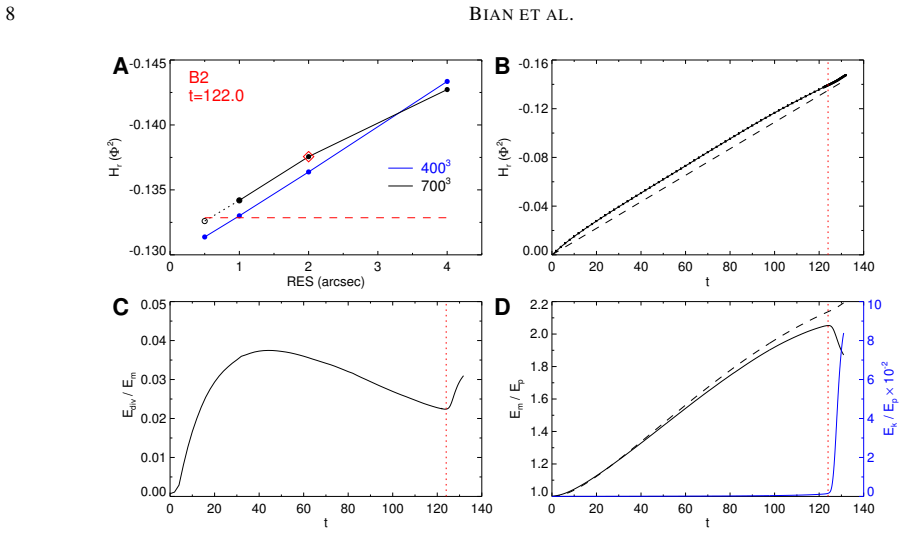
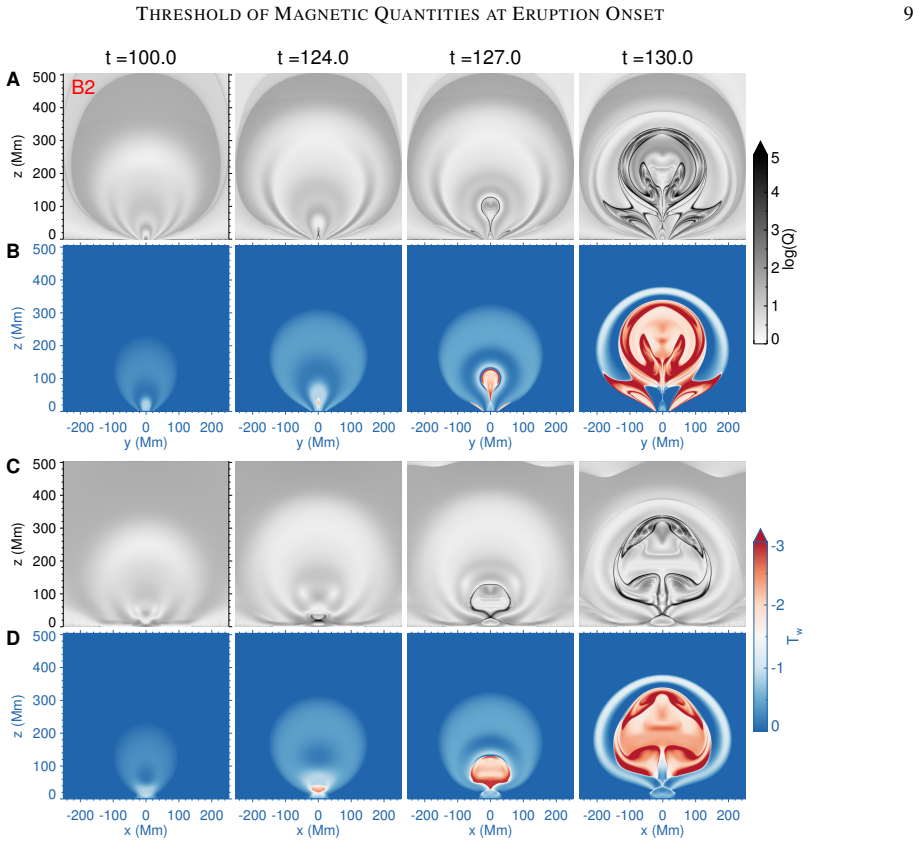
Identifying universal, topology-independent thresholds in the coronal magnetic fields at onset of solar eruptions is crucial for physics-based prediction of eruptions. To this end, we systematically analyze the evolution of magnetic energy and helicity in twelve high-fidelity 3D magnetohydrodynamic simulations where eruptions are triggered by magnetic reconnection. The simulations encompass a comprehensive parameter space, including bipolar and quadrupolar configurations, sheared arcades and pre-existing flux ropes, and various photospheric driving motions. We find that the ratio of current-carrying helicity to total relative helicity $(H_j/H_r)$ exhibits a remarkably consistent threshold of $0.38 \pm 0.04$ at eruption onset across all cases, with a coefficient of variation of only $\sim 10$\%. This threshold specifically characterizes the critical conditions at eruption onset and is largely independent of the subsequent temporal evolution, making it the most robust eruptivity indicator identified. In contrast, other normalized helicity and energy metrics show greater scatter. Crucially, we further find that $H_j/H_r$ does not necessarily achieve its peak at the eruption onset time and its post-eruption evolution diverges based on magnetic topology: it continues to increase in bipolar configurations due to tether-cutting reconnection, which transforms sheared arcade into the erupting current-carrying magnetic flux, but decreases in quadrupolar configurations as breakout reconnection peels off the erupting flux. These results highlight the helicity ratio as a promising and consistent eruptivity indicator and provide new insights into its dynamic evolution due to different reconnections.
Editorial analysis
A structured set of objections, weighed in public.
Referee Report
Summary. The manuscript analyzes the evolution of magnetic energy and helicity across twelve high-fidelity 3D MHD simulations of solar eruptions triggered by reconnection. The simulations include bipolar and quadrupolar topologies, sheared arcades and flux ropes, and varied photospheric driving. The central result is that the ratio of current-carrying helicity to total relative helicity (H_j/H_r) reaches a consistent threshold of 0.38 ± 0.04 at eruption onset, with a coefficient of variation of only ~10%, making it the most robust eruptivity indicator identified; other metrics show greater scatter. Post-onset evolution of the ratio differs by topology due to tether-cutting versus breakout reconnection.
Significance. If the reported threshold proves robust, it would constitute a valuable topology-independent diagnostic for the onset of solar eruptions, with direct relevance to physics-based space-weather prediction. The multi-configuration simulation suite provides a stronger basis than single-case studies, and the distinction between onset threshold and subsequent evolution offers mechanistic insight. However, the significance is limited by the absence of quantitative parameter-space coverage metrics and resolution/convergence details.
major comments (3)
- [Abstract] Abstract: the claim of a 'remarkably consistent' threshold of 0.38 ± 0.04 (CV ~10%) across all twelve cases cannot be verified without either a table listing the individual H_j/H_r values at onset for each simulation or an explicit statement of how the mean and standard deviation were computed; this information is load-bearing for the universality assertion.
- [Abstract] Abstract (and implied Methods): the statement that the twelve simulations 'encompass a comprehensive parameter space' including bipolar/quadrupolar, arcade/flux-rope, and varied driving cases is not supported by any quantitative measure of coverage (e.g., ranges of shear angles, flux ratios, or null-point configurations), leaving open the possibility that the observed clustering is an artifact of correlated setups rather than a fundamental property.
- [Abstract] Abstract: the helicity ratio is stated to be 'largely independent of the subsequent temporal evolution,' yet the same paragraph reports that post-eruption evolution diverges systematically between bipolar (continues to increase) and quadrupolar (decreases) cases; this apparent tension requires explicit clarification of the precise meaning of 'independent' at the onset time.
minor comments (1)
- [Abstract] Abstract: the symbols H_j and H_r are introduced without a brief parenthetical definition or reference to their standard definitions in the helicity literature, which would improve accessibility for readers outside the immediate subfield.
Simulated Author's Rebuttal
We thank the referee for the thoughtful and constructive review. The comments highlight areas where the abstract can be strengthened for clarity and verifiability. We address each major comment below and will incorporate the suggested improvements in the revised manuscript.
read point-by-point responses
-
Referee: [Abstract] Abstract: the claim of a 'remarkably consistent' threshold of 0.38 ± 0.04 (CV ~10%) across all twelve cases cannot be verified without either a table listing the individual H_j/H_r values at onset for each simulation or an explicit statement of how the mean and standard deviation were computed; this information is load-bearing for the universality assertion.
Authors: We agree that explicit verification of the reported statistics is essential. The mean and standard deviation were computed directly from the H_j/H_r values measured at the identified eruption onset time in each of the 12 simulations. In the revised manuscript we will add a table in the main text (or supplementary material) that lists the individual H_j/H_r onset values for every run, together with the resulting mean, standard deviation, and coefficient of variation. This will allow readers to confirm the quoted threshold of 0.38 ± 0.04 and the ~10% CV. revision: yes
-
Referee: [Abstract] Abstract (and implied Methods): the statement that the twelve simulations 'encompass a comprehensive parameter space' including bipolar/quadrupolar, arcade/flux-rope, and varied driving cases is not supported by any quantitative measure of coverage (e.g., ranges of shear angles, flux ratios, or null-point configurations), leaving open the possibility that the observed clustering is an artifact of correlated setups rather than a fundamental property.
Authors: The twelve simulations were constructed to sample the principal topological classes (bipolar versus quadrupolar, sheared-arcade versus pre-existing flux-rope) and driving mechanisms described in the Methods section. We acknowledge that the abstract itself does not supply quantitative coverage metrics. In the revision we will insert a concise summary (new table or paragraph) that reports the ranges of key parameters—such as photospheric shear angles, flux ratios between polarities, and heights of coronal null points—across the simulation suite. This addition will substantiate the breadth of the explored parameter space while preserving the focus on the distinct topological categories. revision: yes
-
Referee: [Abstract] Abstract: the helicity ratio is stated to be 'largely independent of the subsequent temporal evolution,' yet the same paragraph reports that post-eruption evolution diverges systematically between bipolar (continues to increase) and quadrupolar (decreases) cases; this apparent tension requires explicit clarification of the precise meaning of 'independent' at the onset time.
Authors: The phrase 'largely independent of the subsequent temporal evolution' is intended to convey that the threshold value attained precisely at eruption onset remains consistent across all topologies, even though the ratio's later evolution differs. The post-onset divergence (increase in bipolar cases due to tether-cutting reconnection, decrease in quadrupolar cases due to breakout reconnection) is a separate dynamical feature discussed in the results. We will revise the abstract wording to state explicitly that the onset threshold itself is robust and independent of the subsequent evolution, thereby removing any ambiguity. revision: yes
Circularity Check
No circularity: threshold is direct empirical measurement from independent simulations
full rationale
The paper's central claim is an observed consistency in the helicity ratio H_j/H_r across twelve MHD simulations with varied topologies and driving. This value is obtained by direct computation and measurement in the simulation outputs at the identified eruption onset times, rather than by algebraic reduction, parameter fitting that forces the result, or self-referential definitions. No load-bearing step reduces to a prior self-citation or ansatz that would make the threshold tautological. The reported low coefficient of variation is a post-hoc statistical summary of the measured data points, not a constructed prediction.
Axiom & Free-Parameter Ledger
axioms (2)
- domain assumption The ideal or resistive MHD equations accurately capture the dynamics of the solar corona on the simulated scales.
- ad hoc to paper The twelve simulations span the relevant range of bipolar/quadrupolar topologies, flux-rope vs. arcade configurations, and photospheric driving motions.
Lean theorems connected to this paper
-
IndisputableMonolith/Foundation/AbsoluteFloorClosure.leanreality_from_one_distinction unclear?
unclearRelation between the paper passage and the cited Recognition theorem.
the ratio of current-carrying helicity to total relative helicity (H_j/H_r) exhibits a remarkably consistent threshold of 0.38 ± 0.04 at eruption onset across all cases, with a coefficient of variation of only ∼10%.
What do these tags mean?
- matches
- The paper's claim is directly supported by a theorem in the formal canon.
- supports
- The theorem supports part of the paper's argument, but the paper may add assumptions or extra steps.
- extends
- The paper goes beyond the formal theorem; the theorem is a base layer rather than the whole result.
- uses
- The paper appears to rely on the theorem as machinery.
- contradicts
- The paper's claim conflicts with a theorem or certificate in the canon.
- unclear
- Pith found a possible connection, but the passage is too broad, indirect, or ambiguous to say the theorem truly supports the claim.
Reference graph
Works this paper leans on
-
[1]
Aly, J. J. 1991, The Astrophysical Journal, 375, L61
work page 1991
-
[2]
Aschwanden, M. J., Xu, Y ., & Jing, J. 2014, The Astrophysical Journal, 797, 50
work page 2014
-
[3]
Aulanier, G., T¨or¨ok, T., D´emoulin, P., & DeLuca, E. E. 2010, The Astrophysical Journal, 708, 314
work page 2010
-
[4]
Berger, M. A. 1984, Geophysical & Astrophysical Fluid Dynamics, 30, 79 —. 1999, Geophysical Monograph Series, 111, 1 —. 2003, in Advances in Nonlinear Dynamos, ed. A. Ferriz-Mas & M. N´u˜nez, V ol. 20030424 (CRC Press), 345–374
work page 1984
-
[5]
Berger, M. A., & Prior, C. 2006, Journal of Physics A: Mathematical and General, 39, 8321
work page 2006
-
[6]
2023, The Astrophysical Journal, 956, 73
Bian, X., Jiang, C., Feng, X., Zuo, P., & Wang, Y . 2023, The Astrophysical Journal, 956, 73
work page 2023
-
[7]
2025, Solar Physics, 300, 143 D´emoulin, P., & Aulanier, G
Bian, X., Jiang, C., Wang, Y ., et al. 2025, Solar Physics, 300, 143 D´emoulin, P., & Aulanier, G. 2010, The Astrophysical Journal, 718, 1388
work page 2025
-
[8]
2023, The Astrophysical Journal, 945, 102
Duan, A., Jiang, C., & Feng, X. 2023, The Astrophysical Journal, 945, 102
work page 2023
-
[9]
2010, The Astrophysical Journal, 723, 300
Feng, X., Yang, L., Xiang, C., et al. 2010, The Astrophysical Journal, 723, 300
work page 2010
-
[10]
Finn, J. M., & Antonsen, Jr., T. M. 1985, Comments on Plasma Physics and Controlled Fusion, 9, 111
work page 1985
-
[11]
1958, Journal of Nuclear Energy (1954), 7, 284
Grad, H., & Rubin, H. 1958, Journal of Nuclear Energy (1954), 7, 284
work page 1958
- [12]
-
[13]
Gupta, M., Thalmann, J. K., & Veronig, A. M. 2021, Astronomy & Astrophysics, 653, A69
work page 2021
-
[14]
2011, The Astrophysical Journal, 727, 101
Jiang, C., Feng, X., Fan, Y ., & Xiang, C. 2011, The Astrophysical Journal, 727, 101
work page 2011
-
[15]
Jiang, C., Feng, X., Zhang, J., & Zhong, D. 2010, Solar Physics, 267, 463
work page 2010
-
[16]
Jiang, C., Wu, S. T., Feng, X., & Hu, Q. 2016, Nature Communications, 7, 11522
work page 2016
-
[17]
2024, Reviews of Modern Plasma Physics, 8, 18
Jiang, C., Bian, X., Feng, X., et al. 2024, Reviews of Modern Plasma Physics, 8, 18
work page 2024
-
[18]
2010, The Astrophysical Journal, 713, 440
Jing, J., Tan, C., Yuan, Y ., et al. 2010, The Astrophysical Journal, 713, 440
work page 2010
-
[19]
Kliem, B., Lin, J., Forbes, T. G., Priest, E. R., & T¨or¨ok, T. 2014, The Astrophysical Journal, 789, 46
work page 2014
-
[20]
2006, Physical Review Letters, 96, 255002
Kliem, B., & T¨or¨ok, T. 2006, Physical Review Letters, 96, 255002
work page 2006
-
[21]
LaBonte, B. J., Georgoulis, M. K., & Rust, D. M. 2007, The Astrophysical Journal, 671, 955
work page 2007
-
[22]
Leake, J. E., Linton, M. G., & Antiochos, S. K. 2014, The Astrophysical Journal, 787, 46
work page 2014
-
[23]
Leake, J. E., Linton, M. G., & T¨or¨ok, T. 2013, The Astrophysical Journal, 778, 99
work page 2013
- [24]
-
[25]
2022, The Astrophysical Journal, 935, 85
Li, L., Peter, H., Pradeep Chitta, L., et al. 2022, The Astrophysical Journal, 935, 85
work page 2022
-
[26]
2021, The Astrophysical Journal Letters, 917, L29
Li, T., Chen, A., Hou, Y ., et al. 2021, The Astrophysical Journal Letters, 917, L29
work page 2021
-
[27]
2025, The Astrophysical Journal Supplement Series, 276, 7
Li, X., Li, X., Zheng, Y ., et al. 2025, The Astrophysical Journal Supplement Series, 276, 7
work page 2025
-
[28]
Liokati, E., Nindos, A., & Georgoulis, M. K. 2023, Astronomy and Astrophysics, 672, A38
work page 2023
-
[29]
Liu, Y ., Welsch, B. T., Valori, G., et al. 2023, The Astrophysical Journal, 942, 27
work page 2023
-
[30]
2025, Advances in Space Research, S0273117725010397
Liu, Z., & Jiang, C. 2025, Advances in Space Research, S0273117725010397
work page 2025
-
[31]
Moore, R. L., Falconer, D. A., & Sterling, A. C. 2012, The Astrophysical Journal, 750, 24
work page 2012
-
[32]
2019, Astronomy & Astrophysics, 628, A50
Moraitis, K., Sun, X., Pariat, ´E., & Linan, L. 2019, Astronomy & Astrophysics, 628, A50
work page 2019
-
[33]
Nindos, A., & Andrews, M. D. 2004, The Astrophysical Journal, 616, L175
work page 2004
-
[34]
Pariat, E., Leake, J. E., Valori, G., et al. 2017, Astronomy & Astrophysics, 601, A125
work page 2017
-
[35]
2015, Astronomy & Astrophysics, 580, A128
Pariat, E., Valori, G., D´emoulin, P., & Dalmasse, K. 2015, Astronomy & Astrophysics, 580, A128
work page 2015
-
[36]
Pariat, E., Wyper, P. F., & Linan, L. 2023, Astronomy & Astrophysics, 669, A33
work page 2023
-
[37]
Rice, O. E. K., & Yeates, A. R. 2022, Frontiers in Astronomy and Space Sciences, 9, 849135
work page 2022
-
[38]
Schuck, P. W. 2008, The Astrophysical Journal, 683, 1134
work page 2008
-
[39]
2010, Astronomy and Astrophysics, 521, A56
Smyrli, A., Zuccarello, F., Romano, P., et al. 2010, Astronomy and Astrophysics, 521, A56
work page 2010
-
[40]
Sturrock, P. A. 1991, The Astrophysical Journal, 380, 5
work page 1991
-
[41]
Sun, X., Bobra, M. G., Hoeksema, J. T., et al. 2015, The Astrophysical Journal, 804, L28
work page 2015
-
[42]
2025, The Astrophysical Journal, 990, 45
Sun, Z., Li, T., Bian, X., et al. 2025, The Astrophysical Journal, 990, 45
work page 2025
-
[43]
2024, Astronomy and Astrophysics, 686, A148
Sun, Z., Li, T., Wang, Q., et al. 2024, Astronomy and Astrophysics, 686, A148
work page 2024
-
[44]
Thalmann, J. K., Gupta, M., Veronig, A. M., & Liu, Y . 2025, Astronomy & Astrophysics, 695, A66
work page 2025
-
[45]
S., Downs, C., Miki´c, Z., et al
Titov, V . S., Downs, C., Miki´c, Z., et al. 2018, The Astrophysical Journal Letters, 852, L21
work page 2018
-
[46]
Tziotziou, K., Georgoulis, M. K., & Raouafi, N.-E. 2012, The Astrophysical Journal, 759, L4
work page 2012
-
[47]
Valori, G., D´emoulin, P., & Pariat, E. 2012, Solar Physics, 278, 347
work page 2012
-
[48]
2016, Space Science Reviews, 201, 147
Valori, G., Pariat, E., Anfinogentov, S., et al. 2016, Space Science Reviews, 201, 147
work page 2016
-
[49]
2023, Research in Astronomy and Astrophysics, 23, 095025
Wang, Q., Zhang, M., Yang, S., Yang, X., & Zhu, X. 2023, Research in Astronomy and Astrophysics, 23, 095025
work page 2023
-
[50]
2004, Solar Physics, 219, 87 —
Wiegelmann, T. 2004, Solar Physics, 219, 87 —. 2008, Journal of Geophysical Research: Space Physics, 113
work page 2004
-
[51]
Wyper, P. F., Antiochos, S. K., & DeV ore, C. R. 2017, Nature, 544, 452
work page 2017
-
[52]
Yang, S., B¨uchner, J., Santos, J. C., & Zhang, H. 2013, Solar Physics, 283, 369
work page 2013
-
[53]
P., Aulanier, G., & Gilchrist, S
Zuccarello, F. P., Aulanier, G., & Gilchrist, S. A. 2015, The Astrophysical Journal, 814, 126
work page 2015
-
[54]
P., Pariat, E., Valori, G., & Linan, L
Zuccarello, F. P., Pariat, E., Valori, G., & Linan, L. 2018, The Astrophysical Journal, 863, 41
work page 2018
discussion (0)
Sign in with ORCID, Apple, or X to comment. Anyone can read and Pith papers without signing in.