Recognition: no theorem link
Modelling Expert Cognition Beyond Behaviour: Towards Interpretation, Tension, and Value Structures
Pith reviewed 2026-05-14 21:01 UTC · model grok-4.3
The pith
Expert cognition emerges from negotiating tensions between competing identity commitments, which stabilize into value structures that guide consistent decisions across contexts.
A machine-rendered reading of the paper's core claim, the machinery that carries it, and where it could break.
Core claim
Expert cognition is conceptualised as an identity-structured negotiation process operating within situational constraints, where constraints are interpreted through internal tensions arising from competing identity commitments and stabilised into value structures that guide action, producing stable judgement patterns across contexts rather than mere behavioural adaptation under constraints.
What carries the argument
The Expert Identity Cognition Model (EICM), a three-layer framework that treats tension arising from competing identity commitments as the central cognitive mechanism connecting world structure and decision formation.
If this is right
- Models of expert judgement can track identity commitments to predict how stable value structures emerge across varying contexts.
- Tacit knowledge in professional domains can be represented as the resolution of identity tensions into guiding value structures.
- Cognitive consistency in cultural expertise and design reasoning follows from negotiation between commitments rather than external constraints alone.
- Training interventions could target the development of value structures by making identity tensions explicit during practice.
Where Pith is reading between the lines
- The framework could inform AI systems that simulate expert reasoning by maintaining internal representations of competing commitments and their resolutions.
- Empirical tests in high-stakes domains like medical diagnosis might check whether experts with stronger identity alignment show faster stabilisation of value structures under time pressure.
- The model suggests studying cultural variations in expertise by mapping differences in typical identity commitment patterns rather than differences in external constraints.
- Extensions to team settings could examine how shared versus individual identity tensions affect collective judgement stability.
Load-bearing premise
Tension from competing identity commitments serves as the central mechanism that connects situational constraints to stable decision formation.
What would settle it
An experiment that holds external constraints constant while reducing or eliminating identity commitments in expert subjects and observes whether stable judgement patterns across contexts disappear or remain unchanged.
Figures

read the original abstract
Existing computational models of expertise primarily focus on observable behaviour or decision outcomes, failing to capture the internal cognitive structures that generate expert reasoning. In this work, we introduce the Expert Identity Cognition Model (EICM), a three-layer framework for modelling expert cognition beyond behaviour. EICM conceptualises expert cognition as an identity-structured process operating within situational constraints, where constraints are interpreted through internal tensions arising from competing identity commitments and stabilised into value structures that guide action. Unlike behaviour-centric or constraint-driven approaches, EICM positions tension as the central cognitive mechanism connecting world structure and decision formation. We argue that expert cognition is not merely behavioural adaptation under constraints but an identity-structured negotiation process that produces stable judgement patterns across contexts. The framework provides a new perspective for modelling tacit knowledge, expert judgement, and cognitive consistency in domains including professional practice, cultural expertise, and design reasoning.
Editorial analysis
A structured set of objections, weighed in public.
Referee Report
Summary. The manuscript introduces the Expert Identity Cognition Model (EICM), a three-layer conceptual framework for modeling expert cognition beyond observable behavior. It claims that expert cognition operates as an identity-structured negotiation process within situational constraints, where constraints are interpreted through internal tensions arising from competing identity commitments and stabilized into value structures that guide action and produce stable judgment patterns across contexts. The framework positions tension as the central mechanism connecting world structure to decision formation, contrasting with behavior-centric or constraint-driven models.
Significance. If operationalized with formal definitions and empirical tests, the EICM could offer a novel perspective on tacit knowledge and cognitive consistency in HCI domains such as professional practice and design reasoning. As presented, however, the contribution remains at the level of conceptual architecture without derivations, algorithms, case studies, or validation, so its significance is limited to suggesting a new vocabulary rather than demonstrating explanatory advance.
major comments (3)
- [Abstract] Abstract: the central claim that 'tension arising from competing identity commitments is the central cognitive mechanism connecting world structure and decision formation' is asserted without any operational definition, quantification procedure, or example showing how tensions are detected, measured, resolved, or stabilized into value structures. This leaves the load-bearing role of tension as a definitional assertion rather than a demonstrated mechanism.
- [Model Description] Model Description: the three-layer EICM is described only at the architectural level with no equations, pseudocode, layer-specific components, or interaction rules provided. Without these, it is impossible to assess whether the model generates testable predictions or adds explanatory power beyond relabeling existing accounts of expertise.
- [Evaluation/Discussion] Evaluation/Discussion: no case studies, datasets, comparative baselines (e.g., behavior-only models), or falsifiable predictions are supplied to show that the tension construct produces stable cross-context judgment patterns or outperforms prior approaches. This absence prevents evaluation of the framework's utility.
minor comments (1)
- [Abstract] Abstract: several novel terms (identity commitments, internal tensions, value structures, Expert Identity Cognition Model) are introduced without brief definitions or illustrative examples, which reduces immediate accessibility.
Simulated Author's Rebuttal
We thank the referee for the constructive and detailed review of our manuscript on the Expert Identity Cognition Model (EICM). We value the recognition of the framework's potential and will revise the paper to address the concerns about operationalization, component detail, and evaluation pathways while preserving its core contribution as a conceptual model.
read point-by-point responses
-
Referee: [Abstract] Abstract: the central claim that 'tension arising from competing identity commitments is the central cognitive mechanism connecting world structure and decision formation' is asserted without any operational definition, quantification procedure, or example showing how tensions are detected, measured, resolved, or stabilized into value structures. This leaves the load-bearing role of tension as a definitional assertion rather than a demonstrated mechanism.
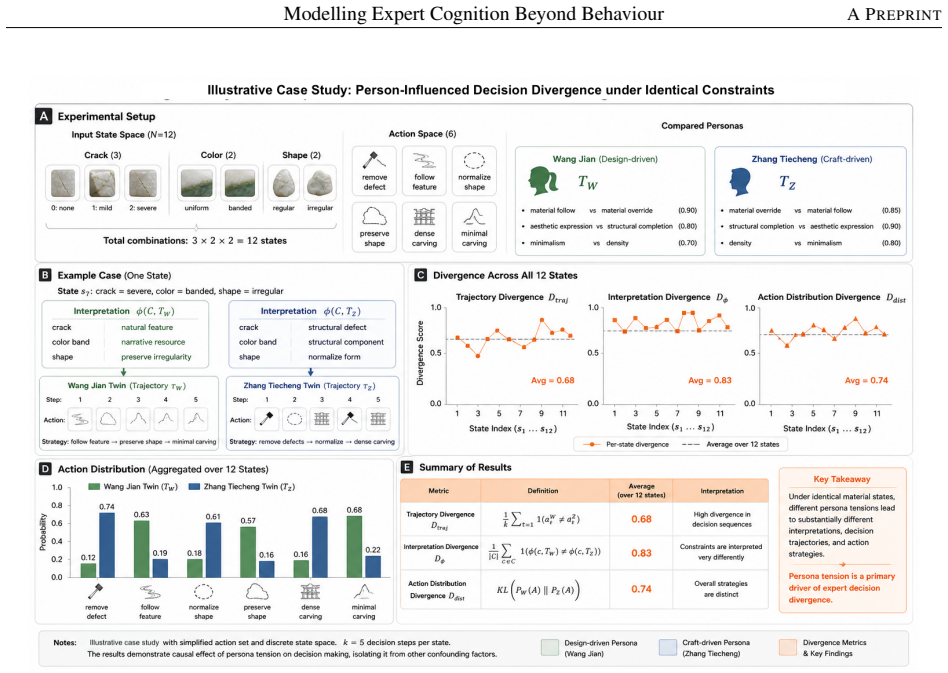
Authors: We accept this observation. In the revised manuscript we will augment the abstract and model introduction with a concise worked example (drawn from design reasoning) that illustrates how competing identity commitments generate detectable tensions, how those tensions are interpreted, and how they stabilize into guiding value structures. This addition will provide an initial operational sketch without introducing quantification or measurement procedures, which remain outside the scope of the current conceptual contribution. revision: partial
-
Referee: [Model Description] Model Description: the three-layer EICM is described only at the architectural level with no equations, pseudocode, layer-specific components, or interaction rules provided. Without these, it is impossible to assess whether the model generates testable predictions or adds explanatory power beyond relabeling existing accounts of expertise.
Authors: We agree that greater specificity is needed. The revised version will expand the model description section with explicit layer-specific components and high-level interaction rules expressed in structured pseudocode. These additions will clarify how the identity, tension, and value-structure layers interact and will indicate the kinds of testable predictions the framework can support. Formal mathematical equations are not appropriate at this stage because EICM is offered as a conceptual architecture rather than a computational implementation. revision: partial
-
Referee: [Evaluation/Discussion] Evaluation/Discussion: no case studies, datasets, comparative baselines (e.g., behavior-only models), or falsifiable predictions are supplied to show that the tension construct produces stable cross-context judgment patterns or outperforms prior approaches. This absence prevents evaluation of the framework's utility.
Authors: We acknowledge the absence of empirical content. The revised discussion section will include a dedicated subsection that derives three falsifiable predictions from the EICM (concerning cross-context judgment stability, tension-resolution patterns, and divergence from behavior-only models) and outlines minimal case-study designs that could test them. We maintain that the manuscript's primary contribution is the introduction of the conceptual framework itself; full empirical validation is planned for subsequent work. revision: partial
Circularity Check
No circularity: purely conceptual framework with no equations or fitted reductions
full rationale
The paper introduces the EICM as a descriptive three-layer conceptual architecture (interpretation of constraints via identity commitments, tension as central mechanism, stabilization into value structures) without any mathematical equations, parameter estimation, derivations, or quantitative predictions. No load-bearing steps reduce by construction to inputs, self-citations, or fitted data; the framework is advanced as an interpretive perspective rather than a derived result. The absence of formalization means there is no derivation chain that can be inspected for circularity.
Axiom & Free-Parameter Ledger
axioms (2)
- domain assumption Expert cognition operates as an identity-structured process within situational constraints.
- ad hoc to paper Constraints are interpreted through internal tensions arising from competing identity commitments and stabilised into value structures.
invented entities (3)
-
Expert Identity Cognition Model (EICM)
no independent evidence
-
internal tensions
no independent evidence
-
value structures
no independent evidence
Reference graph
Works this paper leans on
- [1]
-
[2]
ACM Computing Surveys (CSUR) , volume=
Imitation learning: A survey of learning methods , author=. ACM Computing Surveys (CSUR) , volume=. 2017 , publisher=
work page 2017
-
[3]
Reinforcement learning: An introduction , author=. 1998 , publisher=
work page 1998
-
[4]
Advances in neural information processing systems , volume=
Deep reinforcement learning from human preferences , author=. Advances in neural information processing systems , volume=
-
[5]
Advances in neural information processing systems , volume=
Training language models to follow instructions with human feedback , author=. Advances in neural information processing systems , volume=
-
[6]
Decision and organization , volume=
Theories of bounded rationality , author=. Decision and organization , volume=. 1972 , publisher=
work page 1972
-
[7]
Plans and situated actions: The problem of human-machine communication , author=. 1987 , publisher=
work page 1987
-
[8]
ACM Transactions on Computer-Human Interaction (TOCHI) , volume=
Distributed cognition: toward a new foundation for human-computer interaction research , author=. ACM Transactions on Computer-Human Interaction (TOCHI) , volume=. 2000 , publisher=
work page 2000
-
[9]
The logic of tacit inference , author=. Philosophy , volume=. 1966 , publisher=
work page 1966
- [10]
-
[11]
The reflective practitioner: How professionals think in action , author=. 2017 , publisher=
work page 2017
-
[12]
Handbook of intuition research , year=
Expert intuition and naturalistic decision making , author=. Handbook of intuition research , year=
-
[13]
Harvard business review , volume=
The knowledge-creating company , author=. Harvard business review , volume=
-
[14]
The practice turn in contemporary theory , author=. 2001 , publisher=
work page 2001
-
[15]
Situated learning: Legitimate peripheral participation , author=. 1991 , publisher=
work page 1991
- [16]
-
[17]
Handbook of sociological theory , pages=
Traditional symbolic interactionism, role theory, and structural symbolic interactionism: The road to identity theory , author=. Handbook of sociological theory , pages=. 2001 , publisher=
work page 2001
- [18]
-
[19]
Journal of Consumer Psychology , volume=
Identity-based motivation: Implications for action-readiness, procedural-readiness, and consumer behavior , author=. Journal of Consumer Psychology , volume=. 2009 , publisher=
work page 2009
-
[20]
Advances in experimental social psychology , volume=
Universals in the content and structure of values: Theoretical advances and empirical tests in 20 countries , author=. Advances in experimental social psychology , volume=. 1992 , publisher=
work page 1992
-
[21]
Early engagement and new technologies: Opening up the laboratory , pages=
Value sensitive design and information systems , author=. Early engagement and new technologies: Opening up the laboratory , pages=. 2013 , publisher=
work page 2013
-
[22]
A survey of value sensitive design methods , author=. Foundations and Trends. 2017 , publisher=
work page 2017
-
[23]
Proceedings of the 31st International Conference on Intelligent User Interfaces , pages=
Mental Models in Human-AI Interaction: Systematic Review of Empirical Methodologies and Guidelines , author=. Proceedings of the 31st International Conference on Intelligent User Interfaces , pages=
-
[24]
Extended abstracts of the 2023 CHI conference on human factors in computing systems , pages=
Unlocking the tacit knowledge of data work in machine learning , author=. Extended abstracts of the 2023 CHI conference on human factors in computing systems , pages=
work page 2023
discussion (0)
Sign in with ORCID, Apple, or X to comment. Anyone can read and Pith papers without signing in.