Recognition: no theorem link
Inverse initial data for nonlinear Schr\"odinger equation via Carleman estimates and the contraction principle
Pith reviewed 2026-05-13 02:18 UTC · model grok-4.3
The pith
A contraction mapping on a Legendre-reduced elliptic system recovers the initial wave field for the nonlinear Schrödinger equation from lateral measurements.
A machine-rendered reading of the paper's core claim, the machinery that carries it, and where it could break.
Core claim
By truncating a weighted Legendre expansion in time, the inverse initial-data problem for the nonlinear Schrödinger equation reduces to a system of nonlinear elliptic equations that admits a unique solution obtained as the fixed point of a contraction map constructed via Carleman estimates; this fixed point stays stable under small perturbations of the lateral boundary data.
What carries the argument
The Carleman-based contraction map defined on an admissible set for the spatially coupled nonlinear elliptic system that results from truncating the weighted Legendre expansion in time.
If this is right
- The initial wave field is the unique fixed point of the contraction map and can be computed by iterating the map from any admissible starting guess.
- Small noise in the lateral measurements produces only small changes in the recovered initial data.
- The same reduction and contraction argument applies to several different nonlinear exponents and to domains with different geometries in two space dimensions.
Where Pith is reading between the lines
- The same Legendre-contraction strategy could be tested on inverse problems for other time-dependent nonlinear PDEs once an appropriate Carleman estimate is available.
- Quantifying the truncation error explicitly would give a practical stopping criterion for choosing the number of Legendre modes in computations.
- If the contraction constant can be made independent of the truncation level, the method would extend directly to the full infinite-dimensional problem.
Load-bearing premise
The truncation of the Legendre series in time must be accurate enough that the fixed point of the reduced elliptic system is close to the true solution of the original time-dependent problem.
What would settle it
A concrete numerical experiment in which the Picard iterates fail to converge or the reconstruction error grows rather than shrinks when the number of Legendre modes is increased while the boundary data are held fixed.
Figures


read the original abstract
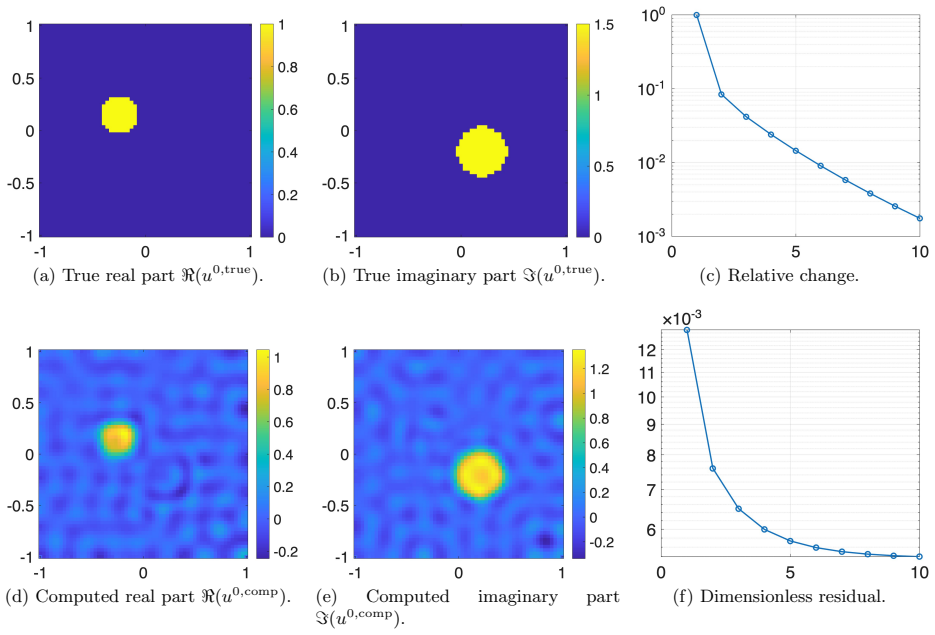
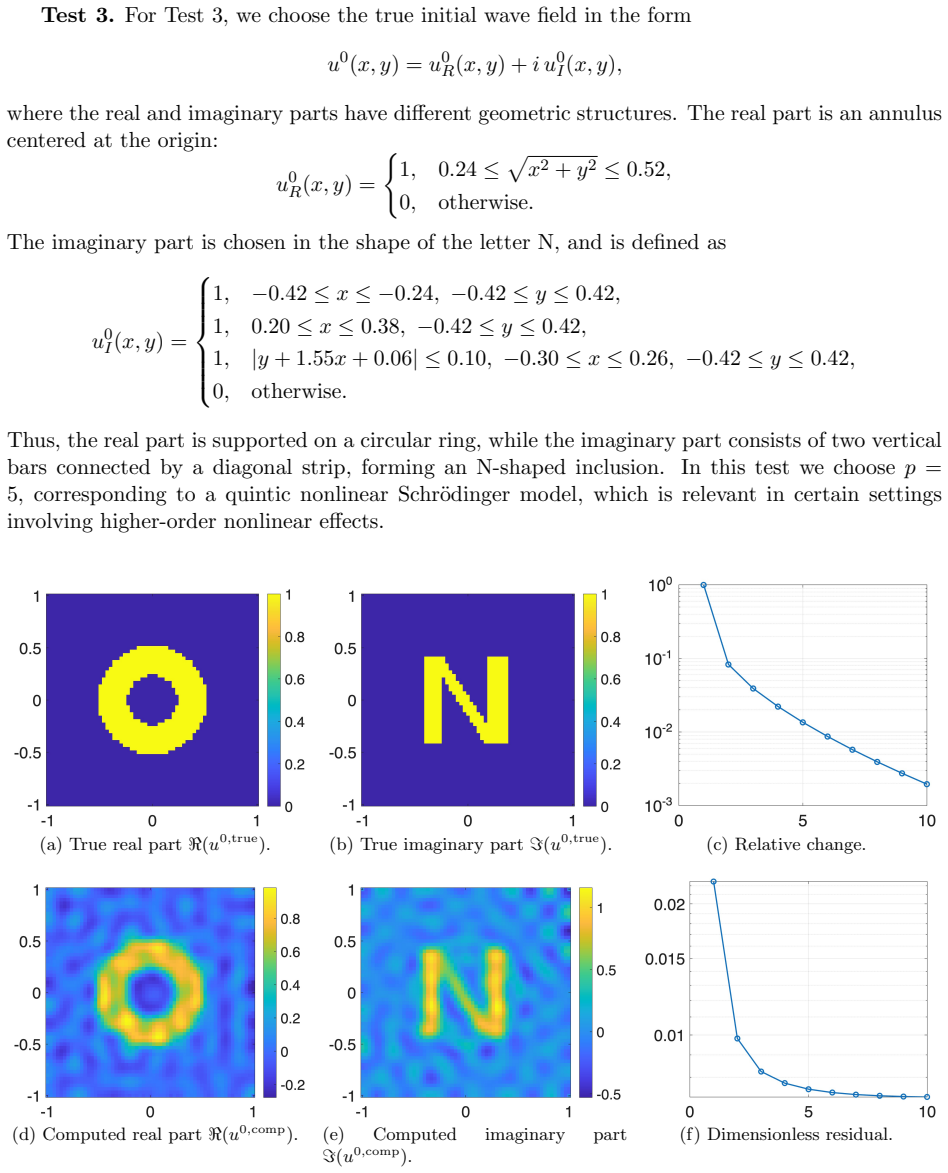
We study an inverse initial-data problem for a nonlinear Schr\"odinger equation in which the initial wave field is reconstructed from lateral measurements. Our approach combines a Legendre-polynomial-exponential-time dimensional reduction with a Carleman-based contraction principle. First, we expand the solution in a weighted Legendre basis in time and truncate the expansion to obtain a coupled nonlinear elliptic system for the spatial coefficients. Next, we solve this reduced system by constructing a contraction map on a suitable admissible set. This contraction map admits a unique fixed point, which is the limit of the corresponding Picard iteration. We also establish a stability estimate showing that this fixed point remains close to the exact reduced solution in the noisy-data case. Finally, we present numerical experiments in two space dimensions for several different geometries and nonlinear exponents. The numerical results show that the proposed method accurately reconstructs the main features of the initial wave field and remains stable even when the boundary data contain noise.
Editorial analysis
A structured set of objections, weighed in public.
Referee Report
Summary. The manuscript addresses the inverse initial-data problem for the nonlinear Schrödinger equation, reconstructing the initial wave field from lateral boundary measurements. It reduces the time-dependent problem via a weighted Legendre polynomial expansion in time, truncates to a coupled nonlinear elliptic system in space, constructs a Carleman-estimate-based contraction mapping on an admissible set whose unique fixed point is obtained as the limit of Picard iteration, proves a stability estimate for this fixed point under noisy data, and validates the approach with 2D numerical experiments across geometries and nonlinear exponents.
Significance. If the truncation error can be rigorously controlled, the work offers a novel synthesis of dimensional reduction and Carleman-based fixed-point arguments for inverse problems in nonlinear dispersive PDEs, with explicit stability under noise and supporting numerics. The contraction-mapping construction and Picard iteration are strengths that could extend to other nonlinear inverse problems.
major comments (1)
- The stability estimate (described in the abstract and stability section) establishes closeness of the fixed point to the exact reduced solution under noisy boundary data, but provides no a priori bound on the Legendre truncation remainder for solutions of the original nonlinear Schrödinger equation in Sobolev or energy norms, nor shows that this remainder remains small relative to the noise level. Without such control, stability of the reduced fixed point does not transfer to the original inverse problem, which is load-bearing for the central claim of accurate reconstruction of the initial wave field.
minor comments (2)
- The abstract and numerical section mention experiments for 'several different geometries and nonlinear exponents' but lack explicit listing of the specific domains, values of the nonlinearity power, or mesh parameters, which would aid reproducibility.
- Notation for the weighted Legendre basis and the admissible set could be introduced with a dedicated preliminary subsection to improve readability for readers unfamiliar with the reduction step.
Simulated Author's Rebuttal
We thank the referee for the thorough reading and valuable feedback on our manuscript. The major comment raises an important point about transferring stability from the reduced system to the original nonlinear Schrödinger equation, which we address below by outlining a planned revision to provide the missing a priori control on the truncation error.
read point-by-point responses
-
Referee: The stability estimate (described in the abstract and stability section) establishes closeness of the fixed point to the exact reduced solution under noisy boundary data, but provides no a priori bound on the Legendre truncation remainder for solutions of the original nonlinear Schrödinger equation in Sobolev or energy norms, nor shows that this remainder remains small relative to the noise level. Without such control, stability of the reduced fixed point does not transfer to the original inverse problem, which is load-bearing for the central claim of accurate reconstruction of the initial wave field.
Authors: We agree that a rigorous a priori bound on the Legendre truncation remainder is necessary to ensure the stability result applies to the original inverse initial-data problem. In the revised manuscript we will add a new subsection (in the stability analysis) that derives such a bound. Under standard regularity assumptions on the solution of the nonlinear Schrödinger equation (e.g., boundedness in a suitable space-time Sobolev norm), the truncation error of the weighted Legendre expansion can be estimated explicitly in terms of the number of retained modes. We will then show that, for any fixed noise level, one may choose the truncation index large enough so that the remainder is smaller than the noise amplitude, thereby allowing the stability estimate for the reduced fixed point to carry over to the original problem. The contraction-mapping parameters will be adjusted accordingly to remain compatible with this choice. This addition will be accompanied by a brief numerical illustration confirming that the truncation error decays as expected for the test cases already considered. revision: yes
Circularity Check
No circularity in derivation chain
full rationale
The paper reduces the inverse NLS problem to a truncated Legendre-weighted elliptic system, then invokes the standard contraction mapping theorem on an explicitly constructed admissible set together with known Carleman estimates to obtain a unique fixed point and a stability bound for that reduced system. None of these steps is defined in terms of its own output, no parameter is fitted to data and then relabeled as a prediction, and no load-bearing uniqueness or ansatz is imported solely via self-citation. The truncation step is presented as an approximation whose accuracy is checked numerically rather than assumed by construction; the theoretical claims remain independent of the numerical experiments. The derivation is therefore self-contained against external mathematical benchmarks.
Axiom & Free-Parameter Ledger
axioms (1)
- domain assumption The solution of the nonlinear Schrödinger equation can be approximated by a finite expansion in weighted Legendre polynomials in time with small truncation error.
Reference graph
Works this paper leans on
- [1]
-
[2]
Pranav Arrepu and Hanming Zhou. Stable determination of coefficients in nonlinear dynamical Schr¨ odinger equations by Carleman estimates. Preprint, arXiv:2508.07231, 2025
-
[3]
Lucie Baudouin and Alberto Mercado. An inverse problem for Schr¨ odinger equations with discontinuous main coefficient.Applicable Analysis, 87(10–11):1145–1165, 2008
work page 2008
-
[4]
Klibanov.Approximate Global Convergence and Adaptivity for Coefficient Inverse Problems
Larisa Beilina and Michael V. Klibanov.Approximate Global Convergence and Adaptivity for Coefficient Inverse Problems. Springer, New York, 2012
work page 2012
-
[5]
Mourad Bellassoued and Oumaima Ben Fraj. Stability estimates for time-dependent coeffi- cients appearing in the magnetic Schr¨ odinger equation from arbitrary boundary measurements. Inverse Problems and Imaging, 14(5):841–865, 2020
work page 2020
-
[6]
Mourad Bellassoued and Mourad Choulli. Logarithmic stability in the dynamical inverse prob- lem for the Schr¨ odinger equation by arbitrary boundary observation.Journal de Math´ ematiques Pures et Appliqu´ ees, 91:233–255, 2009
work page 2009
-
[7]
Mourad Bellassoued and Mourad Choulli. Stability estimate for an inverse problem for the magnetic Schr¨ odinger equation from the Dirichlet-to-Neumann map.Journal of Functional Analysis, 258(1):161–195, 2010
work page 2010
-
[8]
Mourad Bellassoued, Yavar Kian, and Eric Soccorsi. An inverse stability result for non- compactly supported potentials by one arbitrary lateral Neumann observation.Journal of Differential Equations, 260(10):7535–7562, 2016
work page 2016
-
[9]
Mourad Bellassoued, Yavar Kian, and Eric Soccorsi. An inverse problem for the magnetic Schr¨ odinger equation in infinite cylindrical domains.Publications of the Research Institute for Mathematical Sciences, 54:679–728, 2018
work page 2018
-
[10]
Ibtissem Ben A¨ ıcha and Yosra Mejri. Simultaneous determination of the magnetic field and the electric potential in the Schr¨ odinger equation by a finite number of boundary observations. Journal of Inverse and Ill-Posed Problems, 26(2):201–209, 2018
work page 2018
-
[11]
Alexander L. Bukhgeim and Michael V. Klibanov. Global uniqueness of a class of multidimen- sional inverse problems.Soviet Mathematics Doklady, 24:244–247, 1981. 27
work page 1981
-
[12]
American Mathematical Society, Providence, RI, 2003
Thierry Cazenave.Semilinear Schr¨ odinger Equations, volume 10 ofCourant Lecture Notes in Mathematics. American Mathematical Society, Providence, RI, 2003
work page 2003
-
[13]
Mourad Choulli, Yavar Kian, and Eric Soccorsi. Stable determination of time-dependent scalar potential from boundary measurements in a periodic quantum waveguide.SIAM Journal on Mathematical Analysis, 47(6):4536–4558, 2015
work page 2015
-
[14]
Michel Cristofol and Eric Soccorsi. Stability estimate in an inverse problem for non-autonomous magnetic Schr¨ odinger equations.Applicable Analysis, 90(10):1499–1520, 2011
work page 2011
-
[15]
Trong D. Dang, Loc H. Nguyen, and Huong T. T. Vu. Determining initial conditions for nonlinear hyperbolic equations with time dimensional reduction and the Carleman contraction principle.Inverse Problems, 40:125021, 2024
work page 2024
-
[16]
Klaus Deimling.Nonlinear Functional Analysis. Springer-Verlag, Berlin, 1985
work page 1985
-
[17]
Li Deng. An inverse problem for the Schr¨ odinger equation with variable coefficients and lower order terms.Journal of Mathematical Analysis and Applications, 427(2):930–940, 2015
work page 2015
-
[18]
Gregory Eskin. Inverse problems for the Schr¨ odinger operators with electromagnetic potentials in domains with obstacles.Inverse Problems, 19(4):985–996, 2003
work page 2003
-
[19]
Gregory Eskin. Inverse problems for the Schr¨ odinger equations with time-dependent elec- tromagnetic potentials and the Aharonov–Bohm effect.Journal of Mathematical Physics, 49(2):022105, 2008
work page 2008
-
[20]
Xinchi Huang, Yavar Kian, Eric Soccorsi, and Masahiro Yamamoto. Carleman estimate for the Schr¨ odinger equation and application to magnetic inverse problems.Journal of Mathematical Analysis and Applications, 474(1):116–142, 2019
work page 2019
-
[21]
Imanuvilov and Masahiro Yamamoto
Oleg Yu. Imanuvilov and Masahiro Yamamoto. Lipschitz stability in inverse parabolic problems by the Carleman estimate.Inverse Problems, 14(5):1229–1245, 1998
work page 1998
-
[22]
Vo Anh Khoa, Michael V. Klibanov, and Loc H. Nguyen. Convexification for a 3D inverse scat- tering problem with the moving point source.SIAM Journal on Imaging Sciences, 13(2):871– 904, 2020
work page 2020
-
[23]
Yavar Kian and Eric Soccorsi. H¨ older stably determining the time-dependent electromagnetic potential of the Schr¨ odinger equation.SIAM Journal on Mathematical Analysis, 51(2):627– 647, 2019
work page 2019
-
[24]
Michael V. Klibanov, Thuy T. Le, Loc H. Nguyen, Anders Sullivan, and Lam Nguyen. Convexification-based globally convergent numerical method for a 1D coefficient inverse prob- lem with experimental data.Inverse Problems and Imaging, 16(6):1579–1618, 2022
work page 2022
-
[25]
Michael V. Klibanov and Jingzhi Li.Inverse Problems and Carleman Estimates: Global Uniqueness, Global Convergence and Experimental Data. De Gruyter, Berlin, 2021
work page 2021
-
[26]
Michael V. Klibanov and Loc H. Nguyen. Carleman estimates and the contraction principle for an inverse source problem for nonlinear hyperbolic equations.Inverse Problems, 38(3):035009, 2022. 28
work page 2022
-
[27]
Katsiaryna Krupchyk and Gunther Uhlmann. Inverse problems for nonlinear magnetic Schr¨ odinger equations on conformally transversally anisotropic manifolds.Analysis and PDE, 16(8):1825–1868, 2023
work page 2023
-
[28]
Ru-Yu Lai, Xuezhu Lu, and Ting Zhou. Partial data inverse problems for the nonlinear time- dependent Schr¨ odinger equation.SIAM Journal on Mathematical Analysis, 56(4):4712–4741, 2024
work page 2024
-
[29]
Ru-Yu Lai and Ting Zhou. Partial data inverse problems for nonlinear magnetic Schr¨ odinger equations.Mathematical Research Letters, 30(5):1535–1563, 2023
work page 2023
-
[30]
Robert Latt` es and Jacques-Louis Lions.The Method of Quasi-Reversibility: Applications to Partial Differential Equations. Elsevier, New York, 1969
work page 1969
-
[31]
Thuy T. Le. Global reconstruction of initial conditions of nonlinear parabolic equations via the Carleman-contraction method. In D-L. Nguyen, L. H. Nguyen, and T-P. Nguyen, editors, Advances in Inverse problems for Partial Differential Equations, volume 784 ofContemporary Mathematics, pages 23–42. American Mathematical Society, 2023
work page 2023
-
[32]
Huynh P. N. Le, Thuy T. Le, and Loc H. Nguyen. The Carleman convexification method for Hamilton-Jacobi equations.Computers and Mathematics with Applications, 159:173–185, 2024
work page 2024
-
[33]
Thuy T. Le, Linh V. Nguyen, Loc H. Nguyen, and Hyunha Park. The time dimensional reduc- tion method to determine the initial conditions without the knowledge of damping coefficients. Computers and Mathematics with Applications, 166:77–90, 2024
work page 2024
-
[34]
Thuy T. Le and Loc H. Nguyen. A convergent numerical method to recover the initial condition of nonlinear parabolic equations from lateral Cauchy data.Journal of Inverse and Ill-Posed Problems, 30(2):265–286, 2022
work page 2022
-
[35]
Thuy T. Le, Cong B. Van, Trong D. Dang, and Loc H. Nguyen. Inverse initial data reconstruction for Maxwell’s equations via time-dimensional reduction method. Preprint, arXiv:2506.20777, 2025
-
[36]
J.-H. Lee, O. K. Pashaev, C. Rogers, and W. K. Schief. The resonant nonlinear Schr¨ odinger equation in cold plasma physics. application of B¨ acklund–Darboux transformations and super- position principles.Journal of Plasma Physics, 73(2):257–272, 2007
work page 2007
-
[37]
Alberto Mercado, Axel Osses, and Lionel Rosier. Inverse problems for the Schr¨ odinger equation via Carleman inequalities with degenerate weights.Inverse Problems, 24(1):015017, 2008
work page 2008
-
[38]
Dinh-Liem Nguyen, Loc H. Nguyen, and Trung Truong. The Carleman-based contraction principle to reconstruct the potential of nonlinear hyperbolic equations.Computers and Math- ematics with Applications, 128:239–248, 2022
work page 2022
-
[39]
Hoai-Minh Nguyen and Loc H. Nguyen. Cloaking using complementary media for the Helmholtz equation and a three spheres inequality for second order elliptic equations.Trans- actions of the American Mathematical Society, Series B, 2:93–112, 2015
work page 2015
-
[40]
Loc H. Nguyen. An inverse space-dependent source problem for hyperbolic equations and the Lipschitz-like convergence of the quasi-reversibility method.Inverse Problems, 35:035007, 2019. 29
work page 2019
-
[41]
Loc H. Nguyen. The Carleman contraction mapping method for quasilinear elliptic equations with over-determined boundary data.Acta Mathematica Vietnamica, 48:401–422, 2023
work page 2023
-
[42]
Phuong M. Nguyen and Loc H. Nguyen. A Carleman contraction method for inverse ini- tial data recovery in the Navier–Stokes equations with unknown body force.arXiv preprint arXiv:2604.09934, 2026
work page internal anchor Pith review Pith/arXiv arXiv 2026
-
[43]
Phuong M. Nguyen, Loc H. Nguyen, and Huong T. Vu. Solving the inverse scattering problem via Carleman-based contraction mapping.Computers and Mathematics with Applications, 209:129–143, 2026
work page 2026
-
[44]
Lev Pitaevskii and Sandro Stringari.Bose-Einstein Condensation and Superfluidity. Oxford University Press, 2016
work page 2016
-
[45]
Murray H. Protter. Unique continuation for elliptic equations.Transactions of the American Mathematical Society, 95(1):81–91, 1960
work page 1960
-
[46]
Abdelkarim Saci and Salah-Eddine Rebiai. An inverse problem for the Schr¨ odinger equation with Neumann boundary condition.Advances in Pure and Applied Mathematics, 14(1):50–69, 2023
work page 2023
-
[47]
Catherine Sulem and Pierre-Louis Sulem.The Nonlinear Schr¨ odinger Equation: Self-Focusing and Wave Collapse. Springer, New York, 1999
work page 1999
-
[48]
Dang D. Trong, Chanh V. Le, Khoa D. Luu, and Loc H. Nguyen. Recovery of initial displace- ment and velocity in anisotropic elastic systems by the time dimensional reduction method. Journal of Computational Physics, 542:114371, 2025
work page 2025
-
[49]
Cong B. Van, Thuy T. Le, and Loc H. Nguyen. The inverse initial data problem for anisotropic Navier–Stokes equations via Legendre time reduction method.Communications in Nonlinear Science and Numerical Simulation, 161:110074, 2026
work page 2026
-
[50]
Vitanov, Amin Chabchoub, and Norbert Hoffmann
Nikolay K. Vitanov, Amin Chabchoub, and Norbert Hoffmann. Deep-water waves: On the nonlinear Schr¨ odinger equation and its solutions.Journal of Theoretical and Applied Mechan- ics, 43(2):169–191, 2013
work page 2013
-
[51]
Springer-Verlag, New York, 1985
Eberhard Zeidler.Nonlinear Functional Analysis and its Applications, Volume III: Variational Methods and Optimization. Springer-Verlag, New York, 1985. 30
work page 1985
discussion (0)
Sign in with ORCID, Apple, or X to comment. Anyone can read and Pith papers without signing in.