Recognition: 2 theorem links
· Lean TheoremFrom Schrodinger Bridge to Optimal Transport over Sub-Riemannian Manifolds
Pith reviewed 2026-05-13 02:30 UTC · model grok-4.3
The pith
Entropic regularization via Schrödinger bridge enables numerical solution of optimal transport on sub-Riemannian manifolds and recovers the deterministic case as noise vanishes.
A machine-rendered reading of the paper's core claim, the machinery that carries it, and where it could break.
Core claim
We study the least-energy way to reshape a probability distribution when motion is constrained to a horizontal bundle. To obtain a continuous and numerically tractable formulation, we introduce an entropic regularization by adding small noise aligned with the control directions and study the associated Schrödinger bridge problem. The resulting reference process is a degenerate diffusion on the sub-Riemannian manifold. Under bracket-generating hypotheses we obtain smooth, strictly positive transition densities and a forward-backward characterization of the optimal bridge. This leads to a practical Sinkhorn-type algorithm for the Schrödinger potentials and, as the noise level vanishes, a 0.0pt
What carries the argument
The Schrödinger bridge for a degenerate diffusion on a sub-Riemannian manifold obtained by adding noise along horizontal control directions, which regularizes the optimal transport problem.
If this is right
- Smooth strictly positive transition densities for the reference process under bracket-generating hypotheses.
- Forward-backward characterization of the optimal Schrödinger bridge.
- Practical Sinkhorn-type algorithm to compute the Schrödinger potentials.
- Recovery of the deterministic sub-Riemannian optimal transport problem in the vanishing-noise limit.
Where Pith is reading between the lines
- The construction could extend density-control methods to a wider class of nonholonomic mechanical systems.
- Similar noise-based regularizations may render other degenerate geometric transport problems numerically tractable.
- The forward-backward structure opens the door to iterative schemes on manifolds where direct dynamic programming is intractable.
Load-bearing premise
The bracket-generating hypotheses on the sub-Riemannian manifold must hold to ensure the degenerate diffusion has smooth and strictly positive transition densities.
What would settle it
A computation on the Heisenberg group showing that the transition densities are not smooth and positive despite the bracket-generating condition, or that the Sinkhorn algorithm fails to recover known deterministic optimal transport costs as noise approaches zero.
Figures


read the original abstract
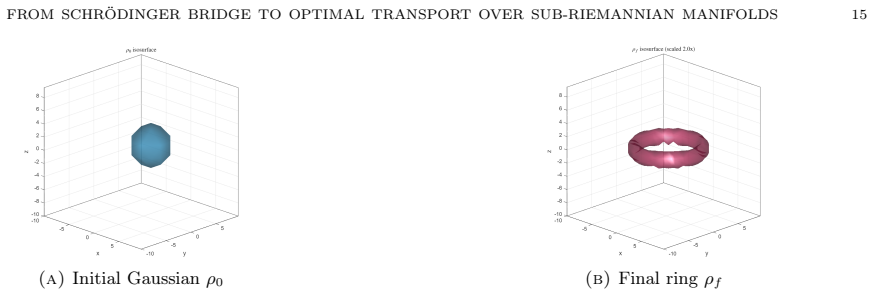
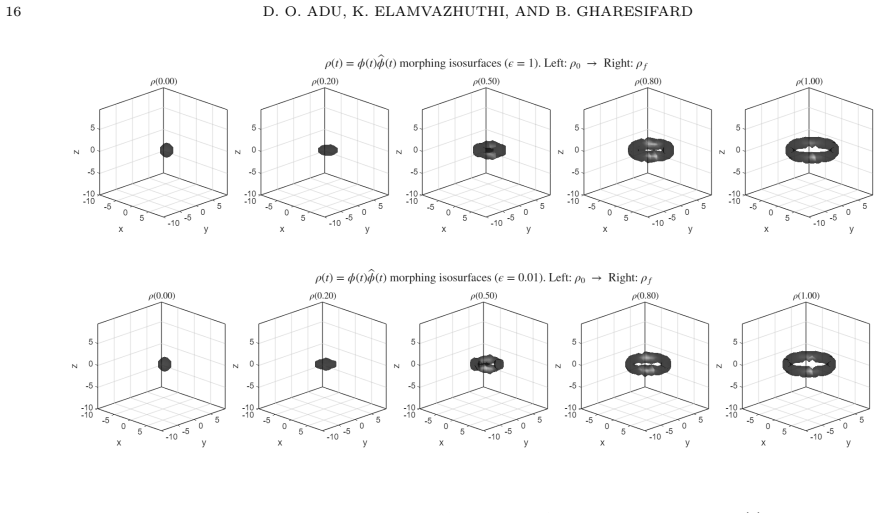
We study the least-energy way to reshape a probability distribution when motion is constrained to a horizontal bundle, that is, optimal transport and distribution steering in sub-Riemannian geometry, motivated by density control over underactuated systems. To obtain a continuous and numerically tractable formulation, we introduce an entropic regularization by adding small noise aligned with the control directions and study the associated Schrodinger bridge problem. The resulting reference process is a degenerate diffusion on the sub-Riemannian manifold. Under bracket-generating hypotheses we obtain smooth, strictly positive transition densities and a forward--backward characterization of the optimal bridge. This leads to a practical Sinkhorn-type algorithm for the Schrodinger potentials and, as the noise level vanishes, a recovery of the deterministic sub-Riemannian optimal transport problem. We demonstrate with a numerical example.
Editorial analysis
A structured set of objections, weighed in public.
Referee Report
Summary. The manuscript extends the Schrödinger bridge and entropic optimal transport to sub-Riemannian manifolds by regularizing the deterministic horizontal control problem with small noise in the control directions, yielding a degenerate diffusion as reference process. Under bracket-generating hypotheses it establishes smooth strictly positive transition densities, derives a forward-backward characterization of the optimal bridge, obtains a practical Sinkhorn-type algorithm for the Schrödinger potentials, and proves that the zero-noise limit recovers the deterministic sub-Riemannian optimal transport problem; the claims are illustrated by a numerical example.
Significance. If the derivations hold, the work supplies a principled, numerically tractable route to distribution steering on underactuated systems and bridges stochastic and deterministic sub-Riemannian control. The combination of hypoelliptic regularity with entropic OT theory is natural; the parameter-free recovery of the deterministic problem and the explicit Sinkhorn iteration are concrete strengths that could be useful in robotics and geometric control.
major comments (2)
- [§4, Theorem 4.3] §4, Theorem 4.3 (forward-backward characterization): the derivation adapts the classical duality argument, but the degeneracy of the diffusion requires an explicit verification that the Girsanov-type change of measure remains valid on the horizontal bundle; the current sketch does not address the possible loss of absolute continuity with respect to the reference measure.
- [§6, Proposition 6.1] §6, Proposition 6.1 (zero-noise limit): the convergence statement is stated in the weak topology, yet the paper claims recovery of the deterministic sub-Riemannian OT; a quantitative rate or a stronger topology (e.g., narrow convergence of plans) would be needed to make the limit claim load-bearing for applications.
minor comments (3)
- [§2] The notation for the horizontal bundle and the sub-Riemannian metric is introduced only in §2; repeating the key symbols in the statement of the main theorems would improve readability.
- [§7] The numerical example in §7 does not specify the discretization scheme for the degenerate diffusion or the convergence tolerance used in the Sinkhorn iteration; these details are necessary for reproducibility.
- [Introduction] Several references to the classical Schrödinger bridge literature (e.g., the original works of Schrödinger and modern entropic OT papers) are missing from the introduction; adding them would better situate the contribution.
Simulated Author's Rebuttal
We thank the referee for the careful reading, positive overall assessment, and constructive technical comments. We address each major point below and have revised the manuscript to incorporate the suggested clarifications and strengthen the arguments where feasible.
read point-by-point responses
-
Referee: [§4, Theorem 4.3] §4, Theorem 4.3 (forward-backward characterization): the derivation adapts the classical duality argument, but the degeneracy of the diffusion requires an explicit verification that the Girsanov-type change of measure remains valid on the horizontal bundle; the current sketch does not address the possible loss of absolute continuity with respect to the reference measure.
Authors: We appreciate this observation on the technical subtlety introduced by degeneracy. In the revised version we have expanded the proof of Theorem 4.3 with an explicit verification: using the bracket-generating condition we establish that the horizontal diffusion produces a reference measure under which the Girsanov density remains a true martingale, thereby guaranteeing absolute continuity on the horizontal path space and validating the duality argument without additional loss of mass. revision: yes
-
Referee: [§6, Proposition 6.1] §6, Proposition 6.1 (zero-noise limit): the convergence statement is stated in the weak topology, yet the paper claims recovery of the deterministic sub-Riemannian OT; a quantitative rate or a stronger topology (e.g., narrow convergence of plans) would be needed to make the limit claim load-bearing for applications.
Authors: The referee correctly notes that only weak convergence is proved. Weak convergence is nevertheless sufficient for recovery of the deterministic problem, since the sub-Riemannian cost is lower semi-continuous and the marginal constraints are preserved. To make the result more directly useful for applications we have added narrow convergence of the entropic plans to an optimal deterministic plan, obtained via tightness from the sub-Riemannian geometry and bracket-generating assumption. A quantitative rate is not included, as it would require further hypotheses on the manifold and cost; a remark has been added outlining the conditions under which such rates follow from standard hypoelliptic estimates. revision: partial
Circularity Check
No significant circularity; standard hypoellipticity and adaptation of entropic OT
full rationale
The derivation begins with the standard Schrödinger bridge formulation on a sub-Riemannian manifold equipped with a degenerate diffusion whose generator satisfies the bracket-generating (Hörmander) condition. This condition is an external, classical hypothesis that directly yields the existence of smooth positive transition densities via well-known hypoelliptic regularity theory; it is not derived from or defined in terms of the paper's own results. The forward-backward characterization of the optimal bridge, the Sinkhorn iteration for the potentials, and the vanishing-noise limit recovering deterministic sub-Riemannian OT are obtained by direct, verbatim adaptation of existing entropic optimal transport arguments on manifolds. No equation is shown to equal its own input by construction, no parameter is fitted to a subset and then relabeled a prediction, and no load-bearing uniqueness or ansatz is imported solely via self-citation. The central claims therefore remain independent of the paper's own fitted quantities or prior self-referential statements.
Axiom & Free-Parameter Ledger
free parameters (1)
- noise level
axioms (1)
- domain assumption bracket-generating hypotheses
Lean theorems connected to this paper
-
IndisputableMonolith/Foundation/AlexanderDuality.leanalexander_duality_circle_linking unclearUnder bracket-generating hypotheses we obtain smooth, strictly positive transition densities... hypoelliptic... Hörmander condition... Bismut/submersion condition
-
IndisputableMonolith/Foundation/ArithmeticFromLogic.leanreality_from_one_distinction unclearSchrödinger bridge problem... Sinkhorn-type algorithm... zero-noise limit... deterministic sub-Riemannian optimal transport
Reference graph
Works this paper leans on
-
[1]
Daniel Owusu Adu,Optimal transport for averaged control, IEEE Control Systems Letters7(2022), 727–732
work page 2022
-
[2]
Daniel Owusu Adu and Yongxin Chen,Schrödinger bridge over averaged systems, (2024)
work page 2024
-
[3]
Andrei Agrachev and Paul Lee,Optimal transportation under nonholonomic constraints, Transactions of the American Mathematical Society361(2009), no. 11, 6019–6047
work page 2009
-
[4]
Luigi Ambrosio, Nicola Gigli, and Giuseppe Savaré,Gradient flows: in metric spaces and in the space of probability measures, Springer, 2005
work page 2005
-
[5]
G Ben Arous and Rémi Léandre,Décroissance exponentielle du noyau de la chaleur sur la diagonale (ii), Probability Theory and Related Fields90(1991), no. 3, 377–402
work page 1991
-
[6]
Davide Barilari, Ugo Boscain, and Robert W Neel,Small-time heat kernel asymptotics at the sub-Riemannian cut locus, Journal of Differential Geometry92(2012), no. 3, 373–416
work page 2012
-
[7]
GérardBenArous,Développement asymptotique du noyau de la chaleur hypoelliptique hors du cut-locus, AnnalesScientifiques de l’École Normale Supérieure21(1988), no. 3, 307–331
work page 1988
-
[8]
Jean-David Benamou and Yann Brenier,A computational fluid mechanics solution to the Monge–Kantorovich mass transfer problem, Numerische Mathematik84(2000), no. 3, 375–393
work page 2000
-
[9]
Patrick Billingsley,Probability and Measure, 3 ed., John Wiley & Sons, New York, 1995
work page 1995
-
[10]
Andrea Bonfiglioli, Ermanno Lanconelli, and Francesco Uguzzoni,Stratified Lie groups and Potential Theory for their Sub- Laplacians, Springer, 2007
work page 2007
-
[11]
Michel Boué and Paul Dupuis,A variational representation for certain functionals of Brownian motion, The Annals of Probability26(1998), no. 4, 1641–1659. MR 1675051
work page 1998
-
[12]
Roger W Brockett,Optimal control of the Liouville equation, AMS IP Studies in Advanced Mathematics39(2007), 23
work page 2007
-
[13]
YongxinChen, TryphonT.Georgiou, andMichelePavon,Entropic and displacement interpolation: A computational approach using the Hilbert metric, SIAM J. Appl. Math.76(2016), no. 6, 2375–2396
work page 2016
-
[14]
Yongxin Chen, Tryphon T Georgiou, and Michele Pavon,Optimal transport over a linear dynamical system, IEEE Transac- tions on Automatic Control62(2016), no. 5, 2137–2152
work page 2016
- [15]
-
[16]
Alberto Chiarini and Markus Fischer,On large deviations for small noise Itô processes, Advances in Applied Probability46 (2014), no. 4, 1126–1147
work page 2014
-
[17]
Marco Cuturi,Sinkhorn distances: Lightspeed computation of optimal transport, Advances in Neural Information Processing Systems26(2013)
work page 2013
-
[18]
Paolo Dai Pra,A stochastic control approach to reciprocal diffusion processes, Applied Mathematics and Optimization23 (1991), no. 1, 313–329
work page 1991
-
[19]
8, Springer Science & Business Media, 2012
Gianni Dal Maso,An introduction toγ-convergence, vol. 8, Springer Science & Business Media, 2012
work page 2012
-
[20]
Amir Dembo and Ofer Zeitouni,Large deviations techniques and applications, 2nd ed., Applications of Mathematics (New York), vol. 38, Springer, New York, 1998
work page 1998
-
[21]
Joseph L. Doob,Classical potential theory and its probabilistic counterpart, Grundlehren der Mathematischen Wissenschaften, vol. 262, Springer, New York, 1984
work page 1984
-
[22]
Paul Dupuis and Richard S. Ellis,A weak convergence approach to the theory of large deviations, Wiley Series in Probability and Statistics, John Wiley & Sons, New York, 1997
work page 1997
- [23]
-
[24]
Karthik Elamvazhuthi, Siting Liu, Wuchen Li, and Stanley Osher,Dynamical optimal transport of nonlinear control-affine systems, Journal of Computational Dynamics10(2023), no. 4, 425–449
work page 2023
-
[25]
Alessio Figalli and Ludovic Rifford,Mass transportation on sub-Riemannian manifolds, Geometric and Functional Analysis 20(2010), no. 1, 124–159
work page 2010
-
[26]
Schrödinger, Journal de Mathématiques Pures et Appliquées19 (1940), no
Robert Fortet,Résolution d’un Système d’équations de M. Schrödinger, Journal de Mathématiques Pures et Appliquées19 (1940), no. 1–4, 83–105
work page 1940
-
[27]
Mark I. Freidlin and Alexander D. Wentzell,Random perturbations of dynamical systems, 3 ed., Grundlehren der Mathema- tischen Wissenschaften, vol. 260, Springer, Berlin, 2012
work page 2012
-
[28]
Asim Halder and Debasish Mondal,Sub-Riemannian geometric approach to design nonlinear optimal STATCOM controller for power systems, 2021 Innovations in Energy Management and Renewable Resources (52042), IEEE, 2021, pp. 1–6
work page 2021
-
[29]
Ahed Hindawi, J-B Pomet, and Ludovic Rifford,Mass transportation with lq cost functions, Acta Applicandae Mathematicae 113(2011), no. 2, 215–229. FROM SCHRÖDINGER BRIDGE TO OPTIMAL TRANSPORT OVER SUB-RIEMANNIAN MANIFOLDS 21
work page 2011
-
[30]
Lars Hörmander,Hypoelliptic second-order differential equations, Acta Mathematica119(1967), 147–171
work page 1967
- [31]
- [32]
-
[33]
Christian Léonard,Stochastic derivatives and generalizedh-transforms of Markov processes, arXiv preprint, 2011
work page 2011
-
[34]
Christian Léonard,From the Schrödinger problem to the Monge–Kantorovich problem, Journal of Functional Analysis262 (2012), no. 4, 1879–1920
work page 2012
-
[35]
Christian Léonard,A survey of the Schrödinger problem and some of its connections with optimal transport, Probability Surveys11(2014), 1–66
work page 2014
-
[36]
Richard M Murray, Zexiang Li, and S Shankar Sastry,A mathematical introduction to robotic manipulation, CRC press, 2017
work page 2017
-
[37]
Bernt Øksendal,Stochastic differential equations, Stochastic Differential Equations: An Introduction with Applications, Springer, 2003, pp. 38–50
work page 2003
-
[38]
Ludovic Rifford,Sub-Riemannian geometry and optimal transport, Springer Science & Business Media (2012)
work page 2012
-
[39]
Erwin Schrödinger,Über die umkehrung der naturgesetze, Verlag der Akademie der Wissenschaften in Kommission bei Walter De Gruyter u ..., 1931
work page 1931
-
[40]
ArchanaTiwariandAmitJena,Optimal control on SU (2) Lie group with stability analysis, InternationalJournalofDynamics and Control8(2020), no. 2, 508–517
work page 2020
-
[41]
Archana Tiwari and KC Pati,An optimal control problem associated with Lorentz group SO (3; 1), International Journal of Modelling, Identification and Control40(2022), no. 3, 271–278
work page 2022
discussion (0)
Sign in with ORCID, Apple, or X to comment. Anyone can read and Pith papers without signing in.