Recognition: no theorem link
Weyl Groups and the Modified Kostant Game
Pith reviewed 2026-05-13 01:48 UTC · model grok-4.3
The pith
A generalization of the Kostant game via multi-vertex modifications establishes a bijection between game configurations and minimal length representatives of parabolic quotients in Weyl groups.
A machine-rendered reading of the paper's core claim, the machinery that carries it, and where it could break.
Core claim
The configurations obtained from the modified Kostant game with arbitrary multi-vertex rules are in one-to-one correspondence with the minimal-length representatives of the parabolic quotients W/W_J. The bijection respects the length function on the Weyl group and is compatible with the Bruhat order, thereby giving an algorithmic and dynamical perspective on reduced words and their properties.
What carries the argument
the multi-vertex modified Kostant game, a combinatorial process on the positive roots where each configuration represents a set of roots and moves update multiple components while preserving positivity and length conditions
If this is right
- The game enumerations produce a novel identity for counting roots in the root system.
- The framework formalizes a Coxeter-theoretic basis for combinatorial attacks on the Mukai conjecture.
- Reduced word languages in these groups are regular and can be recognized by finite state automata.
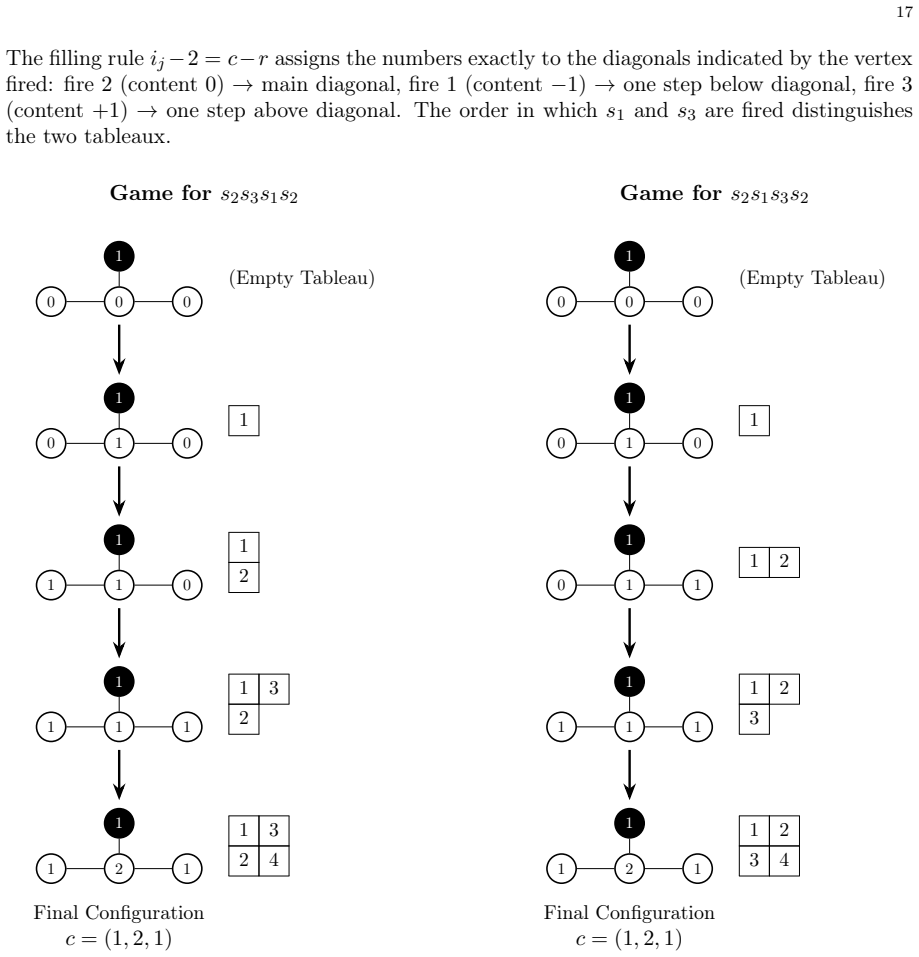
- Standard Young Tableaux arise dynamically as sequences of moves in the game for appropriate choices of the modification rules.
Where Pith is reading between the lines
- The bijection suggests that termination conditions or winning strategies in the game correspond to algebraic properties of the parabolic quotients.
- Similar modifications to other root games could yield analogous bijections for different poset structures in representation theory.
- The automata construction opens the possibility of using language theory tools to analyze word problems in Coxeter groups.
- The dynamic tableau construction may lead to new recursive algorithms for generating tableaux in type A cases.
Load-bearing premise
The specific rules chosen for the multi-vertex modifications must maintain the key combinatorial invariants, including the length function and Bruhat order relations, so that the bijection holds for any parabolic subgroup.
What would settle it
Construct a counterexample by selecting a small Weyl group such as the symmetric group S_4, a nontrivial parabolic subgroup, and a multi-vertex rule for which the number or structure of reachable game configurations differs from the known number of minimal coset representatives.
Figures



read the original abstract
This paper presents a generalization of the Kostant game, a combinatorial framework originally for generating positive roots in Lie algebras. By introducing an arbitrary multi-vertex modification, we prove that the resulting game configurations naturally biject with the minimal length representatives of parabolic quotients W/W_J. This yields a dynamical and algorithmic perspective on reduced words. Finally, we apply this framework to derive a novel root counting identity, formalize the Coxeter-theoretic foundation for combinatorial approaches to the Mukai conjecture, establish the regularity of reduced word languages via finite state automata, and dynamically construct Standard Young Tableaux.
Editorial analysis
A structured set of objections, weighed in public.
Referee Report
Summary. The paper generalizes the Kostant game on positive roots by introducing an arbitrary multi-vertex modification. It claims to prove that the legal configurations of this modified game are in natural bijection with the minimal-length coset representatives of parabolic quotients W/W_J in a Weyl group W. The framework is then used to give a dynamical view of reduced words, derive a root-counting identity, supply a Coxeter-theoretic basis for combinatorial attacks on the Mukai conjecture, prove that the language of reduced words is regular via finite-state automata, and construct standard Young tableaux dynamically.
Significance. If the central bijection is established with the claimed generality, the work supplies a new combinatorial dynamical system for studying parabolic quotients and reduced words. The applications to automata regularity and to the Mukai conjecture would be of interest to specialists in Coxeter combinatorics and representation theory, provided the invariance properties under the modification are rigorously verified.
major comments (1)
- [Abstract and game-definition section] Abstract and the section defining the modified game: the claim that the multi-vertex modification may be chosen arbitrarily while still preserving a bijection with W/W_J for every parabolic J is load-bearing. The rules must leave the length function and the covering relations of the induced Bruhat order invariant; otherwise non-reduced sequences or missing minimal representatives can appear. The manuscript must state the precise constraints on the allowed modifications and prove that every such choice satisfies the required invariance (length additivity and Bruhat compatibility). Without this, the generality asserted in the central theorem does not follow.
minor comments (1)
- [Abstract] The abstract lists four applications; each should be cross-referenced to the corresponding theorem or proposition so that readers can locate the precise statements.
Simulated Author's Rebuttal
We thank the referee for the careful and constructive report. The single major comment identifies a genuine need for greater precision regarding the scope of admissible modifications, and we will revise the manuscript accordingly to strengthen the central claims.
read point-by-point responses
-
Referee: [Abstract and game-definition section] Abstract and the section defining the modified game: the claim that the multi-vertex modification may be chosen arbitrarily while still preserving a bijection with W/W_J for every parabolic J is load-bearing. The rules must leave the length function and the covering relations of the induced Bruhat order invariant; otherwise non-reduced sequences or missing minimal representatives can appear. The manuscript must state the precise constraints on the allowed modifications and prove that every such choice satisfies the required invariance (length additivity and Bruhat compatibility). Without this, the generality asserted in the central theorem does not follow.
Authors: We agree that the modifications cannot be completely arbitrary and that the manuscript should explicitly delineate the admissible class together with a proof of the required invariance. In the revised version we will insert a dedicated subsection immediately after the game definition that (i) states the precise constraints (compatibility with the root poset, preservation of length under each move, and retention of the covering relations of the induced Bruhat order on the quotient), (ii) proves that any modification obeying these constraints yields configurations in bijection with the minimal-length coset representatives of W/W_J, and (iii) verifies that the length function and Bruhat covering relations remain invariant. These additions will be cross-referenced in the abstract and will underpin all subsequent applications (reduced-word dynamics, root-counting identity, automata regularity, and the Mukai-conjecture foundation). The main theorems themselves are unaffected; only their supporting hypotheses are made fully explicit. revision: yes
Circularity Check
No circularity: bijection derived from explicit combinatorial rules
full rationale
The paper defines an arbitrary multi-vertex modification to the Kostant game and then proves (rather than assumes) that the resulting configurations are in bijection with minimal-length coset representatives in W/W_J. The derivation relies on verifying that the modified moves preserve length and Bruhat order compatibility, which is an independent combinatorial check rather than a self-definition, fitted parameter, or self-citation chain. No step reduces the claimed bijection to its own inputs by construction; the result is a theorem whose hypotheses are stated separately from its conclusion.
Axiom & Free-Parameter Ledger
axioms (1)
- standard math Standard properties of Weyl groups, parabolic subgroups, and the length function on cosets
Reference graph
Works this paper leans on
-
[1]
(2005).Combinatorics of Coxeter Groups
Björner, A., & Brenti, F. (2005).Combinatorics of Coxeter Groups. Graduate Texts in Mathematics, vol
work page 2005
-
[2]
Springer, Berlin, Heidelberg
-
[3]
Pure and Applied Mathematics Quarterly19(2023), no
CaviedesCastro, A., Pabiniak, M., &Sabatini, S.(2023).GeneralizingtheMukaiConjecturetothesymplectic category and the Kostant game. Pure and Applied Mathematics Quarterly19(2023), no. 4, 1803–1837
work page 2023
-
[4]
Casagrande,The number of vertices of a Fano polytope, Annales de l’Institut Fourier56(2006), no
C. Casagrande,The number of vertices of a Fano polytope, Annales de l’Institut Fourier56(2006), no. 1, 121–130
work page 2006
-
[5]
(2017).Topics in Combinatorics; Lecture Notes (Taught by Alexander Postnikov)
Chen, E. (2017).Topics in Combinatorics; Lecture Notes (Taught by Alexander Postnikov). MIT Lecture notes
work page 2017
-
[6]
J. E. Hopcroft & J. D. Ullman,Introduction to Automata Theory, Languages, and Computation, Addison- Wesley, 1979
work page 1979
-
[7]
Humphreys, J. E. (1972).Introduction to Lie Algebras and Representation Theory. Graduate Texts in Math- ematics, vol. 9. Springer-Verlag, New York
work page 1972
-
[8]
S. Mukai,Problems on characterization of the complex projective space, Birational Geometry of Algebraic Varieties, Open Problems, Proceedings of the 23rd Symposium of the Taniguchi Foundation at Katata, Japan (1988), 57–60
work page 1988
-
[9]
Pasquier,Variétés horosphériques de Fano,Bull
B. Pasquier,Variétés horosphériques de Fano,Bull. Soc. Math. France,136, (2008), no. 2, 195–225
work page 2008
-
[10]
Reineke,The Mukai Conjecture for Fano Quiver Moduli, Algebras and Representation Theory, Vol
M. Reineke,The Mukai Conjecture for Fano Quiver Moduli, Algebras and Representation Theory, Vol. 27, pp. 1641–1644, 2024. Doi 10.1007/s10468-024-10268-8
-
[11]
R. Winkel,A combinatorial bijection between standard Young tableaux and reduced words of Grassmannian permutations, Séminaire Lotharingien de Combinatoire36(1996), Article B36h. Department of Mathematics, Universidad Nacional de Colombia Email address:acaviedesc@unal.edu.co Department of Mathematics, Universidad Nacional de Colombia Email address:juascort...
work page 1996
discussion (0)
Sign in with ORCID, Apple, or X to comment. Anyone can read and Pith papers without signing in.