Recognition: no theorem link
Resolving the Gibbs Phenomenon in Fractional Fourier Series via Inverse Polynomial Reconstruction
Pith reviewed 2026-05-13 02:20 UTC · model grok-4.3
The pith
The inverse polynomial reconstruction method extends to fractional Fourier series and removes the Gibbs phenomenon independently of the rotation angle.
A machine-rendered reading of the paper's core claim, the machinery that carries it, and where it could break.
Core claim
The paper claims that extending the inverse polynomial reconstruction method to fractional Fourier series produces a fractional transformation matrix whose conditioning is governed by an alpha-independent Gram matrix; this yields an L infinity error estimate that guarantees exponential convergence for analytic functions and, in numerical tests on piecewise analytic functions, completely eliminates the Gibbs phenomenon.
What carries the argument
The inverse polynomial reconstruction method, which enforces that the fractional Fourier coefficients of a Gegenbauer polynomial expansion exactly match the given spectral data.
Load-bearing premise
The target functions must be piecewise analytic or at least smooth away from jumps, and the Gegenbauer parameter must be chosen so the Gram matrix stays well-conditioned at the chosen polynomial degree.
What would settle it
Persistent oscillations near discontinuities in the reconstructed series for a simple piecewise analytic test function such as a step, even after the polynomial degree is increased, would show that the Gibbs phenomenon has not been eliminated.
Figures



read the original abstract
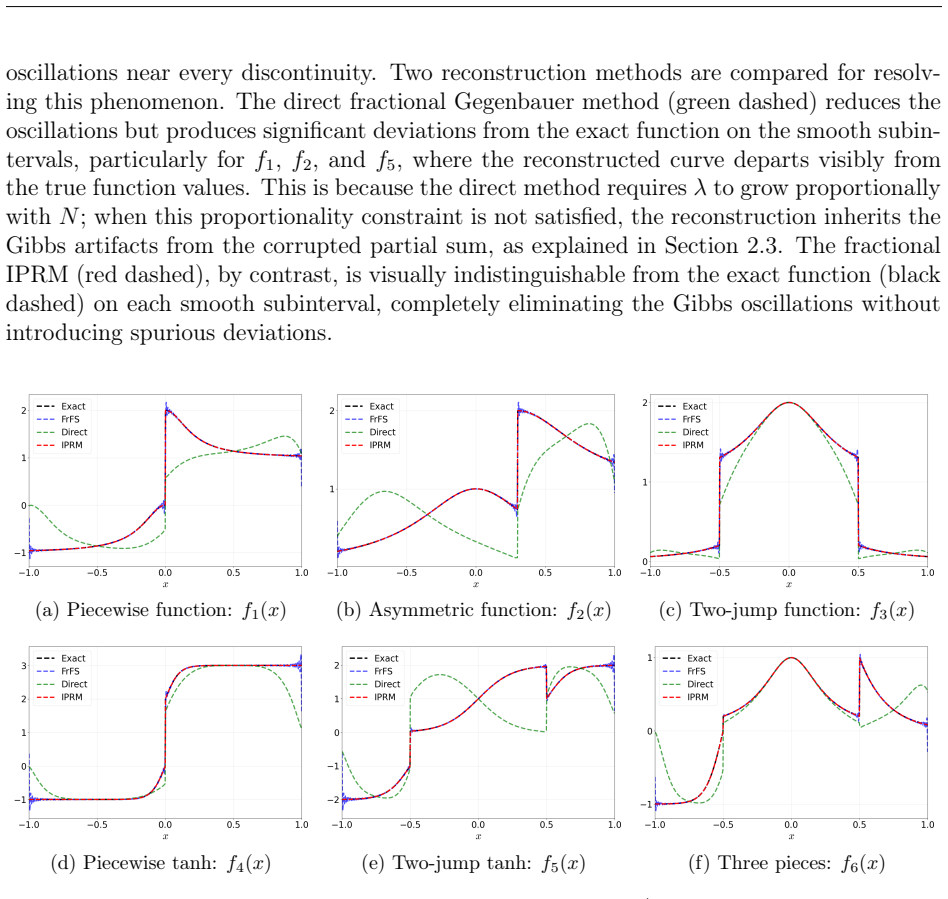
The fractional Fourier series generalizes the classical Fourier series by introducing a rotation angle $\alpha$ in the time-frequency plane, but inherits the Gibbs phenomenon for piecewise smooth functions. Unlike the classical setting, the chirp modulation factor renders the fractional partial sum complex-valued, corrupting both real and imaginary components simultaneously and making direct adaptation of classical remedies insufficient. The Inverse Polynomial Reconstruction Method (IPRM) resolves the Gibbs phenomenon by enforcing that the Fourier coefficients of a Gegenbauer polynomial expansion match the given spectral data, rather than projecting the corrupted partial sum onto a polynomial basis. This paper extends the IPRM to fractional Fourier series for the first time. The fractional transformation matrix is derived and its conditioning is shown to be governed by an $\alpha$-independent Gram matrix, which reveals the dependence on the Gegenbauer parameter $\lambda$ and the polynomial degree $m$, while being entirely insensitive to the transform angle. An $L^{\infty}$ error estimate is established, guaranteeing exponential convergence for analytic functions. Numerical experiments on piecewise analytic test functions demonstrate complete elimination of the Gibbs phenomenon and confirm the theoretical predictions.
Editorial analysis
A structured set of objections, weighed in public.
Referee Report
Summary. The paper extends the Inverse Polynomial Reconstruction Method (IPRM) to fractional Fourier series in order to resolve the Gibbs phenomenon for piecewise smooth functions. It derives the fractional transformation matrix, proves that its conditioning is controlled by an α-independent Gram matrix G(λ,m) arising from Gegenbauer inner products, establishes an L^∞ error estimate that guarantees exponential convergence for analytic functions, and reports numerical experiments on piecewise analytic test functions that demonstrate complete elimination of Gibbs ringing.
Significance. If the conditioning analysis and error bounds are rigorous, the work supplies a stable, angle-independent reconstruction procedure that generalizes classical IPRM to the fractional Fourier setting. The α-independence of the Gram matrix is a genuine technical strength, as it decouples reconstruction stability from the rotation angle. The exponential convergence claim for analytic functions, if supported by a complete proof, would be a useful theoretical guarantee.
major comments (2)
- [Abstract (and the derivation of the fractional transformation matrix)] The central stability claim rests on the Gram matrix G(λ,m) remaining well-conditioned for the chosen m. The abstract asserts that the dependence on λ and m is revealed, yet no explicit growth bound on cond(G(λ,m)) or concrete selection rule λ(m) is supplied that would keep the condition number from outpacing the exponential convergence rate. This is load-bearing for the numerical reliability of the linear solve that recovers the Gegenbauer coefficients.
- [Theoretical Analysis (error estimate section)] The L^∞ error estimate is stated to guarantee exponential convergence for analytic functions. Without a proof sketch, the precise dependence of the constant on cond(G) and on the distance to the nearest singularity, it is impossible to confirm that the bound remains valid once the reconstruction step is included.
minor comments (2)
- [Numerical Experiments] The abstract refers to numerical experiments that demonstrate complete Gibbs elimination and confirm theoretical predictions, but supplies no quantitative error tables, convergence rates, or comparisons with direct fractional Fourier summation.
- [Introduction / Preliminaries] Define the precise form of the fractional Fourier series and the entries of the transformation matrix at the first appearance rather than deferring all notation to later sections.
Simulated Author's Rebuttal
We thank the referee for the careful reading, the positive evaluation of the work's significance, and the constructive comments on stability and error analysis. We address each major comment below.
read point-by-point responses
-
Referee: [Abstract (and the derivation of the fractional transformation matrix)] The central stability claim rests on the Gram matrix G(λ,m) remaining well-conditioned for the chosen m. The abstract asserts that the dependence on λ and m is revealed, yet no explicit growth bound on cond(G(λ,m)) or concrete selection rule λ(m) is supplied that would keep the condition number from outpacing the exponential convergence rate. This is load-bearing for the numerical reliability of the linear solve that recovers the Gegenbauer coefficients.
Authors: We agree that an explicit a priori bound on cond(G(λ,m)) and a concrete selection rule for λ(m) would strengthen the stability analysis. The manuscript derives the closed-form expression for the α-independent Gram matrix G(λ,m) arising from the Gegenbauer inner products and shows how its entries depend on λ and m; this already reveals the dependence. Numerical results in the experiments section confirm that the chosen parameters keep the linear solve stable and yield accurate reconstructions. In the revision we will add a remark (or short appendix) providing a growth estimate for cond(G) based on standard bounds for Gegenbauer polynomials and propose a practical rule λ(m) ∼ m^β with β small enough that cond(G) grows at most polynomially, which remains compatible with exponential convergence. revision: partial
-
Referee: [Theoretical Analysis (error estimate section)] The L^∞ error estimate is stated to guarantee exponential convergence for analytic functions. Without a proof sketch, the precise dependence of the constant on cond(G) and on the distance to the nearest singularity, it is impossible to confirm that the bound remains valid once the reconstruction step is included.
Authors: The L^∞ estimate combines the classical exponential approximation rate of Gegenbauer polynomials (controlled by the distance to the nearest singularity in the complex plane) with the operator norm of the reconstruction step, which is bounded by cond(G). The manuscript states the final bound but does not spell out the intermediate steps that track these two factors separately. We will insert a concise proof sketch in the revised theoretical section that explicitly factors the constant into C(analyticity radius) · cond(G) and verifies that the exponential rate is preserved whenever cond(G) grows slower than the approximation factor, which is ensured by the parameter choices already used in the numerics. revision: partial
Circularity Check
No circularity; derivation rests on independent Gegenbauer properties and analytic approximation theory
full rationale
The paper derives the fractional transformation matrix explicitly and shows its conditioning is controlled by the standard α-independent Gram matrix arising from Gegenbauer inner products. This is a direct algebraic result, not a self-definition or renaming. The L∞ error bound follows from classical polynomial approximation rates for analytic functions and does not presuppose the numerical stability of the solve as part of its statement. No load-bearing step reduces to a fitted parameter, self-citation chain, or ansatz smuggled from prior work by the same authors. The extension of IPRM is presented as a methodological application whose theoretical guarantees are independent of the fractional case outputs.
Axiom & Free-Parameter Ledger
free parameters (2)
- Gegenbauer parameter λ
- polynomial degree m
axioms (2)
- standard math Gegenbauer polynomials form an orthogonal basis with respect to the weight (1-x²)^λ on [-1,1]
- domain assumption The fractional Fourier transform is well-defined and invertible for the function class considered
Reference graph
Works this paper leans on
-
[1]
Wilbraham, On a certain periodic function, Camb
H. Wilbraham, On a certain periodic function, Camb. Dublin Math. J. 3 (1848) 198–201
-
[2]
D. Gottlieb, C. W. Shu, On the gibbs phenomenon and its resolution, SIAM Rev. 39 (4) (1997) 644–668
work page 1997
-
[3]
R.Archibald, A. Gelb, Amethod toreduce theGibbs ringingartifact inMRIscans while keeping tissue boundary integrity, IEEE Trans. Med. Imaging 21 (4) (2002) 305–319
work page 2002
-
[4]
L. Dai, D. Wang, X. Mao, et al., Development and evaluation of a deep learning model for multi-frequency gibbs artifact elimination, Quant. Imaging Med. Surg. 15 (2) (2025) 1160–1174
work page 2025
-
[5]
Y. Liu, J. Lu, C. W. Shu, An entropy stable essentially oscillation-free discontinuous galerkin method for hyperbolic conservation laws, SIAM J. Sci. Comput. 46 (2) (2024) A1132–A1159
work page 2024
-
[6]
S. S. V. Kolluru, N. Besse, R. Pandit, Novel spectral methods for shock capturing and the removal of tygers in computational fluid dynamics, J. Comput. Phys. 519 (2024) 113446
work page 2024
- [7]
- [8]
-
[9]
D. Gottlieb, C. W. Shu, A. Solomonoff, et al., On the Gibbs phenomenon I: Recovering exponential accuracy from the Fourier partial sum of a nonperiodic analytic function, J. Comput. Appl. Math. 43 (1-2) (1992) 81–98
work page 1992
-
[10]
J. P. Boyd, Trouble with Gegenbauer reconstruction for defeating Gibbs’ phenomenon: Runge phenomenon in the diagonal limit of Gegenbauer polynomial approximations, J. Comput. Phys. 204 (1) (2005) 253–264
work page 2005
-
[11]
M. S. Min, T. W. Lee, P. F. Fischer, et al., Fourier spectral simulations and Gegenbauer reconstructions for electromagnetic waves in the presence of a metal nanoparticle, J. Comput. Phys. 213 (2) (2006) 730–747
work page 2006
-
[12]
B. D. Shizgal, J. H. Jung, Towards the resolution of the Gibbs phenomena, J. Comput. Appl. Math. 161 (1) (2003) 41–65
work page 2003
-
[13]
J. H. Jung, B. D. Shizgal, Generalization of the inverse polynomial reconstruction method in the resolution of the Gibbs phenomenon, J. Comput. Appl. Math. 172 (1) (2004) 131–151
work page 2004
-
[14]
J. H. Jung, B. D. Shizgal, Inverse polynomial reconstruction of two dimensional Fourier images, J. Sci. Comput. 25 (3) (2005) 367–399
work page 2005
- [15]
-
[16]
T. Li, A. Gelb, A Bayesian framework for spectral reprojection, J. Sci. Comput. 102 (3) (2025) 78
work page 2025
- [17]
-
[18]
H. M. Ozaktas, M. A. Kutay, The fractional fourier transform, in: Proceedings of the 2001 European Control Conference (ECC), 2001, pp. 1477–1483
work page 2001
-
[19]
R. Tao, Y. L. Li, Y. Wang, Short-time fractional Fourier transform and its applications, IEEE Trans. Signal Process. 58 (5) (2009) 2568–2580
work page 2009
-
[20]
B. Niewelt, M. Jastrzębski, S. Kurzyna, et al., Experimental implementation of the optical fractional Fourier transform in the time-frequency domain, Phys. Rev. Lett. 130 (24) (2023) 240801
work page 2023
-
[21]
H. B. Sun, G. S. Liu, H. Gu, et al., Application of the fractional Fourier transform to moving target detection in airborne SAR, IEEE Trans. Aerosp. Electron. Syst. 38 (4) (2002) 1416–1424
work page 2002
- [22]
-
[23]
S. C. Pei, M. H. Yeh, T. L. Luo, Fractional Fourier series expansion for finite signals and dual extension to discrete-time fractional Fourier transform, IEEE Trans. Signal Process. 47 (10) (1999) 2883–2888
work page 1999
-
[24]
H. Zhu, M. Ding, D. Gao, Resolution of the Gibbs phenomenon for fractional fourier series, IEICE Trans. Fundam. Electron. Commun. Comput. Sci. 97 (2) (2014) 572–586
work page 2014
-
[25]
L. B. Almeida, The fractional Fourier transform and time-frequency representations, IEEE Trans. Signal Process. 42 (11) (2002) 3084–3091
work page 2002
-
[26]
Namias, The fractional order Fourier transform and its application to quantum me- chanics, IMA J
V. Namias, The fractional order Fourier transform and its application to quantum me- chanics, IMA J. Appl. Math. 25 (3) (1980) 241–265
work page 1980
-
[27]
Szeg, Orthogonal polynomials, Vol
G. Szeg, Orthogonal polynomials, Vol. 23, American Mathematical Society, Providence, 1939
work page 1939
-
[28]
G. H. Golub, C. F. Van Loan, Matrix computations, JHU Press, Baltimore, 2013
work page 2013
-
[29]
Rudin, Real and complex analysis, McGraw-Hill, New York, 1974
W. Rudin, Real and complex analysis, McGraw-Hill, New York, 1974
work page 1974
-
[30]
R. A. Horn, C. R. Johnson, Matrix analysis, Cambridge University Press, Cambridge, 2012
work page 2012
-
[31]
Ferizović, On theL2-norm of Gegenbauer polynomials, Math
D. Ferizović, On theL2-norm of Gegenbauer polynomials, Math. Sci. 16 (2) (2022) 115–119
work page 2022
-
[32]
C. Beltrán, D. Ferizović, Approximation to uniform distribution in SO(3), Constr. Ap- prox. 52 (2020) 283–311
work page 2020
-
[33]
R. A. Willoughby, Solutions of ill-posed problems (AN Tikhonov and VY Arsenin), SIAM Rev. 21 (2) (1979) 266
work page 1979
-
[34]
L. N. Trefethen, Approximation theory and approximation practice, extended edition, SIAM, Philadelphia, 2019. 26
work page 2019
discussion (0)
Sign in with ORCID, Apple, or X to comment. Anyone can read and Pith papers without signing in.