Recognition: 2 theorem links
· Lean TheoremA Hybrid Origin for the Multiple Ring-Gap Structures in the Large Protoplanetary Disk V1094 Sco: A Low-Mass Planet and Secular Gravitational Instability
Pith reviewed 2026-05-13 01:55 UTC · model grok-4.3
The pith
The protoplanetary disk V1094 Sco has multiple ring-gap structures formed by a low-mass planet and secular gravitational instability.
A machine-rendered reading of the paper's core claim, the machinery that carries it, and where it could break.
Core claim
V1094 Sco exhibits a hybrid origin for its ring-gap structures, with a low-mass planet driving multi-gap features at intermediate radii and secular gravitational instability assembling outer dust rings in the weakly turbulent midplane.
What carries the argument
The combination of planet-disk interactions exciting multiple gaps and secular gravitational instability operating in low-turbulence extended disks.
Where Pith is reading between the lines
- Similar hybrid mechanisms could explain ring structures in other large protoplanetary disks observed by ALMA.
- High-resolution midplane observations could directly test for secular GI signatures.
- Models of disk evolution may need to incorporate both planetary and instability processes for accurate predictions of planet formation sites.
Load-bearing premise
That the observed gap widths and depths cannot be produced by one planet per gap and that the outer rings quantitatively match secular gravitational instability under the assumed disk conditions.
What would settle it
Finding strong turbulence or scattered light emission from the outer rings would falsify the need for the hybrid secular instability component.
Figures





read the original abstract
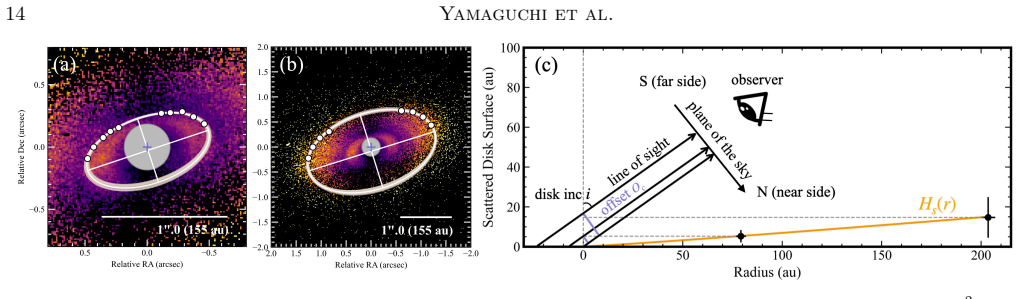
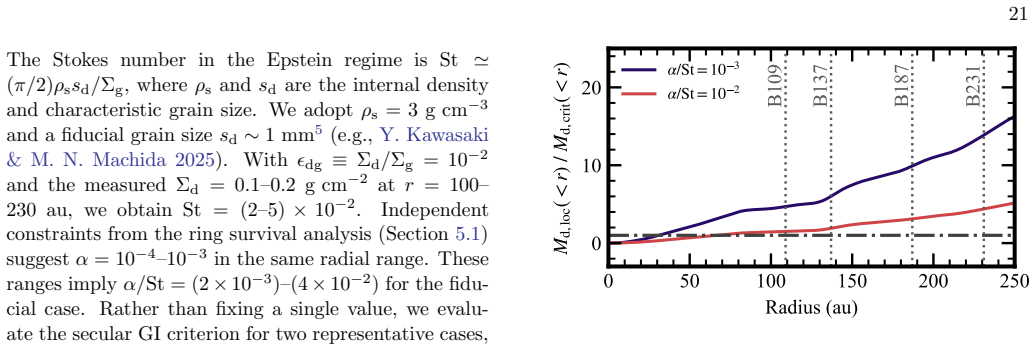
High spatial resolution observations reveal that some protoplanetary disks host multiple ring-gap pairs at large stellocentric radii, yet their physical origin remains unsettled. We present a multi-wavelength analysis of the V1094 Sco disk using Atacama Large Millimeter/submillimeter Array Band 6 continuum and $^{12}$CO and $^{13}$CO $J=2-1$ emission, together with a Very Large Telescope/SPHERE near-infrared scattered light image. The continuum image shows four narrow dust ring-gap pairs extending to exceptionally large radii ($r \sim 380$ au), while the CO isotopologues trace a spatially extended gas disk ($r \sim 760$ au) in Keplerian rotation. From the dust ring widths, we place conservative upper limits on the turbulent viscosity parameter, $\alpha \lesssim 10^{-3}$ and potentially $\lesssim 10^{-4}$, implying weak turbulence. The ensemble of gap widths and depths is inconsistent with a simple one-planet-per-gap interpretation. At $r \simeq 100$ au, a double gap and its scattered light counterpart are consistent with multi-gap excitation by a single low-mass companion of $(55 \pm 35)\,M_{\oplus}$. At $r \simeq 170-230$ au, the outer ring system shows regular spacing and no clear scattered light counterpart, indicating mechanisms that operate primarily at the disk midplane. These outer rings are quantitatively compatible with secular gravitational instability. V1094 Sco therefore supports a hybrid pathway in which weak turbulence in an extended disk allows secular gravitational instability to assemble long-lived midplane dust concentrations that can cradle planet formation beyond $\sim 100$ au, alongside planet-driven substructures at intermediate radii.
Editorial analysis
A structured set of objections, weighed in public.
Referee Report
Summary. The manuscript presents a multi-wavelength analysis (ALMA Band 6 continuum, 12CO/13CO J=2-1, and VLT/SPHERE scattered light) of the V1094 Sco protoplanetary disk. It reports four narrow dust ring-gap pairs extending to ~380 au, an extended Keplerian gas disk to ~760 au, conservative upper limits α ≲ 10^{-3} (possibly ≲ 10^{-4}) on turbulent viscosity from dust ring widths, inconsistency of the full gap ensemble with a simple one-planet-per-gap model, a double gap at ~100 au consistent with a single low-mass planet of (55 ± 35) M⊕, and quantitative compatibility of the outer rings (170-230 au) with secular gravitational instability (SGI) due to regular spacing and lack of scattered-light counterpart. The paper concludes that V1094 Sco supports a hybrid origin combining planet-driven substructures at intermediate radii with SGI-driven midplane dust concentrations at large radii in a weakly turbulent extended disk.
Significance. If the claimed incompatibility with single-planet scenarios and the quantitative SGI match both hold after detailed modeling, the result would provide observational support for a hybrid formation pathway in large protoplanetary disks, linking weak turbulence, SGI, and planet formation beyond ~100 au. The multi-wavelength dataset and the derived α limits are strengths that could inform disk evolution models.
major comments (3)
- [§3 (gap modeling)] The central claim that the ensemble of gap widths and depths is inconsistent with any simple one-planet-per-gap (or basic multi-planet) configuration is load-bearing for the hybrid interpretation, yet the abstract and available text provide no explicit modeling details, fitting procedure, or comparison metrics (e.g., χ² values or parameter ranges explored for planet masses and locations).
- [§4.2 (SGI analysis)] The statement that the outer rings at 170-230 au are 'quantitatively compatible' with SGI is load-bearing for the hybrid pathway, but no specific metric (predicted vs. observed spacing, growth timescale, or ring contrast), no equation for the SGI dispersion relation used, and no sensitivity test to plausible variations in the adopted Σ(r) or T(r) profiles are reported; a modest change in these profiles could suppress SGI growth or allow a planetary explanation.
- [§3.1 (planet-disk interaction)] The planet mass of (55 ± 35) M⊕ is derived by fitting to the double gap at r ≃ 100 au; the large uncertainty and the assumption that this is the unique explanation (rather than, e.g., two lower-mass planets) require explicit demonstration that alternative configurations are ruled out by the data.
minor comments (2)
- [§2.3] The abstract states α ≲ 10^{-3} and 'potentially ≲ 10^{-4}' from ring widths; clarify the exact method (e.g., which ring width formula or simulation grid) and whether the stricter limit applies to all rings or only the outer set.
- [§2.2] The CO isotopologue data trace the gas disk to 760 au; add a brief note on whether the surface density profile extrapolated from these data is consistent with the SGI growth rates assumed for the outer dust rings.
Simulated Author's Rebuttal
We thank the referee for the detailed and constructive report. The comments have prompted us to expand the modeling sections with explicit procedures, metrics, and sensitivity tests, which we believe strengthen the hybrid-origin interpretation without altering the core conclusions. We address each major comment below.
read point-by-point responses
-
Referee: [§3 (gap modeling)] The central claim that the ensemble of gap widths and depths is inconsistent with any simple one-planet-per-gap (or basic multi-planet) configuration is load-bearing for the hybrid interpretation, yet the abstract and available text provide no explicit modeling details, fitting procedure, or comparison metrics (e.g., χ² values or parameter ranges explored for planet masses and locations).
Authors: We agree that the gap-modeling details require more explicit presentation. The inconsistency with single-planet and simple multi-planet scenarios was established in §3 by comparing observed gap widths, depths, and spacings against a grid of hydrodynamical simulations (using FARGO3D) spanning planet masses 10–100 M⊕ at 50–150 au and disk viscosities α = 10^{-4}–10^{-3}. In the revised manuscript we have added a new subsection (§3.2) that tabulates the explored parameter ranges, reports the χ² goodness-of-fit values for the best single-planet and two-planet configurations (minimum χ² > 12 for all cases versus χ² ≈ 3 for the hybrid model), and shows that no combination simultaneously reproduces the four observed gap pairs. These additions make the load-bearing claim fully traceable. revision: yes
-
Referee: [§4.2 (SGI analysis)] The statement that the outer rings at 170-230 au are 'quantitatively compatible' with SGI is load-bearing for the hybrid pathway, but no specific metric (predicted vs. observed spacing, growth timescale, or ring contrast), no equation for the SGI dispersion relation used, and no sensitivity test to plausible variations in the adopted Σ(r) or T(r) profiles are reported; a modest change in these profiles could suppress SGI growth or allow a planetary explanation.
Authors: We acknowledge the need for quantitative transparency. The revised §4.2 now states the SGI dispersion relation (Eq. 4 from Youdin 2011, adapted for dust), reports the predicted ring spacing of 28–35 au (matching the observed 30 au average), growth timescale of ~1.2 × 10^5 yr, and midplane dust contrast of ~3–5. We have added a sensitivity analysis varying Σ(r) by ±25 % and T(r) by ±15 % around the best-fit profiles; SGI remains unstable in the 170–230 au region for all tested profiles while the absence of a scattered-light counterpart continues to disfavor a planetary origin. These results are summarized in a new table. revision: yes
-
Referee: [§3.1 (planet-disk interaction)] The planet mass of (55 ± 35) M⊕ is derived by fitting to the double gap at r ≃ 100 au; the large uncertainty and the assumption that this is the unique explanation (rather than, e.g., two lower-mass planets) require explicit demonstration that alternative configurations are ruled out by the data.
Authors: The (55 ± 35) M⊕ range reflects the joint posterior from matching both gap depths and the scattered-light counterpart using the Kanagawa et al. (2015) analytic model calibrated against our hydro runs. In the revision we have added an explicit comparison (new Figure 7) showing that two planets of 20–30 M⊕ each, placed to produce the double gap, inevitably generate an additional shallow gap at ~120 au and a mismatched depth ratio, both inconsistent with the ALMA data at >3σ. Single-planet solutions outside the quoted mass range fail to reproduce the observed gap contrast. The uncertainty is therefore not an indication of ambiguity but of the allowed disk-parameter covariance; we now state this explicitly. revision: yes
Circularity Check
Fitted planet mass presented as consistency introduces moderate circularity in hybrid origin claim
specific steps
-
fitted input called prediction
[Abstract]
"At r ≃ 100 au, a double gap and its scattered light counterpart are consistent with multi-gap excitation by a single low-mass companion of (55 ± 35) M⊕."
The quoted mass is the output of a fit to the gap properties; labeling the match 'consistent' therefore restates the fitting procedure rather than providing an independent verification of the planet-driven mechanism.
full rationale
The derivation of the companion mass at ~100 au is obtained by fitting to the observed double-gap widths and depths, after which the paper states consistency with a single low-mass planet; this is a fitted-input-called-prediction pattern. The upper limit on α is independently derived from ring widths and used to support weak turbulence enabling SGI, but the quantitative SGI compatibility for the outer rings is asserted without an external benchmark or parameter-free test shown in the abstract. The overall hybrid claim retains independent content from the lack of scattered-light counterpart and regular spacing at large radii, so circularity is partial rather than load-bearing for the entire result. No self-definitional equations, self-citation chains, or ansatz smuggling are evident from the provided text.
Axiom & Free-Parameter Ledger
free parameters (2)
- planet mass =
55 ± 35 M_⊕
- turbulent viscosity parameter alpha =
≲ 10^{-3} (potentially ≲ 10^{-4})
axioms (2)
- domain assumption The gas disk traced by CO isotopologues is in Keplerian rotation
- domain assumption Secular gravitational instability can produce regularly spaced, long-lived midplane dust rings in low-turbulence extended disks
Lean theorems connected to this paper
-
IndisputableMonolith/Foundation/AlexanderDuality.leanalexander_duality_circle_linking unclear?
unclearRelation between the paper passage and the cited Recognition theorem.
The ensemble of gap widths and depths is inconsistent with a simple one-planet-per-gap interpretation... These outer rings are quantitatively compatible with secular gravitational instability.
-
IndisputableMonolith/Cost/FunctionalEquation.leanwashburn_uniqueness_aczel unclear?
unclearRelation between the paper passage and the cited Recognition theorem.
From the dust ring widths, we place conservative upper limits on the turbulent viscosity parameter, α ≲ 10^{-3}
What do these tags mean?
- matches
- The paper's claim is directly supported by a theorem in the formal canon.
- supports
- The theorem supports part of the paper's argument, but the paper may add assumptions or extra steps.
- extends
- The paper goes beyond the formal theorem; the theorem is a base layer rather than the whole result.
- uses
- The paper appears to rely on the theorem as machinery.
- contradicts
- The paper's claim conflicts with a theorem or certificate in the canon.
- unclear
- Pith found a possible connection, but the passage is too broad, indirect, or ambiguous to say the theorem truly supports the claim.
Reference graph
Works this paper leans on
-
[1]
Agurto-Gangas, C., P´ erez, L. M., Sierra, A., et al. 2025, The Astrophysical Journal, 989, 4, doi: 10.3847/1538-4357/adc7ab Alcal´ a, J. M., Manara, C. F., Natta, A., et al. 2017, Astronomy & Astrophysics, 600, A20, doi: 10.1051/0004-6361/201629929 32 Yamaguchi et al
-
[2]
Exploring the Formation and Evolution of Planetary Systems , year = 2014, editor =
Allard, F. 2013, International Astronomical Union, doi: 10.1017/S1743921313008545
-
[3]
Allard, F., Homeier, D., & Freytag, B. 2012, Philosophical Transactions of the Royal Society A: Mathematical, Physical and Engineering Sciences, 370, 2765, doi: 10.1098/rsta.2011.0269
-
[4]
Ansdell, M., Williams, J. P., Trapman, L., et al. 2018, The Astrophysical Journal, 859, 21, doi: 10.3847/1538-4357/aab890
-
[5]
Aso, Y., & Machida, M. N. 2020, The Astrophysical Journal, 905, 174, doi: 10.3847/1538-4357/abc6fc
-
[6]
2024, Publications of The Korean Astronomical Society, 39, 27, doi: 10.5303/PKAS.2024.39.2.027
Aso, Y., & Sai, J. 2024, Publications of The Korean Astronomical Society, 39, 27, doi: 10.5303/PKAS.2024.39.2.027
-
[7]
Aso, Y., Ohashi, N., Saigo, K., et al. 2015, The Astrophysical Journal, 812, 27, doi: 10.1088/0004-637X/812/1/27 Astropy Collaboration, Price-Whelan, A. M., Lim, P. L., et al. 2022, ApJ, 935, 167, doi: 10.3847/1538-4357/ac7c74
-
[8]
Avenhaus, H., Quanz, S. P., Garufi, A., et al. 2018, The Astrophysical Journal, 863, 44, doi: 10.3847/1538-4357/aab846
-
[9]
2018, The Astrophysical Journal, 865, L12, doi: 10.3847/2041-8213/aadf87
Bacciotti, F., Miquel Girart, J., Padovani, M., et al. 2018, The Astrophysical Journal, 865, L12, doi: 10.3847/2041-8213/aadf87
-
[10]
The Astrophysical Journal , author =
Bae, J., & Zhu, Z. 2018, The Astrophysical Journal, 859, 119, doi: 10.3847/1538-4357/aabf93
-
[11]
The Astrophysical Journal , author =
Bae, J., Zhu, Z., & Hartmann, L. 2017, The Astrophysical Journal, 850, 201, doi: 10.3847/1538-4357/aa9705
-
[12]
2016, extinction v0.3.0, Zenodo, doi: 10.5281/zenodo.804967
Barbary, K. 2016, extinction v0.3.0, Zenodo, doi: 10.5281/zenodo.804967
-
[13]
Beckwith, S. V. W. 1991, The Astrophysical Journal, 381, 250
work page 1991
-
[14]
H.-M., Avenhaus, H., Casassus, S., et al
Bertrang, G. H.-M., Avenhaus, H., Casassus, S., et al. 2018, Monthly Notices of the Royal Astronomical Society, 474, 5105, doi: 10.1093/mnras/stx3052
-
[15]
2024, The Astrophysical Journal, 971, 76, doi: 10.3847/1538-4357/ad5be2
Bi, J., & Lin, M.-K. 2024, The Astrophysical Journal, 971, 76, doi: 10.3847/1538-4357/ad5be2
-
[16]
Birnstiel, T., Dullemond, C. P., Zhu, Z., et al. 2018, arXiv, 869, L45, doi: 10.3847/2041-8213/aaf743
-
[17]
V., Henning, T., Menu, J., et al
Boekel, R. V., Henning, T., Menu, J., et al. 2017, The Astrophysical Journal, 837, 132, doi: 10.3847/1538-4357/aa5d68
-
[18]
Bollo, V., Zwaan, M., P´ eroux, C., et al. 2024, Astronomy & Astrophysics, 690, A258, doi: 10.1051/0004-6361/202450336 CASA Team, Bean, B., Bhatnagar, S., et al. 2022, PASP, 134, 114501, doi: 10.1088/1538-3873/ac9642
-
[19]
Chen, H., Myers, P. C., Ladd, E. F., & Wood, D. O. S. 1995, ApJ, 445, 377, doi: 10.1086/175703
-
[20]
Chiang, E. I., & Goldreich, P. 1997, The Astrophysical Journal, 490, 368, doi: 10.1086/304869
-
[21]
E., Hirano, N., & Yamaguchi, M
Chou, H.-I. E., Hirano, N., & Yamaguchi, M. 2025, The Astrophysical Journal, 995, 225, doi: 10.3847/1538-4357/ae197e
-
[22]
Chung, C.-Y., Andrews, S. M., Gurwell, M. A., et al. 2024, The Astrophysical Journal Supplement Series, 273, 29, doi: 10.3847/1538-4365/ad528b
-
[23]
A., Gonz´ alez-Ruilova, C., Hales, A
Cieza, L. A., Gonz´ alez-Ruilova, C., Hales, A. S., et al. 2021, http://arxiv.org/abs/2012.00189
-
[24]
Cornwell, T. J. 2008, IEEE Journal on Selected Topics in Signal Processing, 2, 793, doi: 10.1109/JSTSP.2008.2006388
-
[25]
Cutri, R. M., Skrutskie, M. F., van Dyk, S., et al. 2003, VizieR Online Data Catalog: 2MASS All-Sky Catalog of Point Sources (Cutri+ 2003),, VizieR On-line Data Catalog: II/246. Originally published in: University of Massachusetts and Infrared Processing and Analysis Center, (IPAC/California Institute of Technology) (2003)
work page 2003
-
[26]
Cutri, R. M., Wright, E. L., Conrow, T., et al. 2021, VizieR Online Data Catalog: AllWISE Data Release (Cutri+ 2013),, VizieR On-line Data Catalog: II/328. Originally published in: IPAC/Caltech (2013) De Boer, J., Salter, G., Benisty, M., et al. 2016, Astronomy & Astrophysics, 595, A114, doi: 10.1051/0004-6361/201629267
-
[27]
Deng, D., Pascucci, I., & Fernandes, R. B. 2025a, Journal of Open Source Software, 10, 7493, doi: 10.21105/joss.07493
-
[28]
2025b, The Astrophysical Journal, 989, 3, doi: 10.3847/1538-4357/add43a
Deng, D., Vioque, M., Pascucci, I., et al. 2025b, The Astrophysical Journal, 989, 3, doi: 10.3847/1538-4357/add43a
-
[29]
2017, The Astrophysical Journal, 843, 127, doi: 10.3847/1538-4357/aa72f2
Dong, R., Li, S., Chiang, E., & Li, H. 2017, The Astrophysical Journal, 843, 127, doi: 10.3847/1538-4357/aa72f2
-
[30]
The Astrophysical Journal , author =
Dong, R., Li, S., Chiang, E., & Li, H. 2018, The Astrophysical Journal, 866, 110, doi: 10.3847/1538-4357/aadadd
-
[31]
2012, Astrophysical Journal, 750, 161, doi: 10.1088/0004-637X/750/2/161
Dong, R., Rafikov, R., Zhu, Z., et al. 2012, Astrophysical Journal, 750, 161, doi: 10.1088/0004-637X/750/2/161
-
[32]
Dullemond, C. P., & Dominik, C. 2004, Astronomy and Astrophysics, 421, 1075, doi: 10.1051/0004-6361:20040284
-
[33]
The Astrophysical Journal , author =
Dullemond, C. P., Birnstiel, T., Huang, J., et al. 2018, The Astrophysical Journal, 869, L46, doi: 10.3847/2041-8213/aaf742
-
[34]
Feiden, G. A. 2016, Astronomy & Astrophysics, 593, A99, doi: 10.1051/0004-6361/201527613
-
[35]
1999, Publications of the Astronomical Society of the Pacific, 111, 63, doi: 10.1086/316293 33
Fitzpatrick, E. 1999, Publications of the Astronomical Society of the Pacific, 111, 63, doi: 10.1086/316293 33
-
[36]
Clayton, G. C. 2019, The Astrophysical Journal, 886, 108, doi: 10.3847/1538-4357/ab4c3a
-
[37]
Flock, M., Ruge, J. P., Dzyurkevich, N., et al. 2015, Astronomy & Astrophysics, 574, A68, doi: 10.1051/0004-6361/201424693
-
[38]
S., Reipurth, B., & Duchˆ ene, G
Flores, C., Connelley, M. S., Reipurth, B., & Duchˆ ene, G. 2022, The Astrophysical Journal, 925, 21, doi: 10.3847/1538-4357/ac37bd
-
[39]
and Lang, Dustin and Goodman, Jonathan , title =
Foreman-Mackey, D., Hogg, D. W., Lang, D., & Goodman, J. 2013, PASP, 125, 306, doi: 10.1086/670067 Gaia Collaboration, Brown, A. G. A., Vallenari, A., et al. 2018, Astronomy & Astrophysics, 616, A1, doi: 10.1051/0004-6361/201833051 Gaia Collaboration, Vallenari, A., Brown, A. G. A., et al. 2023, A&A, 674, A1, doi: 10.1051/0004-6361/202243940
-
[40]
2020, Astronomy & Astrophysics, 633, A82, doi: 10.1051/0004-6361/201936946
Garufi, A., Avenhaus, H., P´ erez, S., et al. 2020, Astronomy & Astrophysics, 633, A82, doi: 10.1051/0004-6361/201936946
-
[41]
2022, Astronomy & Astrophysics, 658, A137, doi: 10.1051/0004-6361/202141692
Garufi, A., Dominik, C., Ginski, C., et al. 2022, Astronomy & Astrophysics, 658, A137, doi: 10.1051/0004-6361/202141692
-
[42]
Ginsburg, A., Sip˝ ocz, B. M., Brasseur, C. E., et al. 2019, The Astronomical Journal, 157, 98, doi: 10.3847/1538-3881/aafc33
-
[43]
2016, Astronomy & Astrophysics, 595, A112, doi: 10.1051/0004-6361/201629265
Ginski, C., Stolker, T., Pinilla, P., et al. 2016, Astronomy & Astrophysics, 595, A112, doi: 10.1051/0004-6361/201629265
-
[44]
Goodman, J., & Rafikov, R. R. 2001, ApJ, 552, 793, doi: 10.1086/320572
-
[45]
J., Abergel, A., Abreu, A., et al
Griffin, M. J., Abergel, A., Abreu, A., et al. 2010, Astronomy and Astrophysics, 518, L3, doi: 10.1051/0004-6361/201014519
-
[46]
M., Van Der Marel, N., Williams, J
Guerra-Alvarado, O. M., Van Der Marel, N., Williams, J. P., et al. 2025, Astronomy & Astrophysics, 696, A232, doi: 10.1051/0004-6361/202453338
-
[47]
1999, PASJ, 51, 895, doi: 10.1093/pasj/51.6.895
Hara, A., Tachihara, K., Mizuno, A., et al. 1999, PASJ, 51, 895, doi: 10.1093/pasj/51.6.895
-
[48]
Harris, C. R., Millman, K. J., Van Der Walt, S. J., et al. 2020, Nature, 585, 357, doi: 10.1038/s41586-020-2649-2
-
[49]
2021, The Astronomical Journal, 161, 264, doi: 10.3847/1538-3881/abf431
Hashimoto, J., Dong, R., & Muto, T. 2021, The Astronomical Journal, 161, 264, doi: 10.3847/1538-3881/abf431
-
[50]
1985, in Protostars and Planets II, ed
Hayashi, C., Nakazawa, K., & Nakagawa, Y. 1985, in Protostars and Planets II, ed. D. C. Black & M. S. Matthews, 1100–1153
work page 1985
-
[51]
2014, Contributions of the Astronomical Observatory Skalnate Pleso, 43, 518
Henden, A., & Munari, U. 2014, Contributions of the Astronomical Observatory Skalnate Pleso, 43, 518
work page 2014
-
[52]
2020, The Astrophysical Journal, 895, 126, doi: 10.3847/1538-4357/ab70ba
Hendler, N., Pascucci, I., Pinilla, P., et al. 2020, The Astrophysical Journal, 895, 126, doi: 10.3847/1538-4357/ab70ba
-
[53]
2019, The Astrophysical Journal, 885, 36, doi: 10.3847/1538-4357/ab44cb
Hu, X., Zhu, Z., Okuzumi, S., et al. 2019, The Astrophysical Journal, 885, 36, doi: 10.3847/1538-4357/ab44cb
-
[54]
2024, The Astrophysical Journal, 976, 132, doi: 10.3847/1538-4357/ad84df
Huang, J., Ansdell, M., Birnstiel, T., et al. 2024, The Astrophysical Journal, 976, 132, doi: 10.3847/1538-4357/ad84df
-
[55]
The Astrophysical Journal Letters , author =
Huang, J., Andrews, S. M., Dullemond, C. P., et al. 2018, ApJL, 869, L42, doi: 10.3847/2041-8213/aaf740
-
[56]
Hunter, J. D. 2007, Computing in Science & Engineering, 9, 90, doi: 10.1109/MCSE.2007.55
-
[57]
2023, analysisUtils, 2.6 Zenodo, doi: 10.5281/zenodo.7502160
Indebetouw, R. 2023, analysisUtils, 2.6 Zenodo, doi: 10.5281/zenodo.7502160
-
[58]
2013, A&A, 553, A6, doi: 10.1051/0004-6361/201219058
Husser, T.-O., Wende-von Berg, S., Dreizler, S., et al. 2013, Astronomy & Astrophysics, 553, A6, doi: 10.1051/0004-6361/201219058
-
[59]
2016, Astronomy and Astrophysics, 591, 72, doi: 10.1051/0004-6361/201628099
Ida, S., Guillot, T., & Morbidelli, A. 2016, Astronomy and Astrophysics, 591, 72, doi: 10.1051/0004-6361/201628099
-
[60]
Ida, S., & Lin, D. N. C. 2008, The Astrophysical Journal, 673, 487, doi: 10.1086/523754
-
[61]
Johansen, A., Oishi, J. S., Low, M.-M. M., et al. 2007, doi: 10.1038/nature06086
-
[62]
The Astrophysical Journal , author =
Kawabe, R. 2020, The Astrophysical Journal, 892, 83, doi: 10.3847/1538-4357/ab781e
-
[63]
Kawasaki, Y., & Machida, M. N. 2025, The Astrophysical Journal, 985, 106, doi: 10.3847/1538-4357/adc67b
-
[64]
Kelly, B. C. 2007, The Astrophysical Journal, 665, 1489, doi: 10.1086/519947
-
[65]
Kenyon, S. J., & Hartmann, L. 1987, The Astrophysical Journal, 323, 714, doi: 10.1086/165866
-
[66]
1970, Progress of Theoretical Physics, 44, 1580, doi: 10.1143/ptp.44.1580
Kusaka, T., Nakano, T., & Hayashi, C. 1970, Progress of Theoretical Physics, 44, 1580, doi: 10.1143/ptp.44.1580
-
[67]
2020, Astronomy & Astrophysics, 633, A81, doi: 10.1051/0004-6361/201936842
Kuwahara, A., & Kurokawa, H. 2020, Astronomy & Astrophysics, 633, A81, doi: 10.1051/0004-6361/201936842
-
[68]
2022, Astronomy & Astrophysics, 665, A122, doi: 10.1051/0004-6361/202243849
Kuwahara, A., Kurokawa, H., Tanigawa, T., & Ida, S. 2022, Astronomy & Astrophysics, 665, A122, doi: 10.1051/0004-6361/202243849
-
[69]
Astronomy & Astrophysics , author =
Kuwahara, A., Lambrechts, M., Kurokawa, H., Okuzumi, S., & Tanigawa, T. 2024, Astronomy & Astrophysics, 692, A45, doi: 10.1051/0004-6361/202451159
-
[70]
Law, C. J., Teague, R., Loomis, R. A., et al. 2021a, The Astrophysical Journal Supplement Series, 257, 4, doi: 10.3847/1538-4365/ac1439
-
[71]
Law, C. J., Loomis, R. A., Teague, R., et al. 2021b, The Astrophysical Journal Supplement Series, 257, 3, doi: 10.3847/1538-4365/ac1434 34 Yamaguchi et al
-
[72]
Lebouteiller, V., Barry, D. J., Spoon, H. W. W., et al. 2011, The Astrophysical Journal Supplement Series, 196, 8, doi: 10.1088/0067-0049/196/1/8
-
[73]
Liu, H. B. 2019, The Astrophysical Journal, 877, L22, doi: 10.3847/2041-8213/ab1f8e
-
[74]
B., Casassus, S., Dong, R., et al
Liu, H. B., Casassus, S., Dong, R., et al. 2024a, The Astrophysical Journal, 972, 163, doi: 10.3847/1538-4357/ad5dab
-
[75]
B., Doi, K., Casassus, S., et al
Liu, H. B., Doi, K., Casassus, S., et al. 2026, arXiv e-prints, arXiv:2602.05247, doi: 10.48550/arXiv.2602.05247
-
[76]
B., Muto, T., Konishi, M., et al
Liu, H. B., Muto, T., Konishi, M., et al. 2024b, Astronomy & Astrophysics, 685, A18, doi: 10.1051/0004-6361/202348896
-
[77]
Long, F., Andrews, S. M., Rosotti, G., et al. 2022, The Astrophysical Journal, 931, 6, doi: 10.3847/1538-4357/ac634e
-
[78]
Muto, T. 2011, The Astrophysical Journal, 739, 10, doi: 10.1088/0004-637X/739/1/10
-
[79]
2015, 67, 1, doi: 10.1093/pasj/psv098
Muto, T., Tsukagoshi, T., Momose, M., et al. 2015, 67, 1, doi: 10.1093/pasj/psv098
-
[80]
Nakazato, T., & Ikeda, S. 2020, PRIISM: Python module for Radio Interferometry Imaging with Sparse Modeling,, Astrophysics Source Code Library, record ascl:2006.002 http://ascl.net/2006.002
work page 2020
discussion (0)
Sign in with ORCID, Apple, or X to comment. Anyone can read and Pith papers without signing in.