Recognition: no theorem link
Non-orthogonal Transformations of Structured Light Using Ellipticity-Dependent Ince-Gaussian Modes
Pith reviewed 2026-05-13 01:41 UTC · model grok-4.3
The pith
An explicit finite analytical expression now converts Ince-Gaussian modes between bases of arbitrary ellipticity.
A machine-rendered reading of the paper's core claim, the machinery that carries it, and where it could break.
Core claim
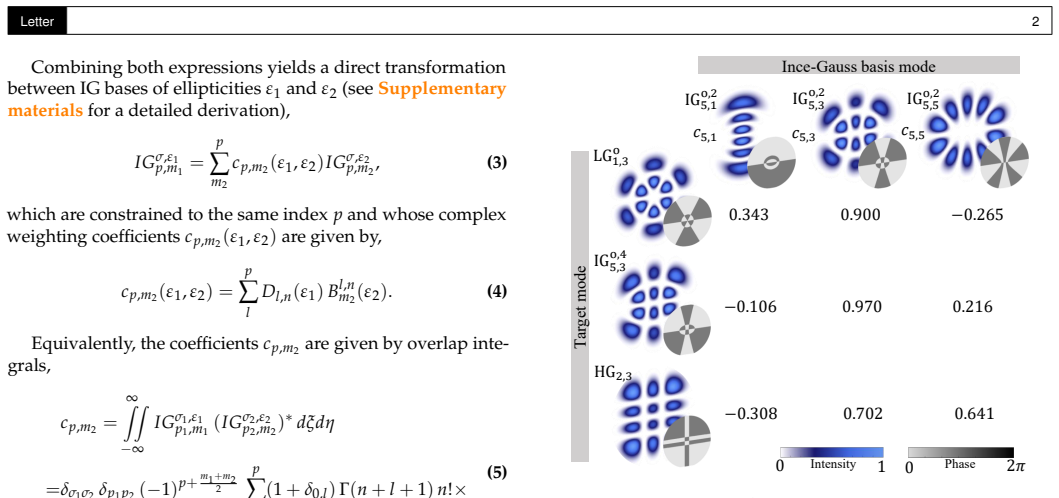
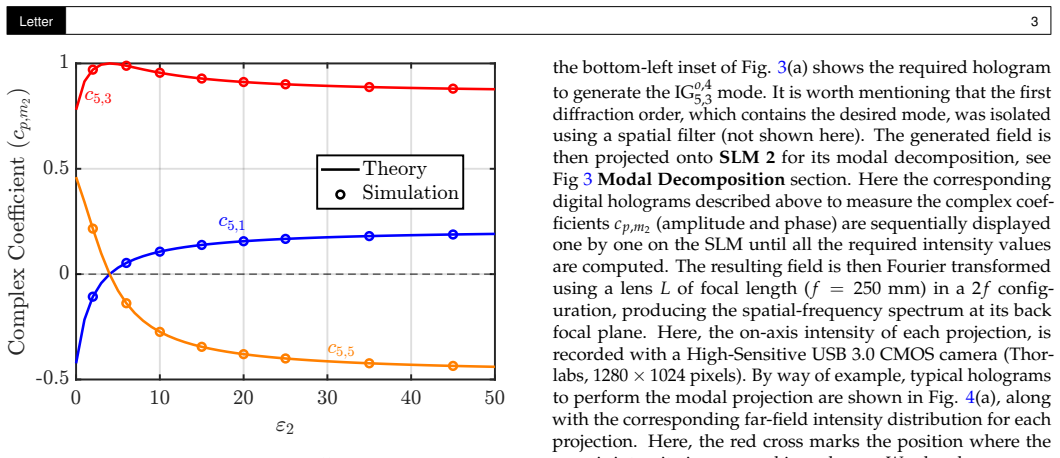
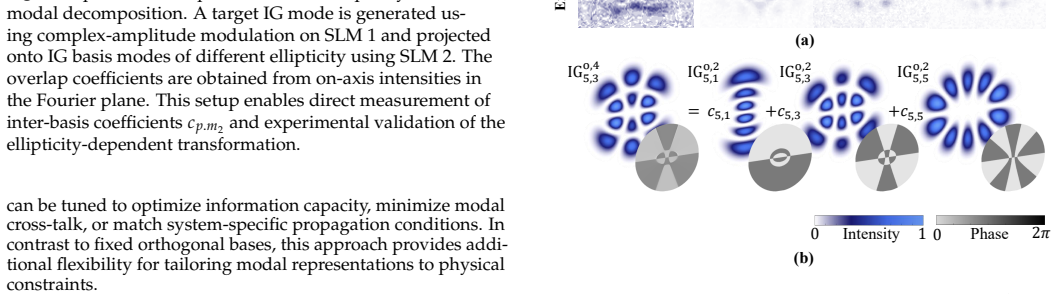
The central result is an explicit finite analytical expression that transforms an Ince-Gaussian mode belonging to one ellipticity parameter into the corresponding mode of any other ellipticity. The expression is obtained directly from the paraxial wave equation and permits exact, non-approximate conversion between non-orthogonal representations. The same formula is implemented experimentally on spatial light modulators to decompose input beams into their ellipticity components.
What carries the argument
The ellipticity-dependent Ince-Gaussian modes together with the derived finite analytical transformation operator that maps any mode at one ellipticity value to its counterpart at a different value.
If this is right
- Mode conversion between Laguerre-Gaussian and Hermite-Gaussian limits becomes direct and analytic for any intermediate ellipticity.
- Ellipticity functions as an additional controllable degree of freedom for encoding or processing high-dimensional optical information.
- Experimental modal decomposition can now resolve beams according to their ellipticity parameter using only spatial light modulators.
- New strategies for structured-light engineering become available without requiring numerical optimization at each ellipticity.
Where Pith is reading between the lines
- The transformation may simplify real-time switching between orthogonal and non-orthogonal mode sets in adaptive optics setups.
- If the mapping preserves coherence properties, it could enable new forms of high-dimensional quantum state manipulation in structured light.
- The analytic form invites extension to other continuous families of paraxial solutions or to mildly non-paraxial regimes.
Load-bearing premise
An explicit finite analytical transformation between Ince-Gaussian bases of different ellipticities exists and remains valid under the paraxial approximation.
What would settle it
An experiment that applies the derived transformation to a known input mode at one ellipticity, records the output intensity and phase at a second ellipticity, and compares them with the analytically predicted pattern; quantitative agreement would support the claim while systematic mismatch would refute it.
Figures

read the original abstract
The Ince-Gaussian modes form a complete set of solutions to the paraxial wave equation parametrized by an ellipticity parameter {\epsilon}, enabling a continuous transition between Laguerre-Gaussian and Hermite-Gaussian modes While each fixed {\epsilon} defines an orthogonal basis, modes associated with different ellipticities are not mutually orthogonal, and no explicit transformation between such bases has been reported. Here, we derive the first explicit finite analytical expression to transformation between Ince-Gaussian bases of arbitrary ellipticity, enabling direct and experimentally accessible mapping between non-orthogonal structured-light representations. We further demonstrate an experimental implementation using spatial light modulators to perform ellipticity-resolved modal decomposition. This framework introduces ellipticity as a controllable degree of freedom for structured light engineering, enabling new strategiesfor mode conversion, encoding, and high-dimensional optical information processing.
Editorial analysis
A structured set of objections, weighed in public.
Referee Report
Summary. The paper derives the first explicit finite analytical expression for the transformation between Ince-Gaussian (IG) mode bases with arbitrary ellipticity parameters ε. These modes solve the paraxial wave equation and form orthogonal bases at fixed ε but are non-orthogonal across different ε values; the transformation is obtained by direct evaluation of overlap integrals exploiting the finite-sum structure of Ince polynomials. The work also presents an experimental demonstration of ellipticity-resolved modal decomposition using spatial light modulators (SLMs) and positions ellipticity as a controllable degree of freedom for structured-light applications including mode conversion and high-dimensional encoding.
Significance. If the central analytic claim holds, the result supplies a missing closed-form bridge between non-orthogonal IG representations, allowing direct, experimentally accessible mappings without additional approximations beyond the paraxial regime. This introduces ellipticity as a tunable parameter that continuously connects Laguerre-Gaussian and Hermite-Gaussian limits, with potential utility in optical information processing, adaptive mode conversion, and encoding schemes. The combination of an explicit finite-sum formula with SLM-based validation is a concrete strength that supports reproducibility and practical adoption.
minor comments (4)
- Abstract, line 3: 'expression to transformation' is grammatically incomplete; suggest 'expression for the transformation' or 'transformation expression'.
- Abstract, final sentence: 'strategiesfor' is missing a space; correct to 'strategies for'.
- The manuscript should include a brief statement in the introduction or methods clarifying the numerical truncation criterion used when evaluating the finite sums for the overlap integrals, even if the expressions are formally closed.
- Figure captions and experimental section: ensure that the SLM phase patterns and decomposition fidelity metrics are cross-referenced to the specific analytic mapping formula being tested.
Simulated Author's Rebuttal
We thank the referee for the positive and detailed summary of our work, the assessment of its significance, and the recommendation for minor revision. We are pleased that the explicit finite transformation formula and its experimental validation with SLMs were viewed as strengths supporting reproducibility.
Circularity Check
No significant circularity; derivation is self-contained
full rationale
The paper obtains the explicit finite analytical transformation by direct evaluation of overlap integrals between Ince-Gaussian modes of differing ellipticity, exploiting the finite-sum structure of Ince polynomials together with the common paraxial wave equation. The resulting closed-form expressions (finite sums of elementary and special functions) are presented as a new derivation rather than a re-expression of fitted quantities, self-cited uniqueness theorems, or ansatzes imported from prior work by the same authors. The experimental SLM decomposition is described as a direct application of the derived mapping and does not feed back into the analytic claim. No load-bearing step reduces by construction to the paper's own inputs; the central result remains independent of the specific fitted values or self-citations used elsewhere.
Axiom & Free-Parameter Ledger
axioms (1)
- standard math Ince-Gaussian modes are complete solutions to the paraxial wave equation
Reference graph
Works this paper leans on
-
[1]
H. Rubinsztein-Dunlop, A. Forbes, M. V . Berry ,et al., J. Opt. 19, 013001 (2017)
work page 2017
- [2]
- [3]
-
[4]
C. Rosales-Guzmán and V . Rodríguez-Fajardo, Appl. Phys. Lett. 125 (2024)
work page 2024
- [5]
- [6]
-
[7]
A. E. Siegman, J. Opt. society Am. 63, 1093 (1973)
work page 1973
-
[8]
M. A. Bandres and J. C. Gutiérrez-Vega, JOSA A 21, 873 (2004)
work page 2004
- [9]
- [10]
-
[11]
W. N. Plick, M. Krenn, R. Fickler, et al., Phys. Rev. A 87, 033806 (2013)
work page 2013
-
[12]
E. G. Abramochkin, V . V . Kotlyar, and A. A. Kovalev, J. Opt. Soc. Am. A 42, 780 (2025)
work page 2025
-
[13]
S. Dirnböck, S.-S. B. Lee, F . B. Kugler,et al., Phys. Rev. Res. 6, 043228 (2024)
work page 2024
- [14]
-
[15]
J. Pinnell, I. Nape, B. Sephton, et al. , J. Opt. Soc. Am. A 37, C146 (2020)
work page 2020
-
[16]
B. Zhao, J.-Y . Wu, X.-Y . Y u,et al., Laser & Photonics Rev. 20, e01902 (2026). 𝑇5,1 CGH Theory Experiment (a) 𝑇5,3 𝑇cos 𝑇sin = +𝑐5,3 +𝑐5,5𝑐5,1 IG5,3 o,4 IG5,1 o,2 IG5,3 o,2 IG5,5 o,2 (b) 0 2𝜋 0 1 PhaseIntensity Fig. 4. Experimental measurement and reconstruction of modal coefficients. (a) Representative computer-generated holograms (top), simulated (mid...
work page 2026
-
[17]
C. Rosales-Guzmán and A. Forbes, Structured light with spatial light modulators (SPIE Press, 2024)
work page 2024
-
[18]
V . Arrizón, U. Ruiz, R. Carrada, and L. A. González, J. Opt. Soc. Am. A 24, 3500 (2007)
work page 2007
discussion (0)
Sign in with ORCID, Apple, or X to comment. Anyone can read and Pith papers without signing in.