Recognition: no theorem link
Digital Annealer-Assisted Accuracy-First Quantum Circuit Transpilation with Integrated QUBO Mapping and Routing
Pith reviewed 2026-05-13 02:06 UTC · model grok-4.3
The pith
Digital Annealer optimization reduces CNOT gate counts by 13.7 percent on average in quantum circuit transpilation.
A machine-rendered reading of the paper's core claim, the machinery that carries it, and where it could break.
Core claim
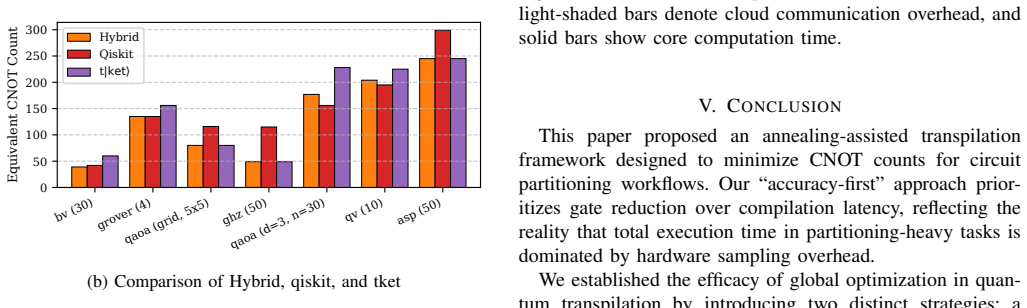
The central claim is that leveraging the Digital Annealer to solve QUBO formulations for qubit mapping and routing in an accuracy-first transpilation framework yields lower CNOT counts than heuristic-based compilers, with a Hybrid strategy achieving 13.7% average reduction and up to 57.4% on structured circuits compared to Qiskit's highest optimization level.
What carries the argument
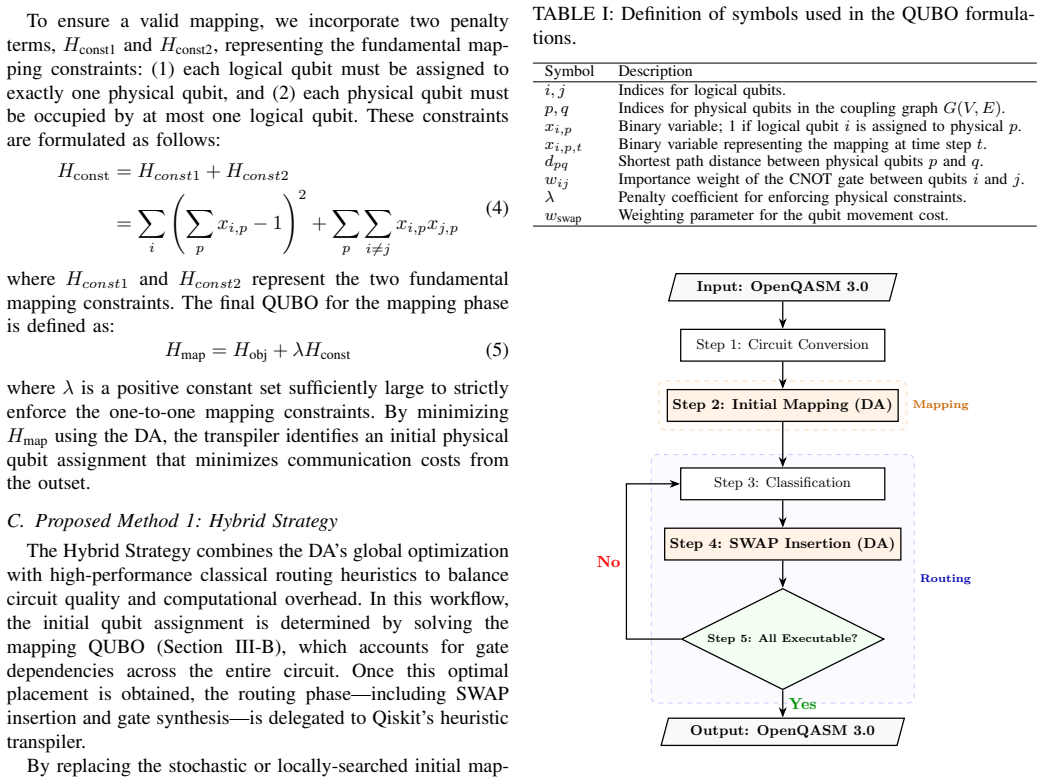
QUBO formulations for mapping and routing solved by the Digital Annealer, which encode the costs of initial qubit placements and subsequent SWAP insertions to minimize total CNOT operations in the final circuit.
If this is right
- Structured circuits like GHZ and ASP see the largest improvements because their connectivity patterns reward careful global layout choices.
- The Hybrid approach provides a practical balance, using DA only for mapping while relying on fast heuristics for routing.
- Full DA encoding of the entire circuit in one pass can achieve even larger gains on some problems but degrades when connectivity is random or concentrated due to growing problem size.
- These global methods incur more compute time than pure heuristics but offer value in high-precision settings where gate noise dominates.
Where Pith is reading between the lines
- Similar annealing techniques might apply to other quantum compilation tasks such as gate scheduling or error mitigation strategy selection.
- Testing the resulting circuits on actual quantum processors could reveal if the CNOT reductions translate directly to higher fidelity beyond simulation.
- Future work could explore scaling the QUBO size or hybridizing with machine learning for faster approximation on larger circuits.
Load-bearing premise
That the QUBO models correctly capture the true costs of mapping and routing decisions and that the Digital Annealer consistently finds higher-quality solutions than heuristics within practical time limits.
What would settle it
Running the same benchmark circuits through the proposed methods and Qiskit on a real NISQ device and finding no statistically significant improvement in output fidelity or success probability despite the reported CNOT reductions.
Figures

read the original abstract
In the Noisy Intermediate-Scale Quantum (NISQ) era, limited qubit counts and high gate error rates directly constrain circuit fidelity, making the minimization of CNOT gate counts crucial. While conventional compilers prioritize heuristic efficiency, there is a compelling need for "accuracy-first" transpilation that prioritizes gate reduction over compilation latency. We propose a framework leveraging the Digital Annealer (DA) via two complementary strategies: (1) Hybrid, which uses DA-driven global initial mapping combined with high-speed heuristic routing by Qiskit, and (2) Full DA, which solves mapping and routing as separate DA-assisted QUBO subproblems within an iterative workflow. Benchmarks demonstrate that our Hybrid approach achieves an average CNOT reduction of 13.7 % (up to 57.4 %) compared to Qiskit's highest optimization level, with the largest gains on structured circuits such as GHZ and ASP where the initial layout is decisive. The Full DA approach matches Hybrid on structured circuits and outperforms ISAAQ by 23.1 % on average (maximum 90.8 %), but degrades on circuits with random or concentrated connectivity - exposing a trade-off between QUBO size and solution quality when the entire circuit is encoded in a single annealing pass. Although these global optimizations incur higher computational overhead than pure heuristics, our results indicate that for high-precision workflows where gate noise is the primary bottleneck, DA-assisted global initial placement provides a practical "time-for-quality" trade-off for enhancing the utility of near-term quantum hardware.
Editorial analysis
A structured set of objections, weighed in public.
Referee Report
Summary. The paper proposes two Digital Annealer (DA)-assisted strategies for accuracy-first quantum circuit transpilation: a Hybrid approach combining DA-driven global initial mapping with Qiskit heuristic routing, and a Full DA approach solving mapping and routing as separate QUBO subproblems in an iterative workflow. It reports empirical benchmarks showing an average 13.7% CNOT reduction (up to 57.4%) for Hybrid versus Qiskit's highest optimization level (largest gains on structured circuits like GHZ and ASP) and 23.1% average improvement (max 90.8%) for Full DA versus ISAAQ, while noting degradation on random/concentrated-connectivity circuits due to QUBO size versus solution quality trade-offs.
Significance. If the empirical claims hold after proper validation, the work demonstrates a practical time-for-quality trade-off for NISQ transpilation by using global DA optimization on QUBO formulations to reduce CNOT counts, which could improve circuit fidelity where gate noise dominates; the distinction between Hybrid and Full DA strategies usefully highlights when full-circuit encoding is viable.
major comments (3)
- [Abstract / Benchmarks] Abstract and benchmarks section: The headline CNOT reductions (13.7% Hybrid average, 23.1% Full DA vs ISAAQ) are reported as concrete percentages without error bars, explicit circuit-selection criteria, number of instances per family, or statistical tests; this is load-bearing for the central claim that DA-driven QUBO solutions are superior to heuristics.
- [Methods / QUBO Mapping and Routing] QUBO formulation and methods: No validation is provided that the QUBO objectives exactly encode swap depths, crosstalk, or cumulative routing costs across layers, nor any comparison of DA outputs to exact ILP solutions on small instances to confirm solution quality within allotted annealing times; this directly affects the weakest assumption that DA reliably outperforms heuristics.
- [Results / Discussion] Results on non-structured circuits: The noted degradation when encoding the full circuit in one annealing pass for random or concentrated-connectivity circuits is acknowledged but not accompanied by analysis of annealing schedules, time caps, or QUBO penalty coefficient sensitivity, leaving the scalability limitation unquantified.
minor comments (3)
- [Methods] The description of the iterative workflow for Full DA could be clarified with pseudocode or a flowchart to distinguish the separate mapping and routing QUBO subproblems.
- [Introduction] Missing references to prior QUBO-based transpilation literature and Digital Annealer applications in quantum compilation.
- [Results] Benchmark tables or figures lack captions detailing the exact circuit families, qubit counts, and baseline configurations used for comparison.
Simulated Author's Rebuttal
We thank the referee for the thorough review and constructive suggestions. We have carefully considered each major comment and provide point-by-point responses below, indicating the revisions we will incorporate in the updated manuscript.
read point-by-point responses
-
Referee: [Abstract / Benchmarks] Abstract and benchmarks section: The headline CNOT reductions (13.7% Hybrid average, 23.1% Full DA vs ISAAQ) are reported as concrete percentages without error bars, explicit circuit-selection criteria, number of instances per family, or statistical tests; this is load-bearing for the central claim that DA-driven QUBO solutions are superior to heuristics.
Authors: We agree that additional details and statistical support would strengthen the presentation of our empirical results. In the revised version, we will expand the Abstract and Benchmarks section to include: explicit criteria for circuit selection and the number of instances per circuit family; standard deviations or error bars alongside the average CNOT reductions; and appropriate statistical tests (such as Wilcoxon signed-rank tests) to assess the significance of the observed improvements over baselines. These additions will provide a more rigorous foundation for our claims. revision: yes
-
Referee: [Methods / QUBO Mapping and Routing] QUBO formulation and methods: No validation is provided that the QUBO objectives exactly encode swap depths, crosstalk, or cumulative routing costs across layers, nor any comparison of DA outputs to exact ILP solutions on small instances to confirm solution quality within allotted annealing times; this directly affects the weakest assumption that DA reliably outperforms heuristics.
Authors: We acknowledge this gap in validation. We will add a new subsection to the Methods section that (i) explicitly details how the QUBO objectives encode swap depths, crosstalk penalties, and cumulative routing costs across circuit layers, and (ii) presents a validation study comparing DA solutions against exact ILP solvers on small-scale instances (circuits with up to 8-10 qubits) to verify solution quality within the given annealing time budgets. This will confirm the fidelity of our QUBO formulations. revision: yes
-
Referee: [Results / Discussion] Results on non-structured circuits: The noted degradation when encoding the full circuit in one annealing pass for random or concentrated-connectivity circuits is acknowledged but not accompanied by analysis of annealing schedules, time caps, or QUBO penalty coefficient sensitivity, leaving the scalability limitation unquantified.
Authors: We will enhance the Results and Discussion sections with a dedicated analysis of the scalability limitations. Specifically, we will include sensitivity studies varying annealing schedules, time caps, and penalty coefficients for the Full DA approach on random and concentrated-connectivity circuits. This will quantify the trade-offs and provide clearer guidelines on the applicability of the method, addressing the unquantified aspects noted. revision: yes
Circularity Check
No circularity: empirical benchmarks against external tools with no self-referential derivation.
full rationale
The paper presents a practical framework for DA-assisted QUBO-based mapping and routing in quantum transpilation, with claims resting entirely on empirical CNOT-count comparisons to Qiskit (level 3) and ISAAQ across benchmark circuits. No equations, uniqueness theorems, or ansatzes are derived or invoked that reduce by construction to the paper's own fitted parameters, self-citations, or input data. The reported averages (13.7 % Hybrid, 23.1 % Full DA) are direct measurement outcomes, not predictions forced by the method's internal definitions. The approach is self-contained against external baselines.
Axiom & Free-Parameter Ledger
free parameters (1)
- QUBO penalty coefficients
axioms (1)
- domain assumption Digital Annealer returns high-quality solutions to the formulated QUBO instances within practical time limits
Reference graph
Works this paper leans on
-
[1]
Simulating large quantum circuits on a small quantum computer,
T. Peng, A. W. Harrow, M. Ozols, and X. Wu, “Simulating large quantum circuits on a small quantum computer,”Physical Review Letters, vol. 125, no. 15, Oct. 2020. [Online]. Available: http://dx.doi.org/10.1103/PhysRevLett.125.150504
-
[2]
Constructing a virtual two-qubit gate by sampling single-qubit operations,
K. Mitarai and K. Fujii, “Constructing a virtual two-qubit gate by sampling single-qubit operations,”New Journal of Physics, vol. 23, no. 2, p. 023021, feb 2021. [Online]. Available: https: //doi.org/10.1088/1367-2630/abd7bc
-
[3]
Overhead for simulating a non-local channel with local channels by quasiprobability sampling,
——, “Overhead for simulating a non-local channel with local channels by quasiprobability sampling,”Quantum, vol. 5, p. 388, Jan. 2021. [Online]. Available: https://doi.org/10.22331/q-2021-01-28-388
-
[4]
Approximation and hardness for token swapping,
T. Miltzow, L. Narins, Y . Okamoto, G. Rote, A. Thomas, and T. Uno, “Approximation and hardness for token swapping,” 2016. [Online]. Available: https://arxiv.org/abs/1602.05150
-
[5]
On the complexity of quantum circuit compilation,
A. Botea, A. Kishimoto, and R. Marinescu, “On the complexity of quantum circuit compilation,” inProceedings of the Eleventh International Symposium on Combinatorial Search (SOCS 2018). AAAI Press, 2018, pp. 138–142. [Online]. Available: https://ojs.aaai. org/index.php/SOCS/article/view/18463
work page 2018
-
[6]
M. Treinishet al., “Qiskit/qiskit: Qiskit 2.0.1,” may 2025. [Online]. Available: https://doi.org/10.5281/zenodo.15442200
-
[7]
A. Javadi-Abhari, M. Treinish, K. Krsulich, C. J. Wood, J. Lishman, J. Gacon, S. Martiel, P. D. Nation, L. S. Bishop, A. W. Cross, B. R. Johnson, and J. M. Gambetta, “Quantum computing with Qiskit,” 2024. [Online]. Available: https://arxiv.org/abs/2405.08810
work page internal anchor Pith review Pith/arXiv arXiv 2024
-
[8]
G. Li, Y . Ding, and Y . Xie, “Tackling the qubit mapping problem for NISQ-Era quantum devices,” inProceedings of the Twenty-Fourth International Conference on Architectural Support for Programming Languages and Operating Systems, ser. ASPLOS ’19. New York, NY , USA: Association for Computing Machinery, 2019, p. 1001–1014. [Online]. Available: https://doi...
-
[9]
S. Sivarajah, S. Dilkes, A. Cowtan, W. Simmons, A. Edgington, and R. Duncan, “t|ket⟩: a retargetable compiler for nisq devices,”Quantum Science and Technology, vol. 6, no. 1, p. 014003, Nov. 2020. [Online]. Available: http://dx.doi.org/10.1088/2058-9565/ab8e92
-
[10]
Digital annealer for high-speed solving of combinatorial optimization problems and its applications,
S. Matsubara, M. Takatsu, T. Miyazawa, T. Shibasaki, Y . Watanabe, K. Takemoto, and H. Tamura, “Digital annealer for high-speed solving of combinatorial optimization problems and its applications,” in2020 25th Asia and South Pacific Design Automation Conference (ASP-DAC), 2020, pp. 667–672. [Online]. Available: https://ieeexplore. ieee.org/stamp/stamp.jsp...
work page 2020
-
[11]
ISAAQ: Ising machine assisted quantum compiler,
S. Naito, Y . Hasegawa, Y . Matsuda, and S. Tanaka, “ISAAQ: Ising machine assisted quantum compiler,” 2023. [Online]. Available: https://arxiv.org/abs/2303.02830
-
[12]
Fujitsu Limited and RIKEN, “Fujitsu and RIKEN develop su- perconducting quantum computer at the RIKEN RQC-Fujitsu col- laboration center, paving the way for platform for hybrid quan- tum computing,” https://www.fujitsu.com/global/about/resources/news/ press-releases/2023/1005-01.html, Oct. 2023, accessed: 2025-12-31
work page 2023
-
[13]
Japanese joint research group launches quantum com- puting cloud service,
Fujitsu Limited, “Japanese joint research group launches quantum com- puting cloud service,” https://www.fujitsu.com/global/about/resources/ news/press-releases/2023/0324-01.html, Mar. 2023, accessed: 2025-12- 31
work page 2023
-
[14]
QASMBench: A low-level quantum assembly benchmark suite,
A. Li, “QASMBench: A low-level quantum assembly benchmark suite,” https://github.com/pnnl/QASMBench, 2020, accessed: 2025-12-31
work page 2020
-
[15]
QASMBench: A low-level quantum assembly benchmark suite for NISQ evaluation and simulation,
A. Li, S. Krishnamoorthy, C. Xie, S. Boettcher, R. J. Williams, and K. Barker, “QASMBench: A low-level quantum assembly benchmark suite for NISQ evaluation and simulation,” in2021 IEEE International Parallel and Distributed Processing Symposium (IPDPS), 2021, pp. 642– 651
work page 2021
- [16]
-
[17]
Fixstars Amplify, “Fixstars amplify sdk,” https://amplify.fixstars.com/, 2021
work page 2021
-
[18]
ABCI-Q: Quantum-Classical Hy- brid Computing Infrastructure,
National Institute of Advanced Industrial Science and Technology (AIST), Global Research and Development Center for Business by Quantum-AI Technology (G-QuAT), “ABCI-Q: Quantum-Classical Hy- brid Computing Infrastructure,” https://unit.aist.go.jp/g-quat/HowToUse/ en/abci q/index.html, 2024, accessed: 2026-01-15
work page 2024
discussion (0)
Sign in with ORCID, Apple, or X to comment. Anyone can read and Pith papers without signing in.