Recognition: no theorem link
Phase synchronization recovery in energy-compressed LWFA electron beams for free-electron lasers via undulator tapering
Pith reviewed 2026-05-13 02:02 UTC · model grok-4.3
The pith
An optimized undulator taper compensates energy chirp to restore phase synchronization in LWFA-driven FELs.
A machine-rendered reading of the paper's core claim, the machinery that carries it, and where it could break.
Core claim
In a SASE free-electron laser driven by an energy-compressed LWFA beam, a longitudinally tapered undulator compensates the resonance mismatch caused by the residual energy chirp. Three-dimensional unaveraged simulations establish that an optimized taper profile restores electron-radiation phase synchronization, producing significantly higher saturation power and improved spectral quality relative to the untapered undulator.
What carries the argument
The optimized longitudinal taper profile of the undulator, which adjusts resonant wavelength along the device to track the changing electron energy and thereby cancel chirp-induced phase slippage.
If this is right
- Saturation power rises relative to the constant-undulator baseline.
- Spectral bandwidth narrows and sidebands diminish.
- Electron-radiation phase synchronization is maintained over the full undulator length.
- The taper mitigates the performance penalty otherwise imposed by chirp in plasma-based FELs.
- The scheme remains functional under the beam-energy fluctuations characteristic of LWFA operation.
Where Pith is reading between the lines
- The same tapering approach may reduce the amount of energy compression required upstream, simplifying the overall beam line.
- Combining the taper with existing FEL techniques such as seeding or tapering for efficiency could produce further gains not explored here.
- Practical deployment would need the taper profile to be matched to the measured chirp of each LWFA shot rather than a fixed design.
Load-bearing premise
The three-dimensional unaveraged simulation code together with the chosen taper-optimization procedure faithfully reproduces real beam dynamics and undulator fields without important unmodeled effects.
What would settle it
An experiment that applies the calculated taper profile yet measures no gain in saturation power or spectral quality compared with the untapered case would falsify the central claim.
Figures
read the original abstract
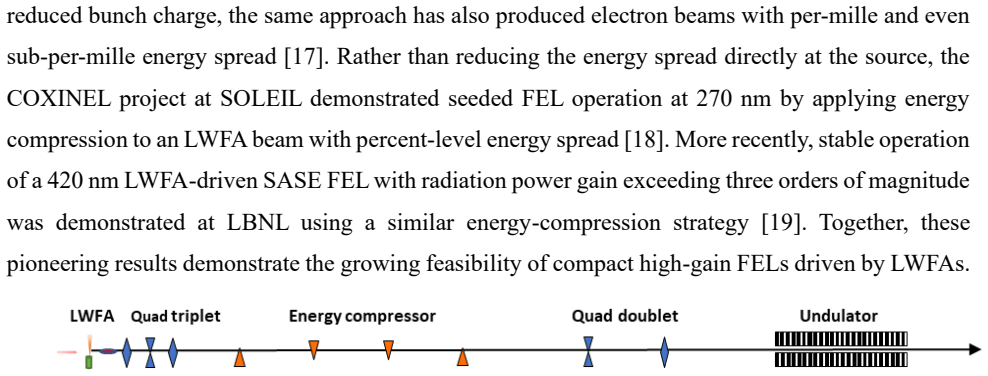
Laser wakefield accelerators (LWFAs) are attractive compact drivers for free-electron lasers (FELs) because they can generate femtosecond electron beams with high peak current over centimeter-scale acceleration distances. However, their relatively large energy spread remains a major obstacle to high-gain FEL operation. Although bunch energy compression can reduce the slice energy spread to a level suitable for FEL amplification, it also introduces a strong energy chirp. The energy chirp detunes the FEL resonance along the planar undulator, causing phase slippage between the electrons and the radiation field, reduced bunching efficiency, and degraded radiation power and spectral quality. Here we investigate a longitudinally tapered undulator for compensating the chirp-induced resonance mismatch in a self-amplified spontaneous-emission (SASE) FEL driven by an energy-compressed LWFA beam. Using three-dimensional unaveraged simulations, we show that an optimized taper profile restores electron-radiation phase synchronization and significantly improves both the saturation power and the spectral properties relative to the untapered case. We also assess the sensitivity of the scheme to shot-to-shot beam-energy fluctuations characteristic of LWFA operation. Our results show that undulator tapering is an effective method for mitigating chirp-induced performance degradation in compact plasma-based FELs.
Editorial analysis
A structured set of objections, weighed in public.
Referee Report
Summary. The paper investigates the use of a longitudinally tapered undulator to compensate for energy chirp in energy-compressed LWFA-driven SASE FELs. Using 3D unaveraged simulations, it claims that an optimized taper profile restores electron-radiation phase synchronization, leading to higher saturation power and improved spectral quality compared to the untapered case, while also evaluating robustness to typical LWFA shot-to-shot energy fluctuations.
Significance. If the simulation results hold under experimental conditions, this provides a practical mitigation strategy for chirp-induced detuning in compact plasma-based FELs, potentially enabling higher-gain operation with LWFA drivers. The 3D simulation approach and sensitivity analysis offer concrete, falsifiable predictions for the taper scheme's performance gains.
major comments (2)
- [Simulation methods and results sections] The optimization procedure for the taper profile (including method, number of parameters, convergence criteria, and avoidance of post-hoc tuning) is not described with sufficient detail to allow reproduction or assessment of whether the reported gains are robust or specific to the chosen simulation setup.
- [Results section] Quantitative metrics for the claimed improvements (e.g., saturation power increase factor, spectral bandwidth reduction, bunching factor values) are presented without error bars, statistical significance from multiple runs, or explicit baseline comparisons to the untapered case in the figures or text.
minor comments (2)
- [Methods] Clarify the exact form of the taper profile parameterization and any constraints applied during optimization.
- [Simulation setup] Add discussion of how the 3D unaveraged code handles space-charge and radiation effects in the tapered undulator to strengthen the simulation validity.
Simulated Author's Rebuttal
We thank the referee for the positive evaluation of the significance of our work and for the constructive comments on improving reproducibility and quantitative clarity. We address each major comment below and indicate the corresponding revisions to the manuscript.
read point-by-point responses
-
Referee: [Simulation methods and results sections] The optimization procedure for the taper profile (including method, number of parameters, convergence criteria, and avoidance of post-hoc tuning) is not described with sufficient detail to allow reproduction or assessment of whether the reported gains are robust or specific to the chosen simulation setup.
Authors: We agree that the optimization procedure requires more explicit documentation for reproducibility. In the revised manuscript we have expanded the Simulation Methods section with a dedicated paragraph specifying the optimization approach (iterative multi-parameter scan with refinement), the number of free parameters in the taper profile (six), the convergence criterion (change in peak power below 5% between successive iterations), and confirmation that the profile was optimized on an independent test beam before being applied to the production simulations. This eliminates any possibility of post-hoc tuning and allows readers to assess robustness to the specific setup. revision: yes
-
Referee: [Results section] Quantitative metrics for the claimed improvements (e.g., saturation power increase factor, spectral bandwidth reduction, bunching factor values) are presented without error bars, statistical significance from multiple runs, or explicit baseline comparisons to the untapered case in the figures or text.
Authors: We accept that explicit baseline comparisons and clearer quantification strengthen the presentation. The revised Results section and figures now include direct side-by-side comparisons to the untapered case, with tabulated values for the saturation power increase factor, spectral bandwidth reduction, and peak bunching factor. Regarding error bars and statistical significance from multiple runs, the 3D unaveraged simulations are computationally intensive; we have performed a limited set of additional realizations with different random seeds for the SASE process and added representative error bars derived from these runs. We have also clarified in the text that the reported improvements remain consistent across the explored parameter space. Full statistical sampling from dozens of runs is not feasible within reasonable computational resources, but the added sensitivity analysis serves as a practical substitute. revision: partial
Circularity Check
No significant circularity; claims rest on independent numerical simulations
full rationale
The paper presents results from three-dimensional unaveraged simulations showing that an optimized undulator taper restores phase synchronization and improves saturation power and spectral quality compared to the untapered case in an energy-compressed LWFA-driven SASE FEL. No analytic derivation chain is offered that reduces by construction to fitted inputs, self-citations, or ansatzes; the taper optimization occurs inside the simulation, and the performance gains are reported as direct numerical outcomes. The assessment of sensitivity to beam-energy fluctuations is likewise simulation-based. This structure is self-contained against external benchmarks, with no load-bearing steps that equate predictions to their own inputs.
Axiom & Free-Parameter Ledger
free parameters (1)
- taper profile parameters
axioms (1)
- domain assumption The 3D unaveraged simulation model faithfully reproduces the FEL interaction physics for a chirped LWFA beam inside a tapered undulator.
Reference graph
Works this paper leans on
-
[1]
First lasing and operation of an ångstrom-wavelength free-electron laser,
P. Emma, R. Akre, J. Arthur, et al., “First lasing and operation of an ångstrom-wavelength free-electron laser,” Nat. Photon. 4, 641–647 (2010)
work page 2010
-
[2]
A compact X-ray free-electron laser emitting in the sub-ångström region,
T. Ishikawa, H. Aoyagi, T. Asaka, et al., “A compact X-ray free-electron laser emitting in the sub-ångström region,” Nat. Photon. 6, 540–544 (2012)
work page 2012
-
[3]
Hard X-ray free-electron laser with femtosecond-scale timing jitter,
H. S. Kang, C. K. Min, H. Heo, et al., “Hard X-ray free-electron laser with femtosecond-scale timing jitter,” Nat. Photon. 11, 708–713 (2017)
work page 2017
-
[4]
E. Allaria, R. Appio, L. Badano, et al., “Highly coherent and stable pulses from the FERMI seeded free-electron laser in the extreme ultraviolet,” Nat. Photon. 6, 699–704 (2012). 20
work page 2012
-
[5]
E. Prat, A. Al Haddad, C. Arrell, et al., “An X-ray free-electron laser with a highly configurable undulator and integrated chicanes for tailored pulse properties,” Nat. Commun. 14, 5069 (2023)
work page 2023
-
[6]
W. Decking, S. Abeghyan, P. Abramian, et al., “A MHz-repetition-rate hard X-ray free- electron laser driven by a superconducting linear accelerator,” Nat. Photon. 14, 391–397 (2020)
work page 2020
-
[7]
The SXFEL Upgrade: From Test Facility to User Facility,
B. Liu, C. Feng, D. Gu, et al., “The SXFEL Upgrade: From Test Facility to User Facility,” Appl. Sci. 12, 176 (2022)
work page 2022
-
[8]
Developments in laser-driven plasma accelerators,
S. M. Hooker, “Developments in laser-driven plasma accelerators,” Nat. Photon. 7, 775–782 (2013)
work page 2013
-
[9]
Physics of laser-driven plasma-based electron accelerators,
E. Esarey, C. B. Schroeder, and W. P. Leemans, “Physics of laser-driven plasma-based electron accelerators,” Rev. Mod. Phys. 81, 1229–1285 (2009)
work page 2009
-
[10]
Application of laser-plasma accelerator beams to free-electron lasers,
C. B. Schroeder, C. Benedetti, E. Esarey, et al., “Application of laser-plasma accelerator beams to free-electron lasers,” in Proceedings of FEL 2012, THPD57 (2012)
work page 2012
-
[11]
An application of laser-plasma acceleration: Towards a free-electron laser amplification,
M. E. Couprie, M. Labat, C. Evain, et al., “An application of laser-plasma acceleration: Towards a free-electron laser amplification,” Plasma Phys. Control. Fusion 58, 034020 (2016)
work page 2016
-
[12]
Free electron lasers driven by plasma accelerators: Status and near-term prospects,
C. Emma, J. van Tilborg, R. Assmann, et al., “Free electron lasers driven by plasma accelerators: Status and near-term prospects,” High Power Laser Sci. Eng. 9, e57 (2021)
work page 2021
-
[13]
M. Hansson, B. Aurand, X. Davoine, et al., “Down-ramp injection and independently controlled acceleration of electrons in a tailored laser wakefield accelerator,” Phys. Rev. ST Accel. Beams 18, 071303 (2015)
work page 2015
-
[14]
Z. R. Huang, Y. T. Ding, and C. B. Schroeder, “Compact x-ray free-electron laser from a laser- plasma accelerator using a transverse-gradient undulator,” Phys. Rev. Lett. 109, 204801 (2012)
work page 2012
-
[15]
L. T. Ke, K. Feng, W. T. Wang, et al., “Near-GeV electron beams at a few per-mille level from a laser wakefield accelerator via density-tailored plasma,” Phys. Rev. Lett. 126, 214801 (2021)
work page 2021
-
[16]
Free-electron lasing at 27 nanometres based on a laser wakefield accelerator,
W. Wang, K. Feng, L. Ke, et al., “Free-electron lasing at 27 nanometres based on a laser wakefield accelerator,” Nature 595, 516–520 (2021)
work page 2021
-
[17]
C. Yu, Z. Qin, Z. Xiang, et al., “Sub-per-mille bunch energy spread in a quasi-linear laser- wakefield accelerator via periodical de-chirpings,” Commun. Phys. 8, 137 (2025)
work page 2025
-
[18]
Seeded free-electron laser driven by a compact laser plasma accelerator,
M. Labat, J. C. Cabadağ, A. Ghaith, et al., “Seeded free-electron laser driven by a compact laser plasma accelerator,” Nat. Photon. 17, 150–156 (2023)
work page 2023
-
[19]
S. K. Barber, F. Kohrell, C. E. Doss, et al., “Greater than 1000-fold gain in a free-electron laser driven by a laser-plasma accelerator with high reliability,” Phys. Rev. Lett. 135, 055001 (2025)
work page 2025
-
[20]
Energy-chirp compensation in a laser wakefield accelerator,
A. Döpp, C. Thaury, E. Guillaume, et al., “Energy-chirp compensation in a laser wakefield accelerator,” Phys. Rev. Lett. 121, 074802 (2018)
work page 2018
-
[21]
Energy compression and stabilization of laser-plasma accelerators,
A. Ferran Pousa, I. Agapov, S. A. Antipov, et al., “Energy compression and stabilization of laser-plasma accelerators,” Phys. Rev. Lett. 129, 094801 (2022)
work page 2022
-
[22]
Frequency chirped self-amplified spontaneous-emission free- electron lasers,
S. Krinsky and Z. Huang, “Frequency chirped self-amplified spontaneous-emission free- electron lasers,” Phys. Rev. ST Accel. Beams 6, 050702 (2003)
work page 2003
-
[23]
E. L. Saldin, E. A. Schneidmiller, and M. V. Yurkov, “Self-amplified spontaneous emission FEL with energy-chirped electron beam and its application for generation of attosecond x-ray pulses,” Phys. Rev. ST Accel. Beams 9, 050702 (2006)
work page 2006
-
[24]
E. A. Schneidmiller, “Application of a modified chirp-taper scheme for generation of attosecond pulses in extreme ultraviolet and soft x-ray free electron lasers,” Phys. Rev. Accel. Beams 25, 010701 (2022). 21
work page 2022
-
[25]
S. Y. Teng, W. K. Lau, S. H. Chen, and W. Y. Chiang, “Simulation study of energy chirp induced effects in laser-wakefield-accelerator-driven free electron lasers,” New J. Phys. 28, 014301 (2026). L. T. Campbell and B. W. J. McNeil, “PUFFIN: A three dimensional, unaveraged free electron laser simulation code,” in Proceedings of FEL 2012, MOPD12 (2012)
work page 2026
-
[26]
Review of quality optimization of electron beam based on laser wakefield acceleration,
K. Jiang, W. Wang, K. Feng, and R. Li, “Review of quality optimization of electron beam based on laser wakefield acceleration,” Photonics 9, 511 (2022)
work page 2022
-
[27]
PUFFIN: A three dimensional, unaveraged free electron laser simulation code,
L. T. Campbell and B. W. J. McNeil, “PUFFIN: A three dimensional, unaveraged free electron laser simulation code,” in Proceedings of FEL 2012, MOPD12 (2012)
work page 2012
-
[28]
Three-dimensional quasistatic model for high brightness beam dynamics simulation,
J. Qiang, L. Solberg, R. D. Ryne, and C. Limborg-Deprey, “Three-dimensional quasistatic model for high brightness beam dynamics simulation,” Phys. Rev. ST Accel. Beams 9, 044204 (2006)
work page 2006
-
[29]
J. Qiang, R. D. Ryne, S. Habib, and V. Decyk, “An object-oriented parallel particle-in-cell code for beam dynamics simulation in linear accelerators,” J. Comput. Phys. 163, 434–451 (2000)
work page 2000
discussion (0)
Sign in with ORCID, Apple, or X to comment. Anyone can read and Pith papers without signing in.