Recognition: 2 theorem links
· Lean TheoremDual-Temporal LSTM with Hybrid Attention for Airline Passenger Load Factor Forecasting: Integrating Intra-Flight and Inter-Flight Booking Dynamics
Pith reviewed 2026-05-13 01:44 UTC · model grok-4.3
The pith
A dual-stream LSTM with hybrid attention improves airline passenger load factor forecasts by jointly processing intra-flight booking accumulation and inter-flight historical patterns.
A machine-rendered reading of the paper's core claim, the machinery that carries it, and where it could break.
Core claim
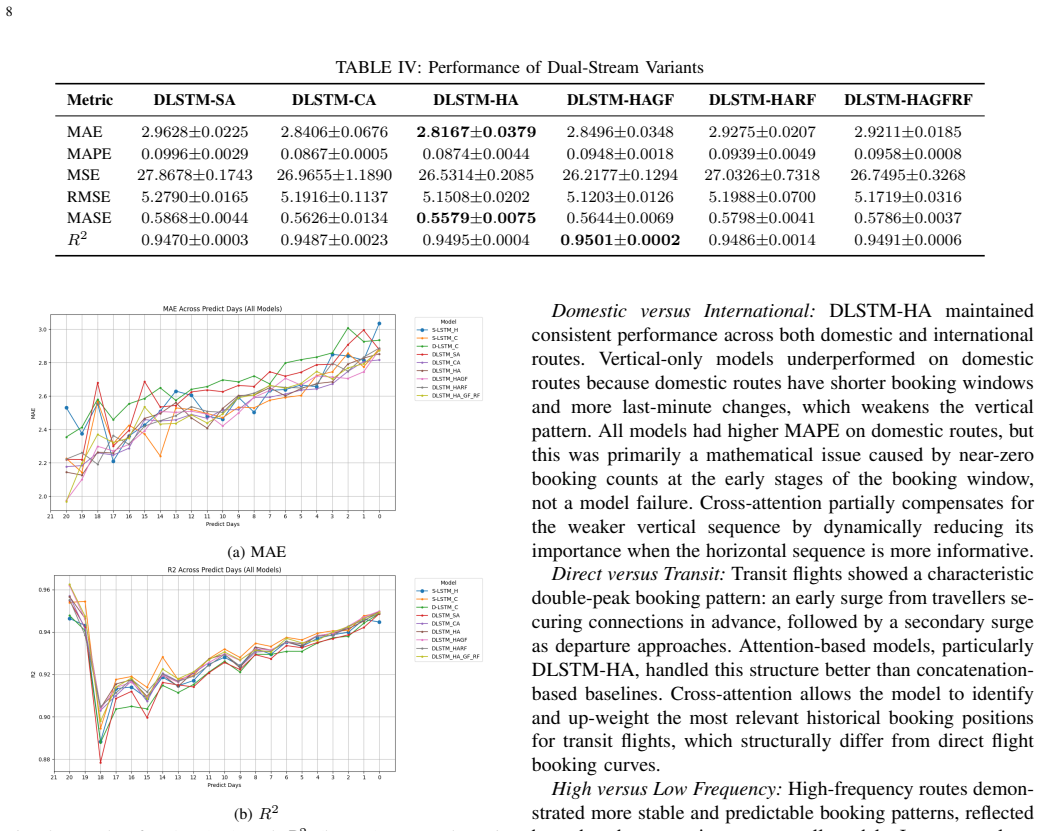
The central claim is that a dual-temporal LSTM integrated with attention simultaneously processes a horizontal intra-flight sequence of booking accumulation over the days before departure and a vertical inter-flight sequence of booking patterns at fixed days-before-departure offsets across historical flights. Multiple variants that combine self-attention, cross-attention, and hybrid attention with concatenation, residual, and gated fusion are evaluated on real reservation data; the hybrid-attention model achieves a mean absolute error of 2.8167 and an R-squared of 0.9495, outperforming single-stream baselines, tree-based models, and three prior dual-LSTM architectures on the same dataset, as
What carries the argument
Dual-stream LSTM with hybrid attention that fuses one intra-flight accumulation sequence and one inter-flight fixed-offset sequence.
If this is right
- Load-factor predictions remain usable when planned aircraft type or total seat capacity changes, because the model does not forecast absolute passenger counts.
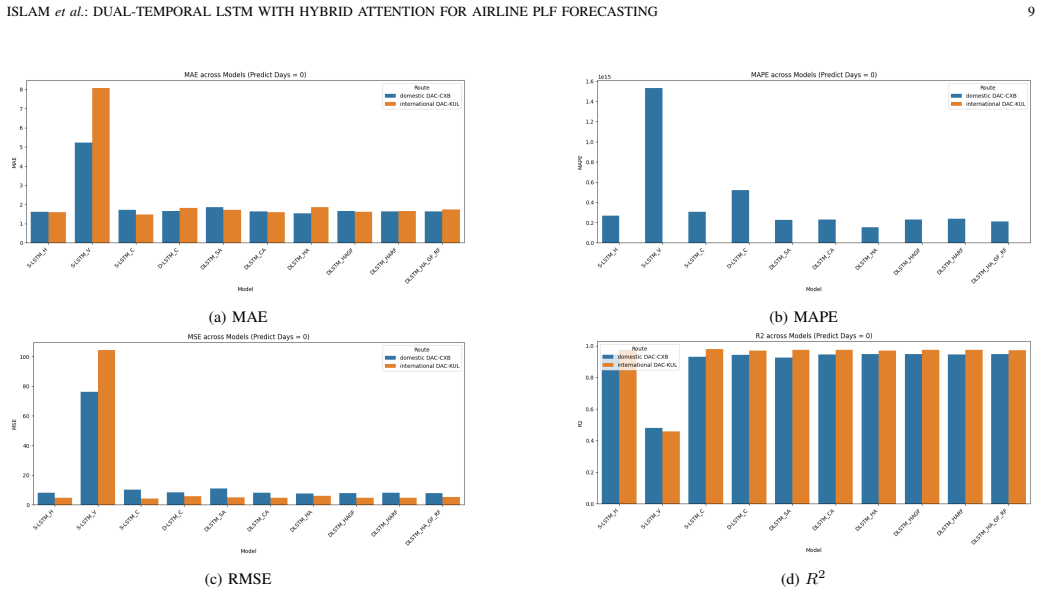
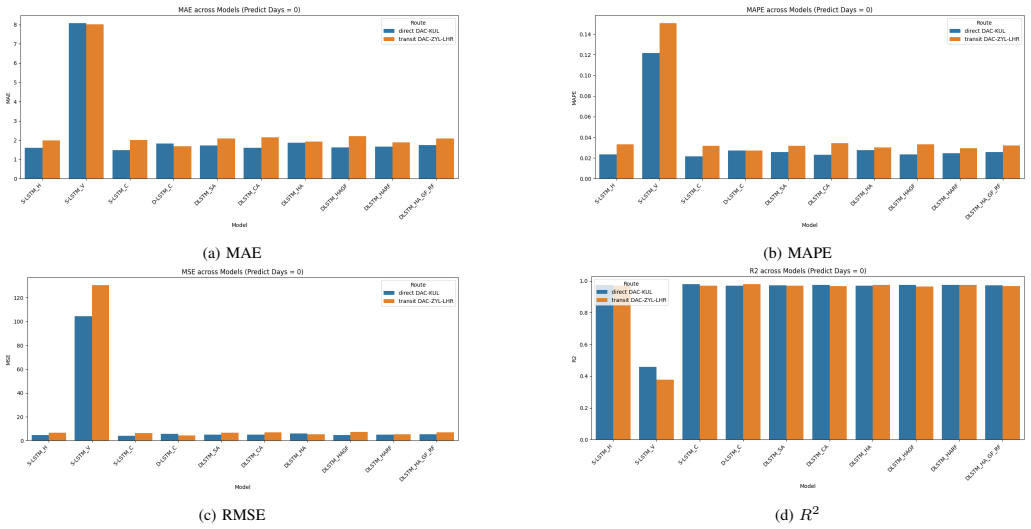
- The same architecture generalizes across domestic versus international, direct versus transit, high versus low frequency, and short versus long-haul routes.
- Hybrid attention fusion outperforms both single-stream LSTMs and earlier dual-LSTM designs on the identical Biman Bangladesh Airlines dataset.
- Real-world deployment at an operating airline demonstrates immediate applicability to revenue-management systems.
- Forecasts can be produced for any future departure date once the two input sequences are assembled from the reservation system.
Where Pith is reading between the lines
- The same dual-stream pattern could be applied to hotel occupancy or event-ticketing data, where both per-item accumulation and cross-item historical curves exist.
- Adding a lightweight module to detect sudden external events would address the current reliance on the two streams alone.
- Re-training and testing the identical architecture on datasets from carriers in other regions would test whether the reported gains are specific to one airline's booking system.
- Extending the vertical stream to include variable rather than fixed offsets could capture longer-term seasonal effects not yet modeled.
Load-bearing premise
The two chosen temporal streams together capture the dominant booking dynamics without additional exogenous features or explicit modeling of external shocks.
What would settle it
A head-to-head test on reservation data from a second airline in which the hybrid dual-stream model shows higher mean absolute error than a carefully tuned single-stream LSTM would falsify the claim that the dual architecture is required for superior performance.
Figures




read the original abstract
Accurate short-term demand forecasting is crucial to airline revenue management, yet most existing systems fail to meet this need because current models treat booking data as a single temporal dimension, either the accumulation of bookings for a specific flight or the historical booking profile of the same route. This unidimensional view discards information carried by the other temporal stream and forecasting absolute passenger counts introduces a further operational fragility when change in planned aircraft type alters total seat capacity. This study addresses both limitations. A dual-stream Long Short-Term Memory (LSTM) integrated with attention framework is proposed that simultaneously processes two complementary input sequences: a horizontal sequence capturing intra-flight booking accumulation over the days preceding departure, and a vertical sequence capturing inter-flight booking patterns at fixed days-before-departure offsets across historical flights. Multiple dual-stream architectural variants, combining self-attention, cross-attention, and hybrid attention with concatenation, residual, and gated fusion strategies, are developed and evaluated. Experiments on real-world reservation data from the national airline of Bangladesh, Biman Bangladesh Airlines (BBA), demonstrate that the proposed hybrid model achieves a Mean Absolute Error of 2.8167 and a coefficient of determination ($R^{2}$) of 0.9495, outperforming single-stream baselines, tree-based models, and three prior dual-LSTM architectures applied to the same data. Validation across four flight category pairs; domestic versus international, direct versus transit, high versus low frequency, and short versus mid versus long haul confirms that the model generalizes across operationally diverse route types. Biman Bangladesh Airlines (BBA) has officially integrated this methodology into its operations.
Editorial analysis
A structured set of objections, weighed in public.
Referee Report
Summary. The paper claims to introduce a dual-temporal LSTM with hybrid attention for forecasting airline passenger load factors by processing intra-flight booking accumulation and inter-flight patterns. On Biman Bangladesh Airlines data, the hybrid model achieves MAE 2.8167 and R² 0.9495, outperforming baselines and generalizing across four route categories, with claimed operational integration.
Significance. If the results hold under scrutiny, this work could meaningfully advance short-term demand forecasting in revenue management by capturing complementary temporal information from booking data. The specific performance numbers and airline adoption suggest potential for practical impact, though the absence of robustness checks to external events limits the assessed significance.
major comments (2)
- Abstract and Results: The reported metrics (MAE of 2.8167 and R² of 0.9495) are presented without error bars, ablation studies on the attention fusion strategies, or statistical significance tests against baselines, which is required to substantiate the outperformance and generalization claims across route pairs.
- Model and Experiments: The central assumption that the two temporal streams capture dominant booking dynamics without exogenous features is not tested against external shocks such as promotions or disruptions; this is load-bearing for the claim that the model generalizes and has been operationally adopted.
minor comments (1)
- Notation: Clarify whether the load factor is expressed as a percentage or fraction, as the MAE value of 2.8167 is consistent with percentage points.
Simulated Author's Rebuttal
We thank the referee for the constructive comments, which highlight opportunities to strengthen the empirical support for our claims. We address each major comment below and will incorporate the necessary revisions.
read point-by-point responses
-
Referee: [—] Abstract and Results: The reported metrics (MAE of 2.8167 and R² of 0.9495) are presented without error bars, ablation studies on the attention fusion strategies, or statistical significance tests against baselines, which is required to substantiate the outperformance and generalization claims across route pairs.
Authors: We agree that error bars, ablation studies, and statistical significance tests are important for rigorously substantiating the reported performance. In the revised manuscript, we will add error bars derived from multiple independent training runs with different random seeds and report standard deviations alongside the mean metrics. We will include a dedicated ablation subsection comparing all dual-stream variants (self-attention, cross-attention, and the three hybrid fusion strategies) with quantitative results. We will also apply paired statistical tests (e.g., Wilcoxon signed-rank test) across the route categories to establish significance of improvements over the single-stream, tree-based, and prior dual-LSTM baselines. These additions will be reflected in the results tables, figures, and a brief mention in the abstract. revision: yes
-
Referee: [—] Model and Experiments: The central assumption that the two temporal streams capture dominant booking dynamics without exogenous features is not tested against external shocks such as promotions or disruptions; this is load-bearing for the claim that the model generalizes and has been operationally adopted.
Authors: The dual-temporal architecture is deliberately restricted to booking-curve inputs because these are the only real-time signals available to revenue-management systems at the short-term forecasting horizon. Historical inter-flight patterns implicitly encode the effects of past promotions and disruptions that occurred in the training data. We acknowledge that explicit robustness testing against labeled external events is absent. In revision we will (i) add a limitations paragraph discussing this modeling choice and the potential benefit of future exogenous features, (ii) provide additional context on Biman Bangladesh Airlines’ internal validation and deployment process (without disclosing proprietary details), and (iii) qualify the generalization and adoption statements to reflect the scope of the current experiments. We do not claim the model is invariant to all external shocks; rather, the cross-category results demonstrate practical utility on the observed distribution of routes. revision: partial
Circularity Check
No circularity: empirical results from held-out training data, not algebraic reduction
full rationale
The paper introduces a dual-stream LSTM architecture with hybrid attention to process intra-flight and inter-flight booking sequences, then reports performance (MAE 2.8167, R² 0.9495) obtained by standard supervised training and evaluation on real reservation data from Biman Bangladesh Airlines. These metrics arise from fitting the model parameters to training splits and measuring generalization on held-out test data, rather than any derivation that reduces the claimed outputs to the inputs by construction. No equations, uniqueness theorems, or self-citations are invoked as load-bearing justifications for the architecture or results; comparisons to baselines and prior dual-LSTM models are external empirical checks on the same dataset. The derivation chain is therefore self-contained as a data-driven modeling contribution.
Axiom & Free-Parameter Ledger
free parameters (2)
- LSTM hidden size, layers, and attention heads
- Fusion gating or residual weights
axioms (2)
- domain assumption LSTM cells can capture sequential dependencies in booking curves.
- domain assumption Attention mechanisms can identify the most informative time steps within each stream.
Lean theorems connected to this paper
-
IndisputableMonolith/Cost/FunctionalEquation.leanwashburn_uniqueness_aczel unclear?
unclearRelation between the paper passage and the cited Recognition theorem.
dual-stream Long Short-Term Memory (LSTM) integrated with attention framework... horizontal sequence capturing intra-flight booking accumulation... vertical sequence capturing inter-flight booking patterns at fixed days-before-departure offsets
-
IndisputableMonolith/Foundation/RealityFromDistinction.leanreality_from_one_distinction unclear?
unclearRelation between the paper passage and the cited Recognition theorem.
hybrid attention model (DLSTM-HA) achieved the best MAE of 2.8167 and R2 of 0.9495
What do these tags mean?
- matches
- The paper's claim is directly supported by a theorem in the formal canon.
- supports
- The theorem supports part of the paper's argument, but the paper may add assumptions or extra steps.
- extends
- The paper goes beyond the formal theorem; the theorem is a base layer rather than the whole result.
- uses
- The paper appears to rely on the theorem as machinery.
- contradicts
- The paper's claim conflicts with a theorem or certificate in the canon.
- unclear
- Pith found a possible connection, but the passage is too broad, indirect, or ambiguous to say the theorem truly supports the claim.
Reference graph
Works this paper leans on
-
[1]
Airline profitability to strengthen slightly in 2025 despite headwinds,
“Airline profitability to strengthen slightly in 2025 despite headwinds,” https://www.iata.org/en/pressroom/2025-releases/2025-06-02-01/, 2025, accessed: Jul. 18, 2025
work page 2025
-
[2]
ARIMA + GARCH + Bootstrap forecasting method applied to the airline industry,
M. R. Nieto and R. B. Carmona-Benítez, “ARIMA + GARCH + Bootstrap forecasting method applied to the airline industry,”Journal of Air Transport Management, vol. 71, pp. 1–8, 2018
work page 2018
-
[3]
Econometric forecasting models for air traffic passenger of Indonesia,
V . Suryan, “Econometric forecasting models for air traffic passenger of Indonesia,”Journal of Civil Engineering Forum, vol. 3, no. 1, 2017
work page 2017
-
[4]
B. Pan, D. Yuan, W. Sun, C. Liang, and D. Li, “A novel LSTM-based daily airline demand forecasting method using vertical and horizontal time series,” inTrends and Applications in Knowledge Discovery and Data Mining (PAKDD Workshops). Cham: Springer, 2018, pp. 168– 173
work page 2018
-
[5]
Flight short-term booking demand forecasting based on a long short-term memory network,
H. He, L. Chen, and S. Wang, “Flight short-term booking demand forecasting based on a long short-term memory network,”Computers & Industrial Engineering, vol. 186, p. 109707, 2023
work page 2023
-
[6]
SARIMA damp trend grey forecasting model for airline industry,
R. B. Carmona-Benítez and M. R. Nieto, “SARIMA damp trend grey forecasting model for airline industry,”Journal of Air Transport Management, vol. 82, p. 101736, 2020
work page 2020
-
[7]
Forecasting air passenger traffic flow based on the two-phase learning model,
X. Wu, Y . Xiang, G. Mao, M. Du, X. Yang, and X. Zhou, “Forecasting air passenger traffic flow based on the two-phase learning model,” Journal of Supercomputing, vol. 77, no. 5, pp. 4221–4243, 2021
work page 2021
-
[8]
An analysis of the prospects of ultra-long-haul airline operations using passenger demand data,
W. Grimme, S. Bingemer, and S. Maertens, “An analysis of the prospects of ultra-long-haul airline operations using passenger demand data,” Transportation Research Procedia, vol. 51, pp. 208–216, 2020
work page 2020
-
[9]
An airport level framework for examining the impact of COVID-19 on airline demand,
S. Dey Tirtha, T. Bhowmik, and N. Eluru, “An airport level framework for examining the impact of COVID-19 on airline demand,”Transporta- tion Research Part A: Policy and Practice, vol. 159, pp. 169–181, 2022
work page 2022
-
[10]
D. P. Bastola, “Air passenger demand model (APDM): Econometric model for forecasting demand in passenger air transports in Nepal,” vol. 1, no. 4, 2017
work page 2017
-
[11]
Estimating unconstrained cus- tomer choice set demand: A case study on airline reservation data,
A. Haensel, G. Koole, and J. Erdman, “Estimating unconstrained cus- tomer choice set demand: A case study on airline reservation data,” Journal of Choice Modelling, vol. 4, no. 3, pp. 75–87, 2011
work page 2011
-
[12]
Dynamic airline booking forecasting,
T. van Ostaijen, B. F. Santos, and M. Mitici, “Dynamic airline booking forecasting,” unpublished manuscript
-
[13]
Dynamic airline booking demand forecasting,
T. L. E. Marques, “Dynamic airline booking demand forecasting,” Master’s thesis, 2016
work page 2016
-
[14]
Forecasting air travel demand for selected destinations using machine learning methods,
M. Firat, D. Yiltas-Kaplan, and R. Samli, “Forecasting air travel demand for selected destinations using machine learning methods,”Journal of Universal Computer Science, vol. 27, no. 6, 2021
work page 2021
-
[15]
J.-H. Chen, H.-H. Wei, C.-L. Chen, H.-Y . Wei, Y .-P. Chen, and Z. Ye, “A practical approach to determining critical macroeconomic factors in air-traffic volume based on K-means clustering and decision-tree classification,”Journal of Air Transport Management, vol. 82, p. 101743, 2020
work page 2020
-
[16]
A machine learning approach to itinerary-level booking prediction in competitive airline markets,
D. Hopman, G. Koole, and R. V . D. Mei, “A machine learning approach to itinerary-level booking prediction in competitive airline markets,” International Journal of Revenue Management, vol. 12, no. 3–4, pp. 153–191, 2021
work page 2021
-
[17]
Exploring deep learning approaches for short-term passenger demand prediction,
Z. Ghandeharioun, P. Zendehdel Nobari, and W. Wu, “Exploring deep learning approaches for short-term passenger demand prediction,”Data Science for Transportation, vol. 5, no. 3, p. 19, 2023
work page 2023
-
[18]
Learning internal representations by error propagation,
D. E. Rumelhart and J. L. McClelland, “Learning internal representations by error propagation,” inParallel Distributed Processing: Explorations in the Microstructure of Cognition. MIT Press, 1987, pp. 318–362
work page 1987
-
[19]
S. Hochreiter and J. Schmidhuber, “Long short-term memory,”Neural Computation, vol. 9, no. 8, pp. 1735–1780, 1997
work page 1997
-
[20]
Forecasting air passenger demand: a comparison of LSTM and SARIMA,
Q. H. Do, S.-K. Lo, J.-F. Chen, C.-L. Le, and L. H. Anh, “Forecasting air passenger demand: a comparison of LSTM and SARIMA,”Journal of Computer Science, vol. 16, no. 7, pp. 1063–1084, 2020
work page 2020
-
[21]
Deep learning models for forecasting aviation demand time series,
A. Kanavos, F. Kounelis, L. Iliadis, and C. Makris, “Deep learning models for forecasting aviation demand time series,”Neural Computing and Applications, vol. 33, no. 23, pp. 16 329–16 343, 2021
work page 2021
-
[22]
S. M. Iacus, F. Natale, C. Santamaria, S. Spyratos, and M. Vespe, “Estimating and projecting air passenger traffic during the COVID-19 coronavirus outbreak and its socio-economic impact,”Safety Science, vol. 129, p. 104791, 2020
work page 2020
-
[23]
Efficient two-stream network for violence detection using separable convolutional LSTM,
Z. Islam, M. Rukonuzzaman, R. Ahmed, M. H. Kabir, and M. Farazi, “Efficient two-stream network for violence detection using separable convolutional LSTM,” inProc. International Joint Conference on Neural Networks (IJCNN), 2021, pp. 1–8
work page 2021
-
[24]
Forecast- ing agricultural commodity prices using dual input attention LSTM,
Y . H. Gu, D. Jin, H. Yin, R. Zheng, X. Piao, and S. J. Yoo, “Forecast- ing agricultural commodity prices using dual input attention LSTM,” Agriculture, vol. 12, no. 2, 2022
work page 2022
-
[25]
Remaining useful life prediction using dual-channel LSTM with time feature and its difference,
C. Peng, J. Wu, Q. Wang, W. Gui, and Z. Tang, “Remaining useful life prediction using dual-channel LSTM with time feature and its difference,”Entropy, vol. 24, no. 12, 2022
work page 2022
-
[26]
K. ¸ Sim¸ sek, N. Ö. Ö. Tu ˘grul, K. Karaçuha, V . Tabatadze, and E. Karaçuha, “Modeling and predicting passenger load factor in air transportation: A deep assessment methodology with fractional calculus approach utilizing reservation data,”Fractal and Fractional, vol. 8, no. 4, p. 214, 2024
work page 2024
discussion (0)
Sign in with ORCID, Apple, or X to comment. Anyone can read and Pith papers without signing in.