Recognition: unknown
General Criteria for Certifying Genuine High-Dimensional Quantum Teleportation
Pith reviewed 2026-05-13 01:13 UTC · model grok-4.3
The pith
Two criteria based on fidelity and robustness certify the entanglement dimension in high-dimensional quantum teleportation.
A machine-rendered reading of the paper's core claim, the machinery that carries it, and where it could break.
Core claim
The central discovery is two universal criteria, one fidelity-based and one robustness-based, that fully identify the dimension of the entanglement resource in high-dimensional quantum teleportation using only the input and output teleportation data under partial Bell-state measurements, with the robustness criterion being applicable in black-box scenarios without prior assumptions about local operations.
What carries the argument
The fidelity-based and robustness-based criteria that extract the entanglement dimension from teleportation input-output statistics.
If this is right
- Successful certification would confirm that the transmission capacity meets high-dimensional thresholds.
- It would verify noise resilience for the claimed dimension.
- This would enable reliable validation of high-dimensional quantum network links.
- Partial measurements suffice, reducing experimental requirements.
Where Pith is reading between the lines
- These criteria could be adapted to certify dimensions in other quantum communication protocols.
- Experimental implementations might test the robustness against specific noise models not covered in the paper.
- The black-box nature suggests use in device-independent scenarios for quantum networks.
Load-bearing premise
That the input and output data from teleportation experiments are sufficient to distinguish the entanglement dimension without full characterization or assumptions on the operations performed.
What would settle it
A counterexample would be a high-dimensional teleportation setup where the fidelity or robustness measure falls below the threshold required for the claimed dimension despite successful state transmission.
Figures

read the original abstract
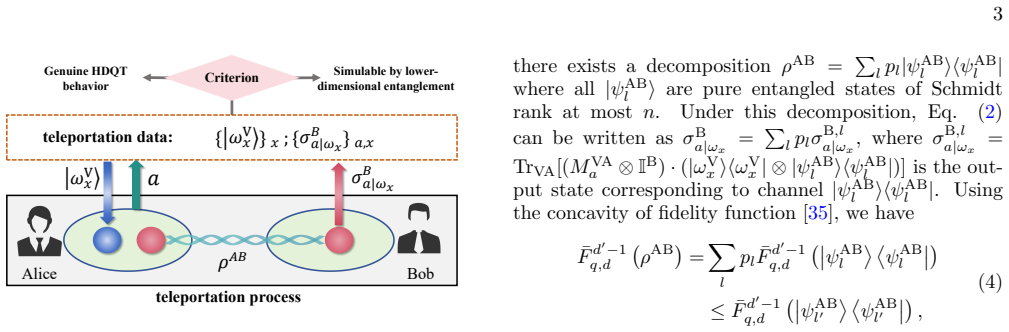
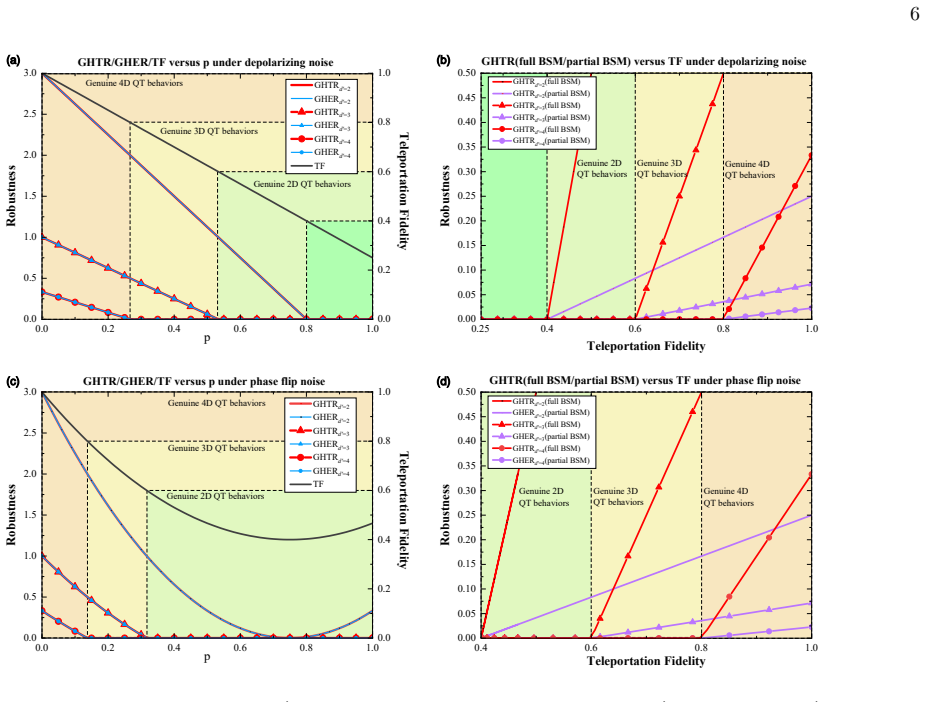
Developing reliable methods for certifying the dimension of a given quantum system or process is essential to ensure the validity of claimed realization of high-dimensional (HD) quantum advantages. The existing criteria for certifying genuine HD quantum teleportation (HDQT) mainly focus on demonstrating the successful transmission of genuine HD quantum states. However, a complete certification of HDQT must also identify the entanglement dimension of resource, which is critical for verifying whether the transmission capacity and noise resilience meet the necessary thresholds. Here we propose two universal criteria (based on fidelity and robustness, respectively) for certifying genuine HDQT behaviors that can close this gap by fully identifying the dimension of the entanglement. Both criteria require only the input and output teleportation data and remain feasible under partial Bell-state measurements. Furthermore, the robustness-based criterion has stronger noise resistance and it requires no prior assumptions about local operations, making it robust even in black-box scenario. Our results establish a universal and reliable theoretical framework for validating the core quantum advantage in HDQT, pivotal for ensuring the reliable links in HD quantum networks.
Editorial analysis
A structured set of objections, weighed in public.
Referee Report
Summary. The paper proposes two universal criteria (fidelity-based and robustness-based) for certifying genuine high-dimensional quantum teleportation (HDQT). These criteria use only input-output teleportation statistics under partial Bell-state measurements to identify the exact dimension of the shared entanglement resource. The robustness criterion is presented as having stronger noise tolerance and requiring no assumptions on local operations, enabling certification even in black-box settings.
Significance. If rigorously established, the criteria would fill an important gap in HDQT verification by certifying the entanglement dimension (rather than only state transmission fidelity), which directly impacts claims about transmission capacity and noise resilience in high-dimensional quantum networks. The black-box applicability of the robustness criterion would be a practical strength for experimental implementations.
major comments (1)
- [Abstract] Abstract: the central claim that the criteria 'fully identify the dimension of the entanglement' using only partial BSM input-output data requires an explicit demonstration that the mapping from dimension d to the observed outcome probabilities is injective for all admissible local operations and noise channels. Partial BSM yields at most d^{2} probabilities per input, so the paper must show that no two different d values can produce overlapping statistics under adversarial local unitaries; without this, the certification is incomplete.
minor comments (1)
- The abstract would benefit from a brief indication of the mathematical form of the two criteria (e.g., the explicit fidelity threshold or robustness measure) to allow readers to assess their construction immediately.
Simulated Author's Rebuttal
We thank the referee for their careful reading of our manuscript and for highlighting the need for greater rigor in establishing the injectivity of our certification criteria. We address the major comment below and have made revisions to strengthen the presentation.
read point-by-point responses
-
Referee: [Abstract] Abstract: the central claim that the criteria 'fully identify the dimension of the entanglement' using only partial BSM input-output data requires an explicit demonstration that the mapping from dimension d to the observed outcome probabilities is injective for all admissible local operations and noise channels. Partial BSM yields at most d^{2} probabilities per input, so the paper must show that no two different d values can produce overlapping statistics under adversarial local unitaries; without this, the certification is incomplete.
Authors: We agree that an explicit demonstration of injectivity is required to substantiate the claim that the criteria fully identify the entanglement dimension from partial BSM statistics alone. While the original manuscript derived dimension-specific fidelity and robustness thresholds (Sections II and III) that implicitly separate the achievable statistics for different d, we acknowledge that a direct proof addressing adversarial local unitaries and noise channels was not presented with sufficient clarity. In the revised manuscript we have added a new subsection (Section IV) together with an expanded appendix that rigorously proves the required separation: for each d we characterize the convex set of all possible input-output probability vectors obtainable under partial BSM, arbitrary local unitaries, and arbitrary noise channels, and we show that these sets are disjoint for distinct dimensions. Specifically, the maximal fidelity (respectively, minimal robustness) attainable for dimension d is strictly less than the minimal fidelity (respectively, maximal robustness) attainable for dimension d+1. The proof proceeds by constructing explicit witnesses that exploit the orthogonality properties of the generalized Bell states and the dimension-dependent support of the partial BSM projectors. We have also updated the abstract to state that the criteria achieve unique identification via this separation. These additions directly address the referee’s concern without altering the core results. revision: yes
Circularity Check
No circularity: criteria derived from input-output statistics without self-referential reduction
full rationale
The paper introduces two new certification criteria (fidelity-based and robustness-based) for identifying entanglement dimension in HDQT. These are constructed directly from teleportation input-output data under partial BSM, with explicit thresholds derived from quantum information inequalities. No step reduces a claimed prediction to a fitted parameter by construction, nor does any load-bearing premise rely on self-citation chains or ansatzes imported from prior author work. The robustness criterion is presented as assumption-free in the black-box setting, and the derivation remains self-contained against external benchmarks such as standard fidelity witnesses and dimension witnesses. The skeptic concern addresses injectivity of the probability map (a correctness question) rather than any definitional or fitted-input circularity.
Axiom & Free-Parameter Ledger
Reference graph
Works this paper leans on
-
[1]
C. H. Bennett, G. Brassard, C. Cr´ epeau, R. Jozsa, A. Peres, and W. K. Wootters, Phys. Rev. Lett.70, 1895 (1993)
work page 1993
-
[2]
S. Pirandola, J. Eisert, C. Weedbrook, A. Furusawa, and S. L. Braunstein, Nat. Photonics9, 641 (2015)
work page 2015
-
[3]
X.-M. Hu, Y. Guo, B.-H. Liu, C.-F. Li, and G.-C. Guo, Nat. Rev. Phys.5, 339 (2023)
work page 2023
- [4]
-
[5]
M. Pompili, S. L. Hermans, S. Baier, H. K. Beukers, P. C. Humphreys, R. N. Schouten, R. F. Vermeulen, M. J. Tiggelman, L. dos Santos Martins, B. Dirkse,et al., Sci- ence372, 259 (2021)
work page 2021
-
[6]
S. Hermans, M. Pompili, H. Beukers, S. Baier, J. Borre- gaard, and R. Hanson, Nature605, 663 (2022)
work page 2022
- [7]
-
[8]
D. Bouwmeester, J.-W. Pan, K. Mattle, M. Eibl, H. We- infurter, and A. Zeilinger, Nature390, 575 (1997)
work page 1997
-
[9]
J.-W. Pan, M. Daniell, S. Gasparoni, G. Weihs, and 9 A. Zeilinger, Phys. Rev. Lett.86, 4435 (2001)
work page 2001
-
[10]
B. Li, Y. Cao, Y.-H. Li, W.-Q. Cai, W.-Y. Liu, J.-G. Ren, S.-K. Liao, H.-N. Wu, S.-L. Li, L. Li,et al., Phys. Rev. Lett.128, 170501 (2022)
work page 2022
- [11]
-
[12]
X.-S. Ma, T. Herbst, T. Scheidl, D. Wang, S. Kropatschek, W. Naylor, B. Wittmann, A. Mech, J. Kofler, E. Anisimova,et al., Nature489, 269 (2012)
work page 2012
-
[13]
J.-G. Ren, P. Xu, H.-L. Yong, L. Zhang, S.-K. Liao, J. Yin, W.-Y. Liu, W.-Q. Cai, M. Yang, L. Li,et al., Nature549, 70 (2017)
work page 2017
-
[14]
T. Gonzalez-Raya, S. Pirandola, and M. Sanz, Commun. Phys.7, 126 (2024)
work page 2024
-
[15]
D. Lago-Rivera, J. V. Rakonjac, S. Grandi, and H. d. Riedmatten, Nat. Commun.14, 1889 (2023)
work page 2023
- [16]
-
[17]
X.-M. Hu, C. Zhang, B.-H. Liu, Y. Cai, X.-J. Ye, Y. Guo, W.-B. Xing, C.-X. Huang, Y.-F. Huang, C.-F. Li,et al., Phys. Rev. Lett.125, 230501 (2020)
work page 2020
-
[18]
S. Liu, Y. Lv, X. Wang, J. Wang, Y. Lou, and J. Jing, Phys. Rev. Lett.132, 100801 (2024)
work page 2024
-
[19]
D. Cozzolino, B. Da Lio, D. Bacco, and L. K. Oxenløwe, Adv. Quantum Technol.2, 1900038 (2019)
work page 2019
-
[20]
S. Liu, Y. Lou, and J. Jing, Nat. Commun.11, 3875 (2020)
work page 2020
- [21]
- [22]
-
[23]
R. Horodecki, P. Horodecki, M. Horodecki, and K. Horodecki, Rev. Mod. Phys.81, 865 (2009)
work page 2009
-
[24]
N. Brunner, D. Cavalcanti, S. Pironio, V. Scarani, and S. Wehner, Rev. Mod. Phys.86, 419 (2014)
work page 2014
-
[25]
R. Uola, A. C. Costa, H. C. Nguyen, and O. G¨ uhne, Rev. Mod. Phys.92, 015001 (2020)
work page 2020
- [26]
-
[27]
J. Bavaresco, N. Herrera Valencia, C. Kl¨ ockl, M. Pivo- luska, P. Erker, N. Friis, M. Malik, and M. Huber, Nat. Phys.14, 1032 (2018)
work page 2018
-
[28]
N. Wyderka, G. Chesi, H. Kampermann, C. Macchi- avello, and D. Bruß, Phys. Rev. A107, 022431 (2023)
work page 2023
-
[29]
O. Lib, S. Liu, R. Shekel, Q. He, M. Huber, Y. Bromberg, and G. Vitagliano, Phys. Rev. Lett.134, 210202 (2025)
work page 2025
-
[30]
D. Cavalcanti, P. Skrzypczyk, and I. ˇSupi´ c, Phys. Rev. Lett.119, 110501 (2017)
work page 2017
-
[31]
In this work, the entanglement dimension of channel state is the total entanglement dimension of all copies of states used in one round of teleportation. For ex- ample, consider three distinct cases for teleporting 4- dimensional quantum states, the first case is that where the channel state between sender A and receiver B is a single copy of 0A0B + 1A1B ...
-
[32]
The entanglement di- mension of channel state of the first two cases are the same as 4 . We won’t discriminate the first two chan- nel states since they function equally of teleporting 4- dimensional states. But our criteria can discriminate the third case because the total entanglement dimension con- tained in the channel state is less than 4
- [33]
-
[34]
N.-F. Gong, D.-B. Cai, Z.-G. Huang, L. Qian, R.-Q. Zhang, X.-M. Hu, B.-H. Liu, and T.-J. Wang, Phys. Rev. Appl.22, 054045 (2024)
work page 2024
-
[35]
B. M. Terhal and P. Horodecki, Phys. Rev. A61, 040301 (2000)
work page 2000
-
[36]
Y.-C. Liang, Y.-H. Yeh, P. E. Mendon¸ ca, R. Y. Teh, M. D. Reid, and P. D. Drummond, Rep. Prog. Phys82, 076001 (2019)
work page 2019
-
[37]
R. A. Bertlmann and P. Krammer, J. Phys. A: Math. Theor.41, 235303 (2008)
work page 2008
- [38]
-
[39]
A. Tavakoli, A. Pozas-Kerstjens, P. Brown, and M. Ara´ ujo, Rev. Mod. Phys.96, 045006 (2024)
work page 2024
- [40]
-
[41]
M. Horodecki, P. Horodecki, and R. Horodecki, Phys. Rev. A60, 1888 (1999)
work page 1999
-
[42]
T. Durt, B.-G. Englert, I. Bengtsson, and K. ˙Zyczkowski, Int. J. Quantum Inf.8, 535 (2010)
work page 2010
- [43]
-
[44]
Gong, https://doi.org/10.5281/zenodo.18366412 (2026)
N.-F. Gong, https://doi.org/10.5281/zenodo.18366412 (2026)
-
[45]
L. Pereira, L. Zambrano, J. Cort´ es-Vega, S. Niklitschek, and A. Delgado, Phys. Rev. A98, 012339 (2018)
work page 2018
-
[46]
M. Rambach, M. Qaryan, M. Kewming, C. Ferrie, A. G. White, and J. Romero, Phys. Rev. Lett.126, 100402 (2021)
work page 2021
-
[47]
Y. Zhou, J. Zhao, D. Hay, K. McGonagle, R. W. Boyd, and Z. Shi, Phys. Rev. Lett.127, 040402 (2021)
work page 2021
-
[48]
Y. S. Weinstein, M. Pravia, E. Fortunato, S. Lloyd, and D. G. Cory, Phys. Rev. Lett86, 1889 (2001)
work page 2001
-
[49]
I. D. Ivonovic, J. Phys. A14, 3241 (1981)
work page 1981
-
[50]
S. Lohani, J. M. Lukens, D. E. Jones, T. A. Searles, R. T. Glasser, and B. T. Kirby, Phys. Rev. Res.3, 043145 (2021). Appendix A: Demonstrating the transmission of genuine high-dimensional state is insufficient for verifying genuine HDQT In this section, we charify the necessity of constructing the new criteria for the dimension certification of HDQT, as ...
work page 2021
-
[51]
And Ref. [17] followed the same idea and proposed a robustness criterionµ >0 whereµis the minimum amount of “white noise” that must be added to the qutrit state such that the mixture can be simulated by qubit states. It was shown that this robustness criterion is useful for a broader scope of input states with the form of|ψ V⟩= (|0 V⟩+e iθ1 |1V⟩+e iθ2 |2V...
-
[52]
Consequently the corresponding teleportation fidelity can be calculated asf i =P mn pi mnf i mn = 2 3. Since the input states are distributed equally, the average teleportation fidelity is ¯f= 1 12 X i f i = 1 12(1×3 + 2 3 ×9) = 3 4 ,(D5) exactly the same as Eq. (D3). Appendix E: The fidelity-based criterion is feasible when Alice performs partial BSM In ...
discussion (0)
Sign in with ORCID, Apple, or X to comment. Anyone can read and Pith papers without signing in.