Recognition: 2 theorem links
· Lean TheoremA hierarchical Bayesian pipeline for soliton-plus-NFW inference on SPARC rotation curves: diagnostics and prior-boundary behaviour
Pith reviewed 2026-05-13 01:32 UTC · model grok-4.3
The pith
A hierarchical Bayesian analysis of SPARC rotation curves finds no population-level soliton component under standard fuzzy dark matter priors.
A machine-rendered reading of the paper's core claim, the machinery that carries it, and where it could break.
Core claim
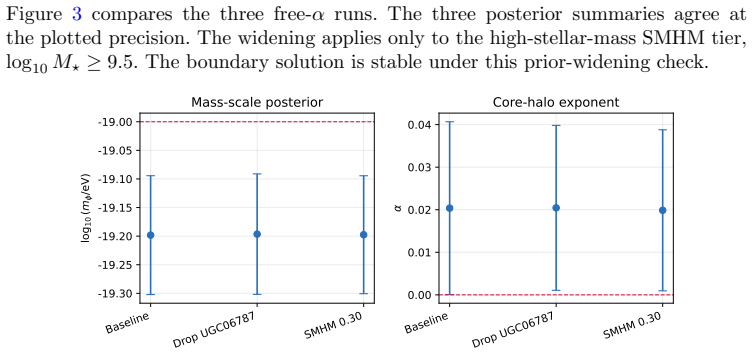
Within the adopted Schive-normalized model and standard SPARC fuzzy-dark-matter prior range, the selected SPARC sample does not identify an interior population-level soliton component. The pipeline treats the core-halo scaling exponent as a global free parameter, employs a Schive-normalized soliton with a regularized NFW envelope and smooth transition, and ties halo-mass priors to V_flat plus stellar-to-halo-mass relations. Posterior sampling over 106 galaxies yields zero divergences and r-hat approximately 1 for global parameters, but the mass posterior reaches the upper prior edge and the scaling posterior reaches the lower edge, giving log10(m_phi/eV) = -19.20^{+0.12}_{-0.11} and alpha =
What carries the argument
The hierarchical Bayesian model that treats the soliton-halo scaling exponent as a global free parameter and samples the joint posterior over all galaxies using NUTS.
If this is right
- The standard Schive normalization combined with current priors produces no detectable interior soliton population in the SPARC sample.
- The diagnostic workflow for spotting prior-boundary solutions can be applied to any full-sample rotation-curve analysis.
- Future fuzzy-dark-matter models must either adjust the core-halo scaling relation or the soliton profile to avoid prior-dominated posteriors.
- The framework provides a reusable template for testing other dark-matter density profiles with global parameters on large galaxy samples.
Where Pith is reading between the lines
- Widening the soliton-mass prior or changing the normalization could move the posterior interior and change the conclusion about soliton presence.
- The same boundary-diagnostic approach might reveal whether other ultralight-dark-matter parameter choices are also prior-limited on rotation-curve data.
- If the boundary behavior persists across multiple independent datasets, it would strengthen the case that the current soliton-plus-NFW form is insufficient for describing observed cores.
Load-bearing premise
That the posterior accumulating at the prior boundaries demonstrates the absence of a soliton component rather than a mismatch between the Schive normalization, transition regularization, or chosen priors and the actual data.
What would settle it
Re-running the same pipeline with an alternative soliton normalization or widened high-mass stellar-to-halo-mass prior that moves the scaling posterior away from the boundary would show whether the boundary behavior is driven by the data or by model choices.
Figures




read the original abstract
Galaxy rotation curves provide a direct test of how baryonic matter and dark matter combine to determine the mass profiles of disk galaxies. In ultralight or fuzzy dark matter models, numerical simulations predict a central solitonic core surrounded by an outer halo, but the population-level relation between the core and the host halo remains an important modelling choice. We present a hierarchical Bayesian pipeline for fitting soliton-plus-NFW rotation-curve models to the SPARC database while treating the core-halo scaling exponent as a global free parameter. The model uses a Schive-normalized soliton, a regularized NFW envelope with a smooth transition, halo-mass priors tied to $V_{\rm flat}$, and stellar-to-halo-mass information. We apply the pipeline to 106 SPARC galaxies, including 26 systems with bulges, and sample the resulting 346-dimensional posterior with JAX/NumPyro NUTS. The free-scaling run has zero divergences and $\hat r \simeq 1.000$ for the global parameters. The posterior reaches the upper edge of the standard mass prior and the lower edge of the scaling prior, with $\log_{10}(m_\phi/{\rm eV})=-19.20^{+0.12}_{-0.11}$ and $\alpha=0.014^{+0.023}_{-0.011}$. This boundary behaviour persists after removing UGC06787 and after widening the high-mass stellar-to-halo-mass prior. Within the adopted Schive-normalized model and standard SPARC fuzzy-dark-matter prior range, the selected SPARC sample does not identify an interior population-level soliton component. The main contribution is the hierarchical inference framework and the diagnostic workflow for recognizing boundary solutions in full-sample rotation-curve analyses.
Editorial analysis
A structured set of objections, weighed in public.
Referee Report
Summary. The paper develops a hierarchical Bayesian pipeline in JAX/NumPyro to fit Schive-normalized soliton-plus-regularized-NFW rotation-curve models to 106 SPARC galaxies (including 26 with bulges), treating the core-halo scaling exponent α as a global free parameter alongside the boson mass m_φ. With 346-dimensional sampling that reports zero divergences and r-hat ≈ 1, the posterior for α and log10(m_φ/eV) accumulates at the lower edge of the α prior and upper edge of the m_φ prior; this boundary behavior persists after removing UGC06787 and widening the high-mass stellar-to-halo-mass prior. The central claim is that, within the adopted model and standard SPARC fuzzy-DM prior range, the sample does not identify an interior population-level soliton component. The main contribution is the inference framework plus a diagnostic workflow for boundary solutions.
Significance. If the boundary accumulation is shown to be data-driven rather than an artifact of the specific Schive normalization, transition regularization, or prior ranges, the result would tighten constraints on ultralight dark matter from rotation curves and demonstrate the value of full hierarchical population-level modeling. The reproducible NumPyro implementation and explicit sensitivity tests to two nuisance choices are strengths that support the diagnostic approach.
major comments (2)
- [Abstract] Abstract: the claim that 'the selected SPARC sample does not identify an interior population-level soliton component' is tied to posterior accumulation at the α lower edge and m_φ upper edge. The manuscript demonstrates persistence after excising UGC06787 and widening the stellar-to-halo-mass prior, yet does not report the posterior shape or mode location when the Schive normalization constant or the soliton-NFW transition regularization is relaxed; in a 346-dimensional hierarchical model this omission leaves open whether boundary piling reflects data inconsistency with the assumed functional form rather than true absence of an interior soliton population.
- [Results] Results (posterior summary): the reported values α = 0.014^{+0.023}_{-0.011} and log10(m_φ/eV) = -19.20^{+0.12}_{-0.11} are direct sampler outputs, but the interpretation as 'no interior component' requires that an interior mode would appear under plausible model variations. Without an explicit likelihood-surface or re-sampling exercise under altered core-halo scaling priors or transition smoothing, the boundary behavior remains conditional on choices whose mismatch could mimic the observed piling.
minor comments (2)
- [Methods] Methods: the exact numerical bounds of the 'standard SPARC fuzzy-dark-matter prior range' for log10(m_φ/eV) and α should be stated explicitly (including whether they are uniform or log-uniform) so that readers can reproduce the boundary location.
- [Figures] Figure captions: the corner plots or trace plots for the global parameters should include the prior boundaries as vertical lines to make the piling visually immediate.
Simulated Author's Rebuttal
We thank the referee for their careful reading and constructive comments on the robustness of our boundary-posterior interpretation. We respond point-by-point to the major comments and indicate the revisions we will incorporate.
read point-by-point responses
-
Referee: The abstract claim that the SPARC sample does not identify an interior population-level soliton component does not report the posterior shape or mode when the Schive normalization constant or the soliton-NFW transition regularization is relaxed, leaving open whether the boundary piling reflects data inconsistency with the functional form.
Authors: We agree that the result is conditional on the adopted Schive et al. (2014) normalization and the smooth transition regularization. The Schive normalization is the standard form derived from cosmological simulations and is the conventional choice in the fuzzy-DM literature; relaxing it would require a new core-halo scaling relation derived from first principles, which lies outside the scope of a paper whose primary contribution is the hierarchical inference pipeline and boundary-diagnostic workflow. The regularization ensures a continuous, differentiable density profile suitable for rotation-curve modeling. We will revise the abstract to qualify the central claim as holding 'within the standard Schive-normalized soliton-plus-regularized-NFW model' and add a short paragraph in the methods section justifying these modeling choices. revision: yes
-
Referee: The interpretation of the reported posterior values as indicating no interior component requires that an interior mode would appear under plausible model variations. Without an explicit likelihood-surface or re-sampling under altered core-halo scaling priors or transition smoothing, the boundary behavior remains conditional.
Authors: The quoted values are the direct marginal posterior summaries from the converged 346-dimensional NUTS run (zero divergences, r-hat ≈ 1). We already performed two explicit sensitivity tests—removal of UGC06787 and widening the high-mass stellar-to-halo-mass prior—both of which preserve the boundary accumulation, indicating the piling is not driven by those nuisance choices. A full likelihood-surface scan or additional re-samplings under varied regularization in 346 dimensions is computationally prohibitive. The diagnostic workflow (convergence diagnostics plus persistence under prior widening) is the paper’s main methodological contribution for recognizing such boundary solutions. We will add a concise discussion paragraph in the results section stating the conditional nature of the conclusion and the rationale for the chosen model components. revision: partial
Circularity Check
No significant circularity in the hierarchical Bayesian inference chain
full rationale
The paper's central result is obtained by running NUTS sampling on an explicitly constructed 346-dimensional hierarchical posterior whose likelihood is the product of per-galaxy rotation-curve likelihoods under a fixed Schive-normalized soliton-plus-regularized-NFW functional form and whose priors are stated in advance. The reported boundary accumulation for the global parameters α and m_φ is a direct numerical output of that sampling procedure, not a quantity defined in terms of itself or recovered by fitting a subset and relabeling the fit as a prediction. No load-bearing step reduces by the paper's own equations to a self-citation, an ansatz smuggled via citation, or a renaming of a known empirical pattern; the model assumptions are external to the data and the conclusion is conditioned on those assumptions rather than being tautological with them.
Axiom & Free-Parameter Ledger
free parameters (2)
- core-halo scaling exponent alpha =
0.014^{+0.023}_{-0.011}
- log10(m_phi / eV) =
-19.20^{+0.12}_{-0.11}
axioms (3)
- domain assumption Schive-normalized soliton profile for the central core
- domain assumption Regularized NFW envelope with smooth transition to the soliton
- domain assumption Halo-mass priors tied to V_flat and stellar-to-halo-mass relation
Lean theorems connected to this paper
-
IndisputableMonolith/Cost/FunctionalEquation.leanwashburn_uniqueness_aczel unclear?
unclearRelation between the paper passage and the cited Recognition theorem.
The solitonic ground state ... ρ_sol(r) = ρ_c [1 + 0.091(r/r_c)^2]^8 ... Schive-normalized relation ρ_c = ρ_norm m_22^{-2} (r_c / 1 kpc)^{-4} ... r_c = A_ch m_22^{-1} M_9^{-α} with A_ch = 1.6 kpc, ρ_norm = 1.9×10^7 M_⊙ kpc^{-3}
-
IndisputableMonolith/Foundation/RealityFromDistinction.leanreality_from_one_distinction unclear?
unclearRelation between the paper passage and the cited Recognition theorem.
log10(m_φ/eV) ~ U(-25,-19), α ~ U(0,1.5) ... Moster stellar-to-halo-mass prior ... Dutton-Maccio concentration prior
What do these tags mean?
- matches
- The paper's claim is directly supported by a theorem in the formal canon.
- supports
- The theorem supports part of the paper's argument, but the paper may add assumptions or extra steps.
- extends
- The paper goes beyond the formal theorem; the theorem is a base layer rather than the whole result.
- uses
- The paper appears to rely on the theorem as machinery.
- contradicts
- The paper's claim conflicts with a theorem or certificate in the canon.
- unclear
- Pith found a possible connection, but the passage is too broad, indirect, or ambiguous to say the theorem truly supports the claim.
Reference graph
Works this paper leans on
-
[1]
Physical Review D98(8), 083027 (2018) https://doi.org/10.1103/PhysRevD.98.083027
Bar, N., Blas, D., Blum, K., Sibiryakov, S.: Galactic rotation curves versus ultralight dark matter: Implications of the soliton-host halo relation. Physical Review D98(8), 083027 (2018) https://doi.org/10.1103/PhysRevD.98.083027
-
[2]
Physical Review D105(8), 083015 (2022) https://doi.org/10.1103/PhysRevD.105.083015
Bar, N., Blum, K., Sun, C.: Galactic rotation curves versus ultralight dark matter: A systematic comparison with sparc data. Physical Review D105(8), 083015 (2022) https://doi.org/10.1103/PhysRevD.105.083015
-
[3]
Bradbury, J., Frostig, R., Hawkins, P., Johnson, M.J., Leary, C., Maclaurin, D., Necula, G., Paszke, A., VanderPlas, J., Wanderman-Milne, S., Zhang, Q.: JAX: composable transformations of Python+NumPy programs (2018). http://github.com/google/ jax Ba˜ nares-Hern´ andez, A., Castillo, A., Mart´ ın Camalich, J., Iorio, G.: Confronting fuzzy dark matter with...
-
[4]
Chan, H.-Y., Schive, H.-Y., Wong, S.-K., Chiueh, T., Broadhurst, T.: Diversity of core- halo structure in fuzzy dark matter models. Monthly Notices of the Royal Astro- nomical Society511(1), 943–954 (2022) https://doi.org/10.1093/mnras/stac063
-
[5]
SciPost Physics Reviews1, 001 (2026) https://doi.org/10.21468/SciPostPhysRev.1
Cirelli, M., Strumia, A., Zupan, J.: Dark matter. SciPost Physics Reviews1, 001 (2026) https://doi.org/10.21468/SciPostPhysRev.1
-
[7]
Eberhardt, A., Ferreira, E.G.M.: Ultralight fuzzy dark matter review (2025). https: //doi.org/10.48550/arXiv.2507.00705 . https://arxiv.org/abs/2507.00705
-
[8]
Physical Review Letters85, 1158–1161 (2000) https://doi.org/ 10.1103/PhysRevLett.85.1158
Hu, W., Barkana, R., Gruzinov, A.: Fuzzy cold dark matter: The wave properties of ultralight particles. Physical Review Letters85, 1158–1161 (2000) https://doi.org/ 10.1103/PhysRevLett.85.1158
-
[9]
Journal of Machine Learning Research15, 1593–1623 (2014)
Hoffman, M.D., Gelman, A.: The no-u-turn sampler: Adaptively setting path lengths in hamiltonian monte carlo. Journal of Machine Learning Research15, 1593–1623 (2014)
work page 2014
-
[10]
Hui, L., Ostriker, J.P., Tremaine, S., Witten, E.: Ultralight scalars as cosmologi- cal dark matter. Physical Review D95(4), 043541 (2017) https://doi.org/10.1103/ PhysRevD.95.043541 Irˇ siˇ c, V., Viel, M., Haehnelt, M.G., Bolton, J.S., Becker, G.D.: First constraints on fuzzy dark matter from lyman-alpha forest data and hydrodynamical simu- lations. Phy...
work page 2017
-
[11]
Khelashvili, M., Rudakovskyi, A., Hossenfelder, S.: Dark matter profiles of sparc galax- ies: a challenge to fuzzy dark matter. Monthly Notices of the Royal Astronomical Society523(3), 3393–3405 (2023) https://doi.org/10.1093/mnras/stad1595
-
[12]
Lelli, F., McGaugh, S.S., Schombert, J.M.: Sparc: Mass models for 175 disk galaxies with spitzer photometry and accurate rotation curves. The Astronomical Journal 152(6), 157 (2016) https://doi.org/10.3847/0004-6256/152/6/157
-
[13]
The origin of the formalism intrinsic degeneracies and their influence on H 0
Moster, B.P., Naab, T., White, S.D.M.: Galactic star formation and accretion histo- ries from matching galaxies to dark matter haloes. Monthly Notices of the Royal Astronomical Society428(4), 3121–3138 (2013) https://doi.org/10.1093/mnras/ sts261
-
[14]
Mocz, P., Vogelsberger, M., Robles, V.H., Zavala, J., Boylan-Kolchin, M., Fialkov, A., Hernquist, L.: Galaxy formation with becdm dark matter. Monthly Notices of the Royal Astronomical Society471(4), 4559–4570 (2017) https://doi.org/10.1093/ mnras/stx1887
work page 2017
-
[15]
Nori, M., Baldi, M.: Scaling relations of fuzzy dark matter haloes. Monthly Notices of the Royal Astronomical Society501(2), 1539–1556 (2021) https://doi.org/10.1093/ mnras/staa3772
work page 2021
-
[16]
Navarro, J.F., Frenk, C.S., White, S.D.M.: The structure of cold dark matter halos. The Astrophysical Journal462, 563 (1996) https://doi.org/10.1086/177173 18
-
[17]
The Astrophysical Journal490, 493–508 (1997) https://doi.org/10.1086/ 304888
Navarro, J.F., Frenk, C.S., White, S.D.M.: A universal density profile from hierarchical clustering. The Astrophysical Journal490, 493–508 (1997) https://doi.org/10.1086/ 304888
work page 1997
-
[18]
Phan, D., Pradhan, N., Jankowiak, M.: Composable effects for flexible and accelerated probabilistic programming in numpyro. arXiv preprint arXiv:1912.11554 (2019)
-
[19]
Physical Review Letters126(7), 071302 (2021) https: //doi.org/10.1103/PhysRevLett.126.071302
Rogers, K.K., Peiris, H.V.: Strong bound on canonical ultralight axion dark matter from the lyman-alpha forest. Physical Review Letters126(7), 071302 (2021) https: //doi.org/10.1103/PhysRevLett.126.071302
-
[20]
Nature Physics10, 496–499 (2014) https://doi.org/ 10.1038/nphys2996
Schive, H.-Y., Chiueh, T., Broadhurst, T.: Cosmic structure as the quantum interfer- ence of a coherent dark wave. Nature Physics10, 496–499 (2014) https://doi.org/ 10.1038/nphys2996
-
[21]
Physical Review Letters113(26), 261302 (2014) https://doi.org/10
Schive, H.-Y., Liao, M.-H., Woo, T., Wong, S.-K., Chiueh, T., Broadhurst, T., Hwang, W.-Y.P.: Understanding the core-halo relation of quantum wave dark matter from 3d simulations. Physical Review Letters113(26), 261302 (2014) https://doi.org/10. 1103/PhysRevLett.113.261302
work page 2014
-
[22]
Physical Review D94(4), 043513 (2016) https://doi.org/10.1103/PhysRevD.94.043513
Schwabe, B., Niemeyer, J.C., Engels, J.F.: Simulations of solitonic core mergers in ultralight axion dark matter cosmologies. Physical Review D94(4), 043513 (2016) https://doi.org/10.1103/PhysRevD.94.043513
-
[23]
Bayesian Analysis16(2), 667–718 (2021) https://doi.org/10.1214/ 20-BA1221 19
Vehtari, A., Gelman, A., Simpson, D., Carpenter, B., B¨ urkner, P.-C.: Rank- normalization, folding, and localization: An improved r-hat for assessing conver- gence of mcmc. Bayesian Analysis16(2), 667–718 (2021) https://doi.org/10.1214/ 20-BA1221 19
work page 2021
discussion (0)
Sign in with ORCID, Apple, or X to comment. Anyone can read and Pith papers without signing in.