Recognition: no theorem link
Circles-foliated stationary surfaces of the Dirichlet energy
Pith reviewed 2026-05-13 01:16 UTC · model grok-4.3
The pith
Non-rotational surfaces foliated by horizontal circles achieve zero anisotropic mean curvature for the Dirichlet energy.
A machine-rendered reading of the paper's core claim, the machinery that carries it, and where it could break.
Core claim
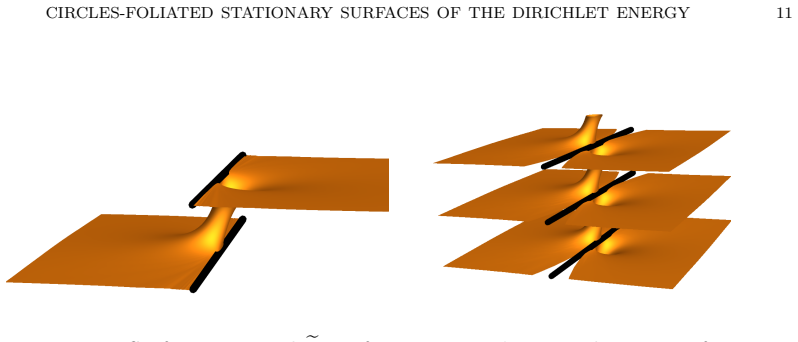
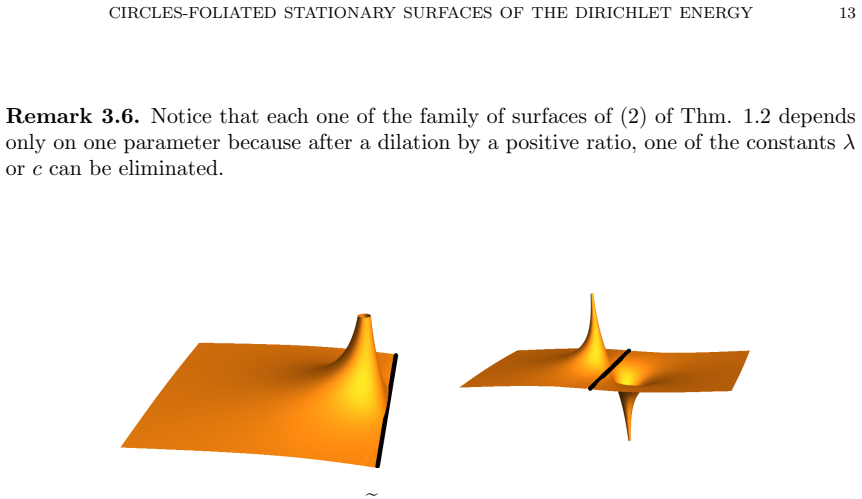
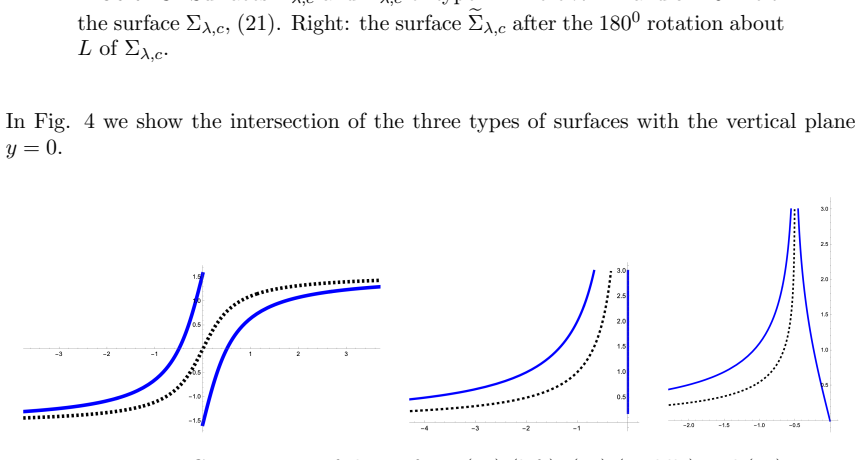
We prove the existence of non-rotational surfaces with Λ=0 and foliated by a one-parameter family of circles contained in horizontal planes obtaining a geometric description of them. These surfaces extend the known Riemann examples of the theory of minimal surfaces to the anisotropic context of the Dirichlet energy. We classify all surfaces with zero anisotropic mean curvature foliated by circles proving that either the surface is axially symmetric about the z-axis or the surface belongs to one of the above examples.
What carries the argument
Foliation by a one-parameter family of circles contained in horizontal planes, which reduces the anisotropic mean curvature condition to a geometric description or solvable equation.
If this is right
- These surfaces provide explicit non-symmetric examples of stationary surfaces for the Dirichlet energy with zero anisotropic mean curvature.
- The classification shows that no other circle-foliated surfaces with zero anisotropic mean curvature exist beyond the axially symmetric ones and the new family.
- The construction and classification extend in part to the case of nonzero constant anisotropic mean curvature.
- The results link classical minimal surface theory to anisotropic variational problems through concrete geometric examples.
Where Pith is reading between the lines
- The geometric description may yield explicit parametrizations that permit direct stability analysis or numerical visualization of the surfaces.
- Foliation assumptions of this type could produce analogous classifications for other anisotropic energies or curvature functionals.
- The examples might serve as benchmarks for testing numerical solvers in anisotropic geometric variational problems.
Load-bearing premise
The surfaces are sufficiently smooth and exactly foliated by a regular one-parameter family of circles lying in distinct horizontal planes.
What would settle it
Construct the surface from the geometric description in the paper and compute its anisotropic mean curvature directly to check if it vanishes identically, or exhibit a circle-foliated surface with zero anisotropic mean curvature that is neither axially symmetric nor one of the constructed examples.
Figures

read the original abstract
In Euclidean space we study surfaces with constant anisotropic mean curvature $\Lambda$ of the Dirichlet energy $\int_\Omega( |Du|^2+\Lambda u)$. We prove the existence of non-rotational surfaces with $\Lambda=0$ and foliated by a one-parameter family of circles contained in horizontal planes obtaining a geometric description of them. These surfaces extend the known Riemann examples of the theory of minimal surfaces to the anisotropic context of the Dirichlet energy. More general, we classify all surfaces with zero anisotropic mean curvature foliated by circles proving that either the surface is axially symmetric about the $z$-axis or the surface belongs to one of the above examples. We also study the case that the anisotropic mean curvature is a non-zero constant.
Editorial analysis
A structured set of objections, weighed in public.
Referee Report
Summary. The manuscript studies surfaces in Euclidean 3-space with constant anisotropic mean curvature Λ associated to the Dirichlet energy functional ∫(|Du|² + Λu). It proves existence of non-rotational surfaces with Λ = 0 that are foliated by a one-parameter family of circles lying in horizontal planes, supplies a geometric description of these surfaces, and shows they extend the classical Riemann examples from minimal surface theory to the anisotropic setting. It further classifies all zero-anisotropic-mean-curvature surfaces foliated by circles, proving that any such surface is either axially symmetric about the z-axis or belongs to the newly constructed family. The paper also treats the case of non-zero constant anisotropic mean curvature.
Significance. If the derivations hold, the work supplies the first explicit non-rotational examples of anisotropic minimal surfaces (Λ = 0) under a natural foliation hypothesis and gives a complete classification within that class. The reduction of the anisotropic mean-curvature equation to an ODE system on the center curve c(h) and radius function r(h) is constructive and directly generalizes the classical Riemann construction; this offers a concrete tool for further study of anisotropic variational problems and may serve as a benchmark for numerical or stability analyses.
minor comments (3)
- [Abstract] The abstract refers to “the above examples” without having defined them within the abstract; rephrase the final sentence of the abstract so that it is self-contained.
- [§1 or Introduction] The precise relation between the anisotropic mean curvature and the Poisson equation Δu = Λ/2 (mentioned in the reader’s summary) should be stated explicitly in the introduction or in the first section where the energy is introduced, including the precise definition of the anisotropic mean curvature operator.
- [Classification theorem (likely §4 or §5)] In the classification statement, clarify whether the foliation is assumed to be regular (non-vanishing gradient, smooth dependence on the height parameter) throughout the surface or only away from possible singular loci; this assumption is load-bearing for the ODE reduction.
Simulated Author's Rebuttal
We thank the referee for the careful reading and positive assessment of our manuscript. The referee's summary and significance statement accurately reflect the main results: the construction of non-rotational circle-foliated surfaces with zero anisotropic mean curvature for the Dirichlet energy, their geometric description as extensions of the classical Riemann examples, the complete classification within the circle-foliated class, and the treatment of the constant non-zero case. We are pleased that the constructive ODE reduction on the center curve and radius function is viewed as a useful tool for further study. No specific major comments were raised in the report.
Circularity Check
Derivation is self-contained with no circular reductions
full rationale
The paper assumes surfaces foliated by a regular one-parameter family of circles in horizontal planes and derives the zero anisotropic mean curvature condition from the variational problem for the Dirichlet energy. This reduces to an ODE system on the center trajectory c(h) and radius r(h), whose solutions are classified into axially symmetric cases or a one-parameter family of non-rotational examples. The classification and existence claims follow from standard geometric analysis applied to the foliation assumption and the Euler-Lagrange equation, without any reduction of outputs to fitted parameters, self-definitional loops, or load-bearing self-citations. The extension of Riemann examples is a geometric description derived independently rather than by construction from the inputs.
Axiom & Free-Parameter Ledger
axioms (2)
- domain assumption The surfaces under consideration are sufficiently smooth (at least C^2) for the anisotropic mean curvature to be well-defined.
- domain assumption The foliation consists of a regular one-parameter family of circles lying in distinct horizontal planes.
Reference graph
Works this paper leans on
-
[1]
E. Barbosa and L. C. Silva, Surfaces of constant anisotropic mean curvature with free boundary in revolution surfaces,Manuscr. Math.169(2022), 439–459
work page 2022
-
[2]
Enneper, ¨Ueber die cyclischen Fl¨ achen, Nach
A. Enneper, ¨Ueber die cyclischen Fl¨ achen, Nach. K¨ onigl. Ges. d. Wissensch. G¨ ottingen,Math. Phys. Kl.(1866) 243–249
-
[3]
Enneper, Die cyklischen Fl¨ achen,Z
A. Enneper, Die cyklischen Fl¨ achen,Z. Math. Phys.14(1869), 393–421
-
[4]
J. A. G´ alvez, P. Mira and M. P. Tassi, Complete surfaces of constant anisotropic mean curvature, Adv. Math.428(2023), Paper No. 109137
work page 2023
- [5]
-
[6]
Jagy, Minimal hypersurfaces foliated by spheres,Michigan Math
W. Jagy, Minimal hypersurfaces foliated by spheres,Michigan Math. J.38(1991), 255–270
work page 1991
-
[7]
Jagy, Sphere-foliated constant mean curvature submanifolds,Rocky Mountain J
W. Jagy, Sphere-foliated constant mean curvature submanifolds,Rocky Mountain J. Math.28(1998), 983–1015
work page 1998
-
[8]
X. Jia, G. Wang and C. Xia, X. Zhang, Alexandrov’s theorem for anisotropic capillary hypersurfaces in the half-space,Arch. Ration. Mech. Anal.247(2023), 25
work page 2023
-
[9]
M. Koiso and B. Palmer, Geometry and stability of surfaces with constant anisotropic mean curvature, Indiana Univ. Math. J.54(2005), 1817–1852
work page 2005
-
[10]
M. Koiso and B. Palmer, Stability of anisotropic capillary surfaces between two parallel planes,Calc. Var. Partial Differ. Equ.25, (2006), 275–298
work page 2006
-
[11]
M. Koiso and B. Palmer, Uniqueness theorems for stable anisotropic capillary surfaces,SIAM J. Math. Anal.39(2007), 721–741
work page 2007
-
[12]
M. Koiso and B. Palmer, Rolling construction for anisotropic Delaunay surfaces,Pacific J. Math.234 (2008), 345–378
work page 2008
-
[13]
M. Koiso and B. Palmer, Equilibria for anisotropic surface energies with wetting and line tension, Calc. Var. Partial Differ. Equ.43(2012), 555–587
work page 2012
-
[14]
F. J. L´ opez, R. L´ opez and R. Souam, Maximal surfaces of Riemann type in Lorentz-Minkowski space L3,Michigan Math. J.47(2000), 469–497
work page 2000
-
[15]
L´ opez, Constant mean curvature hypersurfaces foliated by spheres,Differential Geom
R. L´ opez, Constant mean curvature hypersurfaces foliated by spheres,Differential Geom. Appl.11 (1999), 245–256
work page 1999
-
[16]
L´ opez, Constant mean curvature surfaces foliated by circles in Lorentz-Minkowski space,Geom
R. L´ opez, Constant mean curvature surfaces foliated by circles in Lorentz-Minkowski space,Geom. Dedicata76(1999), 81–95
work page 1999
-
[17]
L´ opez, Cyclic surfaces of constant Gauss curvature,Houston J
R. L´ opez, Cyclic surfaces of constant Gauss curvature,Houston J. Math.27(2001), 799–805
work page 2001
-
[18]
R. L´ opez, Cyclic hypersurfaces of constant curvature,Advanced Studies in Pure Mathematics,34 2002, Minimal Surfaces, Geometric Analysis and Symplectic Geometry, 185–199
work page 2002
-
[19]
Nitsche, Cyclic surfaces of constant mean curvature,Nachr
J.C.C. Nitsche, Cyclic surfaces of constant mean curvature,Nachr. Akad. Wiss. Gottingen Math. Phys. II1(1989) 1–5. 20 RAFAEL L ´OPEZ
work page 1989
-
[20]
S.-H. Park, Sphere-foliated minimal and constant mean curvature hypersurfaces in space forms and Lorentz-Minkowski space.Rocky Mountain J. Math.32(2002), 1019? 1044
work page 2002
-
[21]
R. C. Reilly, The relative differential geometry of nonparametric hypersurfaces,Duke Math.J.43 (1976), 705–721
work page 1976
-
[22]
Riemann, ¨Uber die Fl¨ achen vom kleinsten Inhalt bei gegebener Begrenzung,Abh
B. Riemann, ¨Uber die Fl¨ achen vom kleinsten Inhalt bei gegebener Begrenzung,Abh. K¨ onigl. Ges. d. Wissensch. G¨ ottingen, Mathema.13(1868), 329–333
-
[23]
Rosales, Compact anisotropic stable hypersurfaces with free boundary in convex solid cones,Calc
C. Rosales, Compact anisotropic stable hypersurfaces with free boundary in convex solid cones,Calc. Var. Partial Differ. Equ.62(2023), Paper No. 185, 20 pp
work page 2023
-
[24]
J. E. Taylor, Crystalline variational problems,Bull. Amer. Math. Soc.84(1978), 568–588
work page 1978
-
[25]
Wolfram Research, Inc. Mathematica, Version 13.3. Champaign, IL (2023). Departamento de Geometr´ıa y Topolog´ıa, Universidad de Granada. 18071 Granada, Spain Email address:rcamino@ugr.es
work page 2023
discussion (0)
Sign in with ORCID, Apple, or X to comment. Anyone can read and Pith papers without signing in.