Recognition: no theorem link
An improved upper bound on the oriented diameter of graphs with diameter 4
Pith reviewed 2026-05-13 01:02 UTC · model grok-4.3
The pith
Every bridgeless graph with diameter 4 admits a strong orientation whose diameter is at most 18.
A machine-rendered reading of the paper's core claim, the machinery that carries it, and where it could break.
Core claim
The paper proves that f(4) ≤ 18: for every bridgeless graph G with diam(G) = 4 there exists a strong orientation of G whose diameter is at most 18.
What carries the argument
An explicit construction, via case analysis on the structure of a diameter-4 bridgeless graph, that produces a strong orientation of directed diameter 18.
Load-bearing premise
The case analysis in the proof never leaves an uncovered configuration whose every strong orientation would require directed diameter larger than 18.
What would settle it
A single bridgeless undirected graph of diameter exactly 4 in which every strong orientation has diameter at least 19.
Figures
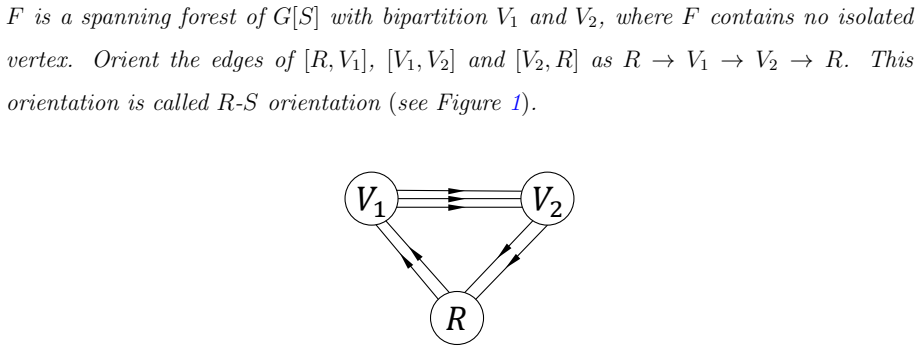
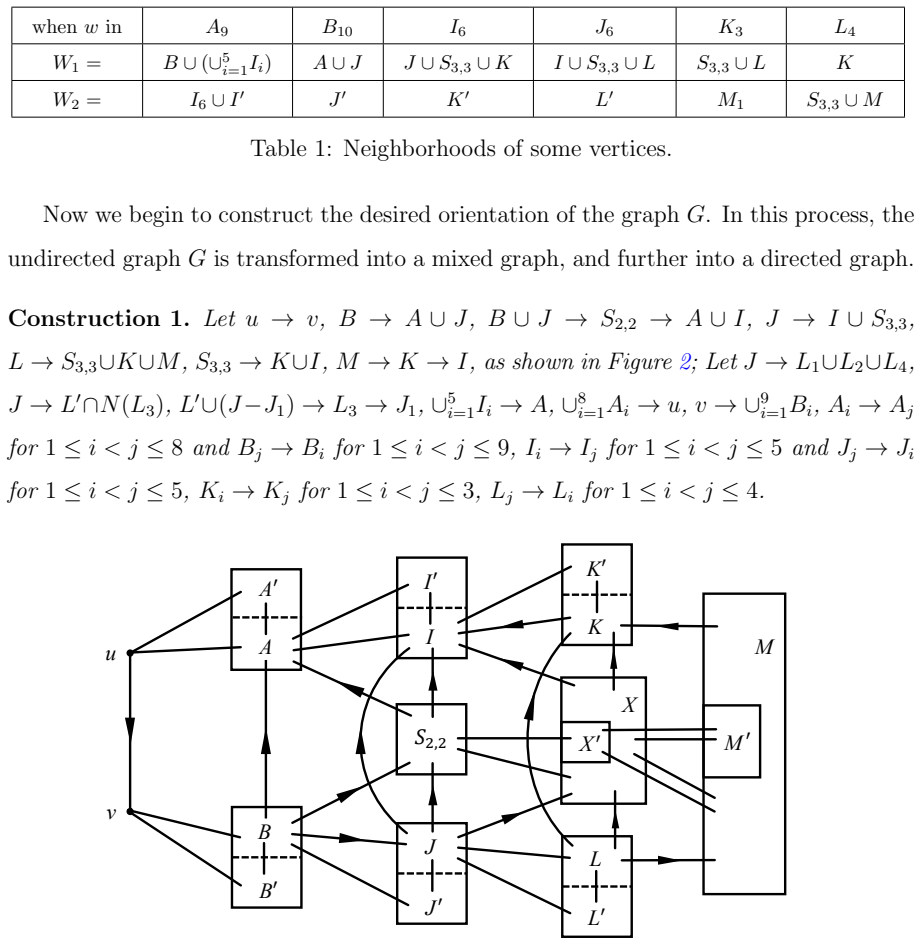
read the original abstract
Let $f(d)$ be the smallest value for which every bridgeless graph $G$ with diameter $d$ admits a strong orientation $\overrightarrow{G}$ such that the diameter of $\overrightarrow{G}$ is at most $f(d)$. Chv\'atal and Thomassen (1978) established general bounds for $f(d)$ which implies $f(4)\geq 12$, and proved $f(2)=6$. Kwok et al. (2010) proved that $9\leq f(3)\leq 11$. Wang and Chen (2022) determined $f(3)=9$. Babu et al. (2021) showed $f(4)\leq 21$. In this paper, we improve the upper bound of $ f(4) $ to $18$.
Editorial analysis
A structured set of objections, weighed in public.
Referee Report
Summary. The manuscript claims to prove that f(4) ≤ 18, improving the previous upper bound of 21 due to Babu et al. (2021). Here f(d) is the smallest integer such that every bridgeless graph of diameter d admits a strong orientation whose oriented diameter is at most f(d). The argument proceeds by reducing an arbitrary bridgeless diameter-4 graph to a finite collection of structural cases (via distance partitions, cut vertices, and bridges) and supplying an explicit strong orientation of diameter ≤18 for each case.
Significance. If the case analysis is exhaustive and each supplied orientation indeed has diameter ≤18, the result narrows the gap between the known lower bound f(4) ≥ 12 and the upper bound. It is an incremental but concrete advance in the study of oriented diameters of bridgeless graphs.
major comments (2)
- [Main proof (case analysis)] The central reduction to structural cases (distance-2 and distance-3 layers, cut vertices, and bridges) must be shown to be exhaustive; any bridgeless diameter-4 graph whose induced subgraphs on these layers fall outside the enumerated subcases would leave the universal claim unproved.
- [Main proof (orientation constructions)] For each enumerated case, the supplied orientation must be verified to produce oriented diameter at most 18 on every graph belonging to that case; a single counter-example instance inside a case would falsify the bound.
minor comments (2)
- [Introduction] The introduction should explicitly restate the definition of f(d) and the precise statement of the main theorem for clarity.
- [References] All citations (Chvátal-Thomassen, Kwok et al., Wang-Chen, Babu et al.) should be given in full bibliographic form in the references section.
Simulated Author's Rebuttal
We thank the referee for the detailed and constructive report. The comments correctly identify the two pillars of the proof—the exhaustiveness of the structural case division and the verification that each supplied orientation achieves oriented diameter at most 18. We address both points below and will revise the manuscript to make these aspects fully explicit.
read point-by-point responses
-
Referee: [Main proof (case analysis)] The central reduction to structural cases (distance-2 and distance-3 layers, cut vertices, and bridges) must be shown to be exhaustive; any bridgeless diameter-4 graph whose induced subgraphs on these layers fall outside the enumerated subcases would leave the universal claim unproved.
Authors: We agree that a self-contained argument for exhaustiveness strengthens the paper. The reduction begins by removing all bridges (which can be oriented in both directions without increasing the oriented diameter beyond the bound for the resulting components) and then handling cut vertices by considering the blocks they separate. Within each block the distance-2 and distance-3 layers from an arbitrary vertex are examined; the possible edge sets between these layers are constrained by the global diameter-4 condition and the absence of bridges. All combinatorially feasible configurations under these constraints are listed in the manuscript. To address the referee’s concern we will insert a short lemma immediately after the case division that proves, by exhaustive enumeration of the possible layer adjacencies and cut-vertex placements, that every bridgeless diameter-4 graph belongs to one of the enumerated cases. revision: yes
-
Referee: [Main proof (orientation constructions)] For each enumerated case, the supplied orientation must be verified to produce oriented diameter at most 18 on every graph belonging to that case; a single counter-example instance inside a case would falsify the bound.
Authors: Each case in the manuscript is accompanied by an explicit strong orientation together with a distance argument showing that any pair of vertices is connected by a directed path of length at most 18. These arguments rely on the layer structure and the chosen orientation of intra-layer and inter-layer edges. Nevertheless, we acknowledge that the current write-up leaves some of the longest-path calculations implicit. In the revision we will expand each verification subsection with a concise table or paragraph that bounds the directed distance between every pair of layer types (e.g., distance-0 to distance-4, distance-2 to distance-3, etc.) under the given orientation, thereby confirming that the maximum is indeed 18 for every graph in the case. revision: yes
Circularity Check
No circularity: pure combinatorial existence proof
full rationale
The paper proves f(4) ≤ 18 by exhibiting explicit strong orientations of diameter at most 18 for every bridgeless graph of diameter 4, via a finite case analysis on distance partitions, bridges and cut-vertices. No parameters are fitted to data, no quantity is defined in terms of itself, and no load-bearing step reduces to a self-citation or prior ansatz of the same authors. The cited prior upper bound of 21 is external and the new construction is self-contained against the definition of oriented diameter.
Axiom & Free-Parameter Ledger
axioms (1)
- standard math Standard definitions of graph diameter, strong orientation, and bridgeless graphs from prior literature.
Reference graph
Works this paper leans on
-
[1]
J. Babu, D. Benson and D. Rajendraprasad, Improved bounds for the oriented radius of mixed multigraphs, J. Graph Theory, 103 (4) (2023) 674–689
work page 2023
-
[2]
J. Babu, D. Benson, D. Rajendraprasad and S.N. Vaka, An improvement to Chv´ atal and Thomassen’s upper bound for oriented diameter, Discrete Appl. Math., 304 (2021) 432–440
work page 2021
- [3]
-
[4]
F. Boesch and R. Tindell, Robbins’s theorem for mixed multigraphs, Amer. Math. Monthly, 87 (1980) 716-719. 35
work page 1980
-
[5]
J.A. Bondy and U.S.R. Murty, Graph theory with Applications, London: Macmillan, 1976
work page 1976
-
[6]
B. Chen and A. Chang, Oriented diameter of graphs with given girth and maximum degree, Discrete Math., 346 (2023) 113287
work page 2023
-
[7]
F.R.K. Chung, M.R. Garey and R.E. Tarjan, Strongly connected orientations of mixed multigraphs, Networks, 15 (4) (1985) 477–484
work page 1985
-
[8]
V. Chv´ atal and C. Thomassen, Distances in orientations of graphs, J. Combin. The- ory Ser. B, 24 (1978) 61–75
work page 1978
-
[9]
P. Dankelmann, Y. Guo and M. Surmacs, Oriented diameter of graphs with given maximum degree, J. Graph Theory, 88 (2018) 5–17
work page 2018
-
[10]
Z. Ding, H. Li and G. Sun, The oriented diameter of mixed multigraphs with diameter 2, Discrete Math., 349 (2026) 115163
work page 2026
- [11]
-
[12]
G. Gutin, Minimizing and maximizing the diameter in orientations of graphs, Graphs Combin., 10 (1994) 225–230
work page 1994
-
[13]
K. Koh and E.G. Tay, Optimal orientations of graphs and digraphs, a survey, Graphs Combin., 18 (2002) 745–756
work page 2002
-
[14]
S. Kurz and M. L¨ atsch, Bounds for the minimum oriented diameter, Discrete Math. Theoret. Comput. Sci., 14 (2012) 109–140
work page 2012
-
[15]
P.K. Kwok, Q. Liu and D.B. West, Oriented diameter of graphs with diameter 3, J. Combin. Theory Ser. B, 100 (2010) 265–274
work page 2010
-
[16]
H. Li, Z. Ding, J. Liu and A. Chang, Diameter three orientability of mixed bipartite graphs, Graphs Comb., 41 (5) (2025) 95
work page 2025
-
[17]
H. Li, Z. Ding, J. Liu, Y. Gao and S. Zhao, A note on improved bounds for the oriented radius of mixed multigraphs, J. Graph Theory, 112 (2026) 15–19. 36
work page 2026
-
[18]
H. Li, Z. Ding, J. Liu and H.-J. Lai, Diameter two orientability of mixed graphs, Discrete Math., 349 (1) (2026) 114732
work page 2026
- [19]
-
[20]
J. Lin and L. You, Oriented diameter of graphs with diameter and given edge girth, arXiv:2507.23517v2, https://doi.org/10.48550/arXiv.2507.23517
-
[21]
Plesn´ ık, Remarks on diameters of orientations of graphs, Acta Math
J. Plesn´ ık, Remarks on diameters of orientations of graphs, Acta Math. Univ. Come- nian., 46 (1985) 225–236
work page 1985
-
[22]
Robbins, A theorem on graphs, with an application to a problem of traffic control, Amer
H.E. Robbins, A theorem on graphs, with an application to a problem of traffic control, Amer. Math. Monthly, 46 (1939) 281–283
work page 1939
-
[23]
ˇSolt´ es, Orientations of graphs minimizing the radius or the diameter, Math
L. ˇSolt´ es, Orientations of graphs minimizing the radius or the diameter, Math. Slo- vaca, 36 (1986) 289–296
work page 1986
-
[24]
Surmacs, Improved bound on the oriented diameter of graphs with given minimum degree, European J
M. Surmacs, Improved bound on the oriented diameter of graphs with given minimum degree, European J. Combin., 59 (2017) 187–191
work page 2017
-
[25]
X. Wang and Y. Chen, Optimal oriented diameter of graphs with diameter 3, J. Combin. Theory Ser. B, 155 (2022) 374–388
work page 2022
-
[26]
X. Wang and Y. Chen, P. Dankelmann, Y. Guo, M. Surmacs, L. Volkmann, Oriented diameter of maximal outerplanar graphs, J. Graph Theory, 98 (2021) 426–444. 37
work page 2021
discussion (0)
Sign in with ORCID, Apple, or X to comment. Anyone can read and Pith papers without signing in.